
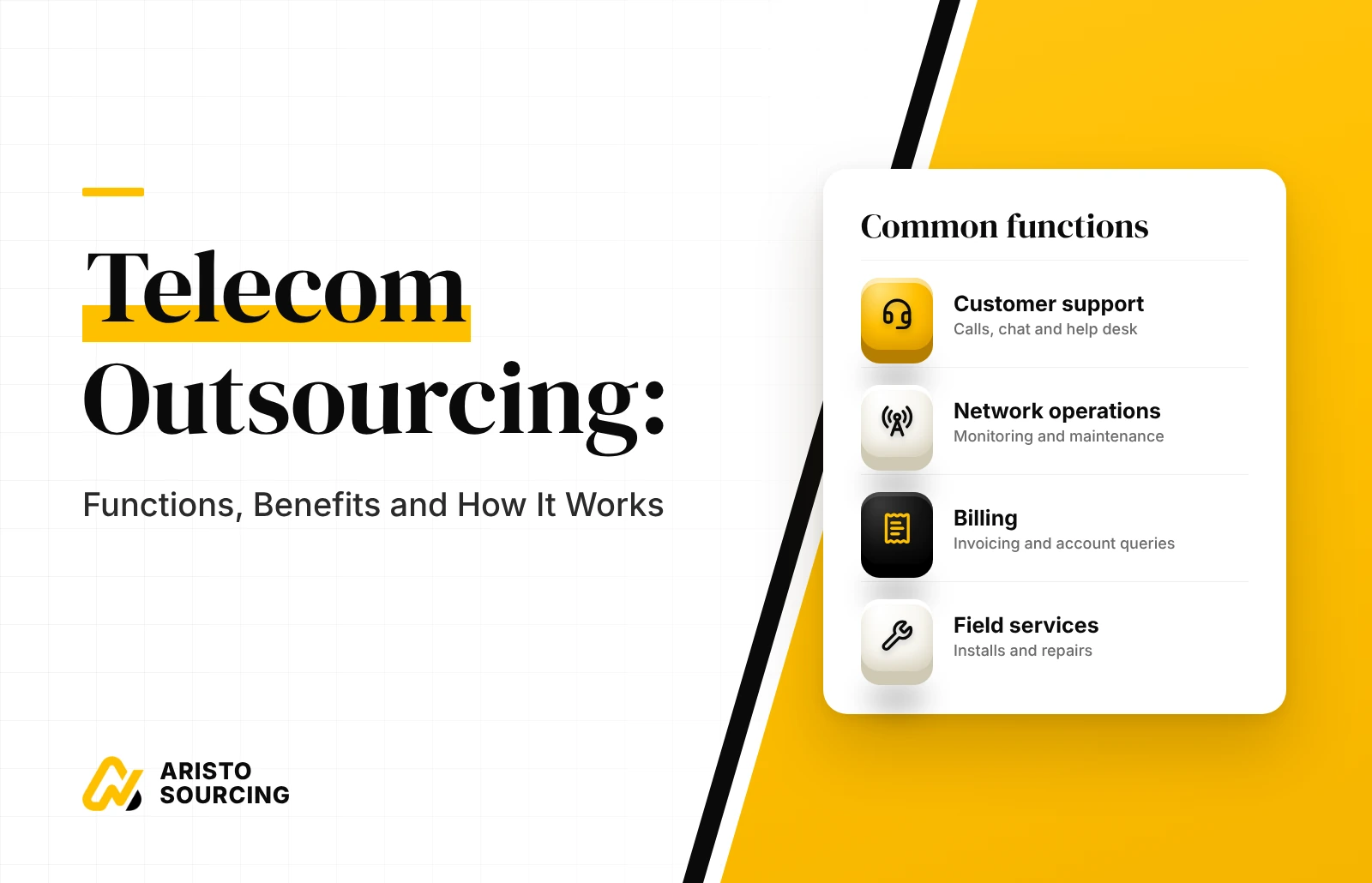
Telecom outsourcing is contracting specialist providers to run telecom functions such as customer care, network operations, and billing. The 6 telecom functions companies outsource most are customer care and contact centers, network operations and NOC monitoring, field engineering, billing and provisioning, telecom expense management, and sales and customer acquisition.
Telecom outsourcing is a growing market. According to Research and Markets, the global telecom outsourcing market is estimated at $27.69 billion in 2026 and is projected to reach $47.17 billion by 2032, growing at a CAGR of 9.21%.
What Is Telecom Outsourcing?
Telecom outsourcing is the practice of contracting external providers to manage telecommunications functions, including customer support, network operations, billing, and field services, under defined service levels. Telecom outsourcing has two meanings: telecom carriers outsourcing their own operations to specialist providers, and non-telecom businesses outsourcing the management of their phone, internet, and mobile services.
Telecom business process outsourcing refers to the first meaning, where carriers and communication service providers (CSPs) hand repetitive, high-volume processes to a BPO partner. The second meaning usually takes the form of telecom expense management, where a provider audits invoices and manages contracts for a business.
How Does Telecom Outsourcing Work?
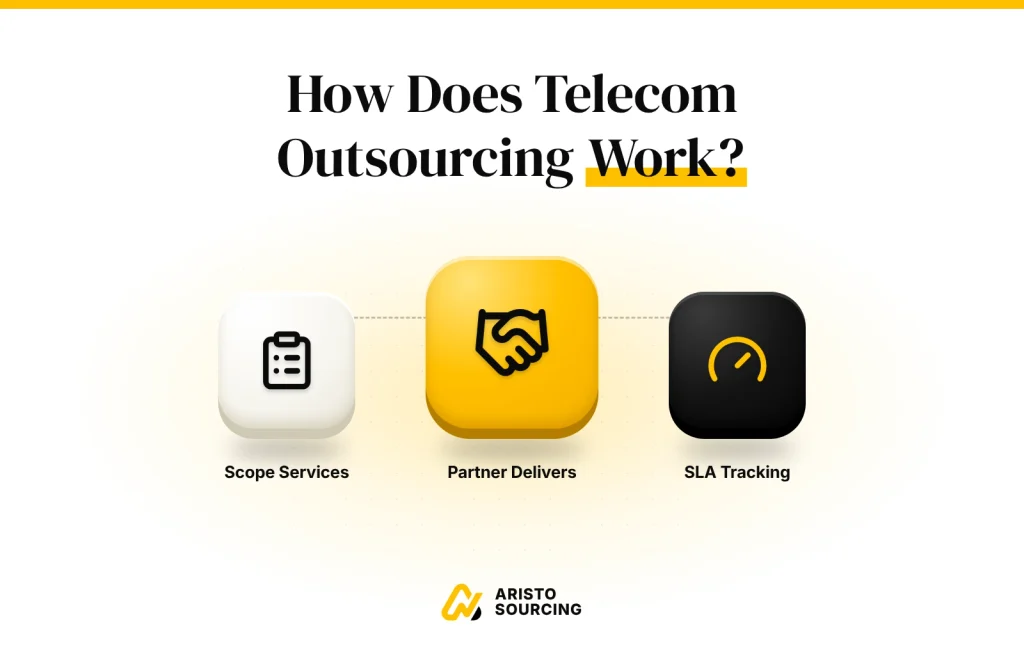
Telecom outsourcing works by defining the scope and service levels of a function, transferring day-to-day operation of that function to a provider, and keeping oversight with the carrier. The carrier and provider first agree on the scope of work and the service level agreement (SLA), including targets such as network availability or call resolution rate. The provider then staffs and runs the function, while the carrier monitors performance through regular reports and reviews.
Carriers keep strategic and regulated functions in-house. The functions telecom companies usually keep in-house are listed below.
- License and Spectrum: The carrier holds the operating license and spectrum rights, so those obligations stay with the carrier.
- Tariff Design: The carrier sets pricing plans and service bundles to protect its commercial strategy.
- Brand: The carrier controls brand positioning and customer-facing messaging.
- Regulatory Affairs: The carrier manages its relationship with regulators and compliance reporting.
6 Telecom Functions You Can Outsource
The 6 telecom functions you can outsource are customer care, network operations, field engineering, billing and provisioning, telecom expense management, and sales. Each function has its own tasks, pricing model, and performance metrics. Smaller telecom providers and resellers that need support capacity without building a full contact center often hire a customer service virtual assistant to cover billing questions and basic troubleshooting.
The 6 telecom functions you can outsource are listed below.
- Customer Care and Contact Centers
- Network Operations and NOC Monitoring
- Field Engineering
- Billing and Provisioning
- Telecom Expense Management
- Sales and Customer Acquisition
1. Customer Care and Contact Centers
Customer care outsourcing is the delegation of subscriber support to an external contact center. Outsourced customer care teams handle inbound calls, live chat, billing inquiries, and technical troubleshooting. The main KPIs for customer care are first contact resolution and average handle time (AHT).
2. Network Operations and NOC Monitoring
Network operations outsourcing is the delegation of network monitoring and maintenance to an external network operations center (NOC). Outsourced NOC teams handle fault monitoring, incident response, and service provisioning around the clock. The main KPIs for network operations are network availability and mean time to restore.
3. Field Engineering
Field engineering outsourcing is the delegation of on-site technical work to an external field services provider. Outsourced field engineering teams handle installations, repairs, and site maintenance. The main KPI for field engineering is first-time fix rate.
4. Billing and Provisioning
Billing and provisioning outsourcing is the delegation of invoicing and service activation to an external provider. Outsourced billing and provisioning teams handle invoice generation, new service activation, and number porting. The main KPIs for billing and provisioning are billing accuracy and dispute rate.
5. Telecom Expense Management
Telecom expense management outsourcing is the delegation of telecom cost control to an external specialist. Outsourced telecom expense management teams handle invoice audits, contract reviews, and inventory tracking of lines and devices. The main KPI for telecom expense management is cost savings against the previous telecom spend.
6. Sales and Customer Acquisition
Sales outsourcing is the delegation of telecom sales activity to an external sales team. Outsourced sales teams handle B2B and B2C sales for fiber, broadband, and wireless services. The main KPI for sales and customer acquisition is conversion rate.
What Are the Benefits and Risks of Telecom Outsourcing?
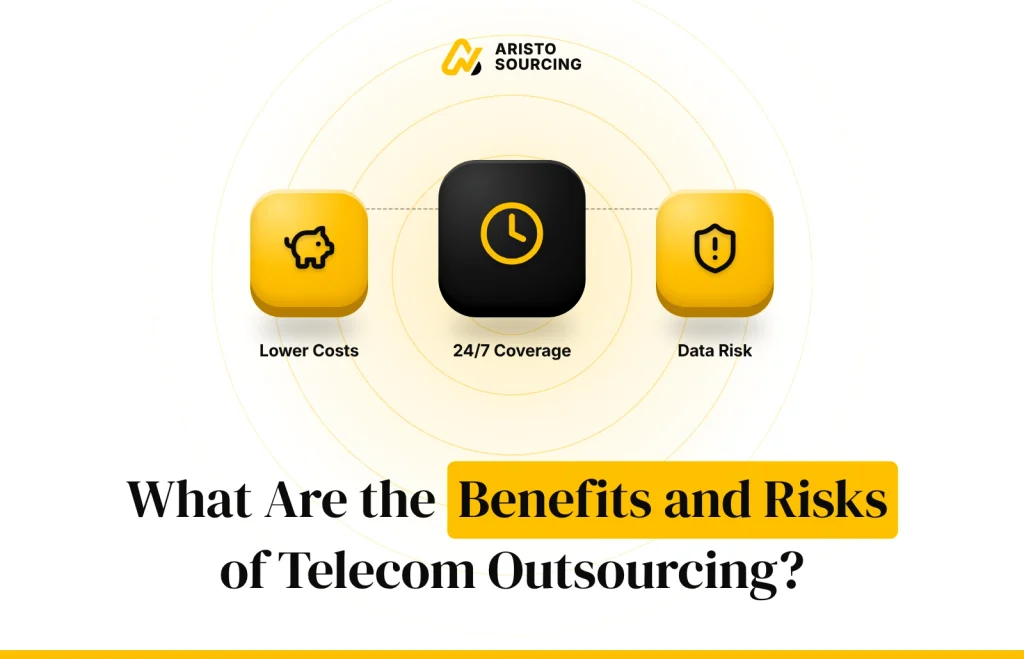
The benefits of telecom outsourcing are lower fixed costs, scalability, 24/7 coverage, specialist expertise, and core focus, while the risks are regulatory exposure, service outages, subscriber churn, and data security. Carriers gain flexible capacity but remain accountable for the service their customers receive.
The benefits of telecom outsourcing are listed below.
- Lowers Fixed Costs: Telecom outsourcing replaces fixed payroll and facility costs with variable service fees.
- Scales Capacity: Telecom outsourcing lets carriers add or reduce staff as subscriber and call volumes change.
- Provides 24/7 Coverage: Telecom outsourcing delivers round-the-clock support and monitoring without staffing three internal shifts.
- Adds Specialist Expertise: Telecom outsourcing gives carriers access to trained network, billing, and support specialists.
- Protects Core Focus: Telecom outsourcing frees internal leadership to focus on network growth and new services.
The risks of telecom outsourcing are listed below.
- Regulatory Exposure: Carriers cannot outsource regulatory duties such as license conditions, lawful intercept, and emergency call obligations, so carriers stay accountable for any provider failure.
- Service Outages: Network failures at an outsourced NOC affect every subscriber and become public quickly.
- Subscriber Churn: Poor outsourced customer care pushes subscribers to switch providers.
- Data Security: Outsourced teams access subscriber data, so weak provider security creates breach risk.
How Much Does Telecom Outsourcing Cost?
Telecom outsourcing costs depend on the function, volume, location, and SLA level, with outsourced customer care ranging from about $7 to $42 per agent hour. Network operations and field services are usually priced as managed services, so their cost depends on scope and service levels rather than an hourly rate.
The 4 telecom outsourcing pricing models are listed below.
- Per Seat: The provider charges a fixed monthly fee for each dedicated agent.
- Per Interaction: The provider charges for each call, chat, or resolved ticket.
- Managed Service With SLA: The provider charges a monthly fee to run a full function against agreed service levels.
- Project-Based: The provider charges a fixed price for a defined project, such as a network rollout.
Location drives the largest cost gap. Crescendo, a customer service company, estimates US-based contact center agents at $29.40 to $42 per hour in 2026, compared with $7 to $16 per hour in India, the Philippines, and Pakistan, and $12 to $19 per hour in Latin America. Carriers comparing these rates with general outsourced call center pricing should also account for SLA level, because stricter availability and resolution targets raise the price.
How Is AI Changing Telecom Outsourcing?
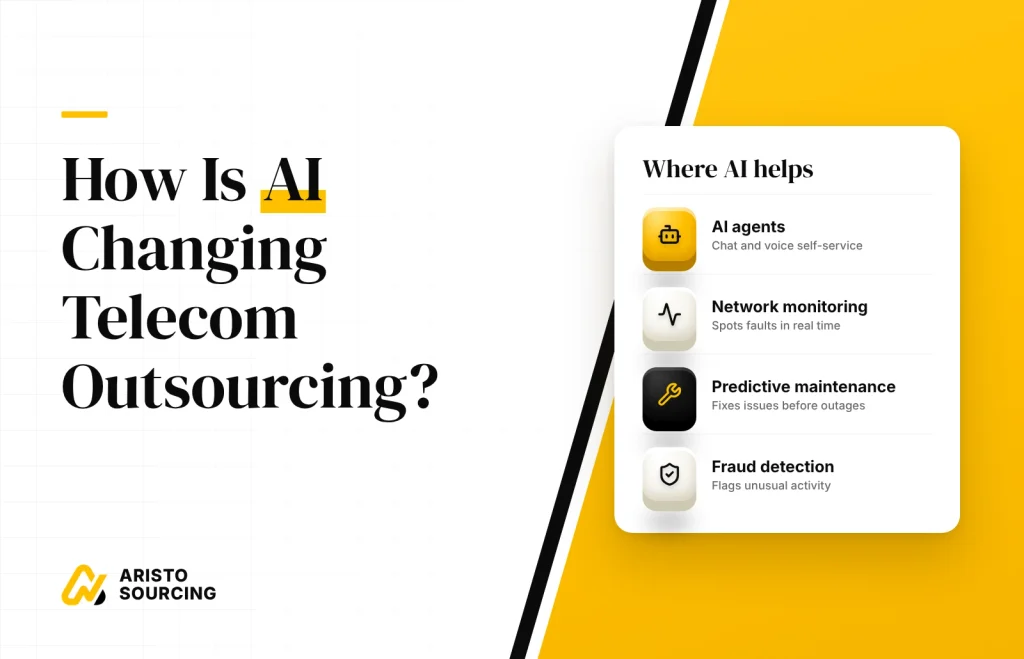
AI is changing telecom outsourcing by automating routine tasks, while outsourced teams shift toward complex work that needs human judgment. AI chatbots now answer routine customer care questions, such as balance checks and plan changes, before a human agent joins. Automated provisioning and ticket triage route network and service requests faster, and predictive network monitoring flags faults before subscribers notice them.
How to Choose a Telecom Outsourcing Partner
To choose a telecom outsourcing partner, carriers should check telecom domain experience, regulatory compliance, SLA terms, security certifications, scalability, and location fit. The steps to choose a telecom outsourcing partner are listed below.
- Confirm the provider’s experience with carriers and telecom processes.
- Check that the provider follows the telecom regulations of every market served.
- Review SLA terms, including targets, reporting, and penalties.
- Verify security certifications such as ISO 27001 and SOC 2.
- Test whether the provider can scale staff up and down with demand.
- Decide between onshore and offshore delivery based on cost, language, and time zone.
Which KPIs Measure Telecom Outsourcing Performance?
The KPIs that measure telecom outsourcing performance are network availability, mean time to restore, first-time fix rate, first contact resolution, average handle time, and billing accuracy. The 6 KPIs that measure telecom outsourcing performance are listed below.
- Network Availability: Network availability measures the percentage of time the network is up and working.
- Mean Time to Restore: Mean time to restore measures the average time to fix a network fault.
- First-Time Fix Rate: First-time fix rate measures the share of field jobs completed on the first visit.
- First Contact Resolution: First contact resolution measures the share of customer issues solved in one interaction.
- Average Handle Time: Average handle time measures the average length of a customer interaction.
- Billing Accuracy and Dispute Rate: Billing accuracy measures error-free invoices, and dispute rate measures the share of invoices customers challenge.
Tracking these KPIs against the SLA is how carriers confirm that telecom outsourcing delivers the functions, benefits, and service levels agreed in the contract.