

Nearshore software outsourcing basically refers to hiring developers in a nearby country to cut costs and share working hours. Nearshore software development gives businesses time-zone alignment with their in-house teams, access to specialized engineering talent, and cost efficiency compared with local hiring.
Pricing of nearshore software outsourcing typically ranges from $25 to $100 per hour, depending on the country, developer seniority, and contract structure. Country selection for nearshore software outsourcing usually narrows to Latin America for North American companies and Eastern Europe for Western European companies, while vendor selection depends on technical expertise, client references, and contract terms. An experienced outsourcing partner can help businesses choose and manage the right nearshore team.
What Is Nearshore Software Outsourcing?
Nearshore software outsourcing is a business arrangement in which a company contracts an outsourcing provider in a nearby country to design, build, test, or maintain software with substantial time-zone overlap. In nearshore outsourcing, the client defines business goals and product priorities, while the provider’s external team runs requirements analysis, onboarding, coding, and quality assurance (QA) through Agile development sprints. For example, a healthcare software company can hire a nearshore provider to build and test a patient scheduling module while the company’s in-house engineers maintain the core platform.
Geographic proximity describes the team’s nearby location, unlike onshore and offshore models that place teams in the same country or a distant one, while the outsourcing business model describes the work, responsibilities, and accountability that the contract transfers to the provider.
As a hypothetical example, a Chicago-based fintech company could hire a development team in Bogotá, Colombia, to build a payments dashboard, with a time difference of one hour or less between the two cities. In this hypothetical setup, both teams hold daily stand-ups and weekly sprint reviews during shared working hours; the client’s product owner keeps project ownership and sets priorities; and the provider’s project manager, developers, and QA engineers take delivery responsibility for code, testing, and progress reports.
How Does Nearshore Software Development Differ From Onshore and Offshore?
Nearshore software development differs from onshore and offshore by placing the external team in a nearby country, usually with a time-zone difference of 0 to 3 hours, while onshore outsourcing keeps the team in the same country and offshore outsourcing places the team in a distant region that is often 6 or more hours away. Nearshore outsourcing supports real-time communication and same-day collaboration, onshore outsourcing makes in-person collaboration easiest, and offshore outsourcing usually relies on asynchronous handoffs because working hours overlap little or not at all.
Onshore development generally carries the highest labor costs, while nearshore and offshore options may reduce labor costs depending on the country and provider. Onshore outsourcing suits projects that need local collaboration, nearshore suits projects that need easier real-time communication, and offshore suits projects that prioritize access to global talent and potential cost savings; businesses that choose nearshore then select among different nearshore software development models.
What Are the Nearshore Software Outsourcing Models?
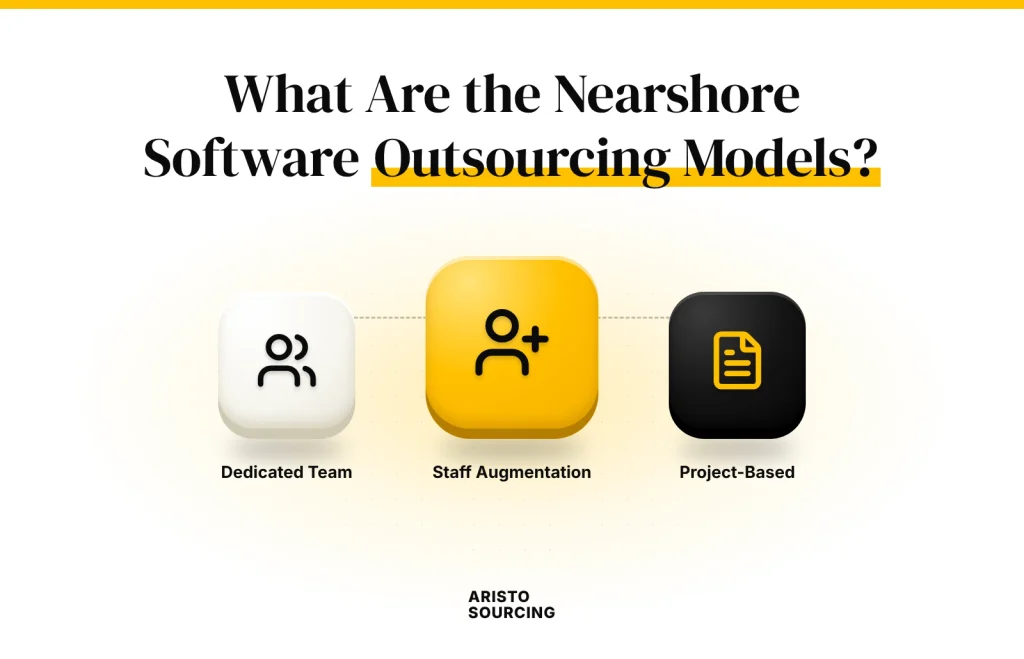
The main nearshore software outsourcing models include staff augmentation, dedicated development teams, and fully managed (end-to-end) outsourcing.
The three models differ in how much day-to-day control, management responsibility, and delivery risk the client keeps or transfers to the provider.
The nearshore software outsourcing models are listed below.
1. Staff Augmentation
2. Dedicated Development Teams
3. Fully Managed Outsourcing
1. Staff Augmentation
Staff augmentation is a nearshore model in which a provider supplies external developers who join the client’s existing team and work under the client’s direction. The external developers fill specific skill or capacity gaps in the in-house engineering team, such as a React developer for a frontend rebuild or two QA engineers for a major release.
The client retains day-to-day technical and delivery management, including task assignment, code reviews, sprint planning, and release decisions, while the provider handles recruitment, payroll, and replacements. Staff augmentation works best when a company already has strong engineering leadership and needs flexible staffing that grows or shrinks with the product roadmap.
2. Dedicated Development Teams
A dedicated development team is a nearshore model in which a provider assembles a stable, long-term team that works exclusively on one client’s product or project. A typical dedicated development team includes software engineers, QA engineers, a UI/UX designer, and a project manager or team lead, with the exact composition based on the product’s needs.
The team joins the client’s sprints, communication channels, and tools, and the same members stay on the product over time, which preserves domain knowledge and code continuity. Management is usually shared, with the client setting product priorities and the provider’s project manager handling daily coordination, performance, and staffing. Team scalability is built into the model, because the provider can add or remove specialists as the roadmap changes without rebuilding the core team.
3. Fully Managed Outsourcing
End-to-end software development outsourcing is a model in which a provider takes responsibility for an entire project, from discovery and design through development, testing, deployment, and post-launch support. In end-to-end outsourcing, the provider delivers agreed project phases and deliverables, such as a clickable prototype, a tested release, or a production deployment, on a contracted timeline.
The project scope defines what the provider will build, the acceptance criteria define how the client approves each deliverable, and the contract assigns accountability for missed milestones and defects. Delivery governance usually includes milestone reviews, steering meetings, change-request procedures, and regular status reports, so the client controls outcomes without managing daily tasks. The amount of control a business wants to keep is a central factor in choosing the right model.
How to Choose the Right Software Outsourcing Model?
To choose the right software outsourcing model, businesses should compare four factors, including scope clarity, internal management capacity, project duration, and the level of control they want to keep. Staff augmentation gives the client the most control, a dedicated development team splits control between the client and the provider, and end-to-end outsourcing transfers delivery ownership to the provider.
As a simple decision matrix, short-term capacity needs with strong internal managers point to staff augmentation, long-term products with evolving requirements point to a dedicated team, and clearly scoped projects with a fixed budget point to end-to-end outsourcing. Project complexity and staffing flexibility refine the choice, because complex multi-system projects benefit from long-term team continuity, while fluctuating workloads favor models that let businesses add or release developers quickly.
What Are the Benefits of Nearshore Software Outsourcing?
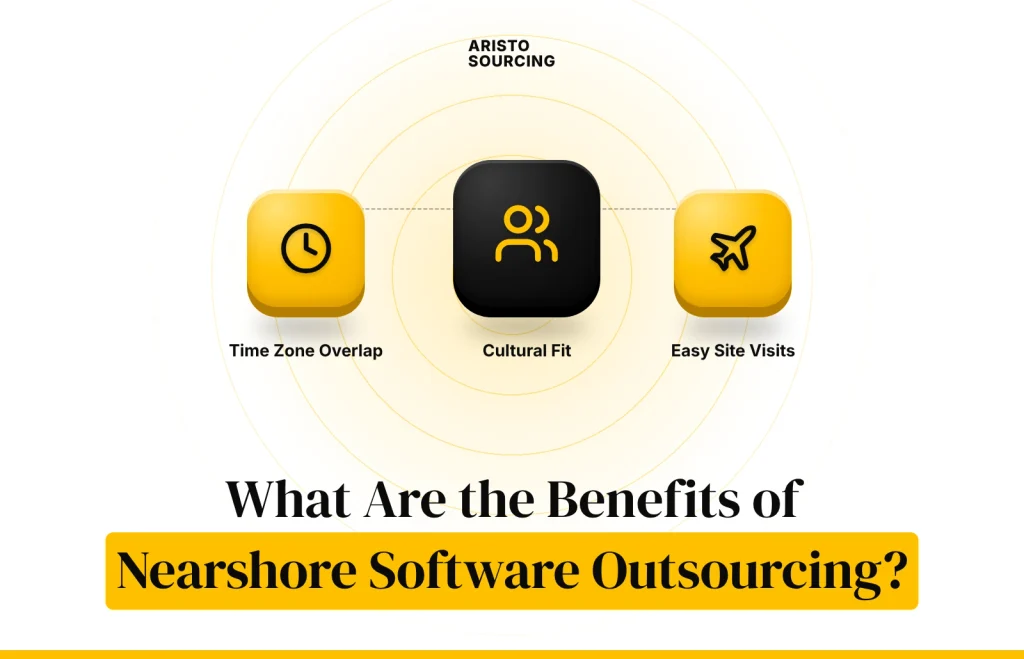
The benefits of nearshore software outsourcing include aligned working hours, access to specialized talent, lower development costs, on-demand team scaling, narrower cultural gaps, faster time-to-market, easier in-person contact, stronger IP protection, and lower turnover risk.
The benefits of nearshore software outsourcing are listed below.
- Aligns Working Hours Across Time Zones: Aligning working hours across time zones means scheduling a nearshore team so that a large part of its workday, often 4 to 8 hours, overlaps with the client’s workday. Time-zone overlap supports sprint planning, code reviews, daily meetings, and same-day issue resolution through real-time collaboration instead of overnight handoffs. Available overlap does not guarantee effective communication, so teams still need fixed meeting times, response-time expectations, and clear decision owners.
- Provides Access to Specialized Software Engineering Talent: Providing access to specialized software engineering talent means giving businesses a wider pool of software engineers with skills that are scarce or slow to recruit locally. Nearshore providers can supply senior developers, solution architects, and specialists in cloud engineering, DevOps, data engineering, and AI. Businesses can request a specific seniority mix and team composition, such as one senior developer leading two mid-level engineers, instead of competing for each hire in a tight local market.
- Reduces Development Costs: Reducing development costs means lowering the total spend required to build and maintain software, not only paying lower hourly rates. Provider billing rates show the price of each hour, while the total cost of ownership also includes management overhead, onboarding, rework, tools, and travel. Actual savings on software development costs depend on these factors and on contract terms such as minimum commitments, notice periods, and change-request pricing.
- Scales Teams on Demand: Scaling teams on demand means adding or reducing engineering capacity as project needs change, without long local hiring cycles. Team scaling works through staff augmentation for individual roles, a dedicated development team for sustained product work, or project-based contracts for defined deliverables. Rapid scaling still has limits, because each new developer needs ramp-up time and knowledge transfer before reaching full productivity.
- Bridges Cultural Gaps: Bridging cultural gaps means reducing the differences in language, business practices, and communication expectations that slow distributed teams down. Cultural alignment depends on each team member’s English proficiency, familiarity with the client’s business norms, and integration into the client’s meetings and tools, and these factors vary by individual and company rather than by country. Shared communication protocols, such as set meeting cadences, written decision logs, and clear escalation paths, keep collaboration consistent across the whole team.
- Accelerates Time-to-Market: Accelerating time-to-market means shortening the time between a product idea and its release. Faster hiring, shorter feedback loops during shared hours, and parallel development across in-house and nearshore teams can shorten release cycles for agile development teams building an MVP or new features. Speed depends on clear requirements, efficient provider onboarding, and mature delivery processes, not on location alone.
- Keeps Teams Within Reach: Keeping teams within reach means locating the external team close enough for practical in-person meetings. Geographic proximity shortens travel time compared with distant offshore locations, which makes on-site visits, discovery workshops, and in-person kickoffs easier to schedule. In-person contact matters most during discovery, onboarding, and critical releases, while remote collaboration is usually enough for routine sprint work.
- Strengthens IP Protection: Strengthening IP protection means using contracts and security controls to keep a client’s intellectual property and data under the client’s ownership. NDAs, IP assignment clauses, and the legal framework in the provider’s country define code ownership and dispute resolution, while access controls and client-owned code repositories support data security. Protection depends on the contract terms and the provider’s practices, not on the region alone.
- Lowers Turnover Risk: Lowering turnover risk means reducing the disruption that occurs when a developer leaves a project. Provider retention practices, backup resources, and structured knowledge transfer support developer retention and keep work moving when individual engineers change. Before signing, businesses should check each provider’s attrition rate, replacement guarantees, and documentation standards rather than assume that any country has lower turnover.
Nearshore software outsourcing also carries disadvantages and risks that businesses should plan for before signing a contract.
What Are the Disadvantages and Risks of Nearshore Software Outsourcing?
The main disadvantages and risks of nearshore software outsourcing include vendor dependency, hidden costs, inconsistent software quality, intellectual property risks, and cybersecurity gaps. Operational risk centers on vendor dependency, which businesses reduce through shared documentation, client-owned code repositories, and contract exit clauses.
Financial risk comes from hidden costs such as onboarding time, management overhead, and rework, which fixed scopes, transparent rate cards, and monthly budget reviews help control. Technical and legal risks affect software quality, intellectual property, and cybersecurity, and businesses reduce them with code review standards, automated testing, NDAs, IP assignment clauses, role-based access controls, and regular security audits.
Onshore development may be more appropriate when strict data residency rules or frequent on-site work apply, and offshore development may suit well-documented, cost-driven work, so the right sourcing model depends on the software services a business plans to outsource.
What Software Services and Roles Can Be Outsourced Nearshore?
The software services and roles that businesses commonly outsource nearshore include frontend developers, backend developers, full-stack developers, mobile developers, QA engineers, DevOps engineers, and UI/UX designers.
The common nearshore software services and roles are listed below.
- Frontend developers build the user-facing parts of web applications with frameworks such as React, Angular, and Vue, focusing on layout, interactivity, accessibility, and performance.
- Backend developers build server-side logic, APIs, databases, and integrations with technologies such as Java, Python, Node.js, and .NET, keeping applications secure, reliable, and scalable.
- Full-stack developers work across frontend and backend code, which makes them a practical fit for MVPs, small product teams, and features that span the entire application.
- Mobile developers build native iOS and Android apps with Swift and Kotlin or cross-platform apps with React Native and Flutter, covering performance, offline behavior, and app store releases.
- QA engineers run manual and automated tests, write test cases, track defects, and verify that each release meets functional, performance, and security requirements.
- DevOps engineers build CI/CD pipelines, manage cloud infrastructure, and automate deployment and monitoring so code moves from development to production quickly and reliably.
- UI/UX designers research user needs, create wireframes, prototypes, and interface designs, and test usability so the product is easy to understand and use.
Matching these roles to a specific business need is the clearest way to decide when nearshore outsourcing does make sense.

When Does Nearshore Software Outsourcing Make Sense for a Business?
Nearshore software outsourcing makes sense when a business needs more engineering capacity or specialized skills, wants lower labor costs than local hiring, and still requires frequent real-time collaboration with its own team. Common use cases include adding capacity to an existing engineering team, new product development, building internal tools, and legacy system modernization.
Projects that rely on Agile development, such as MVPs and evolving products, often suit nearshore teams because short sprints, daily stand-ups, and frequent feedback depend on shared working hours. Real-time collaboration also helps during legacy system modernization, where developers often need quick answers from internal staff who understand the old system’s business rules.
Offshore development may be a better fit for well-documented, low-interaction work where budget is the top priority, while onshore development may be better for projects that require on-site presence, security clearances, or strict local compliance. No model is universally better, so the decision depends on each project’s collaboration needs, compliance requirements, and cost.
How Much Does Nearshore Software Outsourcing Cost?
Nearshore software outsourcing costs between $25 and $100 per hour, depending on the provider’s location, the developer’s seniority and specialization, the team composition, and the contract structure. Location affects hourly rates because developer salaries, employer taxes, and living costs vary between countries and between major tech hubs within the same country.
Seniority and specialization raise rates, so a senior DevOps, cloud, or AI engineer typically bills more than a mid-level frontend or QA engineer. Team composition and contract structure also shape nearshore software development costs, because a full team with a project manager costs more than individual developers, and fixed-price contracts usually include a risk premium compared with time-and-materials billing. Total cost of ownership includes onboarding, management time, tools, and rework, so businesses should compare full engagement costs, not only hourly rates, when evaluating providers in different countries.
What Are the Best Countries for Nearshore Software Development?
The best countries for nearshore software development include Mexico, Brazil, Colombia, Argentina, and Costa Rica in Latin America for North American companies, and Poland, Romania, and Ukraine in Eastern Europe for Western European companies.
The right choice among nearshore software development countries depends on the client’s time zone, required technical skills, developer rates, language needs, and long-term partnership goals.
The best countries for nearshore software development are listed below.
- Mexico: Mexico’s main tech hubs, including Mexico City, Guadalajara, and Monterrey, operate within 0 to 2 hours of continental US time zones and sit a short flight from most major US cities. Developer rates in Mexico tend to sit at the higher end of Latin American ranges, reflecting strong demand from US companies and a mature provider market.
- Brazil: Brazil has one of the largest software engineering talent pools in Latin America, with deep experience in fintech, e-commerce, and enterprise software. São Paulo and Rio de Janeiro run 1 to 2 hours ahead of US Eastern Time, which still leaves a large overlap with North American workdays.
- Colombia: Colombia has fast-growing tech hubs in Bogotá and Medellín, and its developer rates are often lower than Mexico’s for comparable seniority. Colombia uses UTC-5 year-round, which matches US Eastern Time in winter and sits one hour behind it in summer.
- Costa Rica: Costa Rica has a smaller talent pool than Mexico or Brazil, but the country combines political stability with a long-standing presence of multinational technology companies. Costa Rica uses UTC-6 year-round, which matches US Central Standard Time and keeps the country within 2 hours of continental US time zones.
- Poland: Poland has one of the largest developer pools in Central and Eastern Europe, ranked 15th worldwide in the EF English Proficiency Index 2025, and operates under EU law, including the GDPR. Polish developer rates are among the highest in Eastern Europe, and Poland’s Central European Time matches most of Western Europe and runs one hour ahead of the UK.
- Romania: Romania ranked 11th worldwide in the EF English Proficiency Index 2025, and its EU membership gives Western European clients GDPR-aligned data protection. Romanian developer rates are typically lower than Poland’s, and Romania’s Eastern European Time runs one hour ahead of Central European Time.
- Ukraine: Ukraine has a large, experienced engineering workforce, and its developer rates are typically lower than those in Poland and Romania. The ongoing war creates business-continuity risk, so clients should verify each provider’s backup locations, remote-work infrastructure, and contingency plans before signing.
Country selection narrows the field, but a successful partnership depends on choosing the right company within that country.

How to Choose a Nearshore Software Development Company for Partnership?
A nearshore software development company is chosen by defining the project’s requirements, shortlisting providers with matching technical expertise, validating their claims through client references and technical assessments, and completing legal and security due diligence before signing a contract.
The vendor selection process starts with a requirements brief that states the business goals, project scope, technology stack, required roles, preferred engagement model, budget range, timeline, and minimum working-hour overlap. The requirements brief allows businesses to shortlist 3 to 5 nearshore software development companies whose portfolios, industry experience, team size, and time zones match the project.
Vendor evaluation then separates marketing claims from verified capability. Businesses validate claims by requesting case studies with measurable results, speaking with at least two client references from projects of similar size and complexity, interviewing the engineers proposed for the team, and assigning a short paid technical test or pilot sprint. Security and compliance claims should be backed by documents, such as an ISO/IEC 27001 certificate or a SOC 2 report, rather than logos on a website.
Proposals are easier to compare when every provider responds to the same requirements brief. A useful comparison places team composition, seniority mix, hourly rates, total estimated cost, assumptions, exclusions, delivery timeline, and change-request terms side by side, because the lowest rate often hides higher management or rework costs. Due diligence closes the process with a review of the provider’s legal entity, financial stability, data protection practices, IP assignment terms, termination clauses, and knowledge-transfer obligations.
How Does Aristo Sourcing Help with Nearshore Software Development?
Aristo Sourcing helps businesses support nearshore software development by providing access to skilled remote professionals who can strengthen existing development teams and expand delivery capacity. Aristo Sourcing supports staffing needs through remote staffing, talent sourcing, and recruitment process outsourcing (RPO), which help businesses find, screen, and onboard suitable professionals for technical and operational roles.
Access to remote talent helps businesses address skill gaps, expand development capacity without long local hiring cycles, and manage changing staffing needs with greater affordability. Remote professionals sourced through Aristo Sourcing can work inside the client’s existing workflows and software development tools, such as project trackers, code repositories, and communication platforms.
Aristo Sourcing acts as a staffing and talent partner rather than a software development agency, so the client keeps control of the product, the code, and delivery decisions while Aristo Sourcing focuses on finding the right people. Businesses that understand the different models of nearshore software outsourcing, weigh the benefits against the total cost, and treat choosing the right partner as a strategic decision are better positioned to achieve time-zone alignment and cost efficiency.