

Create a Remote-First Handbook That Helps Your Business Scale
Many companies treat an employee handbook as a compliance document, a static list of HR rules and workplace policies.
But for businesses that operate with remote teams and virtual assistants, a handbook serves a far more strategic function.
It becomes the operational blueprint for your distributed workforce.
Without documented systems, founders quickly become trapped in the Founder Bottleneck, answering the same operational questions repeatedly, clarifying expectations, and managing daily decisions that should already be standardized.
A well-designed employee handbook solves this problem by transforming undocumented knowledge into structured systems. It clarifies communication protocols, defines operational standards, and ensures that every team member, regardless of location, understands how work gets done.
Instead of functioning as a rulebook, a modern handbook becomes a scaling framework that enables teams to operate independently.
In this guide, we’ll show you how to create an employee handbook designed specifically for remote teams, virtual assistants, and distributed operations.
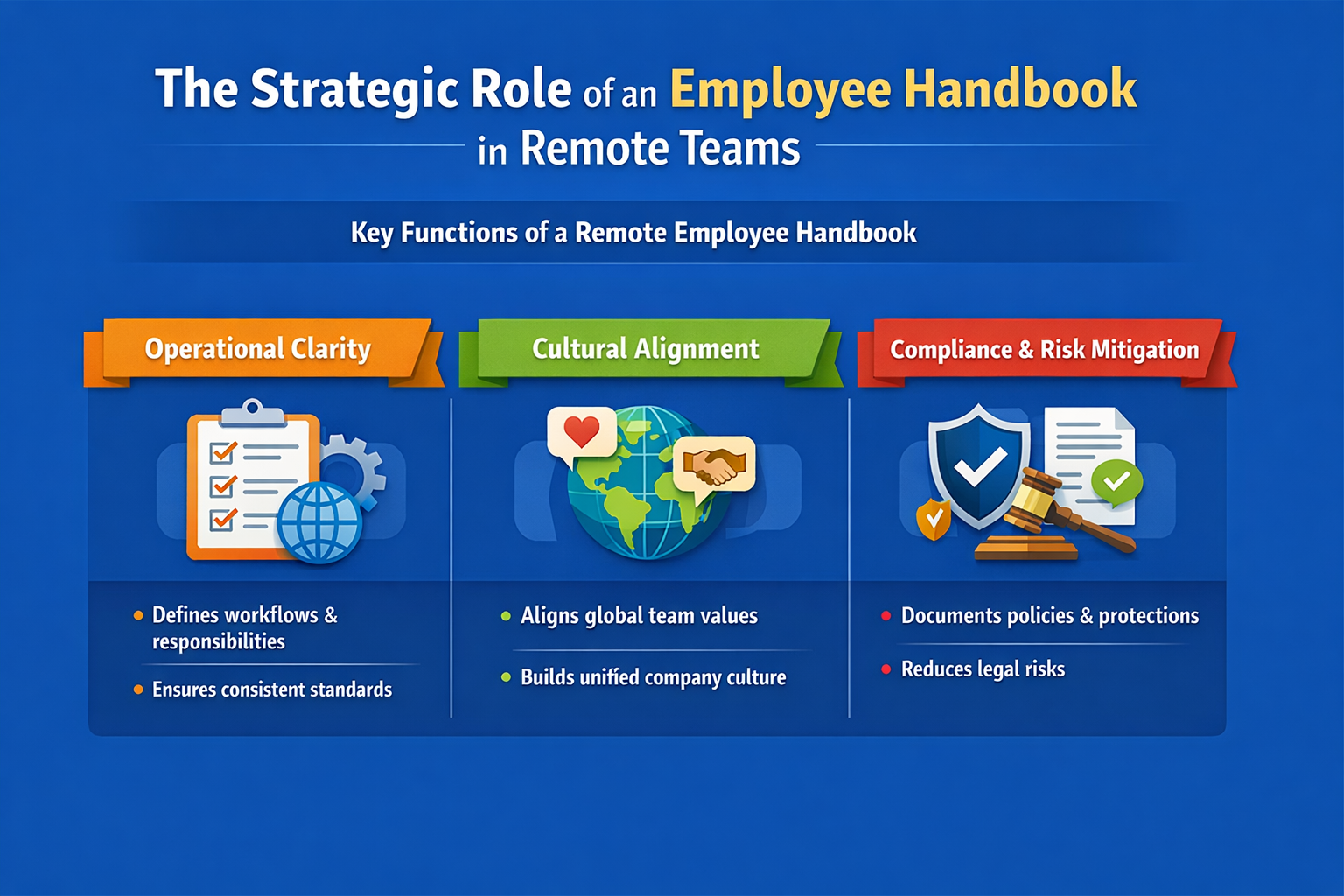
The Strategic Role of an Employee Handbook in Remote Teams
For remote companies, an employee handbook is not just a policy document; it’s a core piece of operational infrastructure.
It performs three essential roles.
Operational Clarity
When teams operate across multiple time zones, clarity becomes essential.
A handbook documents expectations, workflows, and responsibilities so employees can make decisions without constantly relying on management.
This reduces confusion and ensures that every team member operates under the same standards.
Cultural Alignment Across Distributed Teams
In traditional offices, company culture develops organically through daily interaction.
Remote organizations must build culture intentionally.
The handbook provides a space to clearly define the company’s mission, values, and working principles so employees understand how decisions are made and how communication works.
For companies working with global talent, including teams in regions like South Africa or the Philippines, this cultural clarity ensures everyone operates with the same expectations.
Compliance and Risk Mitigation
A handbook also protects the business by documenting policies related to workplace conduct, confidentiality, and employee rights.
Clear documentation demonstrates that the organization has established standards around issues such as anti-discrimination, workplace conduct, and intellectual property protection.
When properly structured, the handbook becomes both an operational guide and a compliance framework.
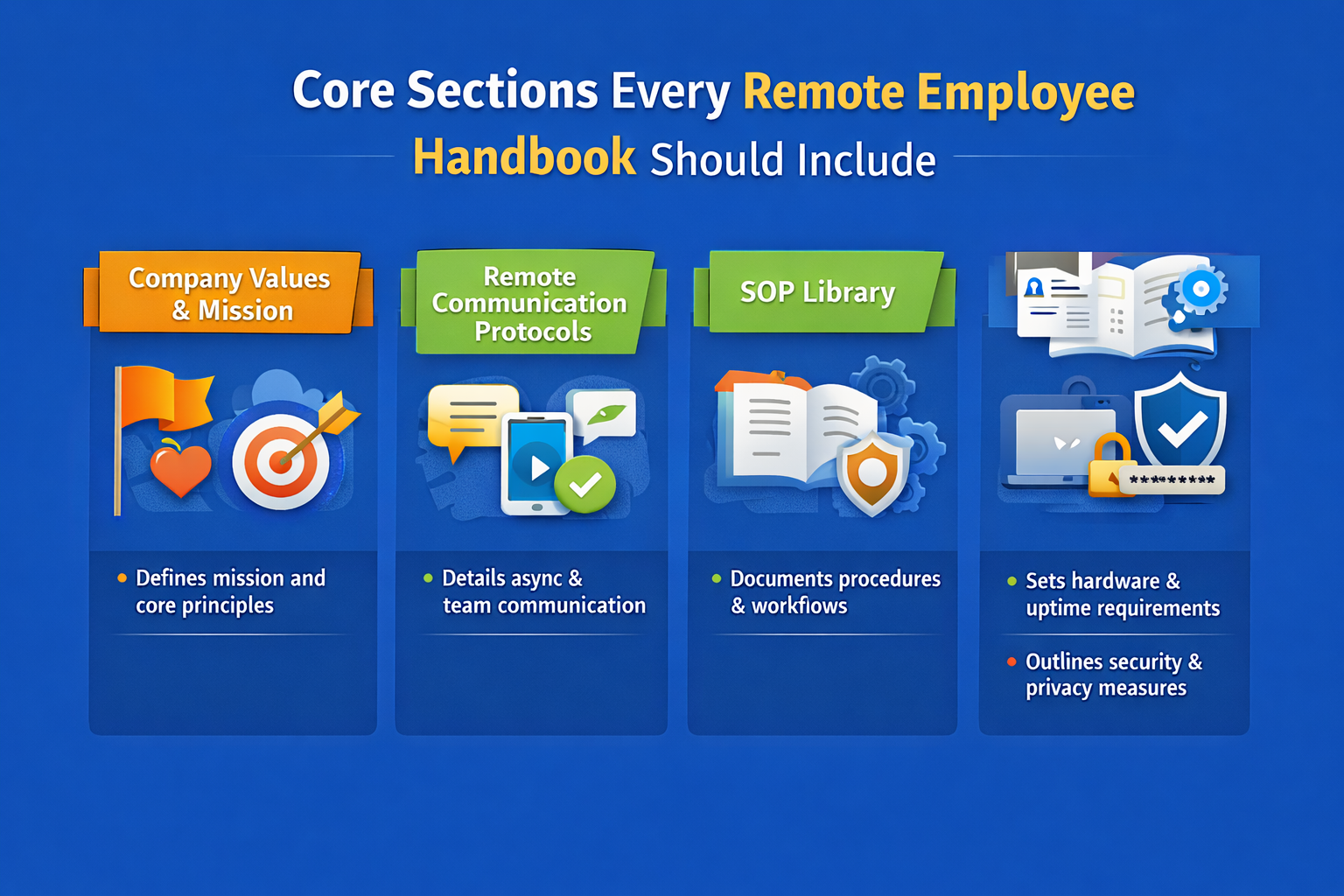
Core Sections Every Remote Employee Handbook Should Include
A strong handbook should function as a working manual for distributed teams, not simply an HR formality.
Below are the most important sections to include.
Company Mission, Vision, and Values
Start by defining the organization’s mission and core principles.
For remote teams, these values often emphasize qualities such as:
- Accountability and ownership
- Transparent communication
- Proactive problem-solving
- Candid feedback
- Results-focused performance
Clearly communicating these values helps align remote employees with the company’s broader purpose.
Remote Communication Protocols
Communication is one of the biggest challenges in distributed teams.
Your handbook should clearly define how team members interact across time zones and platforms.
Topics to address include:
- Asynchronous communication expectations
- Slack or messaging etiquette
- Response time standards
- Documentation of project updates
- When meetings are required versus when written updates are preferred
Many remote companies use platforms like Slack, ClickUp, Notion, or Loom to ensure transparency.
Establishing communication protocols prevents misunderstandings and reduces unnecessary meetings.
The SOP Library: Documenting How Work Gets Done
Remote teams operate most effectively when processes are documented.
Your handbook should introduce employees to the company’s Standard Operating Procedure (SOP) library, which provides step-by-step guidance for recurring tasks.
Typical SOP categories include:
- Client onboarding workflows
- Marketing campaign processes
- Administrative support tasks
- Customer support procedures
- Reporting and documentation standards
By requiring employees to follow documented SOPs, businesses maintain consistency and reduce operational errors.
Job Expectations and Professional Conduct
Every employee should understand what is expected of them.
This section should outline:
- Job responsibilities
- Professional conduct standards
- Confidentiality requirements
- Ethical behavior expectations
- Social media and communication policies
For remote teams, professionalism also extends to digital presence, including responsiveness, meeting etiquette, and maintaining a distraction-free workspace.
Equipment and Connectivity Standards
Remote work depends heavily on reliable technology.
Your handbook should define minimum requirements for equipment and connectivity.
This may include:
- High-speed internet access
- Reliable computer hardware
- Secure work environments
- Backup connectivity options
For teams operating in regions affected by load-shedding, businesses should also establish contingency plans, such as:
- Backup internet solutions
- Uninterrupted power supply (UPS) systems
- Defined load-shedding contingency procedures
Establishing these standards ensures operational continuity even during infrastructure disruptions.
Data Security and Confidentiality
Security is one of the biggest concerns when hiring remote or offshore team members.
A professional handbook should define policies related to:
- Password management tools such as LastPass or Dashlane
- Multi-factor authentication (MFA)
- Least-privilege access policies
- Client data protection
- Non-disclosure agreements (NDAs)
Organizations working with enterprise clients may also adopt best practices such as SOC 2 compliance principles or defined data residency protocols.
These policies protect both the company and its clients while reinforcing trust in remote operations.
Compensation, Benefits, and Leave Policies
Transparency in compensation and time-off policies prevents misunderstandings.
This section should clarify:
- Payment schedules
- Contract structures
- Performance evaluation criteria
- Leave policies
- Holiday schedules
Clearly defining these policies ensures employees understand how compensation and performance reviews are handled.
Conflict Resolution and Feedback Channels
Even distributed teams experience challenges.
Your handbook should define clear channels for resolving concerns.
This may include:
- Direct communication with team leads
- Structured feedback systems
- HR escalation procedures
- Internal dispute resolution frameworks
Clear communication pathways ensure issues are addressed quickly and fairly.
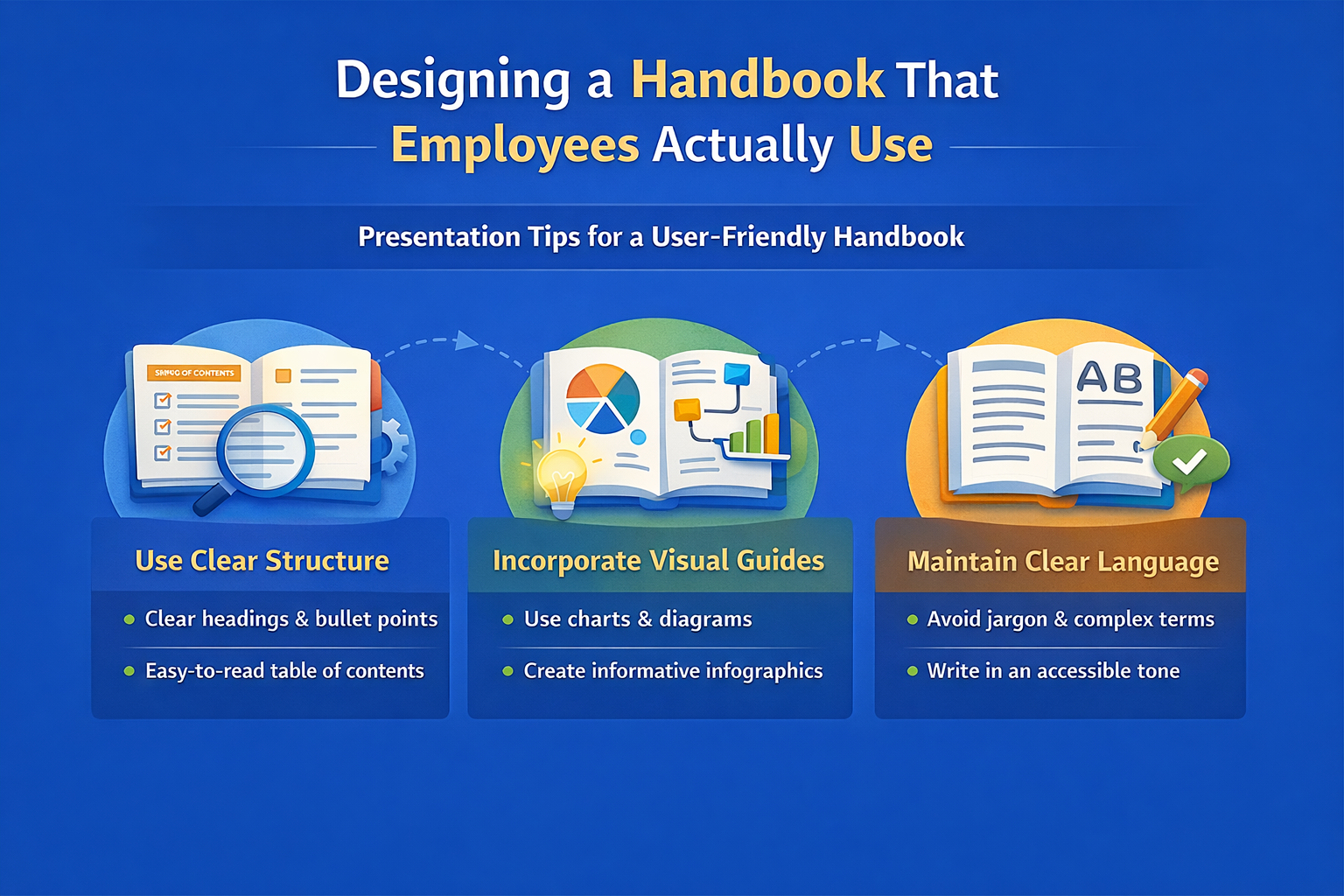
Designing a Handbook That Employees Actually Use
Even well-written policies are ineffective if employees struggle to navigate the document.
Focus on usability by following these best practices.
Use Clear Structure
Organize the handbook using clear headings, bullet points, and logical sections so employees can easily locate information.
Incorporate Visual Guides
Charts, diagrams, and process maps can simplify complex workflows.
Maintain Clear Language
Avoid overly technical or legal language. Instead, prioritize clarity so employees at every level can understand company policies.
Why Many Companies Outsource Handbook Development
Creating a comprehensive handbook requires significant documentation and formatting work.
Many companies choose to outsource this process to experienced professionals or virtual assistants.
A virtual assistant can assist with:
- Policy documentation
- SOP organization
- Handbook formatting and layout
- Internal process documentation
- Training material preparation
This approach allows founders to focus on strategic growth while ensuring the final handbook is clear, structured, and professional.

The Employee Handbook as a Scaling System
For growing companies, the employee handbook is not simply an HR document.
It is the foundation of a scalable business system.
By documenting workflows, expectations, and communication standards, the handbook enables teams to operate independently without constant oversight from leadership.
This shift allows founders to move away from daily operational management and focus on strategic growth.
For organizations building distributed teams or hiring virtual assistants, a well-designed handbook becomes a critical step in eliminating the Founder Bottleneck and creating a scalable remote operation.

Frequently Asked Questions
How do employee handbooks help overcome the Founder Bottleneck?
A handbook transfers operational knowledge from the founder’s head into documented systems. By defining delegation frameworks and operational procedures, virtual assistants can complete tasks independently without constant supervision.
What are the golden rules of asynchronous communication?
The key principle is over-documentation. Every request should include context, a clear deadline, and a defined outcome. This reduces unnecessary back-and-forth messaging and allows teams to collaborate effectively across time zones.
How should a handbook address cultural intelligence in global teams?
Companies working with international staff should define cultural expectations clearly. This includes encouraging candid feedback, proactive communication, and collaborative problem-solving, even when team members come from different workplace cultures.
What is a “least-privilege” access policy?
A least-privilege policy means employees only receive access to the specific tools and data required for their role. This reduces security risks and limits the impact of potential breaches.
Can an employee handbook function as a training guide?
Yes. While the handbook outlines policies, it should link to your company’s SOP library or learning management system. This structure helps new employees understand operational workflows during their onboarding period.
Should companies track time or results for remote employees?
Many modern remote organizations are shifting toward results-based evaluation. Companies may use time-tracking tools like Hubstaff or Time Doctor, but many focus primarily on deliverables and performance metrics.
What is the 70/30 communication rule for remote teams?
A common best practice is that approximately 70% of communication should be asynchronous (Slack, Notion, email) while only 30% should involve live meetings. This approach protects deep work time and reduces meeting fatigue.
How does a handbook protect intellectual property when working with offshore staff?
Employee handbooks typically reference signed NDAs and work-for-hire agreements. These documents confirm that all content, code, or intellectual property produced by the employee belongs to the company or client.

