
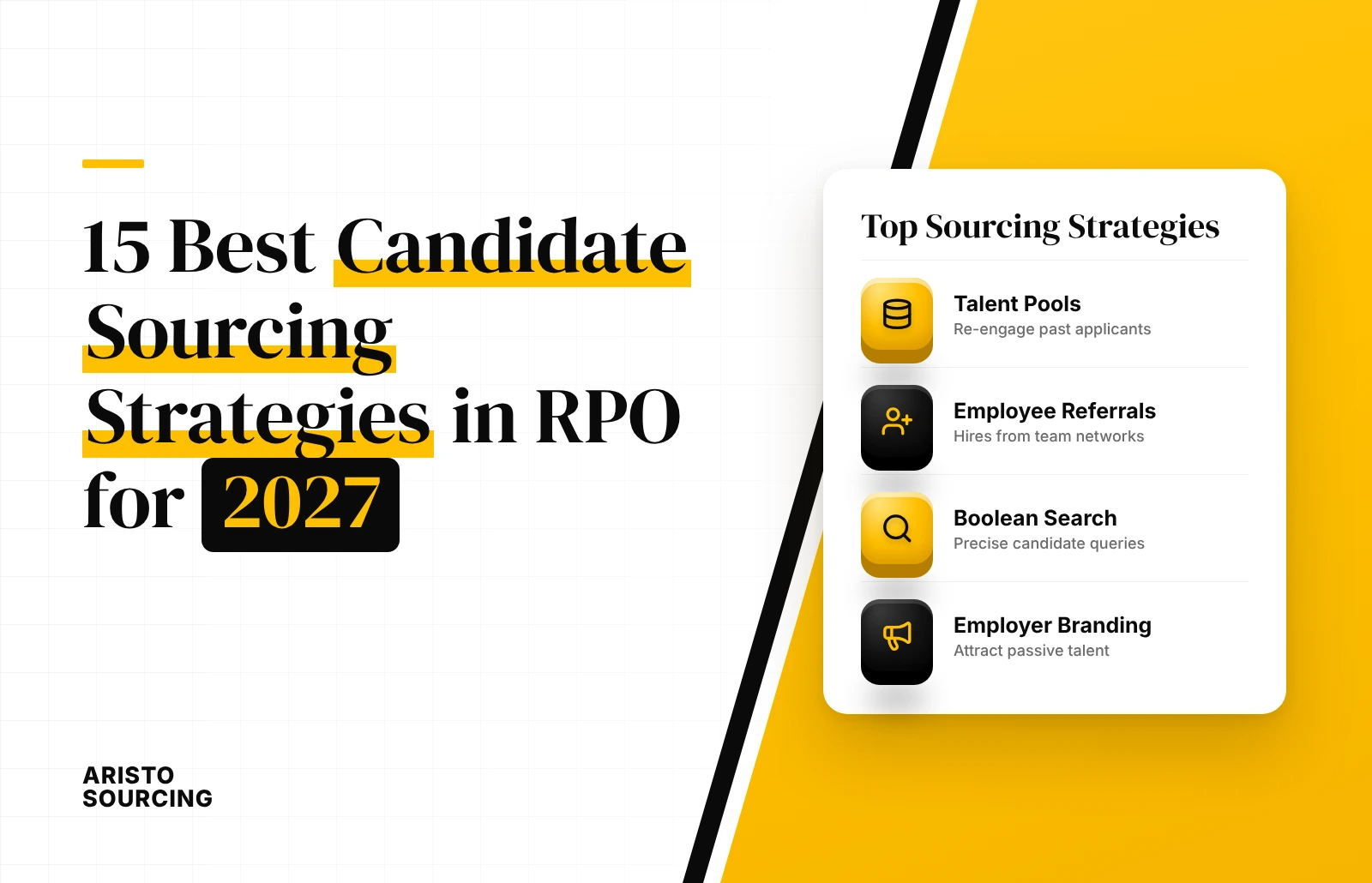
Candidate sourcing in RPO usually refers to an outside provider finding qualified candidates, the first step of modern recruitment. The main strategies include ATS candidate rediscovery, AI-powered matching, Boolean search, personalized outreach, and employee referrals. Together, these strategies increase hiring speed, improve candidate quality through better role matching, and raise recruitment efficiency by reducing manual search work.
Proactive, data-driven sourcing matters in 2027 because skill requirements change quickly and many of the strongest candidates are employed and not applying for jobs. This guide also covers the candidate sourcing workflow, the best channels by job type, sourcing technology, KPIs, common challenges, and a 90-day implementation plan. Choosing the right RPO partner brings these elements together into a stronger talent pipeline.
What Is Candidate Sourcing in RPO?
Candidate sourcing in RPO is the process in which a recruitment process outsourcing provider identifies, researches, and engages qualified candidates for a client’s current and future roles before screening begins. RPO sourcing is proactive, which means sourcers identify candidates before a requisition opens instead of waiting for inbound applications. Sourcing finds and engages potential candidates, screening evaluates whether those candidates meet the role requirements, and full-cycle recruitment covers every stage from job intake to offer acceptance.
Within the talent acquisition function, sourcing specialists work as part of the RPO provider’s delivery team, and they agree on role requirements with each hiring manager before the search begins. The RPO provider sets the sourcing process, tools, and reporting, while the hiring manager gives feedback on sample profiles and submitted candidates. This shared structure lets candidate sourcing strategies run consistently across every role in the engagement.
What Are the 15 Best Candidate Sourcing Strategies in RPO?
The 15 best candidate sourcing strategies in RPO include ATS candidate rediscovery, AI-powered matching, segmented talent communities, Boolean and X-Ray search, personalized outreach, employee referrals, niche communities, alumni re-engagement, talent-market intelligence, workforce planning alignment, candidate personas, social media sourcing, professional partnerships, recruitment analytics, and talent intelligence.
The 15 best candidate sourcing strategies in RPO are listed below.
- Rediscover Candidates in an ATS
- Use AI-Powered Candidate Sourcing and Matching
- Build and Nurture Segmented Talent Communities
- Use Boolean Search and X-Ray Search
- Personalize Multi-Channel Candidate Outreach
- Develop an Effective Employee Referral Program
- Source Candidates From Niche Communities
- Re-engage Former Employees and Alumni
- Use Talent-Market Intelligence and Competitor Mapping
- Align Candidate Sourcing With Workforce Planning
- Create Candidate Personas and Skills Profiles
- Use Social Media and Digital Sourcing
- Build Partnerships With Professional Associations and Talent Networks
- Use Recruitment Analytics to Optimize Sourcing Channels
- Use Talent Intelligence and Predictive Workforce Insights
1. Rediscover Candidates in an ATS
Candidate rediscovery in an ATS refers to searching an applicant tracking system for past applicants, previous finalists, and existing contacts who may now fit a current open role. Silver-medal candidates, who reached the final interview stage but did not receive an offer, are usually the strongest starting point because they have already been assessed. Sourcers then check whether each candidate’s skills, location, and availability match the current vacancy, and they update the record before outreach. Candidate rediscovery reduces sourcing time and effort because the talent pool already exists inside the ATS. The sourcer contacts known, pre-assessed candidates instead of starting a new search from zero.
2. Use AI-Powered Candidate Sourcing and Matching
AI-powered candidate sourcing refers to the use of machine learning tools that search large candidate databases, rank profiles, and match candidate skills to the requirements of an open role. AI candidate sourcing tools read resumes and public profiles, identify related skills and job titles, and score each candidate against the job description, which supports skills-based hiring. Candidate matching through recruitment automation reduces manual sourcing work, such as keyword searches, profile reviews, and initial shortlisting, so sourcers spend more time engaging candidates. However, AI results depend on data quality, and models trained on biased historical hiring data can repeat that bias against qualified candidates. Human oversight is essential, so a sourcer should review every AI-generated shortlist before any candidate is contacted.
3. Build and Nurture Segmented Talent Communities
A segmented talent community is a group of potential candidates organized by skills, location, experience level, or job category, which an RPO team engages over time before roles open. Talent communities segmented this way let sourcers send relevant updates, such as role alerts for data engineers in Texas, instead of generic messages to every contact. Candidate nurturing keeps relationships active through useful content, event invitations, and occasional check-ins, so candidates already know the employer when a vacancy opens. A recruitment CRM supports this ongoing engagement by storing candidate preferences, tracking interactions, and automating scheduled messages for each segment. Well-maintained talent pools give the RPO team a warm shortlist for recurring roles and shorten the time between a new requisition and the first interview.
4. Use Boolean Search and X-Ray Search
Boolean search and X-Ray search are sourcing techniques that combine keywords with operators and search commands to find candidate profiles that match specific job titles, skills, and locations. Boolean search uses AND to require terms, OR to include alternatives, and NOT to exclude unwanted terms, which narrows results on LinkedIn, job boards, and ATS databases. X-Ray search uses the Google site: operator to search a single website, such as LinkedIn or GitHub, and discover relevant public profiles that the platform’s own search may not show. For a technical role, the Boolean string (“Java developer” OR “Java engineer”) AND (Spring OR microservices) AND AWS NOT intern finds experienced Java developers with cloud skills. For a non-technical role, the X-Ray string site:linkedin.com/in (“HR generalist” OR “HR business partner”) “Dallas” -jobs finds HR professionals in Dallas, and sourcers can save both sourcing strings for future searches.
5. Personalize Multi-Channel Candidate Outreach
Personalized multi-channel outreach means contacting candidates through several suitable channels, such as email and LinkedIn, with messages tailored to each candidate’s skills, experience, or recent projects. Personalized recruitment messages reference a specific detail, such as a candidate’s open-source project or recent promotion, which shows the outreach is relevant rather than mass-sent. Passive candidates rarely reply to a single message, so a spaced follow-up sequence, such as a first message, a follow-up after four days, and a final note after one week, improves the response rate. Each follow-up should add new information, such as team details or the salary range, instead of repeating the first message. Sourcing produces candidate names, but candidate outreach is what turns those names into conversations.
6. Develop an Effective Employee Referral Program
An employee referral program is a structured sourcing method in which current employees recommend qualified candidates from their personal and professional networks, usually in exchange for a defined reward. Employee referrals work best when the RPO team shares clear role profiles, so employees know which skills and experience to look for. A simple referral workflow, such as a short submission form, a fast acknowledgment, and regular status updates, keeps employees engaged, while incentives like bonuses or extra paid leave encourage participation. The RPO team should track referral conversion, which measures how many referred candidates are interviewed and hired, along with the performance and retention of referred hires. These hiring outcomes show whether the referral program is producing qualified candidates or only adding volume.
7. Source Candidates From Niche Communities
Niche community sourcing means finding candidates in specialized online and offline groups where professionals in a specific field share work, discuss problems, and build their reputation. Niche sourcing starts by identifying the professional communities that each target group uses, including forums, open-source platforms, portfolio sites, and industry chat groups. For example, GitHub shows a software developer’s code, contributions, and preferred languages, while Behance shows a designer’s portfolio and creative style. Sourcers should match each channel to the requirements of the role, so a UX designer search starts on Behance or Dribbble rather than a general job board. Niche channels usually produce fewer candidates than broad platforms, but those candidates show verifiable evidence of their skills.
8. Re-engage Former Employees and Alumni
Re-engaging former employees and alumni means reconnecting with people who previously worked for an organization and inviting eligible individuals to return or refer candidates for suitable open roles. Re-engagement starts by identifying former employees who left in good standing, along with previous colleagues of current staff who may be open to returning. Boomerang employees, who return to a former employer, usually need less onboarding because they already know the company’s systems, culture, and expectations. The RPO team should keep contact information, career updates, and role preferences current in the ATS or recruitment CRM. Alumni networks, such as corporate alumni groups on LinkedIn, also provide access to experienced candidates who have developed new skills since they left.
9. Use Talent-Market Intelligence and Competitor Mapping
Talent-market intelligence refers to data about where qualified professionals work, how many are available, what they earn, and how competitive a specific skill set is within a market. Talent mapping identifies where relevant skills and professionals are concentrated, such as cloud engineers in Austin or clinical researchers in the Boston biotech cluster. Competitor mapping analyzes the organizations that employ the target talent, including their team structures, job titles, and recent hiring freezes or expansions. Labor-market analysis compares geographic talent markets by supply, demand, and salary levels, which shows whether a role should be sourced locally, remotely, or in another region. RPO teams use these market insights to select the sourcing channels and locations most likely to produce qualified candidates.
10. Align Candidate Sourcing With Workforce Planning
Aligning candidate sourcing with workforce planning means building sourcing pipelines around an organization’s forecasted headcount and skill needs, so qualified candidates are ready before roles become urgent vacancies. Hiring forecasts, such as a plan to add 40 customer support agents next quarter, tell the RPO team which talent pools to build first. Hiring manager alignment at the start of each recruitment project confirms role requirements, interview stages, and decision timelines before sourcing begins. The RPO team then connects sourcing capacity and delivery timelines to the service-level agreement (SLA), which sets targets such as time-to-submit and time-to-fill. This alignment prevents the common pattern of starting a search only after a position is already overdue.
11. Create Candidate Personas and Skills Profiles
A candidate persona is a semi-fictional profile of the ideal candidate for a role, describing the skills, experience, motivations, and career goals that predict success in that position. The ideal candidate profile defines the essential skills, certifications, and years of experience required for each position. Skills-based hiring separates must-have requirements, such as a required license, from skills candidates can learn on the job, such as a specific internal software tool. Transferable skills, such as client communication or data analysis gained in another industry, widen the talent pool without lowering the hiring standard. Sourcers use the persona and profile to choose search terms and channels, and screeners use the same criteria to make consistent decisions.
12. Use Social Media and Digital Sourcing
Social media sourcing refers to finding, researching, and engaging potential candidates through social and professional platforms, such as LinkedIn, X, Facebook, Instagram, and Reddit, based on their public activity. Social recruiting helps recruiters discover candidates through their posts, groups, and shared work, and it gives recruiters a natural reason to start a conversation. Professional content and employer branding, such as team stories, project updates, and employee videos, attract relevant talent before any outreach begins. The employer value proposition strongly influences whether passive candidates respond, because these candidates compare every message against their current job. Recruiters should select platforms based on candidate behavior and job requirements, so LinkedIn suits most corporate roles, while Instagram and TikTok suit many creative and hourly roles.
13. Build Partnerships With Professional Associations and Talent Networks
Partnering with professional associations and talent networks means building formal relationships with industry groups, alumni organizations, and professional networks that give recruiters direct access to specialized candidates. Professional associations, such as the Society of Women Engineers or the American Marketing Association, often run job boards, events, and member directories. Sourcing partnerships with industry communities, university alumni groups, and training bootcamps provide access to specialized talent pools that general job boards rarely reach. Talent networks also add credibility, because candidates trust opportunities shared by an organization they already belong to. The RPO team should track candidate quality and source effectiveness for each partnership, including qualified candidates, interviews, and hires.
14. Use Recruitment Analytics to Optimize Sourcing Channels
Recruitment analytics refers to the collection and analysis of hiring data to measure how sourcing channels, recruiters, and processes perform, and to improve future hiring decisions. Sourcing metrics compare channels by the number of qualified candidates produced, conversion rates, cost, and hiring outcomes. Source-to-hire conversion shows the percentage of sourced candidates from each channel who are hired, while channel ROI compares the value of those hires with the channel’s total cost. These comparisons show which channels deliver the best results for different roles, since a channel that works well for engineers may perform poorly for sales or support roles. RPO teams then use this performance data to shift budget and sourcer time toward the strongest channels.
15. Use Talent Intelligence and Predictive Workforce Insights
Talent intelligence refers to the analysis of internal and external workforce data, such as hiring trends, skill demand, and talent supply, to guide sourcing and recruitment decisions. Workforce analytics tracks hiring trends and changes in skill demand, such as rising demand for AI and data skills across many industries. Skills forecasting assesses talent availability across locations and industries, which shows where specific skills are likely to be scarce or plentiful. Predictive analytics uses this data to anticipate sourcing challenges, such as a shortage of licensed nurses in a region, and to plan recruitment activity months in advance. Together, these insights show the importance of proactive candidate sourcing for RPO in 2027.
Why Is Candidate Sourcing Important for RPO in 2027?
Candidate sourcing is important for RPO in 2027 because talent shortages, changing skill requirements, and strict service-level agreements make waiting for applications too slow and too unpredictable. Proactive sourcing builds pipelines in advance, which helps RPO providers fill high-volume positions quickly and secure talent for hard-to-fill roles that attract few qualified applicants.
Skill requirements also change faster as technology evolves, so workforce planning and sourcing must adapt to new skills before demand peaks. Competition for skilled talent remains strong, and candidates now expect relevant, personalized, and fast communication from recruiters. Sourcing performance directly affects hiring speed, cost per hire, and quality of hire, and RPO engagements commonly carry SLA targets such as time-to-submit, time-to-fill, and candidate quality thresholds. Meeting those targets requires a balance of active and passive candidate sourcing.
What Is the Difference Between Active and Passive Candidate Sourcing in RPO?
The difference between active candidate sourcing and passive candidate sourcing targets is that active candidates are job seekers who apply for open roles, while passive candidates are employed professionals who are not applying but may be open to the right opportunity. RPO providers must source passive candidates proactively because these professionals rarely see job ads, yet they often have the skills and experience that hard-to-fill roles require.
Outbound sourcing reaches candidates directly through search and outreach, inbound sourcing attracts applicants through job ads and career sites, and network sourcing uses referrals, alumni, and partnerships. A talent pool that includes both active candidates and passive candidates gives RPO teams more options for every role. A good candidate sourcing strategy balances all three approaches, and the 90-day plan below shows how to implement one.
How to Implement an RPO Candidate Sourcing Strategy in 90 Days
An RPO candidate sourcing strategy can be implemented in 90 days through three phases, including auditing current sourcing in days 1 to 30, piloting improvements in days 31 to 60, and optimizing results in days 61 to 90.
The 90-day plan for implementing an RPO candidate sourcing strategy is listed below.
- Days 1 to 30: Audit. In days 1 to 30, audit the current sourcing setup to understand which sourcing channels, candidate databases, workflows, and performance results already exist across each role. This baseline shows where candidates come from, how long each stage takes, and which channels produce hires.
- Days 31 to 60: Pilot. In days 31 to 60, pilot two or three sourcing improvements on a small group of roles, then compare their results with the baseline from the audit phase. Strong pilot options include ATS rediscovery, personalized outreach sequences, and AI-assisted matching.
- Days 61 to 90: Optimize. In days 61 to 90, measure pilot results against the baseline, keep the methods that improved speed or quality, and remove the methods that did not perform. The successful methods are then expanded to more roles and built into the standard candidate sourcing workflow.
How to Build an Effective Candidate Sourcing Workflow in RPO
Building an effective candidate sourcing workflow in RPO involves steps such as job intake, role calibration, candidate discovery, outreach, candidate qualification, and handoff.
The steps of an effective candidate sourcing workflow in RPO are listed below.
- Job Intake: Job intake refers to the first meeting between the RPO team and the hiring manager, where both sides define the role, its requirements, and the hiring timeline before sourcing. The hiring manager shares must-have skills, the salary range, location, interview stages, and selling points, and these details vary across different job types.
- Role Calibration: Role calibration refers to the process of testing the agreed role requirements against real candidate profiles to confirm that the RPO team and hiring manager share the same expectations. The sourcer presents a few sample profiles, and the hiring manager’s feedback adjusts the search before full sourcing begins.
- Candidate Discovery: Candidate discovery refers to the stage in which sourcers search internal databases and external channels to build a list of potential candidates who match the calibrated role profile. Common methods include ATS searches, Boolean and X-Ray searches, referrals, and niche communities.
- Outreach: Outreach refers to the stage in which sourcers contact potential candidates with personalized messages that explain the opportunity and invite each candidate to a short conversation. Spaced follow-ups on email and LinkedIn move interested candidates from a first reply to a scheduled call.
- Candidate Qualification: Candidate qualification refers to the stage in which sourcers confirm that an interested candidate meets the role’s core requirements before the candidate is submitted to the recruiter. A short call confirms the candidate’s interest, key skills, salary expectations, and availability.
- Handoff: Handoff refers to the stage in which the sourcer passes qualified candidates, with their notes and screening details, to the recruiter and hiring manager for formal interviews. Interview feedback then returns to the sourcer, who uses it to refine the search for the next candidates.
What Are the Best Candidate Sourcing Channels by Job Type?
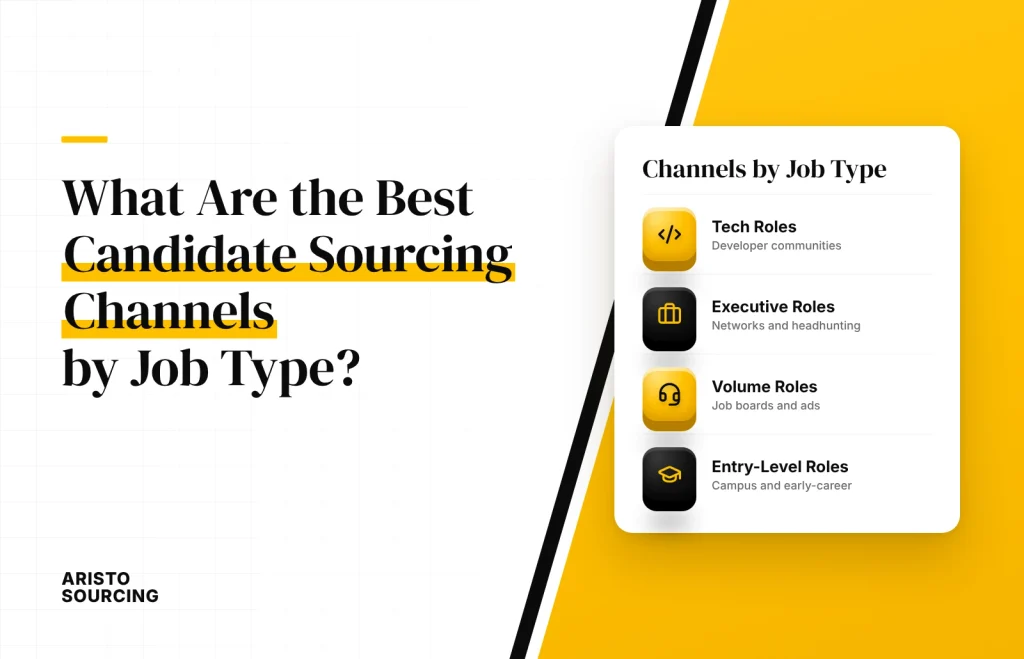
The best candidate sourcing channels vary by job type and include developer platforms for technical roles, professional associations and licensing networks for healthcare roles, portfolio sites for creative roles, academic databases for research roles, and job boards for high-volume roles.
The best candidate sourcing channels by job type are listed below.
- Technical Roles: Technical roles are best sourced through developer platforms, such as GitHub and Stack Overflow, along with Boolean searches on LinkedIn and referrals from current engineering teams. For example, a backend engineer search can start with GitHub repositories in Python or Go, while a data scientist search can include Kaggle competition profiles. Tech meetups and open-source communities also reach engineers who rarely update their LinkedIn profiles.
- Healthcare Roles: Healthcare roles are best sourced through professional associations, healthcare job boards, nursing and medical school alumni networks, and referrals, with every candidate’s license verified before submission. For example, registered nurses can be sourced through state nursing associations and nurse-focused job boards, while physicians are often reached through Doximity and specialty societies. Credential checks with state licensing boards confirm that each candidate is eligible to practice.
- Creative Roles: Creative roles are best sourced through portfolio platforms, such as Behance, Dribbble, and ArtStation, where designers, illustrators, and artists publish work that sourcers can review directly. For example, a UX designer search fits Dribbble and Behance, while a 3D game artist search fits ArtStation. Instagram and design communities, such as local AIGA chapters, also help sourcers assess style and quality before outreach.
- Research Roles: Research roles are best sourced through academic databases, such as Google Scholar, ORCID, and PubMed, along with university networks, conference speaker lists, and research-focused professional associations. For example, a clinical research scientist search can use PubMed publication records, while a machine learning researcher search can review papers presented at NeurIPS or ICML. Publication history and citations give sourcers clear evidence of a candidate’s expertise.
- High-Volume Roles: High-volume roles are best sourced through large job boards, programmatic job advertising, mobile-friendly applications, text recruiting, referral programs, and hiring events that attract many qualified applicants quickly. For example, warehouse and retail roles fit Indeed and local hiring events, while contact center roles fit text-to-apply campaigns and chatbot screening. This volume depends on the right candidate sourcing technology, which the next section covers.
What Technologies Power Candidate Sourcing in RPO?
Technologies that power candidate sourcing in RPO include applicant tracking systems, recruitment CRM platforms, AI sourcing tools, professional search platforms, outreach automation tools, talent intelligence platforms, and recruitment analytics dashboards.
The main candidate sourcing technologies in RPO are listed below.
- Applicant Tracking System (ATS): An applicant tracking system (ATS) is a sourcing technology that stores job applications, candidate records, and interview stages, which makes past applicants searchable for future roles and candidate rediscovery.
- Recruitment CRM: A recruitment CRM is a candidate relationship management platform that segments talent pools, tracks every interaction, and automates nurturing messages to potential candidates before and after roles open.
- AI Sourcing Tools: AI sourcing tools are software platforms that use machine learning to search candidate data, rank profiles against job requirements, and suggest matches, subject to data privacy laws such as GDPR.
- Professional Search Platforms: Professional search platforms, such as LinkedIn Recruiter and specialist job boards, are databases that let sourcers run Boolean searches, filter candidates by skills and location, and contact them.
- Outreach Automation Tools: Outreach automation tools are platforms that schedule personalized email sequences, send timed follow-ups, and track opens and replies, so sourcers can manage more candidate conversations without losing consistency.
- Talent Intelligence Platforms: Talent intelligence platforms are tools that combine labor-market data, competitor information, and skills trends to show where target candidates work and how scarce their skills are.
- Recruitment Analytics Dashboards: Recruitment analytics dashboards are reporting tools that collect data from the ATS and CRM to display each sourcing KPI, such as response rate, time-to-submit, and source-to-hire conversion.
What Are the Main Candidate Sourcing KPIs and Metrics in RPO?
The main candidate sourcing KPIs in RPO include response rate, qualified-candidate rate, source-to-hire conversion, cost per hire, time-to-submit, and time-to-fill.
The main candidate sourcing KPIs and metrics in RPO are listed below.
- Response Rate: Response rate is the percentage of contacted candidates who reply to outreach, and it shows how relevant the messages, channels, and timing are for the target candidate group.
- Qualified-Candidate Rate: Qualified-candidate rate is the percentage of sourced candidates who meet the role’s core requirements after qualification, and it measures how accurately sourcers target the right profiles.
- Source-to-Hire Conversion: Source-to-hire conversion is the percentage of candidates from a specific sourcing channel who are eventually hired, and it identifies which channels produce actual hires, not just volume.
- Cost Per Hire: Cost per hire is the total sourcing and recruitment spend, including tools, advertising, sourcer time, and agency fees, divided by the number of hires in a given period.
- Time-to-Submit: Time-to-submit is the number of days between a requisition opening and the first qualified candidate being submitted to the hiring manager, and it is a common RPO SLA target.
- Time-to-Fill: Time-to-fill is the number of days between a requisition opening and a candidate accepting the offer, and it reflects the combined speed of sourcing, interviewing, and hiring decisions.
Tracking these KPIs together helps RPO teams spot weak points early and avoid challenges that slow down hiring.
What Common Candidate Sourcing Challenges in RPO Should Be Avoided?
The common candidate sourcing challenges in RPO to avoid are listed below.
- Talent Shortages: Talent shortages in specialized fields reduce the number of qualified applicants, so relying only on job postings leaves hard-to-fill roles open far longer than planned.
- Poor Candidate Experience: A poor candidate experience, such as generic messages, slow replies, or no feedback after interviews, damages the employer brand and lowers future response rates.
- Low ATS Data Quality: Low ATS data quality, including duplicate records, outdated contact details, and missing skill tags, makes candidate rediscovery unreliable and wastes sourcing time.
- Weak Hiring Manager Alignment: Weak hiring manager alignment on role requirements leads to rejected submissions, repeated searches, and missed SLA targets.
- Low Sourcing Efficiency: Low sourcing efficiency usually comes from relying on a single channel or repeating manual searches that analytics and automation could improve.
- Not Partnering With an Experienced RPO Provider: Not partnering with an experienced RPO provider leaves hiring teams without specialist sourcers, established talent pools, and proven processes, which makes provider selection a critical decision.

How to Choose an RPO Provider for Candidate Sourcing?
The best ways to choose an RPO provider for candidate sourcing include checking for specialist sourcers, established talent pools, suitable sourcing technology, clear SLA commitments, transparent reporting, flexible scalability, and employer brand fit.
The key criteria for choosing an RPO provider for candidate sourcing are listed below.
- Specialist Sourcers: Specialist sourcers are dedicated sourcing professionals with experience in your industry and roles, so ask an RPO provider how its sourcers find, assess, and engage candidates like yours.
- Established Talent Pools: Established talent pools are existing networks of pre-qualified candidates that a provider has built for similar roles, which shorten time-to-submit compared with starting every search from zero.
- Sourcing Technology: Sourcing technology refers to the ATS, recruitment CRM, and AI tools a provider uses, which should integrate with your systems and meet your data privacy requirements.
- Clear SLA Commitments: Clear SLA commitments are written service-level targets, such as time-to-submit, time-to-fill, and candidate quality thresholds, that define what the provider must deliver and how performance is judged.
- Transparent Reporting: Transparent reporting is regular, shared visibility into sourcing activity and results, including pipeline status, channel performance, and KPIs, so you can see what works and what needs adjustment.
- Flexible Scalability: Flexible scalability is a provider’s ability to increase or reduce sourcing capacity as hiring volume changes, without long delays, rigid minimums, or a drop in candidate quality.
- Employer Brand Fit: Employer brand fit is a provider’s ability to represent your company’s culture and values accurately in every candidate conversation, which protects candidate experience and response rates.
How Does Aristo Sourcing Support Candidate Sourcing in RPO?
Aristo Sourcing supports candidate sourcing in RPO by finding, screening, and presenting pre-vetted remote professionals from South Africa and the Philippines, so businesses can build a proactive talent pipeline without setting up their own internal recruitment infrastructure. Founded in 2014, Aristo Sourcing follows a four-step process of consultation, candidate sourcing, client interviews, and onboarding, and every candidate completes a KSA evaluation that tests knowledge, skills, and abilities. Aristo Sourcing applies several candidate sourcing strategies from this guide in that process.
Aristo Sourcing keeps track of strong potential candidates for future roles, which follows the same logic as ATS rediscovery, while still searching the market for the best talent for each new role. For businesses that run their own hiring, Aristo Sourcing can also provide a dedicated talent acquisition virtual assistant who runs personalized outbound sequences on email and LinkedIn and keeps ATS pipeline records clean. Aristo Sourcing helps businesses assess their sourcing needs and build a candidate sourcing approach that fits their roles and hiring volume. To see how outsourcing strengthens talent acquisition more broadly, explore the benefits of RPO. For 2027 and beyond, Recruitment Process Outsourcing works best when sourcing is proactive, measured, and matched to each role. If you want a stronger talent pipeline for your next hiring cycle, book a free consultation with Aristo Sourcing to talk through your plans.