
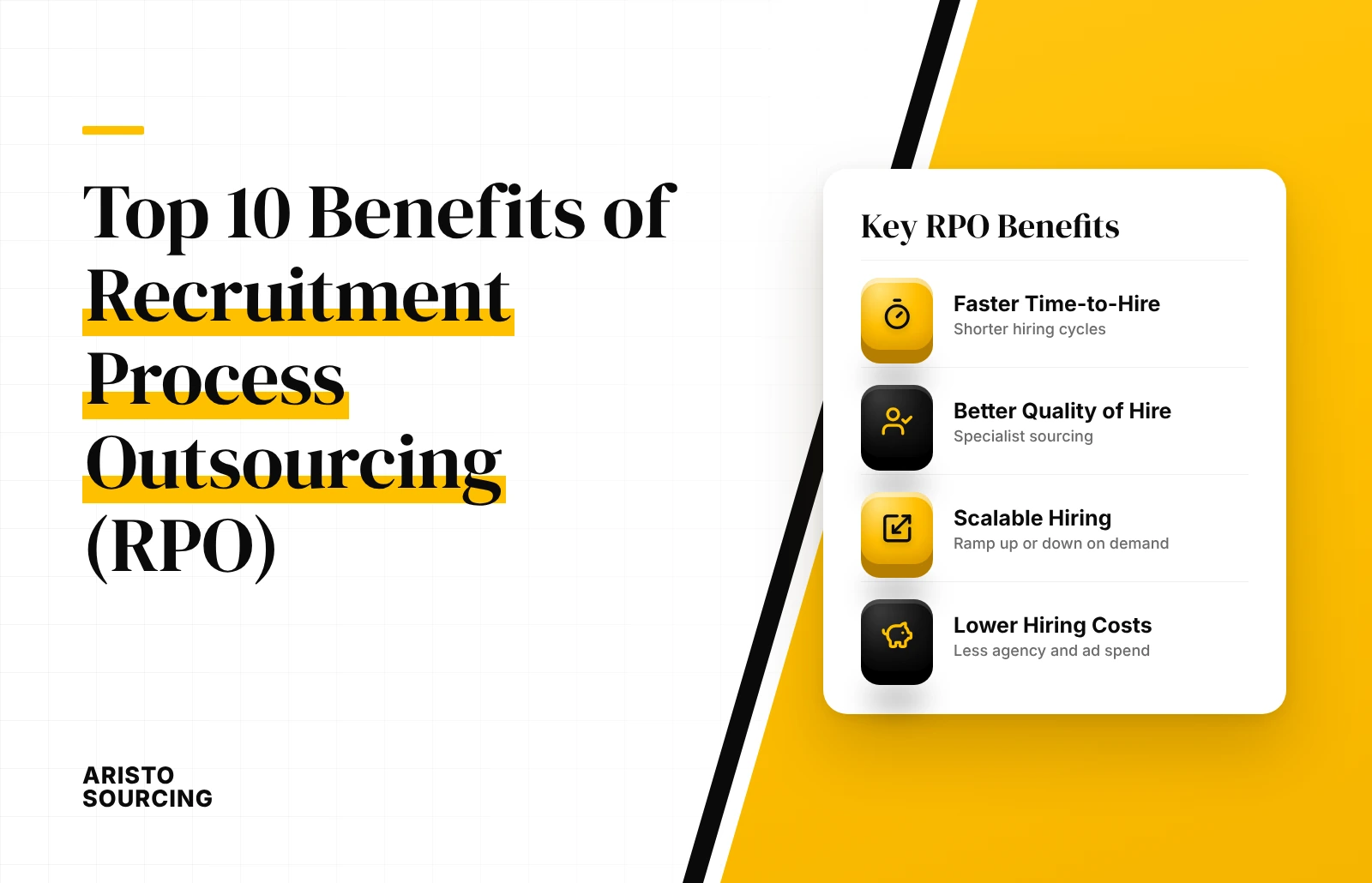
Recruitment process outsourcing basically is a hiring arrangement in which a business hands all or part of its recruitment to an external specialist, and the benefits of RPO include cost savings, faster hiring, scalability, specialist expertise, and improved candidate experience. Businesses use RPO to improve recruitment when internal teams cannot keep up with hiring demand, struggle to reach qualified candidates, or lose too much time to administrative work. An RPO partner closes these gaps with dedicated recruiters, structured processes, and recruitment technology, without the fixed cost of a larger in-house team. Understanding what RPO providers do and how they run the hiring process shows where each of these benefits comes from.
What Is Recruitment Process Outsourcing?
Recruitment process outsourcing (RPO) is a business model where a company transfers all or part of its recruitment process to an external provider that manages talent acquisition for the company. The benefits of RPO include lower recruitment costs, higher hiring efficiency, and access to recruitment expertise that many companies lack internally.
An RPO engagement typically starts with a review of the company’s hiring needs, after which the RPO provider assigns dedicated recruiters, applies its own sourcing methods and technology, and reports results against agreed targets. These benefits come from scale, because the provider shares recruiters, tools, and candidate networks across many clients, so each business gains capabilities that would cost more to build alone. An RPO provider can manage sourcing, screening, interviewing, offer management, onboarding, and reporting, either across the full hiring cycle or for selected stages.
RPO differs from a staffing agency because an agency fills specific vacancies, while an RPO provider manages the recruitment process itself. RPO also differs from in-house recruitment, where the internal team owns every step from job posting to onboarding.
What Are the Benefits of Recruitment Process Outsourcing?
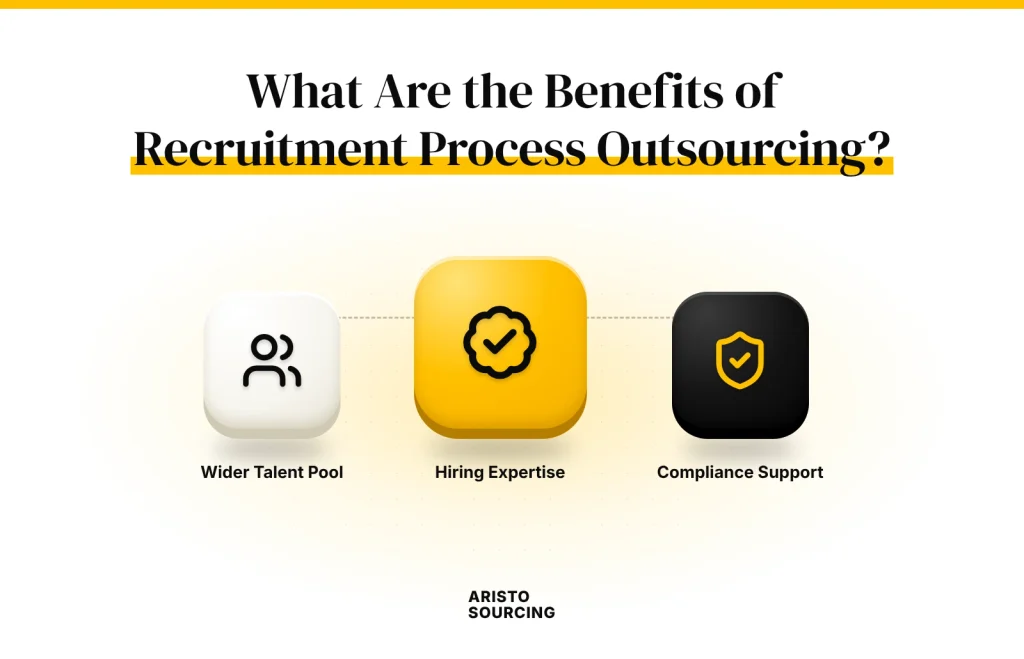
The benefits of recruitment process outsourcing include lower recruitment costs, shorter time-to-fill, higher hiring efficiency, scalable recruitment capacity, access to specialist recruiters, a wider talent pool, better quality of hire, access to recruitment technology, data-driven recruitment analytics, and a better candidate experience. The benefits of recruitment process outsourcing are explained below.
1. Reduces Recruitment Costs
2. Shortens Time-to-Fill
3. Improves Hiring Efficiency
4. Scales Recruitment Capacity
5. Gives Access to Specialist Recruiters
6. Widens the Talent Pool
7. Raises Quality of Hire
8. Unlocks Recruitment Technology
9. Delivers Data-Driven Recruitment Analytics
10. Enhances Candidate Experience
1. Reduces Recruitment Costs
Reducing recruitment costs means lowering the total amount a business spends to attract, assess, and hire each new employee, a figure measured as cost-per-hire. According to SHRM’s 2025 Recruiting Benchmarking Report, the average cost-per-hire for nonexecutive roles is $5,475, and RPO can lower this figure through efficient sourcing, recruiting resources shared across clients, and improved hiring processes. Actual savings depend on provider fees under the chosen RPO pricing model, hiring volume, and implementation costs, so a business should measure recruitment ROI against its current recruitment costs instead of expecting a fixed saving.
2. Shortens Time-to-Fill
Shortening time-to-fill means reducing the number of days a role stays open before a candidate accepts the offer. RPO providers shorten this period with a streamlined recruitment workflow and faster candidate sourcing, often drawing on existing candidate networks from the day a role opens. Time-to-fill differs from time-to-hire because time-to-fill runs from the job opening to the accepted offer, while time-to-hire runs from the candidate’s application to the accepted offer. Tracking both metrics shows whether delays come from slow sourcing before candidates apply or from slow decisions after they apply.
3. Improves Hiring Efficiency
Improving hiring efficiency means filling roles with fewer wasted steps and less effort per hire across the recruitment process. RPO providers standardize each step of the recruitment workflow, so sourcing, screening, interviews, and offers follow one consistent sequence with clear handoffs. The provider also takes on the administrative burden of scheduling, candidate follow-ups, and hiring paperwork, which frees hiring managers to focus on interviews and decisions. Fewer bottlenecks between stages mean fewer stalled candidates and fewer roles reopened after candidates withdraw.
4. Scales Recruitment Capacity
Scaling recruitment capacity means adjusting the number of recruiters and hiring resources to match current hiring demand. RPO supports seasonal hiring, business expansion, and high-volume hiring by adding recruiters when demand rises and reducing them when demand falls. This recruitment scalability lets a business handle hiring peaks and slowdowns without hiring or laying off internal recruiters. Workforce planning also becomes simpler, because recruitment capacity follows the business plan instead of a fixed recruiting headcount.
5. Gives Access to Specialist Recruiters
Getting access to specialist recruiters means working with recruiters who focus on a specific industry, function, or role type. RPO providers assign dedicated recruitment teams with this industry and role expertise, so recruiters can assess technical skills accurately and advise hiring managers on what the talent market can realistically offer. Specialist recruiters add the most value in hard-to-fill roles, such as niche technical, healthcare, or senior leadership positions, where general recruiters often struggle to find qualified candidates. Deeper role knowledge also improves quality of hire, because specialist recruiters screen out unsuitable candidates earlier.
6. Widens the Talent Pool
Widening the talent pool means increasing the number of qualified candidates a business can reach for each role. RPO providers reach beyond active applicants to passive candidates, who are currently employed and not applying for jobs but remain open to the right opportunity. Providers also maintain a talent pipeline of pre-qualified candidates and use wider sourcing channels, such as professional networks, referral programs, and international markets, to reach candidates who do not apply directly. A larger talent pool gives hiring managers more qualified options for each vacancy.
7. Raises Quality of Hire
Raising quality of hire means bringing in new employees who perform well, stay with the business, and fit the team. Quality of hire is the value a new employee adds to the business, and companies typically measure it through job performance, retention, and hiring manager feedback. RPO providers raise quality of hire through structured candidate screening, standardized candidate assessment, and cultural fit evaluation, which produce better matches between candidates and roles. According to SHRM’s 2025 Recruiting Benchmarking Report, only 20% of organizations track quality of hire, so an RPO provider that reports on this metric gives a business visibility that most employers lack.
8. Unlocks Recruitment Technology
Unlocking recruitment technology means gaining access to modern hiring software through an RPO provider instead of building a hiring system internally. RPO providers use an Applicant Tracking System (ATS) to manage applications, sourcing tools to find candidates, and recruitment automation to handle repetitive tasks such as interview scheduling and screening questions. This recruitment technology supports better hiring decisions by keeping candidate data, interviewer feedback, and hiring progress in one place. Businesses avoid the cost of buying, integrating, and maintaining their own recruitment tech stack because the provider already licenses and manages the tools.
9. Delivers Data-Driven Recruitment Analytics
Delivering data-driven recruitment analytics means collecting and interpreting hiring data to show how well the recruitment process performs. RPO providers supply regular recruitment reporting on recruitment KPIs such as time-to-fill, cost-per-hire, and source effectiveness, which shows the sourcing channels that produce the strongest candidates. These recruitment analytics support data-driven hiring decisions, such as moving budget to high-performing channels or fixing the stages where candidates drop out. Regular reviews of the same KPIs support ongoing process improvement across every hiring cycle.
10. Enhances Candidate Experience
Enhancing candidate experience means improving how candidates perceive every interaction with a business, from first contact to the final offer. RPO providers improve the candidate journey through timely candidate communication, organized interviews, and consistent status updates at each stage. A positive candidate experience strengthens the employer brand and can reduce offer declines, because candidates who feel respected during the process are more likely to accept.
These benefits hold only when a business plans the partnership carefully, so understanding the disadvantages of RPO helps a business avoid the most common pitfalls.
Are There Any Disadvantages of Recruitment Process Outsourcing?
Yes, there are some disadvantages of recruitment process outsourcing, including transition costs, provider dependency, reduced control, communication gaps, and data security risks. RPO implementation can involve setup fees, system integration, and a learning period, and a business can become reliant on one external provider for critical hiring.
Handing recruitment to a third party can also reduce direct control over hiring decisions, create communication gaps with hiring managers, and raise data security concerns about how candidate information is stored and shared. Clear contracts, defined responsibilities, and a Service Level Agreement (SLA) that sets measurable service levels reduce these risks. In-house recruitment may be a better fit for businesses with very low hiring volume or a strong internal recruiting team, while other businesses can compare RPO pricing models to find the most cost-effective option.
What Are the Main Pricing Models of RPO?
The main RPO pricing models include the management fee model, the cost-per-hire model, the hybrid model, the cost-per-slate model, and the cost-per-transaction model.
The common RPO pricing models are listed below.
- Management Fee Model: The management fee model refers to an RPO pricing structure in which a business pays the provider a fixed recurring fee, usually monthly, to manage an agreed recruitment scope. The fee stays the same regardless of the number of hires, so this model suits businesses with steady, ongoing hiring needs.
- Cost-per-Hire Model: The cost-per-hire model refers to an RPO pricing structure in which a business pays the provider a set fee for each candidate who accepts an offer and starts work. Because fees apply only to completed hires, this model suits businesses with variable hiring volume that want costs to follow actual results.
- Hybrid Model: The hybrid model refers to an RPO pricing structure that combines a recurring management fee with a per-hire fee, linking part of the provider’s earnings to completed hires. This structure shares risk between both sides, because the business pays a smaller fixed fee and the provider earns more only when it delivers hires.
- Cost-per-Slate Model: The cost-per-slate model refers to an RPO pricing structure in which a business pays the provider for each slate, or batch, of qualified, pre-screened candidates delivered for a role. Fees are tied to delivering candidates rather than completed hires, so the business keeps control of interviews and final hiring decisions.
- Cost-per-Transaction Model: The cost-per-transaction model refers to an RPO pricing structure in which a business pays a separate fee for each recruitment activity, such as a candidate screen, assessment, or scheduled interview. This model is common in modular or project-based RPO, where the provider handles only selected recruitment steps.
Whichever model a business chooses, measuring ROI shows whether the fees deliver enough value.
What Are the Key Ways to Measure the ROI of Recruitment Process Outsourcing?
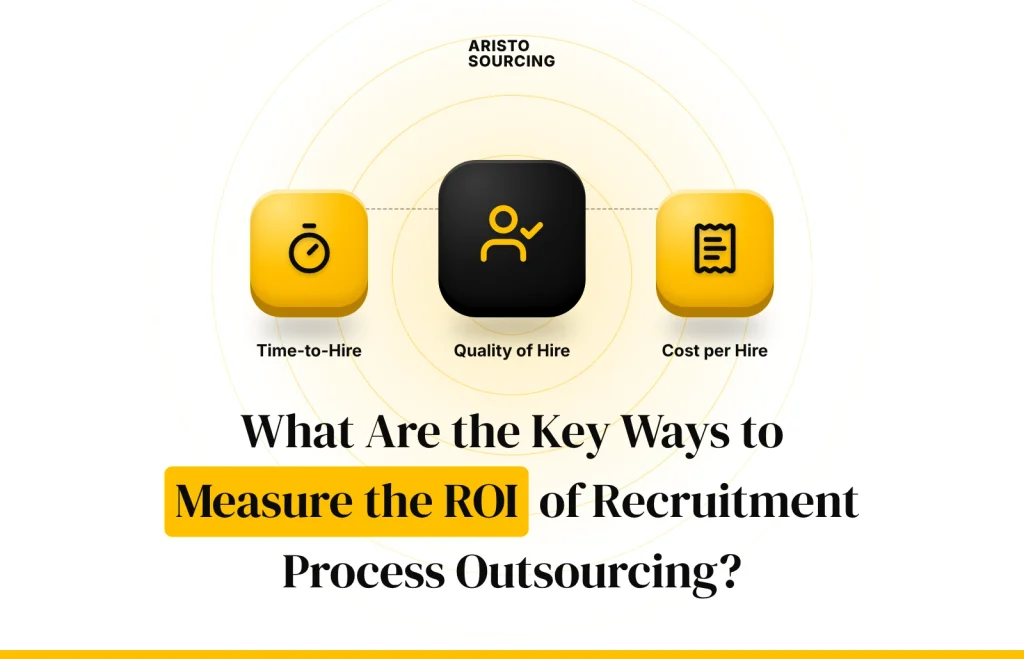
The key ways to measure the ROI of recruitment process outsourcing include comparing recruitment KPIs before and after RPO, calculating the full cost of the service, and tracking hiring quality over time. A business should record baseline performance before RPO implementation, then compare the same metrics, such as cost-per-hire, time-to-fill, and total recruitment spend, once the provider starts. Provider fees and implementation costs belong in the calculation, because savings that ignore them overstate recruitment ROI.
Quality-related outcomes, such as quality of hire, retention, and hiring manager satisfaction, show whether faster and cheaper hiring also produces stronger employees. A recruitment partner can help set a clear baseline and report on recruitment KPIs consistently, which gives any business that plans to consider RPO a reliable way to judge results.

When Should a Business Consider RPO?
A business should consider RPO when hiring demand outgrows its internal team, when recruitment challenges persist, or when it needs expertise it does not have in-house. Rapid growth, high-volume recruitment, and ongoing talent shortages usually suit end-to-end RPO, where the provider manages the full hiring cycle.
Businesses that lack recruitment capacity for specific stages or need specialist expertise for certain roles often choose partial RPO, while a one-time hiring push, such as staffing a new location, suits project-based RPO. Aristo Sourcing works with growing businesses facing these hiring situations, and the next step for each of them is choosing an RPO provider that matches its hiring needs.
How to Choose the Right RPO Provider in 2027
To choose the right RPO provider in 2027, assess the provider’s industry expertise, service scope, technology, and reporting before comparing costs. Industry expertise shows whether the provider understands the roles and talent market, while the service scope confirms which recruitment stages the provider will manage.
Technology and reporting matter because the provider should run a modern ATS and share clear updates on recruitment KPIs such as time-to-fill and quality of hire. A business should also check pricing, performance targets, data protection standards, and contract terms, and confirm that the SLA defines response times, hiring targets, and exit conditions. Finally, an implementation plan should set the onboarding timeline, assign responsibilities on both sides, and agree on how success will be measured.
How Do RPO Providers Like Aristo Sourcing Help a Business?
RPO providers like Aristo Sourcing help businesses manage recruitment more efficiently by supporting hiring processes from the first candidate search to the final hiring decision. The main recruitment support covers candidate sourcing, screening, interview coordination, and recruitment process management, so internal teams spend less time on routine hiring tasks.
This support delivers the core benefits of RPO for a business, including a reduced hiring workload, access to qualified candidates, and support for scaling recruitment as the company grows. Aristo Sourcing supports businesses through recruitment process outsourcing (RPO) and remote staffing solutions, helping companies build teams without expanding their internal recruitment function. For businesses comparing RPO pricing and choosing the right provider in 2027, Aristo Sourcing offers a practical place to start.