

Most leaders ask the wrong question.
They ask if a virtual assistant can replace an employee. The smarter question asks which parts of the role need judgment, and which parts need a system.
When you split work that way, you stop guessing and start scaling.
Key Takeaways
- A VA replaces tasks, not a whole human role, unless the job runs on repeatable workflows.
- The hidden cost of an employee sits in benefits, taxes, management time, and office friction, not only salary.
- A VA wins when the work stays process-driven, measured by outputs, and supported by SOPs.
- An employee wins when the work demands high context, real-time decisions, or deep internal trust.
- The best model for todays needs looks hybrid: a small core team plus specialized VAs and automation.
- Start with a 2–4 week pilot and a scorecard. Expand only after quality stays stable.
- Treat data access like a security project, not a trust exercise.

Why this matters now
Many teams face the same squeeze: more work, tighter budgets, and fewer hires approved. You can respond in two ways. You can stretch your existing team until quality drops, or you can redesign how work moves through your business.
Contract work and freelancing now sit in the mainstream, which gives you more options than “hire full-time or suffer.” In 2023, 64 million Americans did freelance work, which represented 38% of the U.S. workforce.
At the same time, employment costs rarely stop at salary. U.S. Bureau of Labor Statistics (BLS) data shows benefits can represent a large share of total employer compensation costs.
That combination pushes a new operational question: what must live inside your company, and what can live inside a documented system?
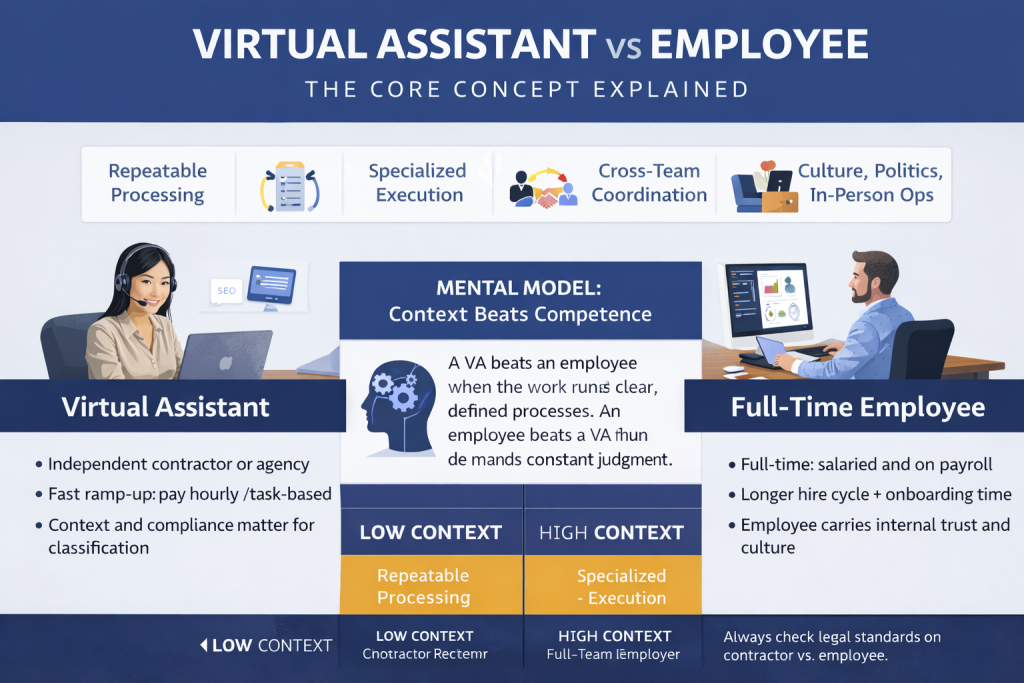
The core concept explained
What “virtual assistant vs employee” really compares
A virtual assistant usually works as a contractor or through an agency. You pay for hours, tasks, or a monthly retainer. You manage outcomes through checklists, SOPs, and QA.
A traditional employee sits inside your company structure. You pay salary, taxes, benefits, and you often invest more in onboarding, culture, and long-term growth.
That difference matters for compliance. The IRS points you to a practical test: you look at behavioral control, financial control, and the relationship of the parties.
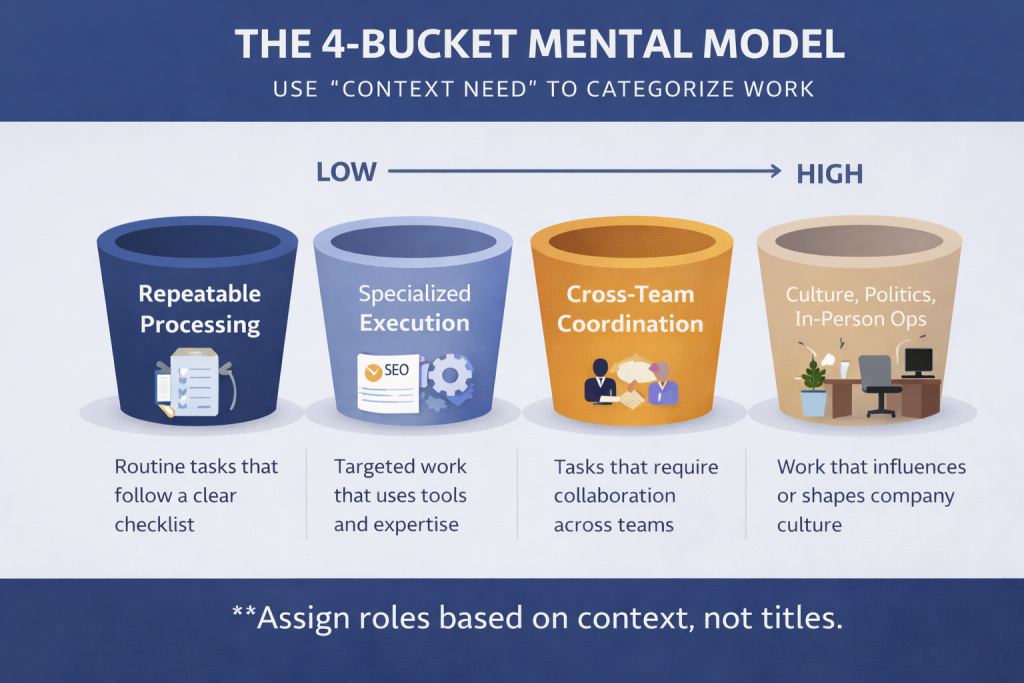
The mental model that makes the decision easy
Use this rule before you compare “virtual assistant cost vs employee.”
Context beats competence.
A VA can handle complex work when you define the inputs, tools, standards, and finish line. An employee beats a VA when the job requires constant judgment that lives in someone’s head.
Think in four buckets:
| Work Type | Context Needed | Best Fit |
|---|---|---|
| Repeatable processing | Low | VA or automation |
| Specialized execution | Medium | Specialized VA or contractor |
| Cross-team coordination | High | Employee or hybrid |
| Culture, politics, in-person ops | Very high | Employee |
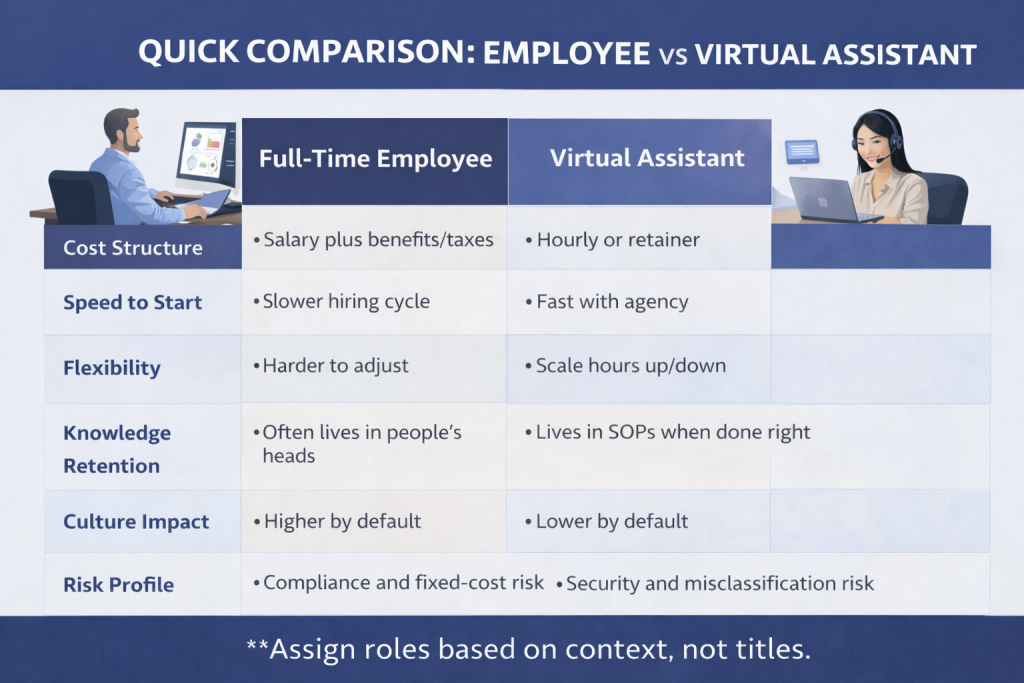
Quick comparison: employee vs virtual assistant
| Feature | Virtual Assistant | Full-time Employee |
|---|---|---|
| Cost structure | Hourly or retainer | Salary plus benefits/taxes (Bureau of Labor Statistics) |
| Speed to start | Fast with agency | Slower hiring cycle |
| Flexibility | Scale hours up/down | Harder to adjust |
| Knowledge retention | Lives in SOPs when done right | Often lives in people’s heads |
| Culture impact | Lower by default | Higher by default |
| Risk profile | Security and misclassification risk | Compliance and fixed-cost risk |
Step-by-step framework
1) Break the role into outcomes, not tasks
What to do: Write the role’s top 10 outcomes in plain language. Example: “Invoices go out every Friday with zero missing data.”
Why it matters: Outcomes let you compare models fairly. A VA can hit outcomes when you define the finish line.
Quick example: Instead of “manage email,” define “inbox under 20 messages by 4 pm, with client replies under 2 hours.”
2) Score each outcome for context and consequence
What to do: Score each outcome 1–5 on two axes: context needed and consequence if it fails.
Why it matters: High consequence plus high context signals a poor “replace the employee” candidate.
Quick example: “Posting social content” often scores low consequence. “Handling chargebacks” scores high consequence.
3) Decide the “ownership level” before you hire
What to do: Assign each outcome an owner: Founder, Manager, Employee, VA, or Automation. Use a simple RACI chart.
Why it matters: Ambiguity creates rework, which kills the time and cost savings.
Quick example: Let the VA run the checklist, but keep final approval for payments with the manager.
4) Build SOPs the way your future self wants them
What to do: Create SOPs that include trigger, tools, steps, quality checks, and escalation rules. Record Loom videos for anything visual.
Why it matters: SOPs convert “institutional memory” into a business asset.
Quick example: “When a lead requests a callback, create a HubSpot task, send the template email, and tag the pipeline stage.”
5) Set a tech stack that supports async work
What to do: Pick one chat tool (Slack or Teams), one project tool (Asana, Monday, or ClickUp), and one source of truth (Notion or Google Drive).
Why it matters: VAs win through clarity and cadence, not hallway conversations.
Quick example: Every task gets a due date, a definition of done, and a QA step.
6) Run a 2–4 week pilot with a scorecard
What to do: Track speed, accuracy, rework rate, and escalation frequency.
Why it matters: You need proof, not vibes.
Quick example: Aim for “under 5% rework” on recurring tasks by week three.
7) Lock down access like an operations leader
What to do: Use least-privilege access, password managers, role-based permissions, and audit logs.
Why it matters: The biggest VA failure mode comes from sloppy access, not talent.
Quick example: Give a VA access to the CRM stage view, not billing admin rights.
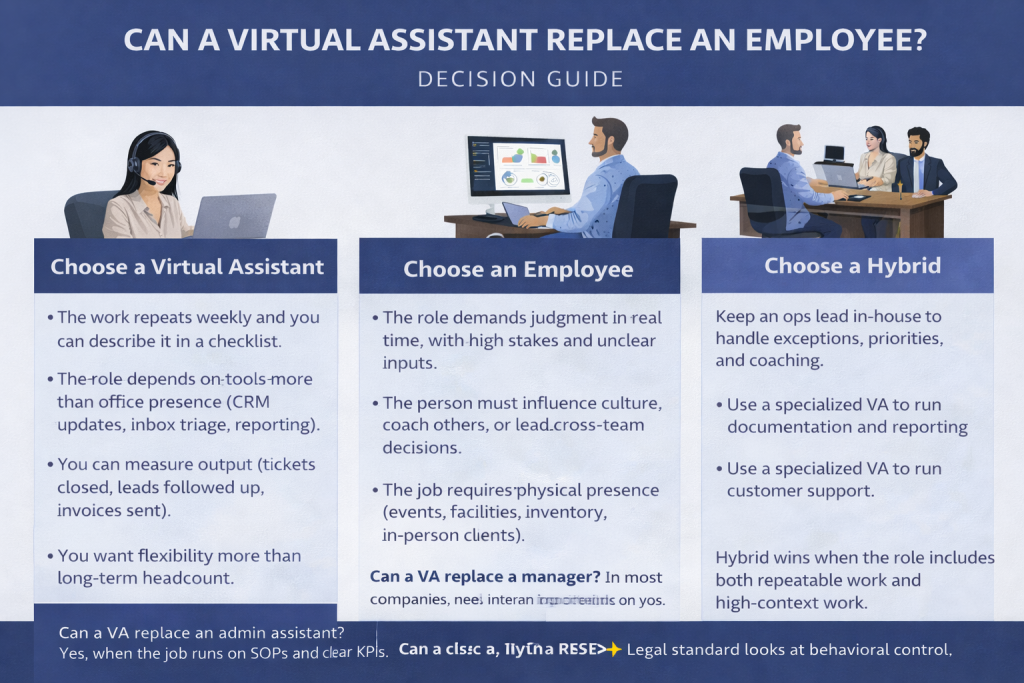
Can a virtual assistant replace an employee? Decision guide
Choose a VA when these conditions show up
- The work repeats weekly and you can describe it in a checklist.
- The role depends on tools more than office presence (CRM updates, inbox triage, reporting).
- You can measure output (tickets closed, leads followed up, invoices sent).
- You want flexibility more than long-term headcount.
This answers common “People Also Ask” intent like: Can a VA replace a full-time admin assistant? Yes, when the job runs on SOPs and clear KPIs.
Choose an employee when these conditions show up
- The role demands judgment in real time, with high stakes and unclear inputs.
- The person must influence culture, coach others, or lead cross-team decisions.
- The job requires physical presence (events, facilities, inventory, in-person clients).
- You need someone who grows into leadership inside your company.
That covers another common question: Can a virtual assistant replace a manager? In most companies, no. A VA can support management workflows, but leadership needs internal authority and context.
Choose a hybrid when the job mixes both
Hybrid wins when the role includes both repeatable work and high-context work.
Example: keep an operations lead in-house, then give them two specialized VAs. One VA runs documentation and reporting. Another VA runs customer support workflows. The lead handles exceptions, priorities, and coaching.
The “are virtual assistants employees” question, answered plainly
In many setups, companies treat VAs as contractors. That choice brings responsibilities. The IRS emphasizes control and independence factors, not your label.
If you want low risk, work with a staffing partner that structures the relationship correctly and supports documentation, onboarding, and performance management.
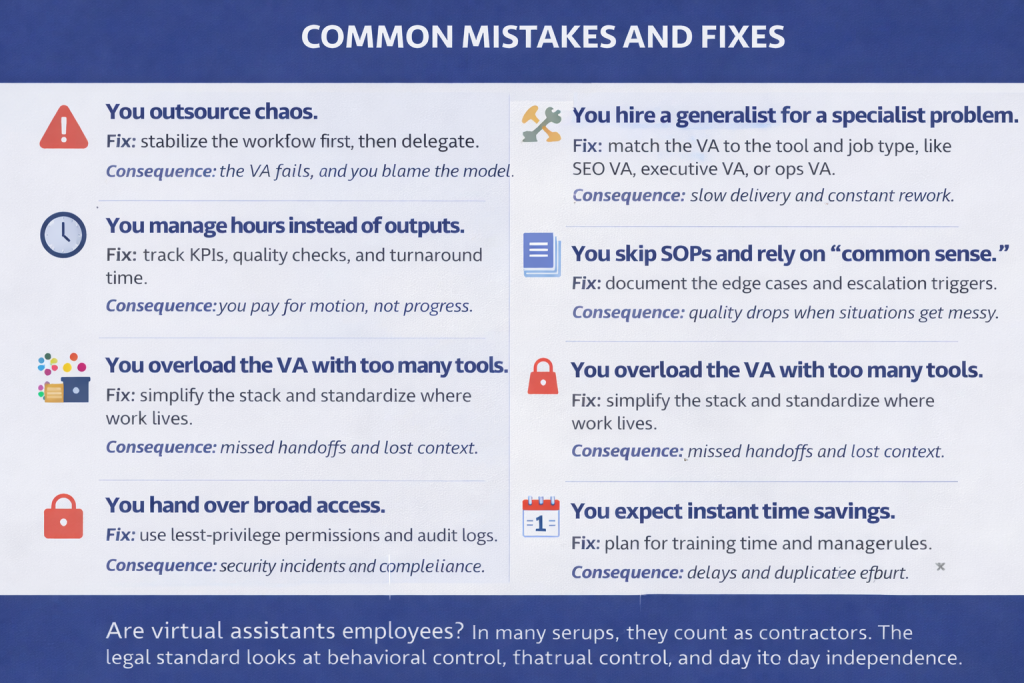
Common mistakes and fixes
- You outsource chaos.
Fix: stabilize the workflow first, then delegate.
Consequence: the VA fails, and you blame the model. - You hire a generalist for a specialist problem.
Fix: match the VA to the tool and job type, like SEO VA, executive VA, or ops VA.
Consequence: slow delivery and constant rework. - You manage hours instead of outputs.
Fix: track KPIs, quality checks, and turnaround time.
Consequence: you pay for motion, not progress. - You skip SOPs and rely on “common sense.”
Fix: document the edge cases and escalation triggers.
Consequence: quality drops when situations get messy. - You overload the VA with too many tools.
Fix: simplify the stack and standardize where work lives.
Consequence: missed handoffs and lost context. - You hand over broad access.
Fix: use least-privilege permissions and audit logs.
Consequence: security incidents and compliance exposure. - You expect instant time savings.
Fix: plan for training time and management drag in week one.
Consequence: frustration and premature churn. - You ignore time zone design.
Fix: define overlap hours and async rules.
Consequence: delays and duplicated effort.
Examples and mini case studies
Case 1: The solopreneur who replaced a part-time admin
A consultant spent 10–12 hours a week scheduling, chasing invoices, and cleaning a CRM. They hired a VA for 15 hours a week. They built SOPs for calendar rules, invoicing cadence, and CRM hygiene. They kept payment approvals and client messaging oversight.
Result: the VA replaced most admin time, but not the “client judgment” work. The owner reclaimed focus time without taking on a full-time salary.
Case 2: The marketing team that chose “employee virtual assistant” support
A department head faced a hiring freeze. They brought in a digital marketing VA to manage reporting, blog formatting, internal links, and content uploads in WordPress. The strategist kept campaign decisions, messaging, and creative direction.
Result: the VA removed bottlenecks and protected specialist time. The team hit deadlines without adding headcount.
Case 3: The ops team that tried to replace culture work
A small company tried to replace an office manager with a VA. The role involved onboarding new hires, resolving conflict, and handling physical vendors. The team struggled because the job required in-person context and culture leadership.
Result: they kept an internal culture owner and used a VA for scheduling, documentation, and vendor billing. Quality recovered fast.

Can a virtual assistant replace an employee completely?
A virtual assistant can replace an employee when the role runs on repeatable workflows, has clear performance indicators, and does not require in‑person presence.
What tasks work best for a virtual assistant?
Tasks that work best for a virtual assistant include inbox triage, calendar management, CRM updates, reporting, invoicing support, customer support workflows, research, and documentation.
When should I avoid replacing an employee with a VA?
You should avoid replacing an employee with a VA when the job demands leadership authority, sensitive judgment calls, physical presence, or deep cross‑team influence.
How does virtual assistant cost vs employee compare in real life?
Employee costs include wages plus benefits and employer taxes, and benefits can represent a significant share of total compensation, making employees more expensive than virtual assistants.
Do VAs improve productivity or slow teams down?
Virtual assistants improve productivity when you design asynchronous workflows and measure output; without structured processes, VAs can cause delays and rework.
What does remote work productivity data show?
Remote work productivity data shows that productivity depends on how remote work is structured, and hybrid setups can perform well when intentionally designed.
What legal risks come with contractors?
The main legal risk with contractors is worker misclassification, which triggers tax and compliance penalties; classification depends on behavioral control, financial control, and relationship factors.
What tools help a VA replace employee work reliably?
Tools that help a VA replace employee work reliably include Slack or Teams for communication, Asana or Monday for task flow, Google Workspace for documents, Loom for SOP videos, and a password manager for secure access.
Can a VA replace an executive assistant?
A virtual assistant can replace an executive assistant for calendar management, travel booking, research, and inbox triage, but an in‑house EA is better when work requires office politics, live events, or high‑trust internal coordination.
Next step
If you want a clear answer for your business, run a role audit and map tasks into low-context and high-context work. Then hire for the system, not the myth.
Aristo Sourcing helps teams build VA setups that hold quality, protect security, and scale without hiring regret. Book a free consultation today.
