
Marketing strategy outsourcing is hiring an external partner to plan a company’s marketing direction, budget, and performance targets. Strategy covers the planning layer of marketing, such as research, positioning, and budget allocation, while execution covers the campaigns, content, and ads that carry the plan out. Businesses outsource marketing strategy through 4 models: a fractional CMO, a marketing agency, an outsourced marketing department, or a hybrid model. The process follows 5 steps: define goals, decide which functions to outsource, choose a model, vet partners, and set reporting.
External partners already hold a large share of marketing spend. According to the Gartner 2025 CMO Spend Survey of 402 marketing leaders, agencies received 20.7% of marketing budgets in 2025, while total marketing budgets held at 7.7% of company revenue.
What Is Marketing Strategy Outsourcing?
Marketing strategy outsourcing is the delegation of strategic marketing decisions, including research, positioning, channel planning, budget allocation, and KPI design, to an external specialist or firm. Strategic marketing outsourcing hands over the plan, the budget, and the KPIs, while tactical outsourcing hands over a single channel or task, such as running ads or writing blog posts.
Marketing strategy outsourcing differs from general outsourced marketing in scope. General outsourced marketing often covers execution only, while marketing strategy outsourcing covers the decisions that tell every execution team what to do.
Which Marketing Strategy Functions Can You Outsource?
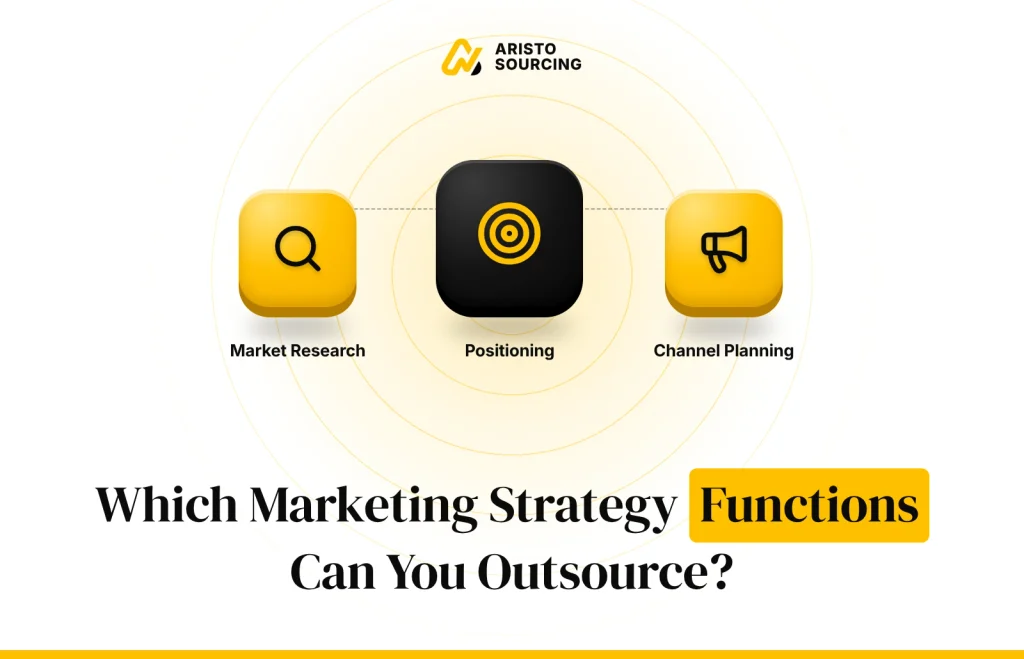
Businesses can outsource 5 marketing strategy functions: research, positioning, go-to-market planning, budget allocation, and measurement design. These functions shape marketing decisions rather than produce marketing output.
The 5 marketing strategy functions businesses can outsource are listed below.
- Market and Competitor Research: An external partner studies the target market, buyer needs, and competitor positioning.
- Positioning and Messaging: An external partner defines how the brand differs from competitors and which messages each audience receives.
- Go-to-Market and Channel Planning: An external partner selects the launch approach and the channels that reach the target audience.
- Budget Allocation: An external partner distributes the marketing budget across channels based on expected return.
- KPI and Measurement Framework: An external partner sets the metrics, targets, and reporting structure that measure marketing performance.
4 Models for Outsourcing Marketing Strategy
The 4 models for outsourcing marketing strategy are a fractional CMO, a marketing agency, an outsourced marketing department, and a hybrid model. Each model differs in how much strategy and execution the external partner owns. In the fractional CMO and hybrid models, execution can stay with an in-house team or move to a marketing virtual assistant.
The 4 models for outsourcing marketing strategy are listed below.
- Fractional CMO
- Marketing Agency
- Outsourced Marketing Department
- Hybrid Model: Outsourced Strategy, In-House Execution
1. Fractional CMO
A fractional CMO is a part-time senior marketing leader who sets marketing strategy for a company without joining as a full-time executive. A fractional CMO fits companies that need senior strategic direction but cannot justify a full-time CMO salary. The main limitation of a fractional CMO is that execution must come from an in-house team or other vendors.
2. Marketing Agency
A marketing agency is an external firm that plans and runs campaigns across one or more marketing channels. A marketing agency fits companies that already have internal strategic direction and need campaign capacity. The main limitation of a marketing agency is that agency work is usually campaign-led and channel-specific, so company-wide strategy still needs an internal owner.
3. Outsourced Marketing Department
An outsourced marketing department is an external team that owns marketing strategy, execution, budget governance, and reporting for a company. An outsourced marketing department fits small and mid-sized companies without an internal marketing team. The main limitation of an outsourced marketing department is a higher monthly commitment and less direct day-to-day control.
4. Hybrid Model: Outsourced Strategy, In-House Execution
A hybrid model is an arrangement where an external partner sets marketing strategy and an in-house team or virtual assistant executes it. A hybrid model fits small businesses that want expert strategy while keeping execution costs low. The main limitation of a hybrid model is that the in-house team must have the skills and time to execute the strategy consistently.
How to Outsource Marketing Strategy in 5 Steps
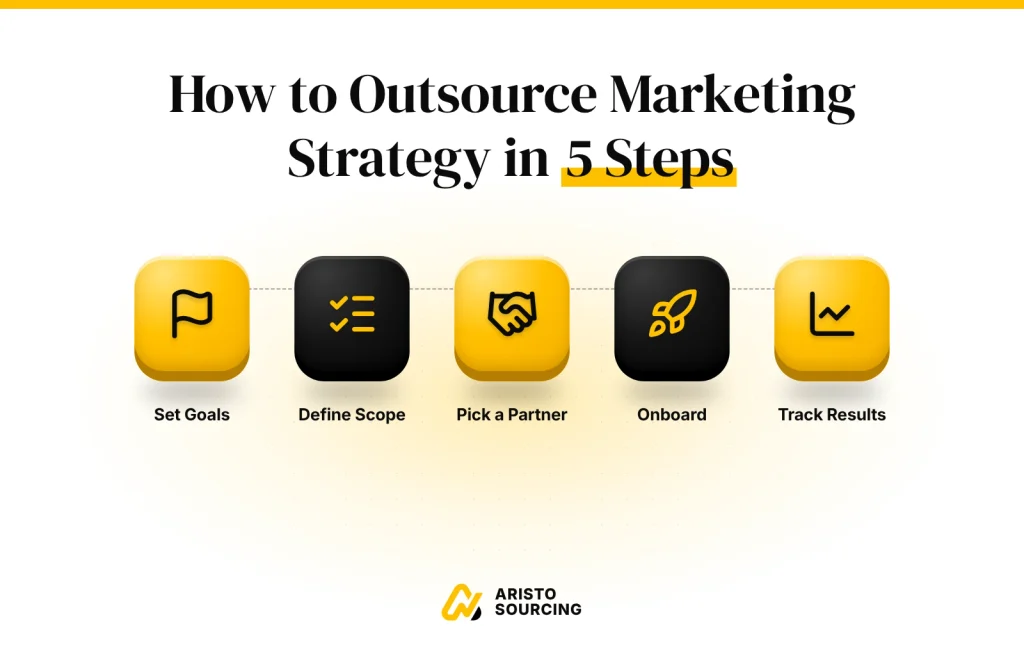
To outsource marketing strategy, businesses define goals, decide which functions to outsource, choose a model, vet partners, and set a reporting structure. Each step produces a decision that feeds the next step.
The 5 steps to outsource marketing strategy are listed below.
- Define Business Goals and KPIs
- Decide Which Strategy Functions to Outsource
- Choose the Right Outsourcing Model
- Vet Partners on Strategy, Creative, and Management
- Set Reporting Cadence and an Internal Owner
1. Define Business Goals and KPIs
Defining business goals and KPIs is the step where businesses set the revenue and growth targets the marketing strategy must deliver. The output of this step is a short list of measurable KPIs. Key actions include setting revenue targets, tying each KPI to a business outcome, and excluding activity-volume metrics such as post counts.
2. Decide Which Strategy Functions to Outsource
Deciding which strategy functions to outsource is the step where businesses split marketing strategy work between internal staff and an external partner. The output of this step is a defined outsourcing scope. Key actions include listing current strategy functions, keeping functions tied to proprietary knowledge in-house, and outsourcing functions the team lacks expertise in.
3. Choose the Right Outsourcing Model
Choosing the right outsourcing model is the step where businesses select a fractional CMO, an agency, an outsourced department, or a hybrid model. The output of this step is one chosen model. Key actions include matching the model to the marketing budget, matching the model to team size, and confirming who owns execution.
4. Vet Partners on Strategy, Creative and Management
Vetting partners on strategy, creative and management is the step where businesses evaluate shortlisted providers against evidence. The output of this step is a selected marketing partner. Key actions include reviewing past strategy work, assessing creative quality, and checking the provider’s project management process.
5. Set Reporting Cadence and an Internal Owner
Setting a reporting cadence and an internal owner is the step where businesses fix how and when the partner reports results. The output of this step is a monthly reporting schedule with a named internal contact. Key actions include agreeing on a monthly report format, naming one internal owner, and scheduling quarterly strategy reviews.
What Are the Benefits and Risks of Outsourcing Marketing Strategy?
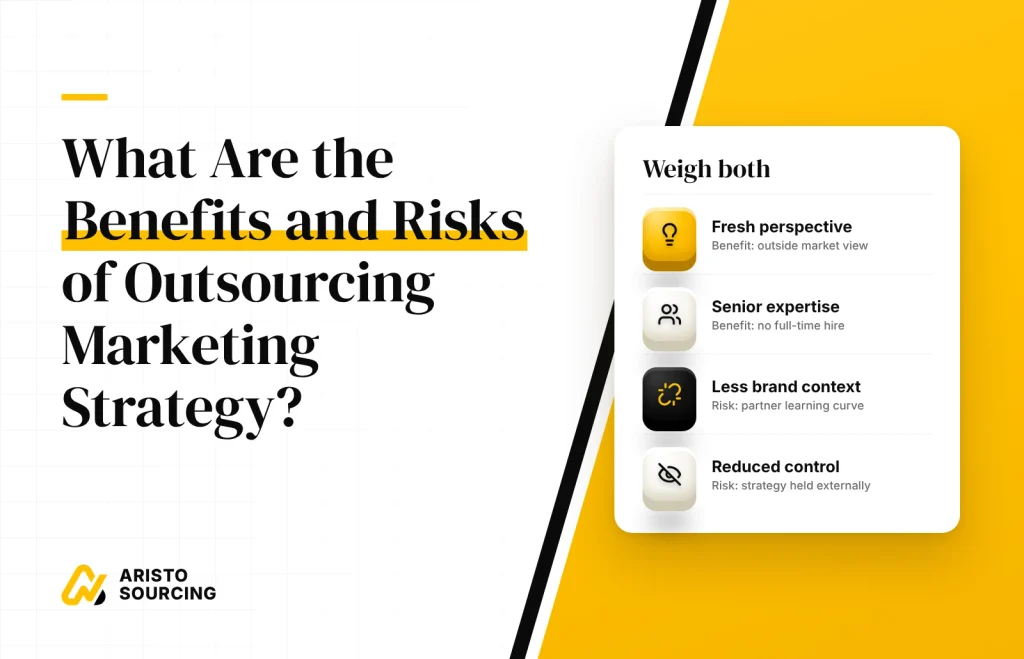
The benefits of outsourcing marketing strategy are specialist expertise, cost efficiency, core focus, and fresh perspective, while the risks are brand dilution, communication gaps, weak accountability, and knowledge loss. Most of these risks can be prevented with clear guidelines and reporting.
The benefits of outsourcing marketing strategy are listed below.
- Provides Specialist Expertise: Outsourcing marketing strategy gives access to senior strategists across research, positioning, and analytics.
- Lowers Cost: Outsourcing marketing strategy costs less than a full-time senior marketing hire with salary, benefits, and payroll taxes.
- Protects Core Focus: Outsourcing marketing strategy lets internal teams concentrate on product, sales, and operations.
- Adds Fresh Perspective: Outsourcing marketing strategy brings an outside view of the market and competitors.
The risks of outsourcing marketing strategy are listed below.
- Brand Dilution: Marketing strategy outsourcing produces generic messaging when no brand guidelines exist, so businesses should hand over documented guidelines before work starts.
- Communication Gaps: Marketing strategy outsourcing slows alignment when the partner works apart from internal teams, so businesses should set a fixed meeting schedule.
- Weak Accountability: Marketing strategy outsourcing loses accountability when results are measured by activity volume, so businesses should tie every KPI to a business outcome.
- Knowledge Loss: Marketing strategy outsourcing leaves strategic knowledge with the partner, so businesses should require documented strategy and data handover.
Businesses that weigh the wider benefits of outsourcing digital marketing usually start with strategy, because strategy decides where execution spend goes.
How Much Does It Cost to Outsource Marketing Strategy?
Outsourcing marketing strategy costs between $3,000 and $25,000 a month for most small and mid-sized businesses, depending on the model, scope, and number of functions outsourced. The main cost drivers are scope, the number of strategy functions outsourced, and the model chosen.
The cost of outsourcing marketing strategy by model is presented in the table below.
| Model | Typical Monthly Cost | Source | Explanation |
| Fractional CMO | $3,000 – $25,000 | MarketerHire | Rises with CMO seniority and hours per week |
| Marketing agency (small business) | $5,000 – $8,000 median | Searchlab, citing Clutch data | Rises with the number of channels managed |
| Outsourced marketing department | Mid-four figures and up | Outsource Marketing | Rises with scope and execution volume |
| Hybrid model | Strategy fee plus in-house or VA execution cost | – | Lowest when execution runs through an in-house team or VA |
MarketerHire places junior fractional CMOs at $3,000 to $6,000 a month, mid-level fractional CMOs at $6,000 to $12,000 a month, and senior fractional CMOs at $12,000 to $25,000 a month. Small businesses comparing these figures with what it costs to outsource marketing overall should add execution costs on top of the strategy fee. Marketing strategy outsourcing gives businesses a way to outsource strategic marketing at a fraction of the cost of a full-time marketing executive.

Is Outsourcing Marketing Strategy Worth It?
Yes, outsourcing marketing strategy is worth it when a business lacks internal strategic marketing expertise and has measurable growth goals. Outsourcing marketing strategy is less useful when a business already has a senior marketer or no clear goals to measure against. The questions below cover AI, the 3-3-3 rule, and the main marketing strategies.
How Is AI Changing Marketing Strategy Outsourcing?
AI is changing marketing strategy outsourcing by speeding up research and content production, while strategy and judgment stay human-led. Gartner reports that 40% of CMOs rank using AI to automate key tasks among their top five productivity actions. As AI handles more execution, outsourced partners focus more on strategy, and the impact of AI on outsourcing still requires human oversight of AI output.
What Is the 3-3-3 Rule for Marketing?
The 3-3-3 rule for marketing is a focus framework that limits a marketing strategy to 3 target audiences, 3 core messages, and 3 marketing channels. The 3-3-3 rule has no single standard definition, and some versions replace audiences with content types.
What Are the 5 Main Marketing Strategies?
The 5 main marketing strategies are content marketing, SEO, social media marketing, email marketing, and paid advertising. The 5 main marketing strategies are listed below.
- Content Marketing: Content marketing attracts buyers with useful articles, videos, and guides.
- SEO: SEO raises a website’s visibility in organic search results.
- Social Media Marketing: Social media marketing builds audience and engagement on social platforms.
- Email Marketing: Email marketing nurtures leads and customers through direct messages.
- Paid Advertising: Paid advertising buys reach through search, social, and display ads.