
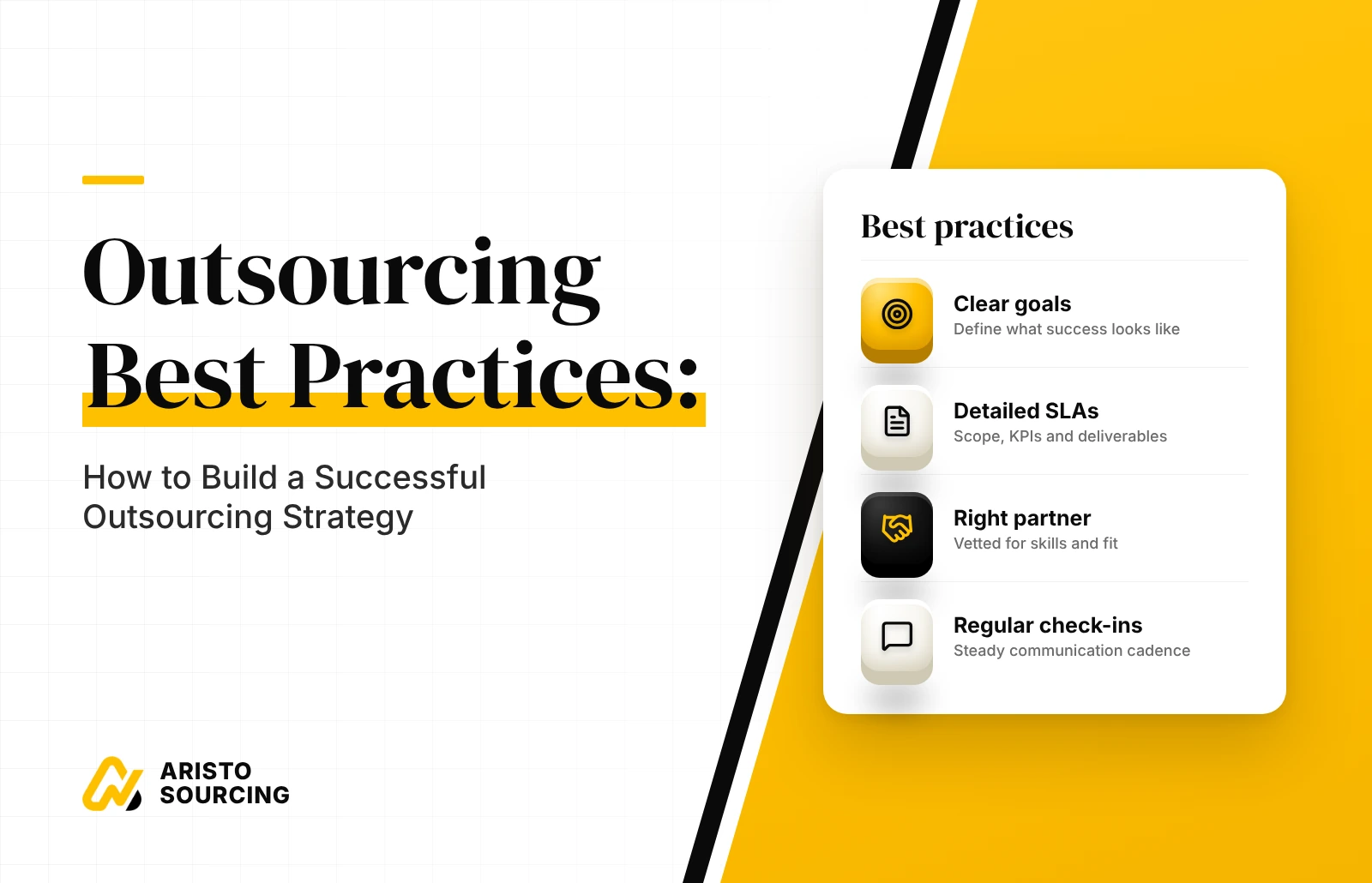
Outsourcing best practices are proven rules that help businesses delegate work to external providers with predictable cost, quality, and control. An outsourcing strategy is the planned approach a business uses to decide which functions to delegate, which provider to hire, and how to govern the relationship. The core outsourcing best practices are clear goals, the right partner, strong contracts, and KPI governance.
This guide covers the 8 outsourcing best practices for success, the definition of an outsourcing strategy, and the 5 steps to build an outsourcing strategy: assess readiness, decide what to outsource, choose the outsourcing model, set a budget and pricing model, and onboard the team. According to Deloitte’s Global Outsourcing Survey 2024 of more than 500 executives, 80% of organizations plan to maintain or increase investment in third-party outsourcing.
8 Outsourcing Best Practices for Success
The 8 outsourcing best practices are defining measurable goals, keeping core functions in-house, choosing partners on evidence, protecting IP, setting SLAs, piloting first, tracking KPIs, and planning an exit. These practices form the basis of outsourcing governance, which is the system of rules, reviews, and metrics that keeps an outsourcing engagement aligned with business goals. Businesses that apply all 8 practices select a vetted remote staffing partner on evidence and manage that partner against measurable targets.
The 8 outsourcing best practices are listed below.
- Define Measurable Goals Before Scope
- Keep Core Functions In-House
- Choose a Partner on Evidence, Not Price
- Protect IP and Data in the Contract
- Set Clear Communication and SLAs
- Start With a Pilot, Then Scale
- Track KPIs and Review Quarterly
- Plan an Exit Strategy
1. Define Measurable Goals Before Scope
Defining measurable goals before scope means setting the KPIs and milestones that define success before writing the scope of work. Vague goals produce vague deliverables and disputed invoices. To apply this practice, businesses should set numeric targets, attach each target to a milestone, and share both with every shortlisted provider.
2. Keep Core Functions In-House
Keeping core functions in-house means retaining the activities that differentiate the business and outsourcing the supporting work around them. Outsourcing a core differentiator transfers competitive knowledge to a third party. To apply this practice, businesses should list their differentiators, keep customer relationships and proprietary processes internal, and outsource repetitive support tasks.
3. Choose a Partner on Evidence, Not Price
Choosing a partner on evidence means selecting a provider based on verified track record rather than the lowest quote. A low hourly rate loses its value when rework, missed deadlines, and replacement hiring follow. To apply this practice, businesses should check client references, confirm security certifications, and review the provider’s financial stability.
4. Protect IP and Data in the Contract
Protecting IP and data in the contract means signing ownership and confidentiality terms before any work or data changes hands. Terms added after work starts leave intellectual property and customer data exposed. To apply this practice, businesses should sign an NDA, an IP ownership clause, a data processing agreement (DPA), and agreed jurisdiction terms before onboarding.
5. Set Clear Communication and SLAs
Setting clear communication and SLAs means agreeing on response times, quality targets, and a fixed meeting cadence at the start of the engagement. Service level agreements (SLAs) turn expectations into measurable obligations. To apply this practice, businesses should use one shared project management tool, schedule daily, weekly, and monthly check-ins, and name an escalation contact on each side.
6. Start With a Pilot, Then Scale
Starting with a pilot means testing the provider on one contained process for one quarter before expanding the scope. A pilot limits financial risk and produces real performance data. To apply this practice, businesses should pick one measurable process, evaluate the pilot against the original goals, and expand only when the provider meets those goals.
7. Track KPIs and Review Quarterly
Tracking KPIs and reviewing quarterly means measuring provider performance continuously and auditing the full relationship every three months. Engagements without regular review drift until renewal, when problems are expensive to fix. To apply this practice, businesses should track KPI trends, monitor scope creep, and check whether process knowledge stays inside the business.
8. Plan an Exit Strategy
Planning an exit strategy means agreeing on the termination and handover terms before the engagement begins. An exit plan prevents service gaps and knowledge loss when a contract ends or a provider underperforms. To apply this practice, businesses should define termination notice periods, require documented knowledge transfer, and specify the handover of all assets and data.
What Is an Outsourcing Strategy?
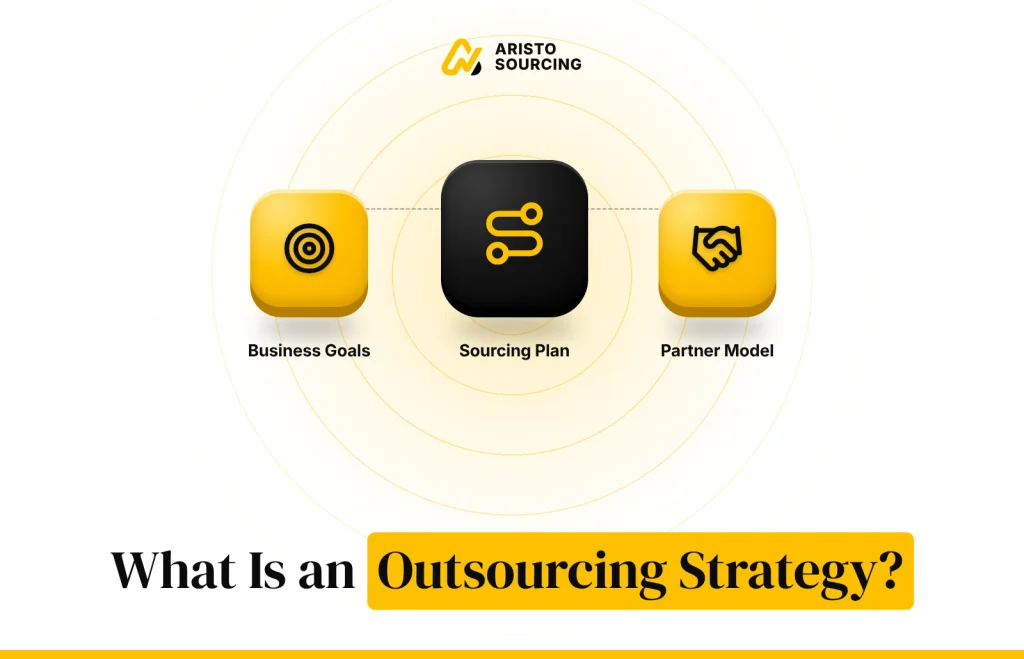
An outsourcing strategy is a structured plan that defines which business functions a company delegates to external providers, under which model, and with which performance controls. An outsourcing strategy is the planning layer of business outsourcing, which turns individual vendor decisions into one consistent approach.
Strategic outsourcing delegates functions to build long-term capability and focus, while tactical outsourcing delegates tasks to solve short-term cost or capacity gaps. Outsourcing strategies combine a location model, such as onshore, nearshore, or offshore, with a function model, such as IT outsourcing (ITO), business process outsourcing (BPO), or knowledge process outsourcing (KPO).
How to Build an Outsourcing Strategy in 5 Steps
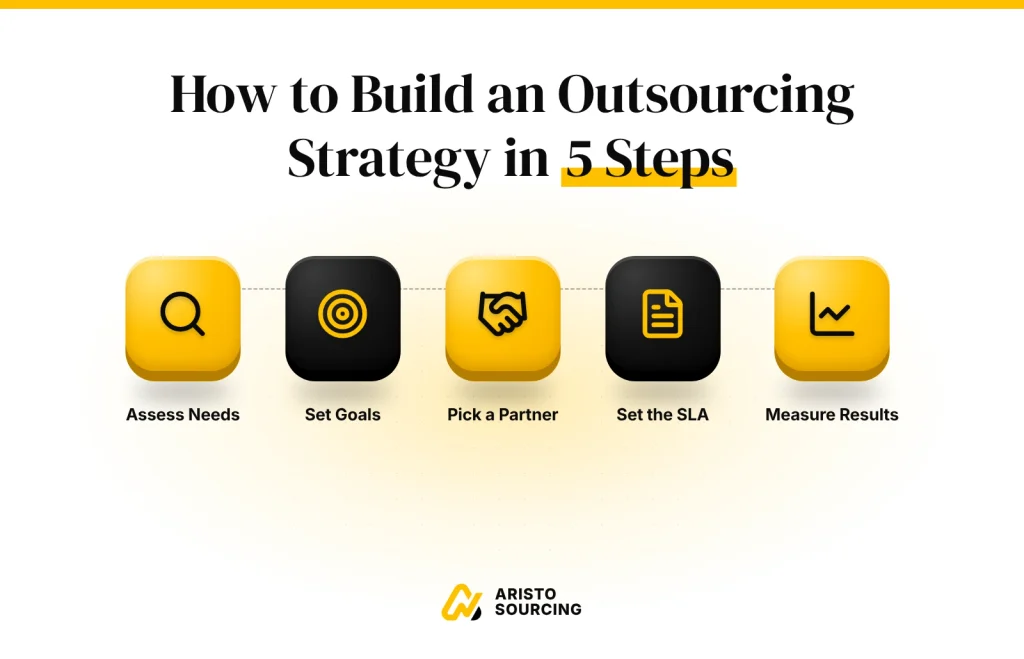
To build an outsourcing strategy, businesses assess readiness, decide what to outsource, choose a model, set a budget and pricing model, and onboard the team. Each step produces a decision that feeds the next step.
The 5 steps to build an outsourcing strategy are listed below.
- Assess Outsourcing Readiness
- Decide What to Outsource
- Choose the Right Outsourcing Model
- Set a Budget and Pricing Model
- Onboard and Integrate the Team
1. Assess Outsourcing Readiness
Assessing outsourcing readiness is the step where businesses confirm they can hand work to an external team. The output of this step is a go or no-go decision for outsourcing. Key actions include documenting current processes, naming an internal process owner, and confirming available budget.
2. Decide What to Outsource
Deciding what to outsource is the step where businesses select the functions an external provider will handle. The output of this step is a shortlist of outsourcing candidates. Key actions include selecting non-core tasks, prioritizing repetitive work, and choosing processes with measurable outputs.
3. Choose the Right Outsourcing Model
Choosing the right outsourcing model is the step where businesses decide where the work happens and how the provider engages. The output of this step is a defined location and engagement model. Key actions include comparing onshore, nearshore, and offshore options, then choosing between staff augmentation, a dedicated team, or project-based outsourcing.
4. Set a Budget and Pricing Model
Setting a budget and pricing model is the step where businesses fix the spend limit and billing structure for the engagement. The output of this step is an approved budget tied to one pricing model. Key actions include estimating required hours, comparing fixed-price, time and material, and milestone pricing, and adding setup and management costs.
5. Onboard and Integrate the Team
Onboarding and integrating the team is the step where businesses give the external team the knowledge and access needed to deliver. The output of this step is a team working inside existing tools and processes. Key actions include sharing process documents, granting tool access, and naming contacts for daily questions.
Applying the 8 outsourcing best practices to each of these 5 steps is how businesses build a successful outsourcing strategy that holds cost, quality, and control over time.
Is Outsourcing Still a Good Strategy?
Yes, outsourcing is still a good strategy, because the main drivers have shifted from cost reduction to capability and speed. Deloitte’s Global Outsourcing Survey 2024 reports that 50% of organizations have used outsourced services for front-office capabilities such as sales, marketing, and R&D, beyond traditional back-office work. The questions below cover the future of outsourcing, failure causes, and the trade-offs of strategic outsourcing.
Is Outsourcing a Dying Concept?
No, outsourcing is not a dying concept; the outsourcing model is evolving through AI and outcome-based delivery. Deloitte finds that 83% of executives already use AI within outsourced services, and providers increasingly price engagements on outcomes rather than hours. Statista projects worldwide IT outsourcing revenue at $618.36 billion in 2026, growing to $821.55 billion by 2031. These shifts show how AI is reshaping the future of outsourcing rather than replacing it.
Why Do Outsourcing Strategies Fail?
Outsourcing strategies fail because of undefined success criteria, unbounded scope, poor communication, and no regular performance review. Each cause maps directly to a missed best practice, such as skipping measurable goals or quarterly reviews. These failure causes overlap with the common outsourcing challenges that buyers report after the contract starts.
What Are the Advantages and Disadvantages of Strategic Outsourcing?
The advantages of strategic outsourcing are cost efficiency, specialist access, and core focus, while the disadvantages are less control, data risk, and hidden costs. The advantages and disadvantages of strategic outsourcing are listed below.
- Improves Cost Efficiency: Strategic outsourcing lowers labor and overhead costs compared with in-house hiring.
- Provides Specialist Access: Strategic outsourcing gives businesses skills that are expensive or slow to hire internally.
- Protects Core Focus: Strategic outsourcing frees internal teams to concentrate on revenue-generating work.
- Reduces Direct Control: Strategic outsourcing moves day-to-day execution outside the business’s direct supervision.
- Increases Data Risk: Strategic outsourcing exposes customer and company data to a third party.
- Adds Hidden Costs: Strategic outsourcing adds setup, management, and transition costs beyond the provider fee.