
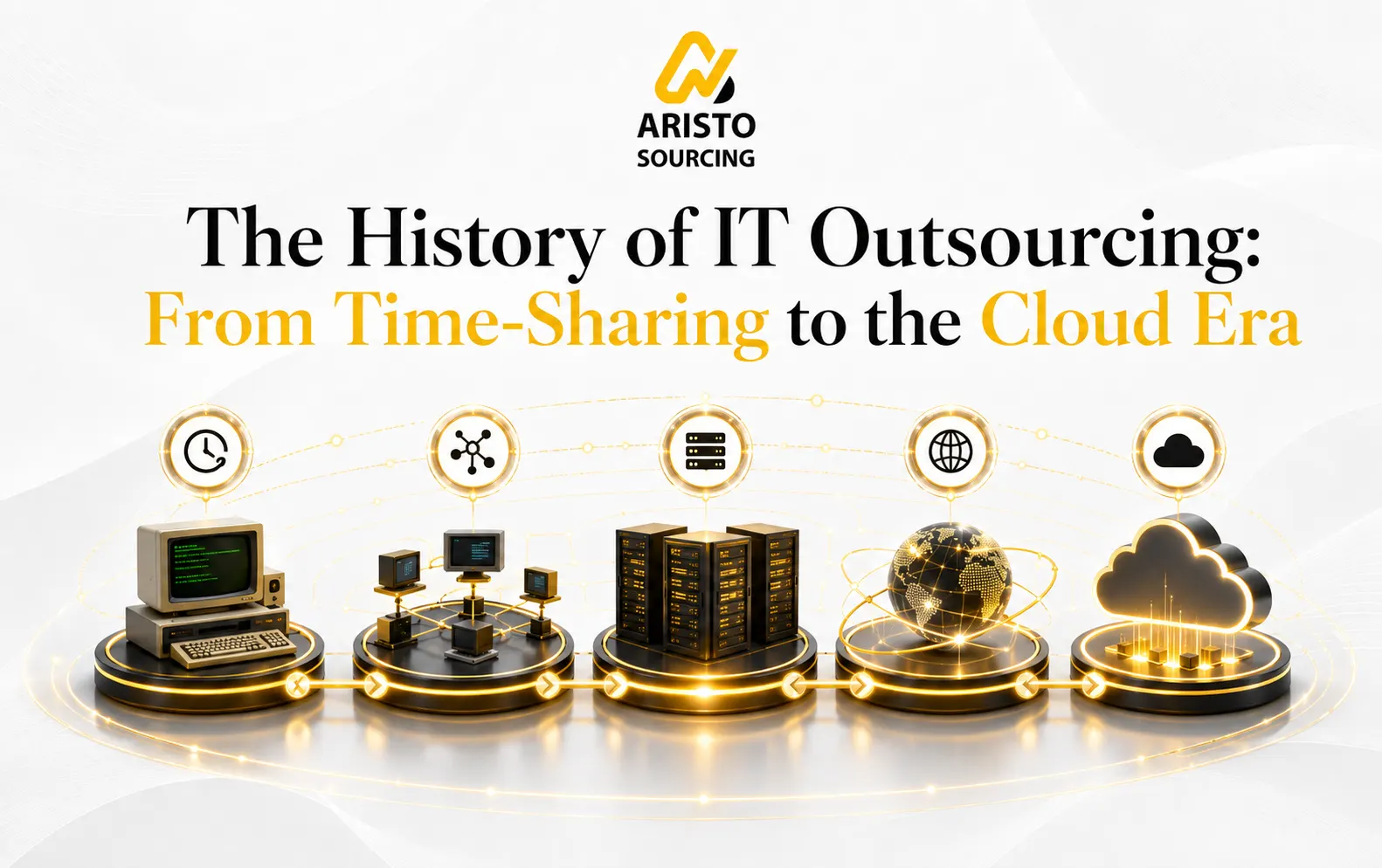
IT outsourcing is basically the practice of contracting external service providers to manage information technology functions that would otherwise be performed internally. The history of IT outsourcing traces a 60-year arc from shared mainframe computing in the 1960s to AI-driven, cloud-native service delivery today.
Companies began using IT outsourcing to reduce capital expenditure, access scarce technical expertise, and focus internal resources on core business competencies. Today, artificial intelligence, cloud, robotic process automation, and cybersecurity are reshaping the market, shifting outsourcing from cost arbitrage to strategic capability augmentation.
What Is IT Outsourcing?
IT outsourcing refers to the delegation of technology-related business processes, infrastructure management, or software development to third-party vendors operating under formal contractual agreements. The model functions through 3 primary mechanisms: onshore outsourcing (domestic providers), nearshore outsourcing (proximate geographic regions), and offshore outsourcing (distant labor markets). Each mechanism delivers distinct trade-offs across cost, communication latency, and regulatory alignment.
IT outsourcing provides 4 measurable benefits for enterprise clients. First, it reduces costs by converting fixed IT capital expenses into variable operating costs, which can improve financial flexibility. Second, it provides access to specialized expertise by supplying technical skills and knowledge that may not be available within internal teams. Third, it supports scalability by allowing organizations to expand or reduce IT capacity quickly without a proportional increase in staffing levels. Finally, it enables management to focus on core competencies by directing more time and resources toward activities that drive business growth and revenue generation.
The concept first entered business discourse in the early 1960s, coinciding with the commercialization of mainframe computing and the emergence of service bureaus that sold excess processing capacity to external clients.
The Pre-History: Time-Sharing and Service Bureaus (1960s–1970s)
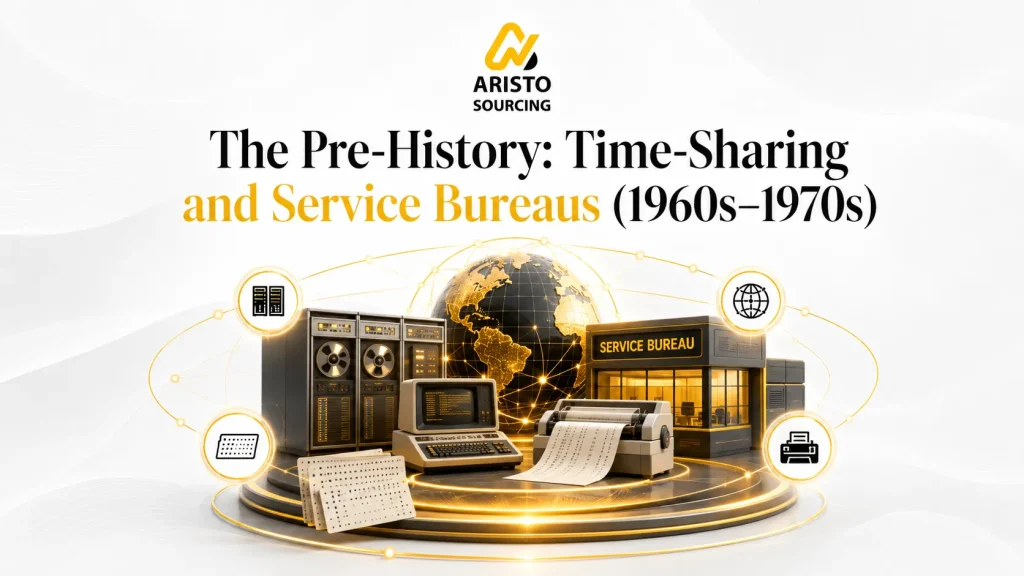
Time-sharing was a computing architecture that enabled multiple concurrent users to access a single mainframe system through partitioned processing cycles. Early mainframes, such as the IBM System/360 series introduced in 1964, cost between $133,000 and $5.5 million per unit, making outright ownership economically prohibitive for most organizations. This capital intensity forced shared computing models where enterprises purchased processing time rather than hardware.
Service bureaus emerged as commercial intermediaries that owned mainframe infrastructure and resold computational capacity to client organizations. By 1966, an estimated 800 service bureaus operated in the United States, generating $650 million in annual revenue and sustaining 40% yearly growth rates according to ADAPSO (the Association of Data Processing Service Organizations). These bureaus processed payroll, inventory records, and insurance claims through batch processing workflows, establishing the commercial precedent for externalized IT service delivery.
Electronic Data Systems (EDS) was founded by Henry Ross Perot on June 27, 1962, in Dallas, Texas, with an initial investment of $1,000 borrowed from his wife Margot’s teaching savings. Perot, a former IBM salesman, recognized that IBM’s customers possessed expensive hardware but lacked operational expertise to maximize utilization. EDS pioneered “facilities management,” a model where the company assumed complete operational responsibility for client data centers. EDS secured its first long-term commercial contract with Frito-Lay in 1963, followed by Medicare and Medicaid claims processing contracts that delivered 25% of company revenue by 1968. Perot’s innovation was decoupling IT service delivery from hardware manufacturing, a structural separation that defined the modern outsourcing industry.
The Turning Point: The 1989 Eastman Kodak–IBM Deal
The 1989 Eastman Kodak–IBM outsourcing agreement marked the inflection point where IT outsourcing transitioned from operational tactic to strategic corporate policy. Kodak transferred hundreds of internal IT staffers to IBM’s Integrated Systems Solution Corporation (ISSC), a subsidiary created specifically to deliver outsourced technology services. IBM assumed responsibility for designing, building, and managing Kodak’s data center infrastructure.
This arrangement became known as the “Kodak Effect,” a phenomenon documented by MIT researchers Lawrence Loh and N. Venkatraman in their 1992 Information Systems Research paper. The Kodak Effect describes imitative behavior among Fortune 500 corporations: when a prestigious firm like Eastman Kodak legitimized large-scale IT outsourcing, competitors rapidly followed suit to avoid perceived strategic disadvantage. Post-1989 outsourcing adoption was driven more by internal industry influence than by external market pressure, demonstrating that outsourcing decisions are socially constructed within executive peer networks.
The Kodak deal also involved Digital Equipment Corporation (DEC) and Businessland as secondary service providers, distributing infrastructure management across multiple vendors rather than consolidating under a single supplier. This multi-sourcing architecture reduced dependency risk and established negotiation leverage through competitive tension.
IBM’s dominance in outsourced IT services persisted throughout the 1990s, with ISSC evolving into a cornerstone of the company’s services division.
The 1990s: Cost-Cutting, Official Strategy, and the Y2K Boom
The 1990s institutionalized IT outsourcing as a formal cost-reduction strategy. McKinsey & Company, Bain & Company, and other management consultancies embedded outsourcing recommendations into operational excellence frameworks, treating externalized IT as a lever for balance-sheet optimization rather than a technical necessity.
The Y2K (Year 2000) crisis generated unprecedented demand for legacy code remediation. American corporations faced a December 31, 1999 deadline to repair date-formatting logic in COBOL and Fortran systems, programming languages in which domestic talent pools had atrophied. India possessed abundant English-speaking programmers proficient in these obsolete languages, creating a geographic arbitrage opportunity.
The Y2K remediation wave drove offshoring to India at scale. General Electric established its first India-based international call center in 1997 through GE Capital International Services (GECIS). By 2000–2003, the number of Fortune 500 companies offshoring work to India grew from 125 to 282. Indian firms including Wipro, Infosys, and HCL Technologies began as Y2K subcontractors and subsequently expanded into end-to-end software development, infrastructure management, and business process outsourcing, establishing the foundation for India’s $200 billion IT services industry.
The 2000s: Broadband, Global Delivery, and the Rise of BPO
Broadband internet infrastructure enabled real-time offshore service delivery in the 2000s. High-speed, low-latency connectivity eliminated the communication barriers that previously constrained remote IT operations, allowing offshore teams to participate in agile development cycles, manage network operations centers, and deliver customer support with near-domestic responsiveness.
India and the Philippines emerged as the dominant global outsourcing hubs. India’s competitive advantage lay in deep technical education infrastructure and software engineering expertise. The Philippines leveraged cultural compatibility with Western markets, American-influenced English proficiency, and government policies including Republic Act No. 7916 (1995), the Special Economic Zone Act that created tax incentives for foreign BPO investment. According to data from the IT and Business Process Association of the Philippines (IBPAP), the Philippine BPO sector achieved a 20% compound annual growth rate between 2000 and 2010 as it expanded from voice-based call centers into finance, accounting, IT services, and analytics.
Business process outsourcing (BPO) broadened the outsourcing definition beyond technology, encompassing human resources, finance and accounting, customer relationship management, and knowledge process outsourcing. This era established the Global Delivery Model: work distributed across onshore, nearshore, and offshore locations based on task complexity, regulatory sensitivity, and cost optimization requirements.
The 2010s to Today: Cloud, SaaS, and the MSP Model
Cloud computing and Software-as-a-Service (SaaS) reshaped IT outsourcing delivery architecture in the 2010s. Infrastructure-as-a-Service (IaaS) platforms, launched commercially by Amazon Web Services in 2006 and followed by Microsoft Azure (2010) and Google Cloud Platform (2012), commoditized server provisioning, storage, and networking. Clients no longer required outsourced staff to manage physical hardware. Instead, they purchased elastic computational capacity through API-driven interfaces.
SaaS applications, including Salesforce (CRM), Workday (HRM), and ServiceNow (ITSM), transferred software maintenance responsibility from client IT departments to vendor operations teams. This shift reduced the scope of traditional IT outsourcing contracts while increasing demand for integration services, data migration expertise, and cloud security governance.
The ASP-to-MSP shift defines this transition. Application Service Providers (ASPs), prevalent in the late 1990s, hosted single-tenant applications on behalf of clients but retained infrastructure management burdens. Managed Service Providers (MSPs) evolved this model by assuming comprehensive responsibility for client IT ecosystems: monitoring, patching, backup, cybersecurity, and strategic roadmap planning. Modern MSPs operate on subscription-based pricing with service-level agreements (SLAs) guaranteeing uptime percentages, response times, and security compliance, transforming IT outsourcing from project-based procurement to continuous operational partnership.
IT Outsourcing Timeline at a Glance (1960s–Present)
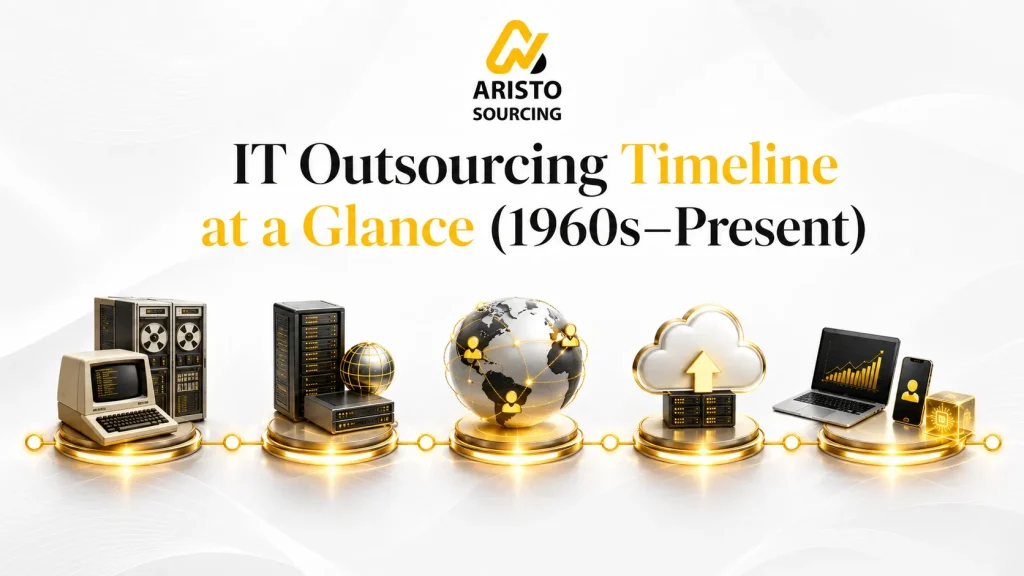
The IT outsourcing timeline at a glance covers the progression from time-sharing arrangements on leased mainframes to the AI-augmented, cloud-native delivery models that companies use today.
The IT outsourcing timeline is presented in the table below.
| Era | Time Period | Dominant Model | Key Entities | Technological Enabler | Geographic Focus |
| Time-Sharing & Service Bureaus | 1960s–1970s | Facilities management, batch processing | EDS (Ross Perot, 1962), IBM Service Bureau Corporation, ADP | Mainframe computing (IBM System/360, 1964) | United States |
| The Kodak Effect | 1989 | Strategic outsourcing, multi-sourcing | Eastman Kodak, IBM ISSC, DEC, Businessland | Client-server architecture | United States |
| Cost Strategy & Y2K | 1990s | Offshore outsourcing, body shopping | Wipro, Infosys, HCL Technologies, GECIS | Internet protocol networks, COBOL remediation | India |
| Broadband & BPO | 2000s | Global Delivery Model, business process outsourcing | Accenture, Convergys, SYKES, Telstra Enterprise Services | Broadband internet, VoIP | India, Philippines |
| Cloud & SaaS | 2010s | Managed services, subscription IT | AWS, Microsoft Azure, Salesforce, ServiceNow | Virtualization, API ecosystems, mobile computing | Global distributed |
| AI-Driven & Cloud-Native | 2020s–Present | Intelligent automation, autonomous operations | OpenAI, UiPath, CrowdStrike, SentinelOne | Machine learning, RPA, zero-trust security | Global distributed |
Companies use outsourcing across all 6 phases to convert fixed technology costs into variable operational expenditures, access specialized capabilities unavailable internally, and maintain strategic flexibility in rapidly evolving technology markets.
Why Did Companies Start Outsourcing IT in the First Place?
Companies started outsourcing IT because maintaining technology infrastructure requires significant investment, specialized expertise, and ongoing support that can divert resources from core business activities. By outsourcing IT functions, organizations can reduce operational costs, gain access to specialized skills, and improve service reliability through vendor accountability and service-level agreements.
Many organizations choose to focus their internal resources on activities that create competitive advantage while outsourcing functions that can be managed more efficiently by external providers. Cost savings can result from lower labor costs, shared infrastructure, and the shift from large capital investments to more predictable operating expenses. Outsourcing can also accelerate project delivery by providing immediate access to experienced technical professionals without the delays associated with recruiting, hiring, and training new employees.
The role of IT outsourcing continues to evolve alongside advances in enterprise technology. Emerging trends include AI-assisted service delivery, automated infrastructure management, and pricing models that are tied to business outcomes rather than service volume. When evaluating outsourcing providers, organizations should assess technical expertise, security practices, cultural compatibility, and contract flexibility to ensure the partnership supports their long-term objectives.
Where Is IT Outsourcing Headed Next?
IT outsourcing is now heading toward an AI-driven, cloud-native direction characterized by intelligent automation, autonomous service management, and outcome-based commercial models. Information technology services are evolving from human-staffed delivery centers to algorithmically managed operations where artificial intelligence handles tier-1 support, infrastructure monitoring, and predictive maintenance without human intervention.
The current situation of information technology services reflects 3 converging pressures, including artificial intelligence, cloud systems, and cybersecurity. AI evolution means large language models and machine learning systems now perform code generation, vulnerability detection, and incident response at accuracy levels matching or exceeding human analysts. Cloud-native architecture involves containerization (Docker, Kubernetes) and serverless computing that abstract infrastructure management entirely, reducing the operational surface area requiring human oversight. Cybersecurity complexity reflects threat landscapes expanding beyond the defensive capacity of internal IT teams, mandating specialized security operations center (SOC) outsourcing.
How Are AI, RPA, and Cybersecurity Reshaping the IT Outsourcing Market?
AI, RPA, and cybersecurity are reshaping IT sourcing by automating routine operational tasks, augmenting human decision-making with predictive intelligence, and elevating security compliance from contractual obligation to competitive differentiator. These 3 forces restructure the economics, skill requirements, and risk profiles of outsourced technology services.
Artificial intelligence transforms IT outsourcing through intelligent ticket classification where NLP models categorize and route service requests without human triage, predictive infrastructure failure detection where anomaly detection algorithms identify server degradation before outage occurrence, and automated code review and generation where GitHub Copilot and comparable tools accelerate software development lifecycle throughput.
Robotic Process Automation (RPA) deploys software bots to execute repetitive, rule-based tasks across legacy systems lacking API connectivity. RPA extends the outsourcing value proposition beyond labor cost reduction to process velocity, where bots operate 24/7 at consistent accuracy without fatigue-induced error. According to a forecast by Gartner and subsequent industry models through 2030, the RPA market reached $2.9 billion in 2022 and is projected to maintain double-digit annual growth through 2030.
Cybersecurity has become the fastest-growing segment within IT outsourcing contracts. The average cost of a data breach reached $4.45 million in 2023, creating procurement urgency for managed detection and response (MDR), zero-trust architecture implementation, and compliance automation. Outsourced security providers now deliver 24/7 threat monitoring and incident response retainers, as bundled service components.
The history of outsourcing demonstrates how organizations have continually adapted to technological change. Early time-sharing services emerged as a solution to limited access to expensive mainframe computers. The landmark Kodak outsourcing agreement helped establish the practice of strategically transferring IT operations to external providers. Later, offshore delivery models leveraged globalization to reduce costs and expand access to skilled talent. The rise of cloud computing further transformed the industry by reducing the need for organizations to manage their own infrastructure.
Today, the industry is undergoing another major shift driven by artificial intelligence, cloud-native technologies, and heightened cybersecurity requirements. Organizations that align their technology procurement and outsourcing strategies with these developments can improve operational efficiency, reduce risk, and accelerate innovation. In contrast, organizations that rely solely on legacy outsourcing models may face higher costs and struggle to keep pace with evolving technological capabilities.