

Why businesses search for a Boldly virtual assistant alternative. Remote executive assistants have become essential for modern companies. Founders, consultants, and leadership teams rely on remote support professionals to manage communication, organize workflows, and maintain operational momentum.
Premium providers such as Boldly helped establish this market. Boldly offers experienced executive assistants through a structured service model built around W-2 employees and subscription-based support.
Many companies start with this model because it provides reliability and structured administrative assistance.
However, as companies grow, they often begin searching for a Boldly virtual assistant alternative.
The reason rarely involves dissatisfaction with remote assistants themselves. Instead, companies outgrow the operational structure surrounding the service.
Growing businesses typically need:
- broader operational support roles
- flexible workload scaling
- improved cost-to-output efficiency
- support that extends beyond executive administration
Entrepreneur and investor Naval Ravikant explains the underlying principle clearly:
“The most important form of leverage is labor — other humans working for you.”
Remote support provides that leverage.
The structure behind the support determines whether that leverage multiplies productivity or creates operational friction.
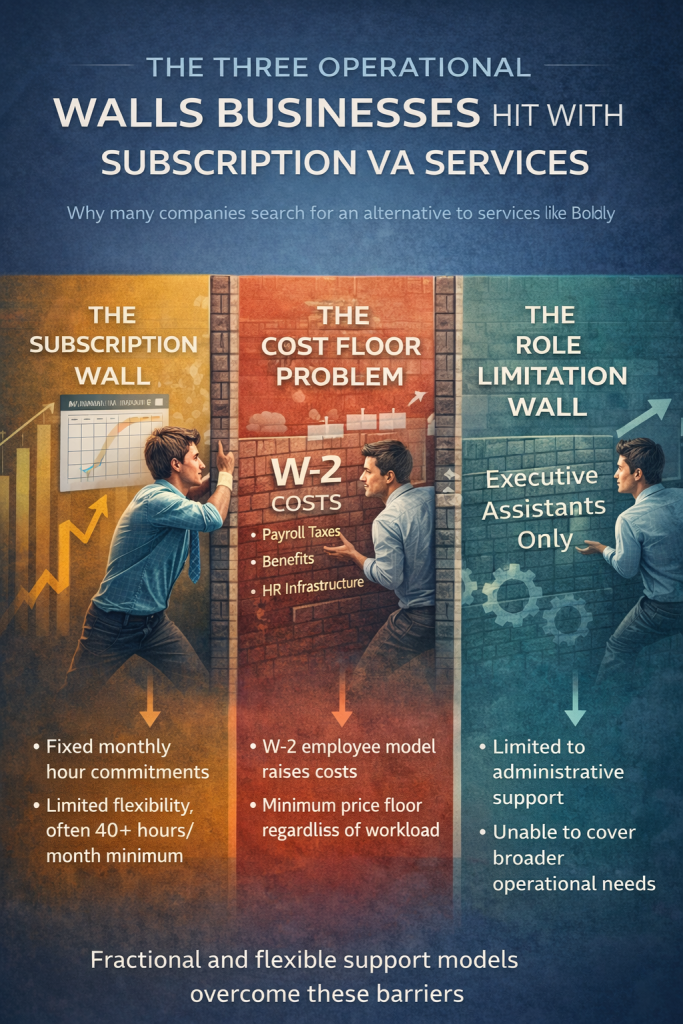
The Three Operational Walls Businesses Hit With Subscription VA Services
Many companies encounter structural limits when they rely on subscription-based assistant services.
These limits often appear gradually as organizations scale.
The Subscription Wall
Most premium assistant providers require fixed monthly commitments.
Boldly typically requires a minimum number of hours per month.
This model works well when workloads remain predictable. However, growing companies rarely operate on stable operational demand.
A startup may require:
- 12 hours of support during development cycles
- 40 hours during product launches
- 60 hours during investor fundraising
Rigid subscription structures restrict this type of scaling.
Leadership teams often pay for unused hours or struggle to increase support during high-activity periods.
Fractional support eliminates this constraint.
Fractional staffing allows companies to scale assistance based on real operational demand rather than predetermined subscription blocks.
The Cost Floor Problem
Boldly hires assistants as W-2 employees.
This employment structure provides stability and strong compliance with US employment regulations.
However, W-2 employment introduces operational overhead.
Employers must cover:
- payroll taxes
- employee benefits
- HR administration
- compliance infrastructure
These obligations create a higher cost floor.
Many businesses searching for a Boldly alternative want the same level of professionalism without the rigid employment cost structure.
Managed contractor models provide this alternative.
In this model, the staffing partner manages the contractor relationship while the client receives structured operational support.
The client avoids the legal complexity of managing independent contractors directly.
This model improves the cost-to-output ratio while maintaining operational reliability.
The Role Limitation Wall
Boldly primarily focuses on executive assistant services.
Executive assistants provide enormous value for leadership teams. They manage:
- inbox communication
- calendar scheduling
- meeting coordination
- travel planning
However, modern organizations require additional operational support roles.
Growing companies often need professionals who manage:
- CRM systems
- project management tools
- documentation processes
- marketing coordination
- customer onboarding workflows
These functions form the operational backbone of the business.
Companies searching for a Boldly virtual assistant alternative often want a multi-role operational support structure rather than a single assistant.
The Infrastructure Gap: Comparing Boldly’s W-2 Model to Managed Fractional Support
Businesses evaluating remote support providers must understand the structural differences between service models.
| Feature | Boldly | Fractional Support Model |
|---|---|---|
| Employment Model | W-2 employees | Managed contractor structure |
| Minimum Commitment | Fixed subscription | Fractional hours available |
| Roles Offered | Executive assistants | Executive, operations, CRM, marketing |
| Talent Locations | Primarily Western markets | Global remote professionals |
| Operational Model | Dedicated assistant | Multi-role support team |
Subscription models prioritize consistency.
Fractional models prioritize scalable operational leverage.

Fractional Support: The Modern Remote Workforce Model
Fractional staffing has become one of the fastest-growing workforce trends.
Instead of hiring full-time staff for every operational role, companies increasingly rely on fractional professionals.
Examples include:
- fractional CFOs
- fractional CMOs
- fractional operations managers
- fractional executive assistants
According to McKinsey’s Future of Work research, more than 36% of companies now use fractional specialists to support operations.
Fractional support provides several advantages.
Elastic Operational Capacity
Businesses increase or decrease support hours depending on workload.
Access to Specialists
Companies gain access to professionals who already understand platforms like:
- Salesforce
- HubSpot
- ClickUp
- Notion
Lower Operational Overhead
Organizations pay for expertise and output rather than idle capacity.
This structure aligns well with startups, SaaS companies, agencies, and distributed teams.

Global Talent Advantage: South Africa and the Philippines
Remote staffing provides access to global talent markets.
Two of the strongest regions for professional remote assistants are South Africa and the Philippines.
Strong English Communication
Both countries rank highly in the EF English Proficiency Index, which measures global English ability.
Clear communication matters when assistants manage:
- executive inboxes
- client relationships
- internal coordination
Cultural Alignment With Western Businesses
Professionals in these regions regularly work with US, UK, and Australian companies.
They understand:
- Western communication norms
- professional etiquette
- operational expectations
Cost-to-Output Efficiency
Labor cost differences allow companies to hire highly skilled professionals at significantly lower cost than equivalent Western hires.
Businesses can build larger operational teams while maintaining high standards.

From Administrative Assistance to Fractional Operations Support
The role of the virtual assistant has evolved significantly.
Ten years ago, assistants handled mostly administrative tasks.
Today, many assistants function as fractional operations professionals.
They manage systems rather than isolated tasks.
CRM Management
CRM specialists maintain databases in systems such as:
- Salesforce
- HubSpot
- Zoho CRM
They maintain pipeline accuracy and data integrity.
Workflow Coordination
Project coordinators manage platforms such as:
- ClickUp
- Asana
- Monday.com
They track deliverables and maintain team accountability.
Documentation Systems
SOP specialists document processes using tools such as:
- Notion
- Confluence
- Loom
These systems prevent knowledge loss and improve onboarding.
Security and Compliance in Remote Support
Companies must protect sensitive business data when working with remote professionals.
Professional staffing providers implement structured security practices.
These practices often include:
- password vaults such as 1Password or LastPass
- secure device environments
- role-based access permissions
- SOC 2-aligned security practices
- Data Processing Agreements (DPA)
These safeguards protect:
- CRM systems
- financial data
- customer databases
- internal documentation
The Management Framework Behind Scalable Remote Teams
Remote teams perform best when organizations implement structured management systems.
Many remote professionals operate within the Mads Singers Management Framework.
This framework emphasizes:
- clear expectations
- defined ownership
- measurable performance
- structured communication
Managers define outcomes rather than micromanaging tasks.
This approach turns remote assistants into operational contributors.
Real-World Examples of Fractional Remote Support
SaaS Startup Regains Strategic Focus
A SaaS startup struggled with operational overload.
The CEO spent nearly three hours per day coordinating administrative work.
These tasks included:
- scheduling investor meetings
- updating CRM pipelines
- organizing documentation
The company introduced a fractional remote support structure:
- executive assistant
- CRM specialist
- documentation coordinator
Within two months, the CEO regained 15 hours of strategic work per week.
Marketing Agency Improves Workflow Efficiency
A marketing agency struggled with inconsistent campaign execution.
Campaign details existed across spreadsheets and email threads.
The agency hired:
- a remote project coordinator
- an SOP documentation specialist
The team introduced centralized project dashboards and documented campaign workflows.
Within three months, project delays dropped by 40%.

FAQ: Boldly Virtual Assistant Alternative
What is the best Boldly virtual assistant alternative?
The best alternatives offer flexible support models, fractional staffing, and broader operational roles beyond executive assistance.
What is the difference between W-2 and contractor staffing?
W-2 employees work directly for the provider with benefits and employment protections. Managed contractor models provide flexibility while the staffing partner manages compliance.
What is fractional support?
Fractional support allows businesses to hire professionals for limited hours instead of committing to full-time roles.
Which countries produce strong virtual assistants?
South Africa and the Philippines produce many highly skilled remote professionals.
How quickly can remote assistants improve productivity?
Many companies see measurable improvements within two to four weeks once workflows become structured.
A Smarter Alternative to Subscription VA Services
Remote work has fundamentally changed how companies build operational teams.
Modern businesses no longer rely on a single assistant to manage administrative tasks.
They build distributed operational teams that include specialists responsible for workflows, documentation, and data systems.
Companies searching for a Boldly virtual assistant alternative often want this flexibility.
Managed remote staffing partners bridge the gap between administrative support and fractional operations support.
Businesses gain professionals who support real operational growth.
Because modern companies rarely fail due to lack of ideas.
They fail when leaders lose time, focus, and operational leverage.
