

You may be a small business owner or an employee working for one. Either way, your clients keep your business alive. Without great client relationships, you lose renewals, referrals, and long-term revenue.
The challenge is that as your client list grows, admin grows faster. Emails pile up, follow-ups slip, scheduling gets messy, and service quality drops. This is where a Virtual Assistant (VA) becomes a practical advantage. A VA helps you run consistent communication, protect boundaries, and build trust without burning out.
Strong client relationships are not about chasing volume. They are about clarity, consistency, professional boundaries, and proactive communication. Here are 10 simple ways to improve client experience and strengthen client retention.

1. Understand Client Value (Even When They’re Challenging)
Not every client is easy, but every client can create value through revenue, feedback, exposure, and referrals. If you treat a demanding client like a “problem,” you miss patterns that could improve your onboarding and delivery.
How a VA helps:
- Logs client history, preferences, and pain points in your CRM
- Tracks sentiment and recurring issues
- Flags risk signs early (delays, frustration, unclear expectations)
2. Set Clear Boundaries and Protect Your Scope of Work
One of the fastest ways to damage a client relationship is unclear boundaries. Scope creep, unlimited revisions, and last-minute requests create resentment on both sides.
How a VA helps:
- Organizes onboarding docs, service terms, and expectations
- Tracks deliverables, deadlines, and revision limits
- Routes requests through a structured workflow, so the scope stays clean
3. Master Active Listening and Clear Communication
Strong communication prevents misalignment. Active listening helps you uncover the real goal behind the request, not just the surface task.
How a VA helps:
- Manages inbox triage and response prioritization
- Summarizes calls into action items and next steps
- Maintains a single source of truth (notes, decisions, approvals)
4. Build Rapport Through Professionalism and Empathy
Rapport is not “being friendly.” It is making clients feel respected, understood, and safe to be honest. That comes from consistency and tone, especially when things go wrong.
How a VA helps:
- Schedules check-ins and milestone updates
- Prepares client-ready agendas and follow-up summaries
- Ensures your communication stays calm, clear, and professional
5. Always Be Prepared and Dependable
Always Be Prepared and Dependable
Dependability builds trust faster than almost anything else. Clients notice when you show up prepared, keep meetings focused, and follow through.
How a VA helps:
- Builds agendas, collects documents, and prepares meeting notes
- Sends confirmations, reminders, and pre-call briefs
- Keeps project files organized so you never scramble mid-delivery
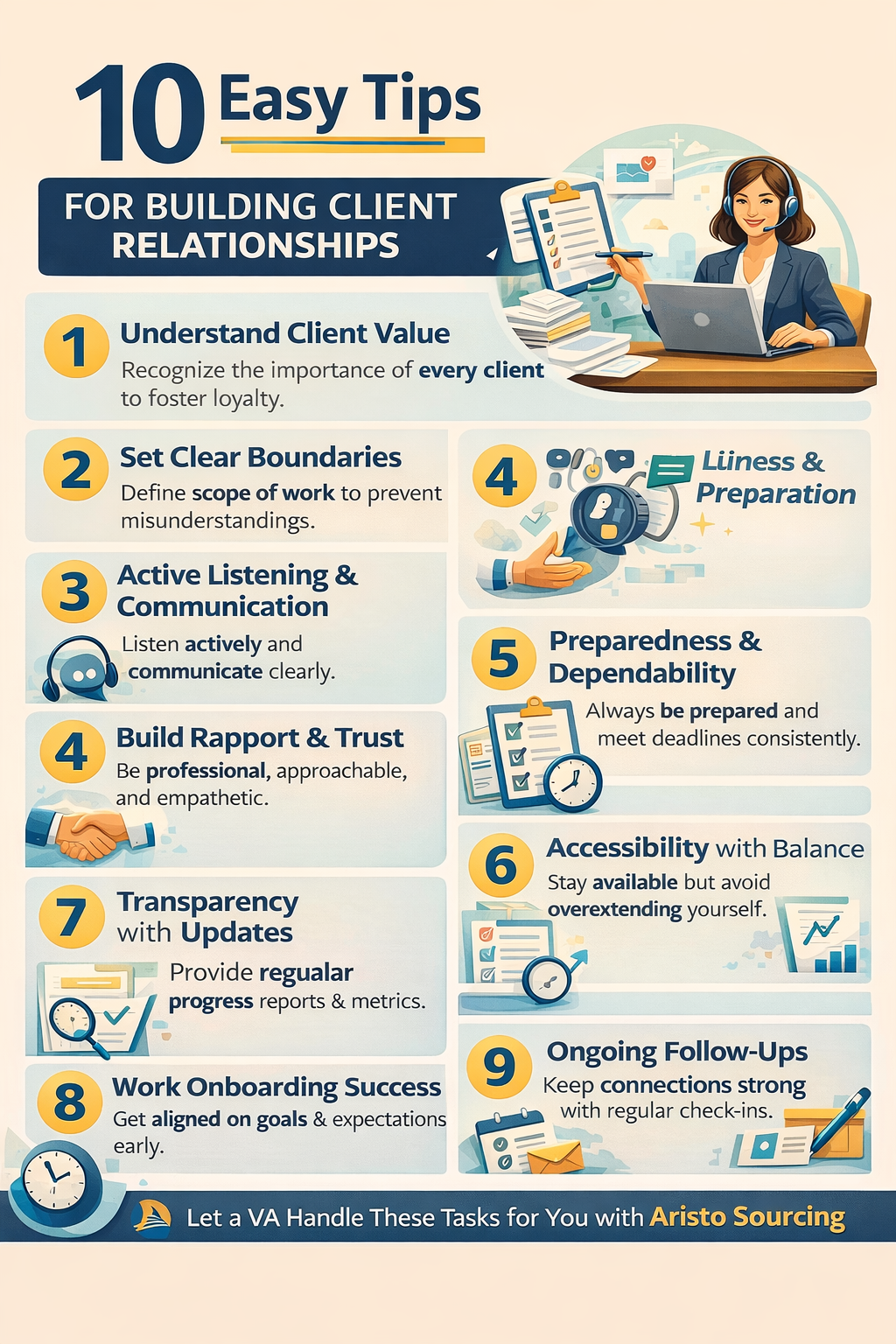
6. Be Available. Without Overextending Yourself
Accessibility builds confidence. Overavailability destroys quality. If you overbook, you rush work, miss details, and damage client experience.
How a VA helps:
- Manages scheduling and screens low-priority requests
- Protects deep-work blocks on your calendar
- Monitors response times and sets realistic expectations
7. Lead with Transparency and Shared Goals
Trust grows when clients can “see” progress. Transparency is how you reduce anxiety and prevent surprise disappointment.
How a VA helps:
- Tracks tasks, timelines, and deliverables in a shared dashboard
- Sends weekly updates and status reports
- Documents decisions, approvals, and performance feedback
8. Get Aligned on Goals During Onboarding
Most relationship issues start with weak onboarding. If goals, roles, and success criteria stay vague, conflict becomes inevitable.
How a VA helps:
- Runs onboarding checklists and kickoff scheduling
- Collects requirements, access, and stakeholder details
- Documents goals, responsibilities, and “definition of done.”
9. Create Consistent Follow-Ups and Long-Term Client Nurturing
Many clients do not leave because you did bad work. They leave because they feel forgotten. Consistent follow-up protects client retention and increases customer lifetime value (CLV).
How a VA helps:
- Schedules check-ins and “quiet period” touchpoints
- Tracks renewals, upsells, and contract milestones
- Keeps CRM records current, so nothing slips
10. Treat Respect Like a System, Not a Slogan
Respect is shown through small actions: fast replies, clear expectations, reliable delivery, and gratitude. Over time, those behaviors create loyalty.
How a VA helps:
- Sends thank-you notes, recap emails, and appreciation messages
- Maintains response SLAs and client communication standards
- Supports retention workflows that make clients feel valued
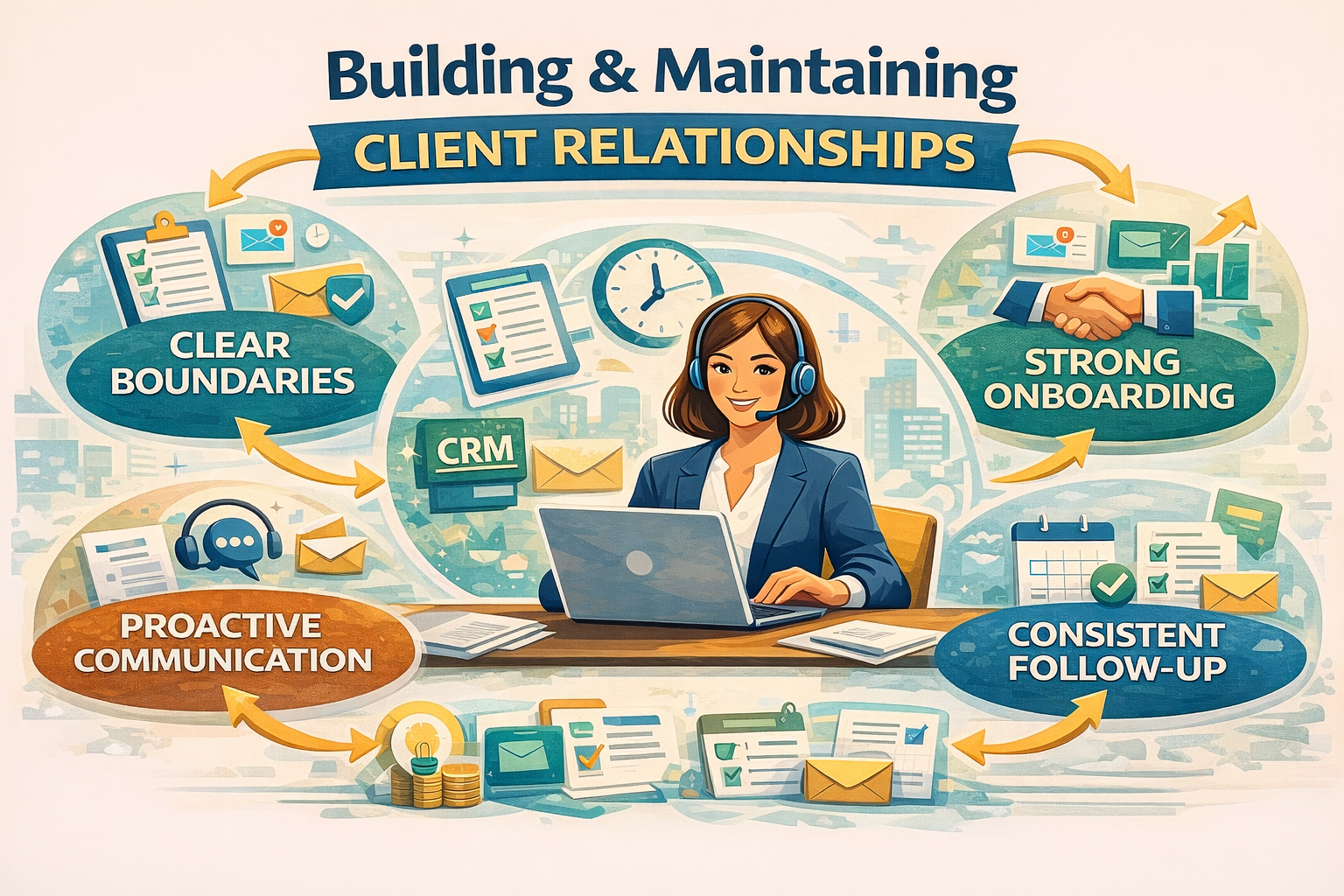
Conclusion: 10 Easy Tips for Building & Maintaining Client Relationships
Client relationships grow when you run a repeatable system: clear boundaries, strong onboarding, proactive communication, and consistent follow-up. The more you grow, the more those systems matter.
Turn One-Time Clients into Long-Term Revenue with Consistent Follow-Ups
Client retention does not happen by accident. It happens through structured follow-ups, CRM hygiene, and ongoing communication.
With a dedicated VA from Aristo Sourcing, your follow-ups, renewals tracking, and relationship touchpoints get handled daily, so no opportunity gets forgotten.
Your VA can:
- Schedule ongoing check-ins
- Manage CRM follow-ups and reactivation campaigns
- Track renewals, upsells, and repeat business
- Ensure every client feels remembered and supported
Want to improve client relationships without adding more to your plate? Book a free consultation with Aristo Sourcing, and we’ll match you with a VA who can run your communication and CRM workflows.
Why is client retention more cost‑effective than acquisition?
Client retention is more cost‑effective than acquisition because retaining a customer costs far less than acquiring a new one. Research shows that acquiring a new customer costs 5× to 25× more than keeping an existing one. Retained clients stabilize revenue and increase Customer Lifetime Value (CLV). Retention reduces marketing overhead and reallocates resources to improving service quality.
How do clear professional boundaries prevent scope creep?
Clear professional boundaries prevent scope creep by defining project limits upfront. Boundaries, often in a Service Level Agreement (SLA), state what is included and excluded. When limits are determined, additional tasks are not added without compensation. Defined boundaries protect profit margins and reduce burnout that harms trust.
What role does a CRM play in modern client relationship management?
A CRM organizes and tracks all client interactions as the single source of truth. CRM systems record emails, touchpoints, project milestones, and preferences. This data enables personalized communication and ensures clients do not feel like “just another number.” For Virtual Assistants, a CRM maintains consistency and smooth handovers.
How does proactive communication impact client churn rates?
Proactive communication reduces client churn by reinforcing perceived value. Proactive updates before clients ask show priority and commitment. When communication signals active engagement, clients feel secure and are less likely to switch to competitors.
What is the “under‑promise and over‑deliver” strategy in business?
The “under‑promise and over‑deliver” strategy sets conservative expectations, then exceeds them. Businesses set achievable goals (the promise) and then surpass them with higher quality or faster results (the over‑delivery). This surplus of value increases Net Promoter Scores (NPS) and drives referrals.
Why is a structured onboarding process critical for long‑term loyalty?
A structured onboarding process builds long‑term loyalty by eliminating confusion in the first 30 days. Clear roadmaps and expectations reduce buyer’s regret and friction. When clients know what to expect early, they trust the process and remain engaged throughout the relationship.
How should businesses handle mistakes to maintain trust?
Businesses maintain trust by owning mistakes and presenting corrective action plans immediately. Radical transparency during failures shows accountability. Clients value a dependable partner who fixes problems more than a “perfect” partner who hides them.
Can a Virtual Assistant help scale personalized client relationships?
A Virtual Assistant helps scale personalized client relationships by managing administrative tasks. As businesses grow, personalization often falls. Virtual Assistants handle scheduling, CRM updates, and timely follow‑ups. This allows owners to focus on strategy without losing personal connection.
