

When should you hire a virtual assistant? This question emerges when administrative load replaces strategic work. You start as a builder. You become an operator. That shift creates a constraint that limits growth.
A virtual assistant (VA) is not a generic support role. A VA is a leverage layer within a Business Process Outsourcing (BPO) model. The function exists to extend execution capacity, stabilize operations, and protect high-value decision time.
Harvard Business Review states, “Time is the scarcest resource for executives.” Misallocation reduces output and slows organizational performance. This principle applies directly to founders and small business owners.
Many business owners hesitate. They focus on cost instead of return. They fear losing control. They assume delegation reduces quality.
This hesitation creates task saturation—a condition where operational demands exceed available cognitive capacity.
CB Insights reports that 23% of startups fail due to operational inefficiencies. Execution failure—not strategy—drives collapse.
The correct question is not whether you need help.
The correct question is:
Are you the bottleneck preventing your business from scaling?Strategic Signals: When Should You Hire a Virtual Assistant for Growth?
Strategic signals indicate structural limitations. These signals show that your business requires fractional support to scale effectively.

The Founder Bottleneck
Work accumulates around you. Decisions, approvals, and execution tasks depend on your availability.
You experience:
- Delayed execution of initiatives
- Decision fatigue
- Reduced strategic thinking time
The American Psychological Association reports that task switching reduces productivity by up to 40%. When you manage every function, you reduce performance across all areas.
A scalable business cannot depend on a single decision node.
The Opportunity Cost Gap
You perform tasks below your value level.
| Activity Type | Strategic Value | Delegation Potential | Business Impact |
|---|---|---|---|
| Revenue generation | High | Low | Critical |
| Strategic planning | High | Low | Critical |
| CRM updates | Low | High | Operational |
| Scheduling | Low | High | Operational |
| Inbox triage | Medium | High | Operational |
This gap represents lost revenue potential.
Dan Martell states, “You cannot scale a business while doing tasks that someone else can do at a fraction of your value.”
Stalled Growth Despite Clear Strategy
You know what to execute:
- Marketing campaigns
- Market expansion
- Partnerships
You do not execute consistently.
McKinsey research shows that companies with strong execution outperform competitors by up to 2x in revenue growth.
Execution capacity, not knowledge, limits scale.
Inconsistent Customer Experience
Service delivery becomes unstable.
You observe:
- Slow response times
- Missed follow-ups
- Incomplete onboarding
HubSpot reports that responding to leads within 5 minutes increases conversion likelihood by 21x.
Without support, response speed declines. Revenue follows.
Task Saturation and Cognitive Load
You reach a limit where additional effort does not produce proportional output.
You experience:
- Mental fatigue
- Reduced clarity
- Slower decisions
Cognitive load theory shows that performance declines when working memory exceeds capacity.
A VA reduces cognitive load by removing operational friction.

Secondary Signals: When Should You Hire a Virtual Assistant for Daily Operations?
Operational signals show immediate inefficiencies. These signals indicate that execution systems require support.
The Inbox as a Bottleneck System
Email dominates your workflow.
You:
- Spend 2–4 hours daily managing email
- Lose visibility on priorities
- Miss critical communication
McKinsey reports that knowledge workers spend 28% of their time on email.
Inbox management is a core delegable function within BPO systems.
Workflow Instability
Routine processes lack consistency.
Examples:
- Irregular billing cycles
- Outdated CRM data
- Delayed reporting
Inconsistent workflows prevent predictable outcomes.
A VA introduces structured execution and repeatability.
Administrative Backlog
Tasks accumulate faster than completion.
You see:
- Unsent invoices
- Unscheduled meetings
- Incomplete documentation
Backlog signals insufficient operational capacity.
Work-Life Boundary Collapse
Work extends beyond sustainable limits.
You:
- Work evenings and weekends
- Experience fatigue
- Lose recovery time
The World Health Organization defines burnout as a syndrome caused by unmanaged workplace stress.
Burnout reduces performance and increases error rates.
Skill Gaps in Specialized Functions
You require capabilities outside your expertise:
- Semantic SEO implementation
- CRM automation
- Legal or medical administration
- Technical troubleshooting
A specialized VA provides fractional expertise without full-time hiring costs.

Decision Criteria: The “Hire or Hold” Framework
Use a structured model to evaluate readiness.
Task Audit (Time-Based Analysis)
Track activities over 5–7 days.
| Category | Definition | Action |
|---|---|---|
| Strategic | Revenue, leadership, growth decisions | Retain |
| Delegable | Repeatable, process-driven tasks | Outsource |
| Redundant | Low-value tasks | Eliminate |
If 30–50% of time falls into Delegable, you have reached the delegation threshold.
ROI vs. ROT (Return on Time)
Example:
- VA cost: R10,000/month
- Hours recovered: 40
- Owner hourly value: R500
Recovered value: R20,000
Net gain: R10,000
This excludes:
- Faster execution
- Increased revenue
- Reduced errors
This model reflects Return on Time (ROT)—a more accurate scaling metric than cost alone.
SOP Readiness (System Transfer)
A VA requires defined processes.
Minimum inputs:
- Task steps
- Expected outputs
- Tool access
Michael Gerber states, “Systems run the business. People run the systems.”
You need clarity, not perfection.
The 10-Hour Leverage Question
Ask:
If you had 10 extra hours this week, what would you execute?
If the answer includes growth or revenue, you need support.
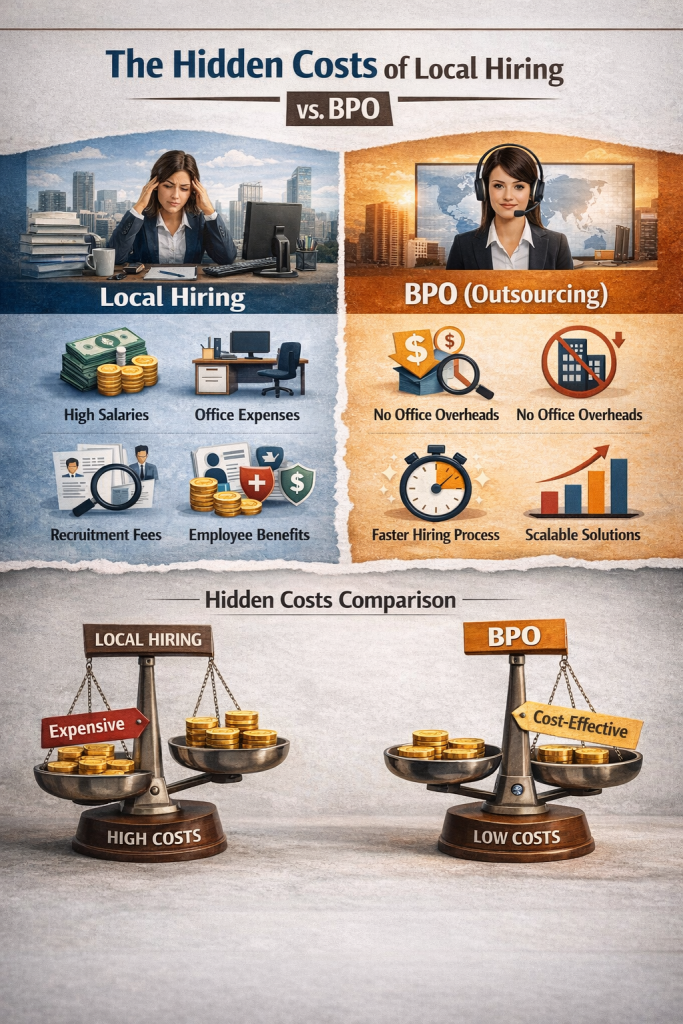
The Hidden Costs of Local Hiring vs. BPO
Many business owners compare hiring a VA to hiring a local employee. This comparison often ignores structural cost differences.
Direct Cost Comparison (South African Context)
| Cost Component | Local Hire (Monthly) | Virtual Assistant (BPO Model) |
|---|---|---|
| Salary | R12,000–R25,000 | Included in service fee |
| UIF Contributions | Required | Not applicable |
| Office Space | R2,000–R5,000 | Not required |
| Equipment (Laptop, etc.) | R10,000+ (once-off) | Included |
| Software Licenses | Additional | Often included |
| Training Cost | High | Reduced via SOP onboarding |
Total effective cost of a local hire often exceeds R18,000–R35,000/month (US Dollars is roughly $1,080–$2,110 per month).
A VA operates as an all-in operational cost, reducing financial risk.
Flexibility and Risk Reduction
Local hiring creates fixed overhead:
- Contracts
- Compliance requirements
- Long-term commitments
BPO provides:
- Scalability
- Reduced risk
- Faster onboarding
Deloitte reports that 59% of businesses use outsourcing to reduce operational costs and increase flexibility.
Access to Global Talent
Remote staffing removes geographic limitations.
You gain:
- Specialized expertise
- Faster hiring cycles
- Higher quality talent pools
This model aligns with modern distributed work systems.

The Tech Stack of Delegation (Execution Infrastructure)
Delegation succeeds when supported by the right tools. Technology enables visibility, control, and consistency.
Core Communication Layer
- Slack or Microsoft Teams → real-time communication
- Email (structured inbox rules) → formal communication
Clear communication reduces friction.
Task and Workflow Management
- ClickUp / Asana / Trello → task tracking
- SOP documentation tools → process clarity
These tools create execution visibility.
Security and Access Control
- LastPass / 1Password → password management
- Role-based permissions → restricted access
Security depends on structured access control.
CRM and Data Systems
- HubSpot / Zoho CRM → client tracking
- Automated workflows → consistency
CRM systems centralize operational data.
Reporting and Performance Tracking
- Dashboards → performance visibility
- KPIs → measurable outcomes
Data-driven management ensures accountability.

How to Transition: From Solo Operator to Scalable System
Step 1: Identify the “First 5” Tasks
Start with:
- Inbox management
- Scheduling
- CRM updates
- Follow-ups
- Reporting
These tasks create immediate time recovery.
Step 2: Choose the Support Model
| Model | Description | Use Case |
|---|---|---|
| Project-Based | Short-term execution | One-off needs |
| Fractional VA | Part-time support | Growing businesses |
| Dedicated VA | Full integration | Scaling operations |
Step 3: Implement a Human-in-the-Loop System
Process:
- Assign
- Review
- Correct
- Document
- Repeat
MIT research shows that human-in-the-loop systems improve accuracy and efficiency in complex workflows.
Step 4: Interview for Execution Capability
Ask:
- “How do you structure unclear tasks?”
- “Describe a process you improved.”
- “How do you manage priorities?”
Evaluate:
- Problem-solving
- Communication
- Reliability
Execution determines success.
Case Study: Recovering 15 Hours of Billable Time
A mid-sized legal firm faced declining billable hours. Attorneys spent time on:
- Document preparation
- Client follow-ups
- Filing administration
These tasks reduced billable capacity.
After implementing a legal virtual assistant:
- Administrative workload reduced by 60%
- Billable hours increased by 15 hours per week
- Response times improved by 70%
Result:
- Increased revenue without hiring additional attorneys
- Improved client satisfaction
- Reduced burnout
This case demonstrates how delegation directly impacts revenue performance.

Frequently Asked Questions (The Internal Decision Layer)
Is my business too small for a virtual assistant?
No. Complexity determines readiness, not size.
If you manage repeatable tasks and face time constraints, you qualify.
How do I secure sensitive data?
Use:
- NDAs
- Access controls
- Password management tools
Systems create security.
Will training take too long?
Training creates long-term efficiency.
Stanford research shows process standardization reduces training time by up to 50%.
How do I measure success in 90 days?
Track:
- Response time
- Task completion
- Error rates
- Time recovered
Milestones:
- 30 days: adaptation
- 60 days: consistency
- 90 days: optimization
Conclusion: From Bottleneck to Scalable Leadership
You do not hire a virtual assistant to reduce workload. You hire a virtual assistant to increase leverage, execution speed, and operational control.
The signals are clear:
- Strategic work declines
- Operational load increases
- Growth slows
- Systems fail
The cost of waiting includes:
- Lost revenue
- Reduced efficiency
- Increased burnout
- Delayed scale
A business cannot scale if the owner remains the system.
A scalable business requires:
- Delegation
- Systems
- Structured support
When should you hire a virtual assistant?
You should hire when your time no longer aligns with high-value work and your business shows measurable signs of task saturation.
Call to Action
Audit your last 7 days.
Classify your tasks:
- Strategic
- Delegable
- Redundant
If delegation dominates, act immediately.
Because once you identify the bottleneck, you have already reached the limit of solo execution.
Book a consultation call to identify what to delegate first and build a system that scales with your business.