

You already know marketing works. You do not need convincing that content builds trust or that ads bring in leads. What you need is a way to do more of it without hiring a full in-house team. This guide gives you that path: Which marketing tasks to hand off first, what a marketing virtual assistant actually costs, how to onboard one without breaking your campaigns, and which advanced strategies turn a single VA hire into a real growth engine.
Marketing improves business growth. That simple idea sums up why this topic matters, and the rest of this guide shows you how to put it into practice with real people, real tools, and a real plan.

What Marketing Actually Does (In Plain Terms)
Marketing is the work of getting the right message in front of the right person at the right time, so that person becomes a customer and stays one. That is the whole job. Every tactic in this guide, from a Facebook ad to a referral program, exists to serve that one goal.
Most of that work today falls under digital marketing, meaning any marketing that happens through an online channel such as search, social media, email, and paid ads. That is also where a virtual assistant delivers the most value, since digital channels produce the reports, schedules, and repeatable tasks a VA can own directly. Marketing thinker Peter Drucker put it: “Marketing aims to know and understand the customer so well the product or service fits him and sells itself.” Marketing is not one task. It is a chain of smaller tasks, each one moving a stranger closer to becoming a paying customer.
Marketing teams often use a simple model called the marketing funnel to describe this chain: Awareness, consideration, conversion, and loyalty. A person becomes aware of your brand, considers whether you solve their problem, converts into a customer, and, if you do it right, stays loyal and refers others. Seeing marketing as a funnel with stages makes delegation easier, because you can hand off entire stages to a VA instead of guessing which random tasks to give away, exactly what the task delegation matrix below does.

Why 2026 Is the Right Time to Delegate Marketing
Three shifts make this the right moment to bring in a marketing VA instead of waiting.
First, the virtual assistant industry has matured. The global market for human VA services sits at roughly $6.5 billion in 2026, with a 23.4% annual growth rate through the next decade. Marketing and social media execution alone account for about 31% of all VA work, and 40% of digital marketing agencies now depend on VAs to manage campaigns, per the same research. This is not a fringe trend. It is standard practice.
Second, artificial intelligence has changed what one person can produce, and it has changed how search engines read what that person publishes. HubSpot’s 2026 AI Trends survey found that marketers recover an average of 6.1 hours a week using AI tools, with senior practitioners saving 8 to 10 hours. On the search side, Google’s BERT-based ranking systems now read the relationships between ideas on a page rather than just matching keywords, which is part of why generic, keyword-stuffed content ranks worse than it used to. A trained marketing VA who also knows how to use AI writing and design tools does not need a full team behind them. They multiply their own output instead.
Third, the return on content and organic marketing keeps climbing. The average 2025 return on content marketing spend was $7.65 for every $1 invested, and content marketing generates roughly three times more leads than outbound marketing (cold email, cold calls, and other tactics that reach out to strangers directly) at 62% lower cost per lead, based on data compiled by Sender’s 2025 to 2026 ROI benchmark report. Email marketing alone returns close to $42 for every $1 spent. None of that return arrives on its own. It requires steady, consistent execution, which is exactly what a dedicated VA provides.
In-House vs Freelance vs Managed Marketing VA: The Real Cost Comparison
Business owners usually weigh three options when they need more marketing hands: hire in-house, hire a freelancer, or work with a managed VA provider that vets and places talent for you.
| Option | Typical Annual Cost (USD) | What You Get |
|---|---|---|
| In-house U.S. marketing coordinator | $51,000 USD to $66,000 USD base salary, plus an estimated 25% to 40% on top for payroll tax, benefits, and equipment | Full-time attention, but slow to hire, expensive to replace, and limited to one skill set |
| Freelancer (Upwork/Fiverr style) | Highly variable, often $15 USD to $50+ USD per hour with no vetting guarantee | Flexible, but inconsistent quality and no accountability structure |
| Managed offshore marketing VA (Philippines or South Africa) | Roughly $8,000 USD to $31,000 USD depending on seniority and hours, based on 2026 country rate data | Vetted talent, full-time or part-time flexibility, and a fraction of the in-house cost |
Salary figures for the in-house coordinator role come from a 2026 average across Indeed, Glassdoor, and ZipRecruiter. The gap is not small. A managed marketing VA can cost a third to a half of an in-house hire while still delivering trained, specialized support.
That table is ROI analysis in its simplest form: comparing what an option costs against what it returns before you commit to it, rather than judging a hire on sticker price alone.
The Marketing VA Task Delegation Matrix
Do not hand a new VA a random pile of tasks. Map the work to the funnel stage it serves. This matrix gives you a starting structure you can copy directly into your own standard operating procedure, or SOP.
| Funnel Stage | Tasks to Delegate | Common Tools |
|---|---|---|
| Top-of-funnel (Awareness) | Short-form video editing, social media scheduling, content calendar management, lead magnet creation | Canva, CapCut, Buffer, Later |
| Middle-of-funnel (Consideration) | Email sequence setup, CRM hygiene, lead nurturing, landing page copy drafts. | ActiveCampaign, Klaviyo, HubSpot |
| Bottom-of-funnel (Conversion) | Ad operations support, analytics reporting, conversion rate optimization tracking, A/B test setup | Google Analytics 4, Meta Ads Manager, Google Ads |
| Loyalty and Retention | Referral program management, review requests, reputation monitoring, customer email newsletters | Trustpilot, Google Business Profile, Klaviyo |
A specialized marketing VA takes ownership of campaign execution: content staging, ad reporting, and the daily administrative work that otherwise eats your calendar. The handoff point matters as much as the task list. For an email campaign, you set the offer and pick the audience segment, and the VA drafts the copy, builds the sequence in your email tool, and schedules the send. For social media, you set the content themes and approve the calendar, and the VA writes the captions, edits the video, and posts on schedule. Keep that division consistent across every task type, and the matrix above turns from a list into a working system.

The Marketing Delegation Principle: The 80/20 Rule
Italian economist Vilfredo Pareto observed that, in many systems, roughly 80% of results come from 20% of causes. Business writers later applied this to work itself: about 20% of your tasks drive 80% of your outcomes. Applied to marketing delegation, that principle gives you a clear rule: founders keep the 20%; VAs run the 80%.
The 20% you should keep is strategy. Positioning, pricing, brand voice, and big campaign decisions need your judgment. The 80% you should delegate is execution. Scheduling posts, formatting emails, pulling reports, and setting up ad campaigns inside a plan you already approved. A marketing VA who owns that 80% frees your time for the 20% that actually needs you.
A second idea worth knowing here is Parkinson’s Law: work expands to fill the time available for it. If you try to do everything yourself, marketing execution will eat your entire calendar, no matter how small your business is. Handing off the execution layer does not just save hours. It protects the hours you have left for strategic thinking.
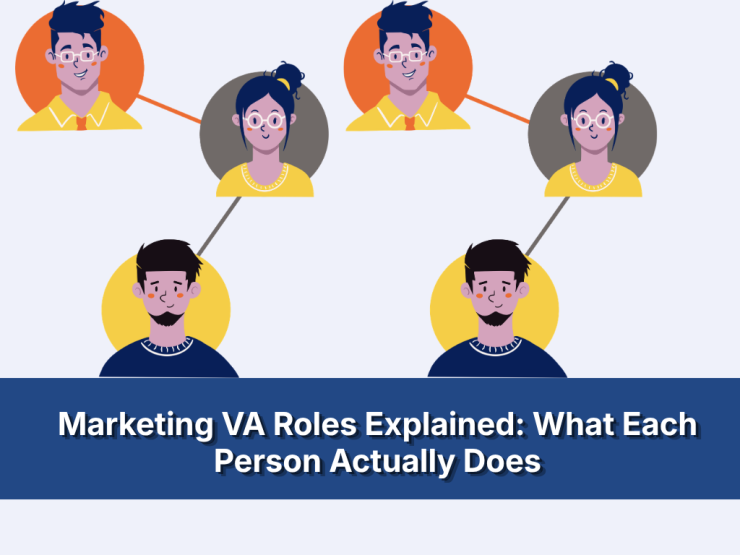
Marketing VA Roles Explained: What Each Person Actually Does
- Social Media VA. This role handles social media marketing in its most hands-on form: using platforms like Instagram, Facebook, and TikTok to build audience relationships and drive traffic. They post content, reply to comments and DMs, and track engagement metrics. In 2026, this role increasingly includes short-form video editing for TikTok and Instagram Reels, since HubSpot’s 2026 State of Marketing names short-form video the top ROI-driving content format, chosen by 49% of marketers surveyed. Many also handle YouTube marketing, using longer video to build trust in a way a 30-second clip cannot. A dedicated social media assistant can turn a single piece of raw footage into five platform-specific posts within a day.
- Content and Digital Marketing VA. Writes blog posts, formats landing pages, manages your content calendar, and increasingly uses AI writing tools as a first-draft engine before a human edit. This is content marketing at its core: creating and sharing valuable material to attract and keep an audience without directly advertising to them. Done well, it builds organic reach, meaning the people who find your content without you paying for their attention. This is the role most often described as a virtual digital marketing assistant, since it blends several specialist skills into one generalist support person.
- Paid Media VA (Facebook, Google, TikTok Ads). Sets up campaigns, manages ad spend, tracks return on ad spend, and adjusts audience targeting based on performance data. This person needs to understand attribution basics, meaning which touchpoint actually gets credit for a sale, since misreading that data wastes ad budget fast.
- Email and CRM VA. Builds nurture sequences, keeps your customer database clean, segments your list by behavior, and sets up automated flows in tools like Klaviyo or ActiveCampaign. Since email marketing returns roughly $42 for every $1 spent, this role often pays for itself fastest.
- Research and Analytics VA. Pulls data from Google Analytics 4 and social platforms, tracks key performance indicators (KPIs, such as cost per lead and click-through rate, and turns raw numbers into a short weekly report you can actually use. Tracking software only helps if someone reads it and tells you what changed.
- Virtual Marketing Manager. Oversees the other roles, maintains partner and client relationships, and keeps campaigns aligned to your bigger goals. This is relationship marketing in practice: a long-term focus on keeping customers and partners loyal, rather than treating every interaction as a single sale to close. A game-changing marketing assistant at this level often functions closer to a marketing manager than a basic assistant, which is why hiring one through a vetted channel matters more than it does for entry-level admin work.
Advanced Marketing Strategies: Taking Execution Further
Delegating the basics is the starting point. Are you ready to take your social media marketing to the next level? These are the strategies that separate a business running on autopilot from one that compounds its growth year over year.
- Omnichannel marketing. This means your brand shows up with one consistent message across social media, email, your website, and paid ads, and each channel hands the customer smoothly to the next. Omnichannel marketing increases revenue growth because customers who interact with a brand across multiple channels tend to spend more than single-channel customers.
- Marketing automation. Automation tools trigger emails, tag leads, and move contacts through a funnel without manual work. Marketing automation increases efficiency in a direct way. A VA can build these workflows once, and they run for months with only light maintenance.
- Retargeting. Most website visitors leave without buying. Retargeting shows ads to people who already visited your site or engaged with your content, which is why it converts at a far higher rate than cold advertising. Retargeting recovers leads that would otherwise vanish for good.
- A/B testing and conversion rate optimization. Instead of guessing which headline, image, or offer works best, you test two versions against each other and let the data decide. A/B testing improves conversion rate more reliably than guesswork ever does. This single habit, applied consistently, often produces bigger gains than any single new marketing channel.
- Referral and affiliate programs. Existing customers and partners can bring in new business at a lower cost than paid ads, if you give them a clear incentive and an easy way to share. Referral programs increase revenue growth without raising your ad spend.
- Reputation management. Online reviews now function as a trust signal for new customers before they ever speak to you. Monitoring and responding to reviews, and managing your public relations proactively, keeps the brand story you have worked to build intact even after a bad review or a public complaint.
- AI and human hybrid workflows. The most effective setup in 2026 pairs a skilled VA with AI tools rather than choosing one over the other. The quality control step is what separates this from generic AI content. Artificial intelligence in marketing drafts a rough outline or first version, and the VA takes it from there: checking every fact, rewriting anything that sounds generic, matching your brand voice, and formatting it for the platform it will publish on. Skip that last step and AI output reads like AI output. Keep it, and nobody can tell. AI adoption among small businesses using marketing tools has reached 54%, with another 27% planning to adopt within the next 12 months, according to 2026 small business AI adoption research.
- Media planning and yearly marketing plans. Instead of reacting week to week, a strong marketing operation sets a yearly plan with quarterly campaigns mapped to product launches, seasonal demand, and budget. This is where a virtual marketing manager earns their keep, since someone needs to hold the calendar and keep every channel pointed at the same goals.
- Mobile marketing. Most of your audience now finds you on a phone, not a desktop. Mobile marketing means designing campaigns and pages specifically for that screen, including responsive design so a page resizes and displays correctly no matter what device opens it. A VA who checks every landing page on a phone before it goes live catches problems your desktop preview never will.
- Getting your advertising to the next level with paid media. Paid ads work best alongside market research, meaning the process of gathering information about your audience and competitors before you spend a dollar, and audience segmentation. Research gathered from past campaigns tells you which audience segment responds best, so future ad spend gets sharper instead of starting from zero each time.
How to Take Your Small Business to the Next Level With a Marketing VA
Small businesses often assume outsourcing is only for large companies with big budgets. The opposite is closer to the truth. A small team benefits more from delegation, since every hour a founder spends on execution is an hour not spent on the strategy that actually grows the business. Aristo Sourcing vets marketing virtual assistants specifically for small and scaling businesses. That focus exists because smaller teams need vetted talent even more than large ones, given they usually cannot absorb the cost of a bad hire.
Aristo Sourcing has recruited and placed virtual assistants with more than 1,000 businesses since its founding in January 2014, sourcing talent exclusively from the Philippines and South Africa. Two regions were chosen for a mix of strong English fluency, workable time zone overlap with U.S. and European clients, and deep marketing skill availability, rather than spreading thin across many markets.
A 30/60/90-Day Onboarding Playbook
Hiring the right person solves half the problem. Handing over marketing tasks without a plan causes the other half, which is why campaigns often stall right after a new VA starts. Use this playbook to avoid that.
- Days 1 to 30: Foundation. Share brand guidelines, past campaign results, and login access through a password manager, not plain text messages. Set one weekly check-in call. Start with a single task type, such as social media scheduling, before adding more.
- Days 31 to 60: Expansion. Add a second task category, such as email marketing or reporting. Write down your standard operating procedures as you go. If a VA had to figure something out through trial and error, that process belongs in a document now, so the next task does not require the same guesswork.
- Days 61 to 90: Ownership. Shift from giving instructions to reviewing outcomes. A VA who understands the goal, not just the task, starts suggesting improvements instead of waiting for direction. By day 90, you should be spending minutes reviewing work rather than hours assigning it.
This structure protects you from the single biggest onboarding mistake: handing over everything at once and hoping it works out.
An Illustrative Example: What Delegation Can Look Like
This is a composite example, not a specific client result. A fabricated success story with invented numbers would sound convincing. Still, it would not be true, so here is a modeled scenario built from the real market data cited above instead.
Picture a small B2B service business spending 15 hours a week on marketing execution split between the founder and one part-time employee. They bring on a marketing VA to own social media scheduling, email nurture sequences, and monthly reporting. Based on the cost ranges above, that VA runs somewhere between $800 and $2,000 USD a month, compared to $4,250 USD or more a month for an in-house hire at U.S. salary levels. With content marketing generating three times more leads at 62% lower cost per lead than outbound tactics, and email marketing returning roughly $42 USD per $1 USD spent, the math suggests a well-run VA marketing function can pay for itself well before it becomes a major line item. Your actual results will depend on your industry, offer, and how well you follow the onboarding playbook above, but the direction of the math holds across most service businesses.
Two Views on Marketing Delegation
Not every marketing leader agrees on how far to delegate, and it helps to see both sides before you decide.
The traditionalist view holds that brand voice is too important to hand to anyone outside the founding team, and that outsourcing risks message drift. This view has merit for highly regulated industries or businesses built entirely on a founder’s personal brand.
The hybrid view, which most modern marketing operations now follow, holds that strategy stays with leadership while execution moves to trained support, whether that support sits in-house or offshore. The rise of managed VA providers who vet talent before placement exists specifically to bridge this gap, so businesses get trained hands without losing quality control.
Most growing businesses land somewhere in the hybrid camp, keeping final approval on anything customer-facing while delegating the repetitive work that builds up around it.

Frequently Asked Questions
Is hiring a marketing VA worth it for a small business?
Yes, for most service and product businesses. The cost sits well below an in-house hire, and a vetted VA arrives already trained in the tools your marketing needs, such as email platforms and analytics dashboards.
What is the difference between a marketing VA and a freelancer?
A freelancer is usually a single independent contractor you find and vet yourself. A marketing VA sourced through a managed provider like Aristo Sourcing goes through a structured vetting process before you ever meet them, and comes with a replacement option if the placement does not work out.
What should I delegate first?
Start with top-of-funnel tasks such as social media scheduling and content calendar management. These tasks are lowest risk, easiest to review, and free up the most time fastest.
How long does it take to see results after hiring a marketing VA?
Expect 30 days for foundation building, 60 days for expanded task ownership, and meaningful independent output by day 90, based on the onboarding playbook above.
Are you ready to take your business to the next level with a marketing VA?
If you are spending more hours on marketing execution than on strategy, the answer is yes. The delegation matrix above lists the tasks to hand off first.
Ready to Take Your Marketing to the Next Level?
You do not need a bigger team to get more marketing done. You need the right tasks in the right hands, starting with the delegation matrix above. Book a free discovery call with Aristo Sourcing and find out which vetted marketing VA fits your business, sourced from our talent pool across the Philippines and South Africa, backed by more than a decade of placement experience since 2014.