

A vendor invoice arrives in a client’s inbox, formatted exactly like the fifty before it, requesting a routing number update before the next payment. Nobody hacked the accounting software. Nobody stole a password. A virtual assistant with drafting access processed it as instructed, because the email came from what looked like the real vendor. That single scenario, not a dramatic system breach, is now the dominant way bookkeeping fraud actually happens, and most security advice for hiring a virtual bookkeeping assistant never mentions it.
Financial data is a weapon, not just a record. A general ledger, AR aging, payroll summaries, and bank statements reveal margins, vendor relationships, and cash runway, and a compromised account turns that visibility into fraud fast. The instinct to solve this with either blind trust or a total lockdown misses the actual answer: Bookkeeping security is a design problem, built from identity, access, evidence, and a realistic model of how the fraud actually happens, not the version most vendors sell.
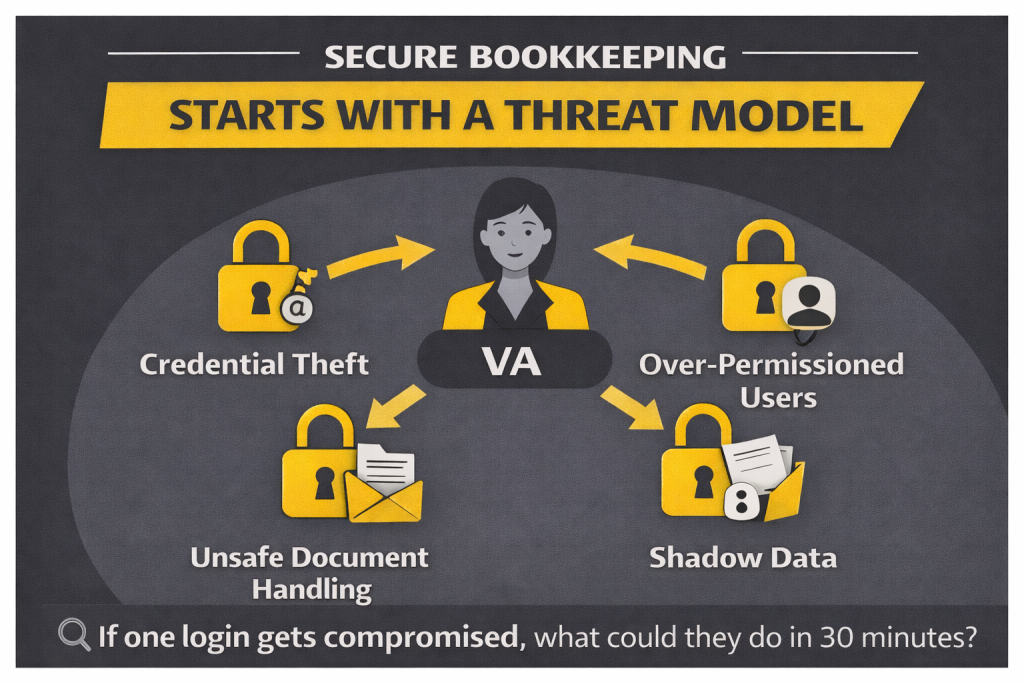
What’s the Actual Threat When You Give a Virtual Assistant Access to Your Books?
Credential theft gets the most attention in security advice, and it deserves some of it. Verizon’s Data Breach Investigations Report lists stolen credentials as the top initial attack vector, and over-permissioned users, invoices forwarded to personal inboxes, and payroll exports sitting on someone’s desktop all widen the blast radius once a single login goes bad.
Over-permissioning compounds whatever credential theft manages to achieve. When a VA gets admin rights “just to make onboarding easier,” a single stolen login stops being one person’s problem and becomes the entire business’s exposure. A twelve-person consulting firm learned this after a VA’s email got phished through an unrelated personal account; because that same login also carried admin rights inside the firm’s accounting platform, the attacker spent four days quietly forwarding vendor correspondence before anyone noticed the pattern. The forensic review afterward found the actual damage traced not to the phishing itself, which happens to well-trained people constantly, but to the admin access that phishing email should never have been able to reach.
But credential theft is not the fastest-growing threat to a bookkeeping operation, and treating it as the whole picture leaves a business exposed to the thing actually accelerating right now. Business Email Compromise and its close variant, Vendor Email Compromise, don’t require stealing anything. The FBI’s IC3 unit logged 24,768 BEC complaints and US$3.05 billion in reported losses in 2025, up from US$2.77 billion the year before, and separate research puts the average BEC incident at US$4.67 million. Vendor Email Compromise specifically, an attacker impersonating a trusted supplier to insert fraudulent payment instructions into a real workflow, rose 137 percent in a single recent year. The most cited case remains a scammer who convinced Google and Facebook to collectively wire over US$100 million by sending invoices that looked exactly like their real hardware supplier’s, no breach, no malware, just a convincing document and a routine approval process. A bookkeeping VA who can draft or forward a payment request is standing at the exact point where this fraud succeeds or fails, which makes training on vendor-change verification, not just password hygiene, a core part of the role.
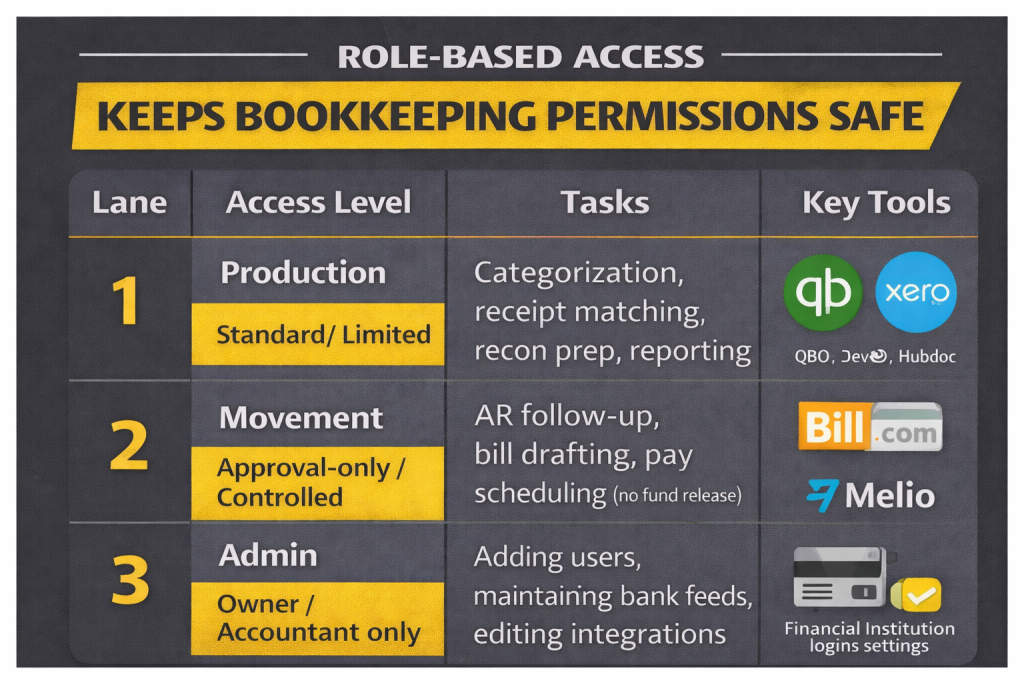
How Do You Structure Permissions So a VA Can Work Without Full Access?
Role-based access control means access attaches to a role, not a person, and it prevents the default failure mode: Granting admin rights “to make things easier” and quietly handing over business-wide blast radius. Least privilege is the same idea applied tighter, each user gets the minimum access a specific task requires, nothing granted “just in case.”
The cleanest version of this splits bookkeeping access into three lanes rather than a single all-or-nothing decision.
| Lane | Access Level | Tasks | Key Tools |
|---|---|---|---|
| Production | Standard, limited | Categorization, reconciliation prep, reporting | QuickBooks Online, Xero, Dext, Hubdoc |
| Movement | Approval-only | AR follow-up, drafting bills, scheduling payments, never releasing funds | Bill.com, Melio |
| Admin | Owner or accountant only | Adding users, bank feed changes, integration settings | Bank portals, admin settings |
A VA operates fully inside Production, partially inside Movement, and never touches Admin. That structure is what separates “we hired help” from “we built a system,” and it holds regardless of how much the business owner trusts the specific person in the role, since the whole point of the structure is that it doesn’t depend on trust to work.
The platforms themselves already support this distinction; most businesses just never configure it. QuickBooks Online separates Company Admin from Standard User, and a Standard User role can be scoped further to Customers-only or Vendors-only access. Xero draws the same line between Adviser access, which carries full control, and Standard access, which doesn’t. Neither platform requires a paid upgrade or a technical specialist to configure correctly. The gap between insecure and secure bookkeeping access is usually a fifteen-minute setup task nobody scheduled, not a missing tool.
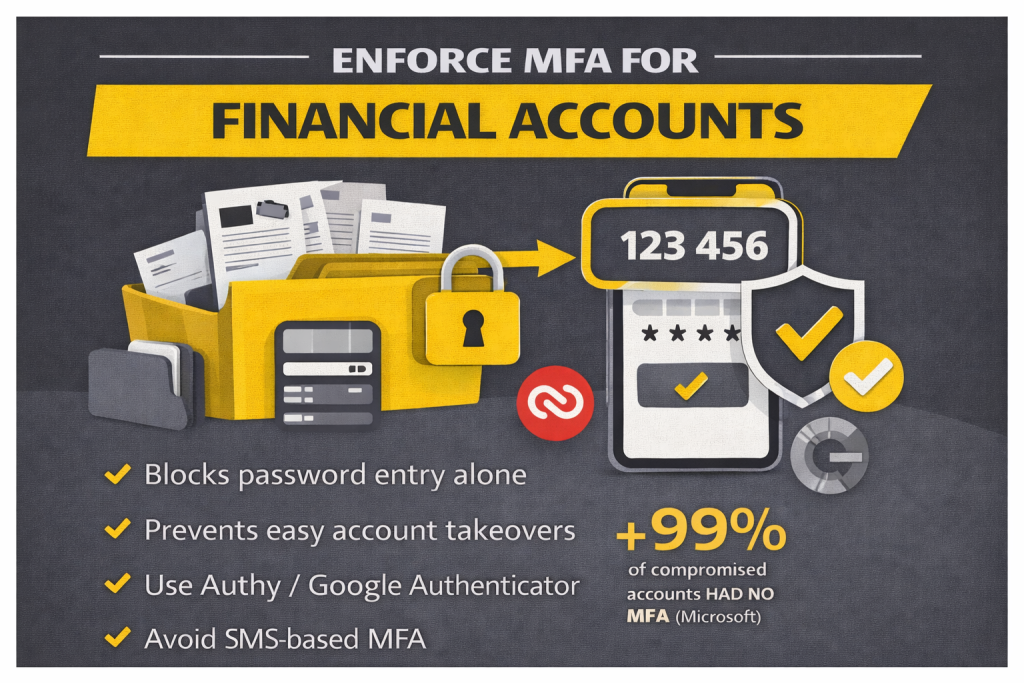
Is MFA Actually Enough to Stop a Credential Breach?
Security vendors treat multi-factor authentication as close to a silver bullet, and the headline statistic explains why: Microsoft has reported that more than 99.9 percent of compromised accounts had no MFA enabled. On the credential-theft threat alone, that argument holds. Authenticator apps on email, the accounting platform, and bill-pay tools close most of the door stolen or reused passwords open.
The claim falls apart against the threat actually growing fastest. BEC and Vendor Email Compromise don’t touch a login at all, which means MFA does nothing to stop the exact fraud pattern responsible for billions in reported losses. A VA with properly secured, MFA-protected credentials can still process a fraudulent vendor-change request, because the attack never tried to get past the login screen in the first place. The honest position sits between the two extremes: MFA is close to mandatory for the credential-theft threat and close to irrelevant for the impersonation threat, which means a business that stops at “we enabled MFA” has solved roughly half the problem while believing it solved all of it. Vendor-change verification, a callback to a known phone number before any routing detail changes, closes the gap MFA structurally cannot.
Can an NDA With an Overseas Virtual Assistant Actually Be Enforced?
The cynical view, and it’s a fair one, says an NDA signed with a contractor in another country is closer to theater than protection. Foreign courts routinely decline to enforce a US judgment against a party with no assets or presence in the US, which means a standard NDA naming a US court as the venue can be functionally unenforceable against a bad actor who never intended to comply in the first place.
That critique is accurate and incomplete. The gap closes, not fully but substantially, with an arbitration clause instead of a domestic court clause. Arbitration awards are recognized in more than 170 countries under the New York Convention, giving a business an actual enforcement path a standard litigation clause doesn’t provide. Working through a staffing partner adds a second layer: the agency, not just the individual VA, holds a direct contractual relationship under local labor law, which gives a client a party with an ongoing business reputation and local presence to hold accountable, distinct from chasing an individual who can disappear. Neither mechanism makes an NDA airtight against someone determined to steal data and vanish. Both mechanisms are the difference between a document that only deters the honest and one that gives a business a real remedy against the dishonest. An NDA without a specified governing law, jurisdiction, and dispute resolution mechanism is, as the cynics correctly argue, mostly a formality. An NDA built with those three elements is not.
A properly built NDA for this kind of engagement also needs to read like an operating document, not boilerplate. It should name the specific categories of data covered, bank details, payroll records, customer financial information, define secure handling requirements in terms that match how the business actually works, require prompt reporting of any suspected compromise rather than a vague “best efforts” clause, and specify return or deletion of data at the engagement’s end. A tripartite structure, naming the client, the staffing partner, and the individual assistant as parties with distinct, defined obligations, closes a gap a two-party contract leaves open: It gives the client a claim against an established business with ongoing operations and a reputation to protect, not only against an individual who may have neither.
What Should a Placement Partner Actually Guarantee?
A staffing partner placing bookkeeping virtual assistants should be able to answer every question this guide raises before a client signs anything, not after: what role the assistant gets configured with in the client’s accounting platform, whether the confidentiality agreement names the client, the agency, and the assistant as distinct parties with defined obligations, and whether MFA gets enforced across every connected account from day one rather than left to the client to configure later. Aristo Sourcing places bookkeeping and finance-support virtual assistants across South Africa and the Philippines, and a client evaluating any placement partner, Aristo Sourcing included, should ask these exact questions directly rather than assume a generically reassuring answer covers them.
Does Your Bookkeeping Stack Need SOC 2 Compliance?
Gartner’s research found 78 percent of enterprise buyers now require SOC 2 Type II certification from their service providers, and SOC 2 has become close to a default expectation in vendor evaluation conversations. SOC 2 Type II specifically audits whether a service organization’s security controls actually held up over six to twelve months, not just on the day of the audit, covering security, availability, processing integrity, confidentiality, and privacy.
Applying that standard directly to a small business hiring one virtual bookkeeping assistant asks the wrong question, though. SOC 2 certifies a service organization’s own systems, and the more useful question for a business at this scale is whether the software the VA actually works inside, the accounting platform, the bill-pay tool, the document repository, carries that certification, not whether the individual staffing arrangement does. QuickBooks Online, Xero, and Bill.com all maintain SOC 2 compliance as vendors; that’s the layer actually protecting the data, regardless of whether the specific staffing relationship sourcing the VA holds its own certification. A business should ask a staffing partner which certified platforms the engagement runs through, rather than treating “does the agency have SOC 2” as the decisive question a small VA placement was never really the right scale to demand.
That distinction matters because SOC 2 has become something of a trust shortcut in vendor conversations, a single certification standing in for a genuine security review nobody has time to conduct manually. The Gartner figure showing 78 percent of enterprise buyers now requiring it reflects real enterprise procurement standards, built for six and seven-figure vendor contracts with dedicated security teams reviewing the audit report line by line. A business hiring one bookkeeping VA is not running that procurement process, and demanding an enterprise-grade credential from a staffing arrangement operating at a completely different scale asks a real question in the wrong place. The right question, which platform certifications actually protect the data and which access controls actually limit exposure, gets a more useful answer than a compliance checkbox does.
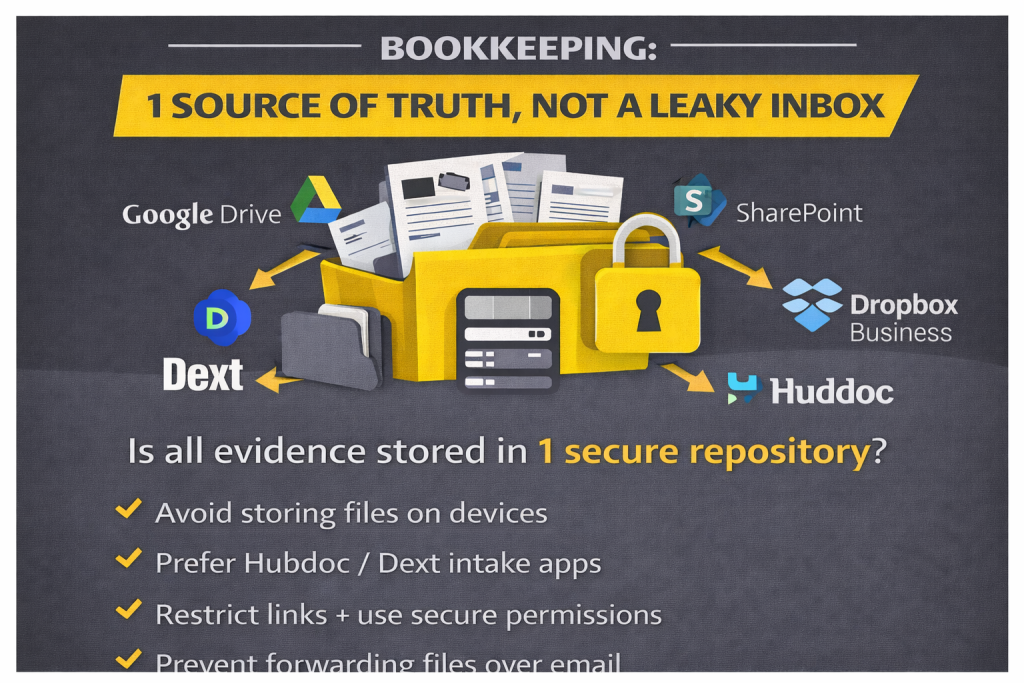
How Do You Stop Documents From Leaking Into Email and WhatsApp?
Bookkeeping security fails quietly when documents scatter: invoices in email, receipts in WhatsApp, bank statements on a desktop, payroll reports in a chat thread. That scatter is shadow data, and it’s nearly impossible to audit once it exists. The fix is a single controlled repository, Google Drive, SharePoint, or Dropbox Business, structured like an actual audit trail: Restricted folders, view-only access by default, expiring links for anything shared externally. Routing receipts and invoices through Dext or Hubdoc, which capture and log the document’s origin automatically, keeps that evidence out of unsecured inboxes entirely. A useful test: Can a business owner find supporting evidence for any high-value transaction in under two minutes without asking a person? If not, the problem is document discipline, not the accounting software.
Monitoring closes the loop the rest of this system opens. Activity logs inside the accounting platform and the document repository turn “I trust this person” into “I can verify this activity,” which is a meaningfully different, calmer position for a founder to operate from. A quarterly access review, checking who still has a login and whether that access still matches their current role, catches the account nobody remembered to revoke after a contractor’s engagement quietly ended three months earlier. Revoking access the day an engagement ends, not the week after, closes the single most common gap a post-incident review finds: A credential that should have been dead weeks before anyone used it.
What Does a Secure VA Onboarding Checklist Actually Look Like?
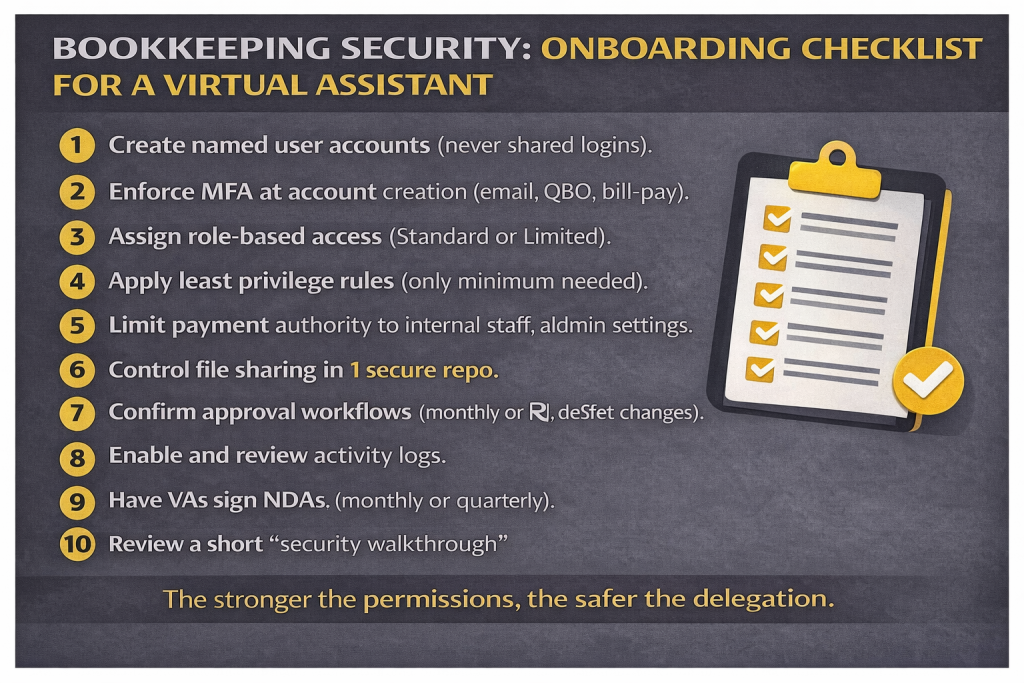
Provision a company-owned password manager, 1Password, LastPass, or Okta for larger teams, and share credentials through the vault rather than a message or a spreadsheet, so the VA never sees a raw password at all. Configure Production-lane access in QuickBooks Online or Xero as a Standard, limited role before the VA’s first login, not after. Route every invoice and receipt through Dext or Hubdoc from day one. Enforce dual-authorization on Bill.com or Melio so no payment executes without the owner’s separate mobile approval. Collect a signed W-9 as part of onboarding rather than reconstructing contractor records the following January. Enable activity logs, and review access quarterly, revoking it immediately the day any engagement ends, not whenever someone remembers to.
The Debate Worth Having
Some founders optimize for speed and grant broad access to avoid friction. Others optimize for safety and slow delegation down until it barely helps at all. The system above resolves that tension by design rather than by compromise: A VA moves fast inside a well-defined Production lane, while Movement and Admin stay gated behind approvals no single person, however trusted, can bypass alone.
The real question isn’t whether to trust a virtual assistant. It’s whether the business has built a structure where that trust is never the only thing standing between the books and a fraud loss. A business that answers yes has turned security into a routine. A business still relying on personality and hope has a policy document, not a system, and the difference only becomes visible at the exact moment it matters most.
