

Most real estate teams do not lose deals because they lack leads. They lose momentum because the contract-to-close process turns into a daily scramble of missing signatures, unclear deadlines, and last-minute surprises. When you are juggling multiple files at once, small admin mistakes become expensive distractions. A real estate transaction coordinator solves that by turning closings into a repeatable system instead of a hero effort.
If your agency is closing enough volume that you feel busy all day but still behind, you are already paying the price of weak transaction operations. Clients experience that chaos as slow updates, confusing next steps, or avoidable delays. Lenders and title teams experience it as missing items and late responses. A dedicated coordinator, or a virtual specialist, removes that friction and protects your reputation at scale.

What is a real estate transaction coordinator?
A real estate transaction coordinator is the person who manages the operational work that happens after a deal goes under contract. They track deadlines, organize documents, and keep communication moving between the buyer, seller, agents, lender, escrow or title, and vendors. Many teams also call this role a closing coordinator, contract-to-close specialist, or file manager, depending on the brokerage model. The goal is simple: keep every moving part aligned so the transaction closes cleanly and on time.
What does a transaction coordinator do from contract to close?
The easiest way to understand the role is to think of it as timeline ownership. A coordinator builds the checklist, assigns due dates, and makes sure every party follows through before a deadline becomes an emergency. They also prevent silent stalls where a document was sent but not received, reviewed, or approved. When done well, their work is quiet, consistent, and measurable because fewer deals drift into last-minute panic.
Process diagram: contract-to-close workflow (place this visual here)
Step 1: Contract accepted → file opened
Step 2: Escrow/title opened → key dates confirmed
Step 3: Disclosures delivered → signatures tracked
Step 4: Inspections scheduled → reports collected
Step 5: Repair requests/addenda managed → timelines updated
Step 6: Appraisal ordered and followed up → issues flagged early
Step 7: Lender conditions tracked → underwriting stays moving
Step 8: Closing scheduled → final docs confirmed
Step 9: Funding and close → compliance file completed
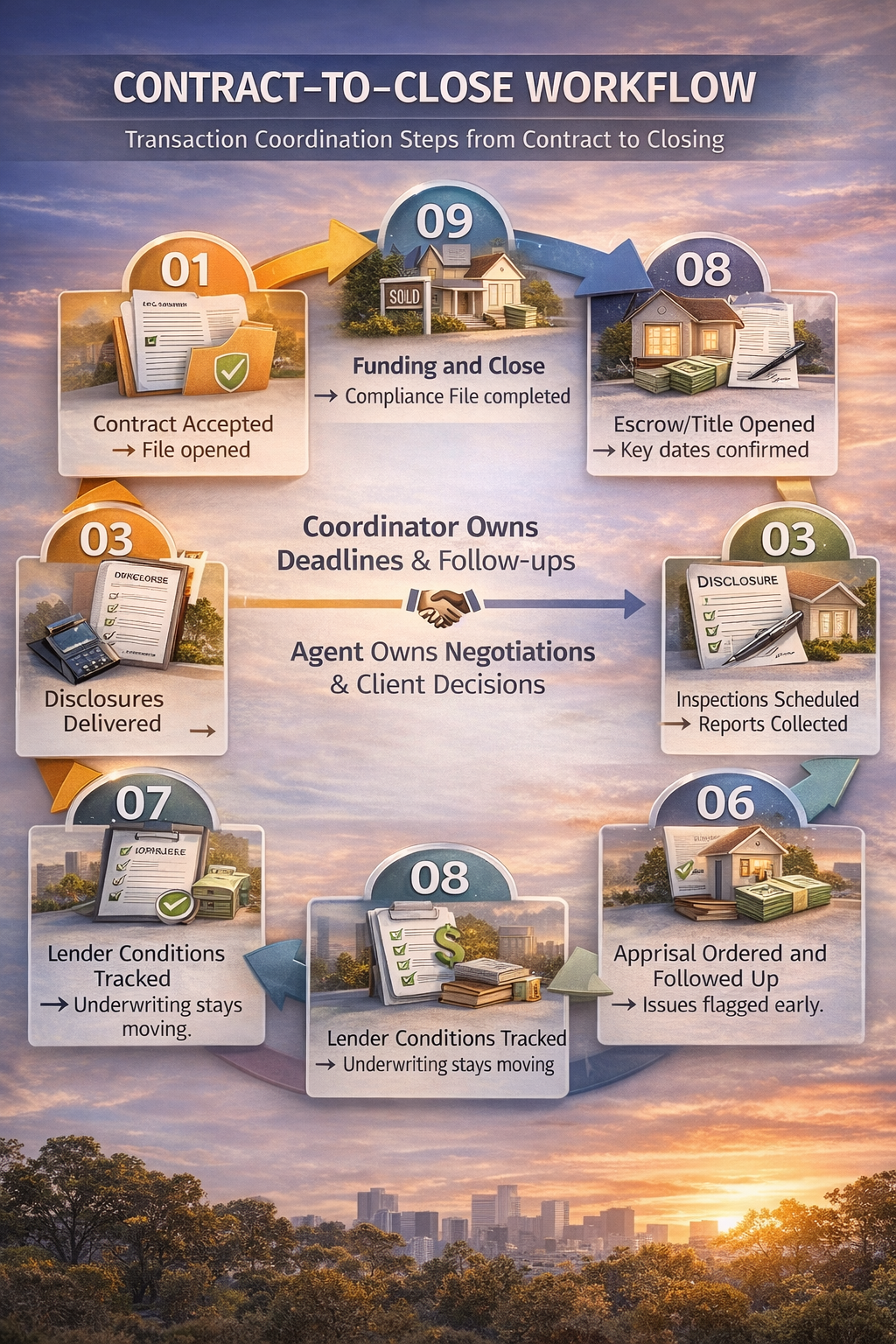
Use this as a simple diagram with arrows between steps, plus a small side note that the TC owns deadlines and follow-ups, while the agent owns negotiations and client decisions. Keep it clean and scannable so readers immediately “get” the system.
A coordinator typically handles:
- Opening Escrow/Title: Initiating the file with the title company and confirming everything is set up correctly.
- Kickoff Communication: Sending an intro email with key dates, contacts, and the next actions for every party.
- Deadline Calendar: Building the contract timeline and tracking every contingency date so nothing slips quietly.
- Disclosures and Signatures: Routing documents, chasing signatures, and confirming receipt rather than assuming it arrived.
- Inspections and Vendors: Scheduling inspections, coordinating access, and keeping reports and invoices organized.
- Appraisal Follow-Up: Tracking appraisal scheduling, nudging for updates, and escalating issues before deadlines hit.
- Lender Conditions: Monitoring underwriting requests and making sure required documents are delivered and acknowledged.
- Addenda Management: Organizing amendments, ensuring correct versions are signed, and updating the timeline as terms change.
- Closing Logistics: Confirming closing date/time, final numbers, and signing requirements so closing day is calm.
- Compliance Close-Out: Finalizing the file for brokerage compliance and proper record retention.

Why do agencies and agents need a closing coordinator?
Because transaction volume creates complexity faster than most people expect. The more deals you run at the same time, the more your day becomes reactive, and reactive teams miss details. A coordinator keeps the back office stable so agents can focus on negotiations, client trust, and new business. In practical terms, this is what allows a team to scale beyond the point where the agent becomes the bottleneck.
There is also a client experience angle that most agencies underestimate. Buyers and sellers do not see your internal workload; they only feel response time and clarity. When updates are consistent and milestones are handled proactively, clients feel in control, even when problems come up. That confidence leads to better reviews, fewer complaint calls, and more referrals.

How does a contract-to-close specialist reduce risk and compliance issues?
Real estate transactions are paperwork-heavy for a reason: the process is regulated, time-bound, and highly documented. A missed signature, an expired contingency date, or an incomplete disclosure packet can delay closing or create disputes after closing. Coordinators reduce that risk by running consistent checklists and verifying completion, not just sending requests. They also help brokerages maintain clean compliance files, which matters for audits and internal risk management.
Compliance requirements vary by state and brokerage policy. Some tasks may require licensed supervision, and some brokerages require specific forms and retention rules. A good coordinator works within your brokerage standards rather than freelancing the process. That is why hiring should include a clear scope, a checklist, and a defined escalation path for anything legal or advisory.
What software should a transaction coordinator know?
Modern transaction coordination is not only about being organized, but it is also about being fluent in the tools your team already uses. If a coordinator cannot work inside your transaction platform, documents will still pile up, and updates will still be late. The best hires are comfortable jumping between systems, keeping data consistent, and maintaining a single source of truth. This also matches how people search, because many queries include the tool name, not just the job title.
Common platforms include transaction management tools like SkySlope, Dotloop, Brokermint, Lone Wolf Transactions, and Paperless Pipeline, plus e-signature tools like DocuSign and Adobe Acrobat. Many teams also expect CRM updates in Follow Up Boss, kvCORE, LionDesk, or Chime, depending on the brokerage stack. Communication usually runs through Gmail or Outlook, plus Slack or Microsoft Teams for internal handoffs. If your coordinator already knows your stack, onboarding is faster, and mistakes drop immediately.
Real Estate Transaction Coordinator Cost: In-house vs. VA models
Cost depends on whether you hire in-house, contract a local coordinator, or outsource the function. In-house hires come with salary, payroll overhead, onboarding time, and management time, even before they touch their first file. Outsourced coordinators often charge per file, on a monthly retainer, or as a hybrid model based on workload and complexity. What matters is not the cheapest option; it is the option that protects closings while freeing agent time.
A common pricing model is a flat fee per transaction, especially for residential files, while some providers use monthly retainers for a defined number of active files. If you are comparing options, do not ignore hidden costs like slow onboarding, inconsistent follow-up, or a coordinator who only uploads paperwork but does not manage timeline ownership. Ask what is included, because vendor coordination, lender follow-up, client updates, and compliance close-out are not always part of basic file management. Your real cost is the amount of agent time the coordinator actually gives back.
Should you hire in-house, outsource locally, or use a virtual model?
Hiring in-house makes sense when your agency has consistent volume, clear processes, and enough transactions to keep a coordinator fully utilized. Local outsourcing can work well if you want a specialist who already knows your state forms and your preferred workflow. A virtual model makes sense when you want flexibility, fast scaling, and lower overhead without sacrificing operational coverage. The right choice depends on deal volume, brokerage compliance requirements, and how standardized your process already is.
Compare based on outcomes instead of labels. Can this person own the timeline without constant reminders from the agent? Can they work in your software stack without months of training? Can they keep communication tight with lenders, title, and clients so that issues surface early? If the answer is yes, the model matters less than the execution quality.
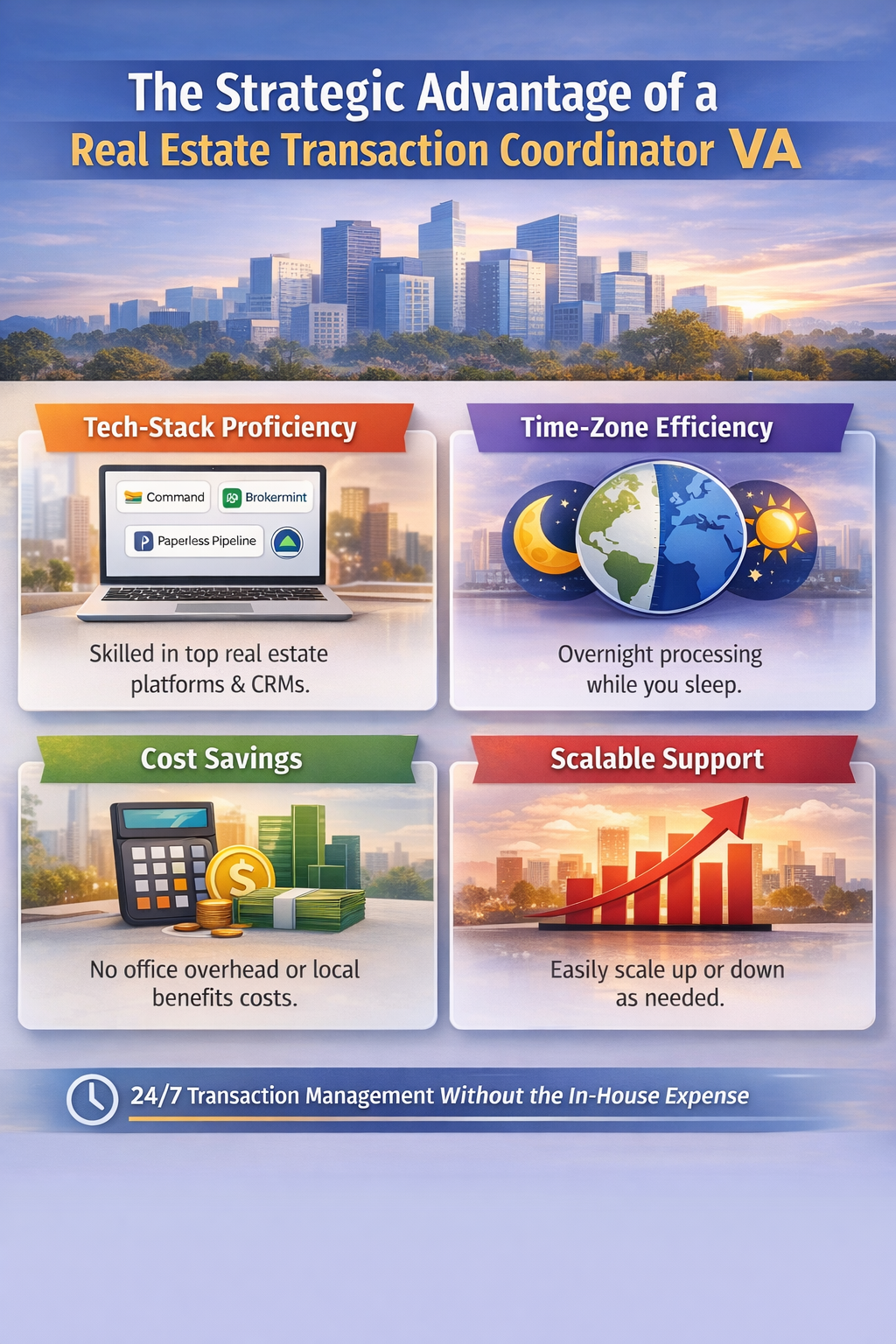
The strategic advantage of a Real Estate Transaction Coordinator VA
Many agencies assume they must hire locally to get reliable contract-to-close support. In reality, a Real Estate Transaction Coordinator VA can deliver the same operational ownership without the fixed overhead of a full-time, in-office hire. This model is especially useful when volume fluctuates, because you can scale support up or down without rebuilding your entire back office. The result is higher margins and fewer operational bottlenecks.
Tech-stack proficiency without the long ramp-up
A strong TC VA should be able to step into your existing tools and run your files without reinventing the system. That includes transaction platforms, e-signature workflows, shared drives, and your CRM updates. When software onboarding is short, the agency gets value faster and avoids the two-month training trap. Hiring through a specialist provider also helps because the talent pool is filtered for real estate operations experience.
Time-zone leverage that keeps files moving
Virtual coordinators in South Africa or the Philippines can create a practical advantage for busy US teams. The work does not stop when the agent’s day ends, because checklists, document requests, and file updates can continue outside US business hours. That means a contract sent late afternoon can be organized, logged, and queued for the next day’s follow-ups before the agent is back online. The agency feels more responsive without forcing agents into late-night admin.
Pro tip: time-zone “night shift” advantage
When you hire a Real Estate Transaction Coordinator VA in a different time zone, you can create a quiet operational edge. Late-evening contracts can be processed overnight, and your morning starts with escrow opened, timelines built, and signature requests already out. This reduces next-day lag and keeps deals moving without adding pressure to the agent’s personal time. If you want to convert this into clicks, link this box to your Real Estate VA service page using natural anchor text like “transaction support without hiring in-house.”
Lower infrastructure cost without lowering standards
A VA model removes the need for desk space, local equipment budgets, and many payroll-related costs that come with in-house headcount. Those savings are only valuable if the coordinator still owns outcomes, not just tasks. The standard should be simple: fewer missed deadlines, cleaner files, faster responses, and smoother closings. When the coordinator is measured on file health and timeline accuracy, the quality stays high while overhead stays controlled.
How to onboard a transaction coordinator so it actually works.
Most transaction coordinator hires fail because the agency hands over chaos and expects the coordinator to figure it out. Start with a single contract-to-close checklist that reflects your brokerage requirements and your preferred communication style. Then define ownership clearly: what the coordinator handles, what the agent handles, and what gets escalated immediately. When those boundaries are clear, the coordinator can move fast without creating risk.
Use a short weekly file review to keep quality high without micromanaging. You should be scanning for deadlines, lender conditions, appraisal status, inspection results, and anything that could delay closing. The coordinator should arrive with a short list of risks and next actions for each file, not a vague status report. That rhythm prevents surprises and keeps agents focused on revenue work.
Conclusion: Do you need one?
If you are closing a small number of deals at a time, you can often manage the admin load through discipline and good templates. Once you are running multiple active files at once, coordination becomes a revenue lever because it directly impacts agent time and client experience. A transaction coordinator, whether in-house or virtual, is the role that turns closings into a system. If your agency wants to grow without creating chaos, this is one of the highest-leverage operational hires you can make.
3 key takeaways
A transaction coordinator owns the contract-to-close timeline, documents, and follow-up so agents do not become the bottleneck. Teams scale faster when they standardize tools and checklists, especially in platforms like SkySlope, Dotloop, Brokermint, or Paperless Pipeline. A Real Estate Transaction Coordinator VA can reduce overhead while keeping files moving through time-zone coverage and proven process execution.
Not sure what to outsource or what your coordinator should own?
If you are deciding between hiring in-house, outsourcing locally, or using a transaction coordinator VA, the fastest path is to map your workflow and identify where deals stall. Once you know the stall points, it becomes easy to define the role, the checklist, and the tools required. Aristo Sourcing can help you scope the position and match you with a real estate operations specialist who works inside your systems. Book a free hiring consultation to get a clean plan and a realistic support model for your current deal volume.
