

Benefits administration outsourcing isn’t just a cost-cutting tactic, it’s now essential for scaling compliance, reducing risk, and modernizing the employee experience. But is it right for your business in 2026?
What Is Benefits Administration (and Why You’re Probably Doing Too Much Manually)
Employee benefits administration covers everything from open enrollment (OE) and ACA reporting to COBRA notices and 50-state compliance with Paid Family Leave (PFL) and State Disability Insurance (SDI) laws. Managing this in-house strains most HR teams especially without a compliance-ready system or benefits tech stack.
If you’re still distributing Summary Plan Descriptions (SPDs) via email or tracking Qualifying Life Events (QLEs) in spreadsheets, your company is exposed to legal and operational risk.
What Is Outsourced Benefits Administration?
Outsourced benefits administration shifts HR compliance, employee enrollment, and vendor communications to third-party experts. Providers operate under three models:
- HRO (Human Resources Outsourcing): Full-service support without co-employment.
- PEO (Professional Employer Organization): Co-employment model offering bundled benefits and payroll.
- ASO (Administrative Services Organization): Handles administrative tasks while you retain employer-of-record status.
Each model fits different company sizes, goals, and compliance needs.
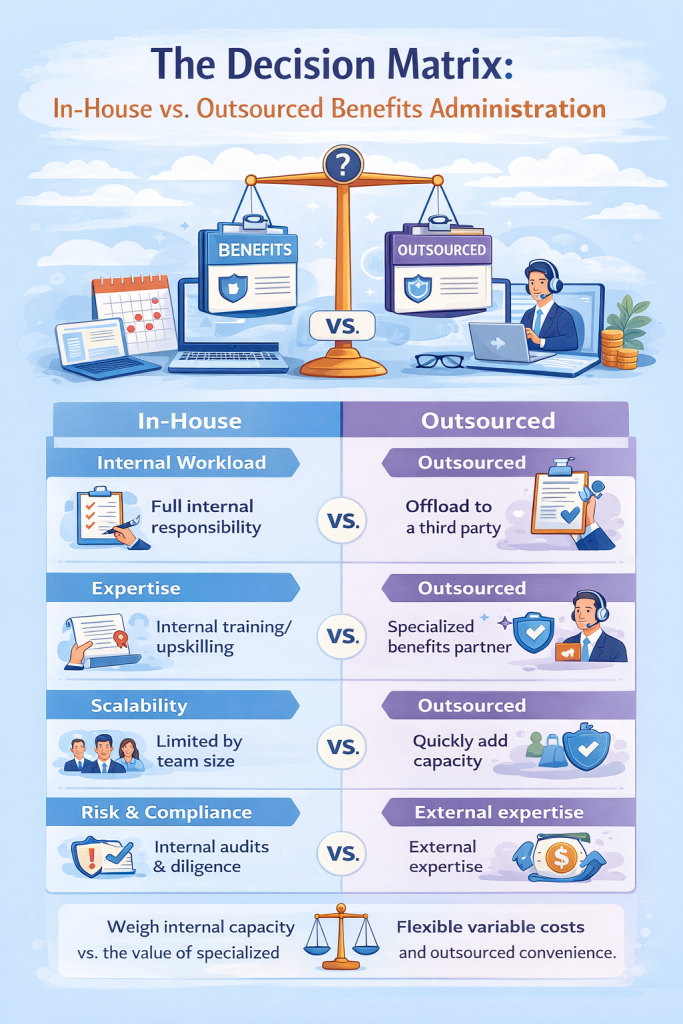
The Decision Matrix: In-House vs. Outsourced Benefits Administration
| Feature | In-House | Outsourced (HRO, PEO, ASO) |
|---|---|---|
| ACA Compliance | Manual 1095-C prep; audit risk | Automated tracking & audit defense |
| Form 5500 Filing | HR/legal responsibility | Provider-prepared and filed |
| State Compliance | Risk of missing PFL, SDI updates | Pre-programmed compliance engine |
| Tech Stack | Basic HRIS, often siloed | Cloud-based portals, mobile UX |
| Employee Support | Direct but slow | Instant chat, phone, app |
| Scalability | Dependent on HR headcount | Real-time scaling with headcount |
| Cost Clarity | Fixed salaries, vendor mix | Per employee/month (PEPM) pricing |
| Customization | High control, high effort | Depends on provider flexibility |
Why Employers Are Shifting to Outsourced Benefits Admin
1. ACA Penalties Haven’t Slowed: Automation Prevents Fines
As of 2026, IRS audit rates for mid-market ACA filings remain at historic highs. Non-compliance with Form 1095-C or ESRP reporting can trigger penalties exceeding $2,880 per employee annually.
Outsourced providers automate:
- 1095-C/1094-C tracking
- Employee eligibility analysis
- ESRP safe harbor calculations
- Filing to IRS AIR system
For example: Over 62% of midsize U.S. firms faced at least one ACA penalty or audit flag due to manual filing errors. (Source: Mercer Benefits Outlook, 2025)
2. Employees Expect Portals, Not PDFs
Gen Z and Millennial workers demand mobile-first benefits. Self-service enrollment, real-time FSA tracking, and chatbot QLE guidance are now table stakes.
Most in-house teams can’t offer this without investing six figures in tech outsourcing delivers it instantly.
“We cut open enrollment time by 78% with an outsourced system that handled plan comparisons, carrier feeds, and employee updates without us touching a spreadsheet.” Director of People Ops, SaaS firm, 90 employees
3. Health Insurance Costs Keep Rising — PEOs Pool Buying Power
Health premiums rose 6.8% in 2025, and early 2026 forecasts expect a similar climb. Small and midsize firms can’t match enterprise rates but PEOs can.
PEOs bundle thousands of workers into a single group plan. A 52-person logistics company in Texas cut monthly premiums by $192 per employee by switching from a regional broker to a PEO partner.

Common Misconceptions And What’s Actually True
“We’ll lose control of our benefits strategy.”
You won’t unless you choose to. ASOs and many HROs allow full control of plan design and broker choice. You decide; they execute.
“Employees will hate call center support.”
Most top-tier providers assign dedicated account teams and offer in-app help desks. It’s faster than overwhelmed in-house HR.
“It’s expensive.”
In reality, fully loaded HR admin costs (salary, compliance risk, penalties, software) often exceed what vendors charge per head.
What to Look For in a 2026 Benefits Administration Vendor
Must-Have Features:
- ACA penalty defense automation
- SPD and Section 125 plan generation
- COBRA and QLE automation
- Preloaded PFL/SDI compliance by state
- Native integrations (Gusto, Rippling, Paychex)
- Employee mobile access and HR analytics
Who Should Stay In-House?
- Companies with a full-time compliance analyst and benefits manager
- Firms using all-in-one systems (e.g., Workday) already supporting benefits workflows
- Organizations with collective bargaining agreements requiring internal plan control.
Final Verdict: Outsourcing Isn’t a Shortcut. It’s a Modern HR Strategy
Employers can’t afford outdated, manual benefits administration. Between ACA audits, state law changes, and rising expectations for digital access, outsourcing shifts HR from reactive to strategic.
If your benefits team still juggles COBRA notices, 5500 filings, and open enrollment spreadsheets, the risk isn’t outsourcing, the risk is standing still.
What is the difference between a PEO and an HRO in benefits administration?
The difference between a PEO and an HRO in benefits administration is that a PEO creates a co-employment relationship and offers benefits through its own group health plan, while an HRO allows employers to retain plan sponsorship and only outsources administrative functions.
How does outsourcing handle multi-state compliance for employee benefits?
Outsourced benefits administration handles multi-state compliance by using compliance engines preloaded with state-specific requirements, including SDI, PFL, and mandated notice laws. These engines automatically update with regulatory changes across all 50 states.
Can I keep my current insurance broker while outsourcing benefits?
Employers can keep their current insurance broker when outsourcing benefits. ASO and HRO providers manage administration only and do not replace the employer’s existing benefits advisor.
What risks does outsourced benefits administration help reduce?
Outsourced benefits administration helps reduce risks such as ACA penalties, COBRA violations, missed Form 5500 filings, SPD distribution failures, and non-compliance with state programs like NY DBL and CA PFL.
How long does it take to implement an outsourced benefits solution?
Implementing an outsourced benefits solution typically takes 4 to 8 weeks. The timeline includes plan migration, system configuration, and employee onboarding.
