
Architects don’t lose commissions because they lack design talent. They lose them because the firm down the street shows up first when a developer searches for “mixed-use mass timber architect Seattle,” or because a competitor’s Houzz profile carries forty fully tagged project galleries while theirs sits at four outdated photos nobody has touched since the site launched.
Marketing for architecture firms isn’t about chasing traffic or publishing generic blog posts. It’s about showing up, with proof, at the exact moment a prospective client builds a shortlist. Hinge Research found that 84% of architecture, engineering, and construction clients visit a firm’s website before they ever pick up the phone, and a nearly identical share rules a firm out entirely because of what they find there. Marine Sargsyan, head of economic research at Houzz, put the broader industry mood this way heading into 2026: design and construction firms are operating with “a measured but resilient outlook,” investing more heavily in tools and productivity even as new project activity softens. That combination, cautious budgets and a website that can make or break a firm before a call even happens, is exactly why marketing can’t stay an afterthought.
Most marketing advice aimed at architects misses the point entirely. It treats a design practice like a generic small business and hands over the same loop every other industry gets: post more, blog more, email more. None of that is useless exactly, but it skips the part that determines whether you actually win the commission, which is that architects don’t sell the way a retail brand sells. You sell through portfolios, through platforms built specifically for visual work, and through sales cycles that can run twelve to eighteen months on the institutional side. A generic content calendar can’t navigate that. A system built around how firms actually win work can.

The Money Already Shows the Split
Architecture firms now spend an average of 6% of gross revenue on marketing and business development, up from roughly 1.5% to 2% a decade ago. That jump tells you something on its own: firms that used to coast entirely on referrals have figured out referrals alone don’t scale fast enough anymore.
That 6% average hides a real divide, though, and the divide matters more than the headline number.
| Practice type | Typical marketing spend | Sales cycle | Where the work actually gets won |
|---|---|---|---|
| Commercial and institutional | 7% to 10% of revenue | 12 to 18 months | RFPs, RFQs, LinkedIn relationships, trade press, design awards |
| Custom residential | 8% to 12% of revenue | 3 to 6 months | Houzz, Pinterest, Instagram, local map search |
Institutional and commercial work makes up more than half of total architecture firm billings industry-wide, and those commissions get won through formal solicitations with evaluation committees and scoring criteria. By the time a developer or municipality publishes the RFP, the shortlist already exists in the selection committee’s head, built from firms they’ve seen in the trade press, run into on LinkedIn, or recognized from a regional award. Show up after the solicitation drops, and you’re not competing anymore. You’re filling out paperwork for a decision that’s already been made.
Custom residential practices run a different race entirely. They win one household at a time, with no procurement officer standing between the homeowner and the decision. That buyer’s journey runs through Pinterest boards and local map searches for a specific aesthetic, not through a scoring matrix. A blog post titled “Five Mistakes to Avoid in Your First Renovation” might catch that homeowner early. It does nothing for a developer’s project manager searching for a firm with documented experience navigating a steep-slope zoning variance. Treating both buyers the same way wastes effort in both directions.
The Objection Nobody Says Out Loud
Here’s the real reason a lot of principals never hire help with marketing, even when they know they need it: they’re convinced a remote assistant will misuse architectural terms, post a stock photo that looks nothing like their work, and quietly chip away at a visual identity they spent fifteen years building. That fear is reasonable. Architects train for years to develop an eye, and handing public-facing content to someone who can’t tell a curtain wall from a rainscreen feels like a genuine risk.
A generalist VA who answers emails and occasionally drafts a caption doesn’t fix this. It confirms the fear. The actual fix is a different role: a specialized assistant who acts less like an admin and more like a visual asset coordinator, someone who never touches a design decision but takes full ownership of what happens to a finished project after it leaves your hands.
| What this VA never touches | What this VA owns completely |
|---|---|
| Design decisions or CAD and BIM files | The image renaming, tagging, and upload pipeline |
| Client relationships and proposals | Houzz, Pinterest, and Google Business Profile updates |
| The firm’s written voice on sensitive matters | SF330 document libraries and award entry assembly |
| Creative direction on new projects | RFP and RFQ deadline tracking |
That split is the wholesale. You’re not handing over your design judgment. You’re handing over the administrative grind of distributing work you already finished, which is precisely the part most principals never get around to anyway.
The Image Pipeline Search Engines Actually Read
A search engine can’t look at a photograph and recognize good proportion or material honesty. It reads file names, alt text, and metadata. A firm that uploads forty unoptimized photos straight from a photographer’s delivery folder is invisible to the exact visual searches that should be finding that project.
A specialized VA runs the same sequence every time a finished project comes back from the photographer:
- Pull the raw files into a structured archive. Every TIFF or RAW image gets sorted into a digital asset management system using a consistent tag built from the year, the project name, the phase, and the component shown, so a five-year archive stays searchable instead of turning into an unlabeled pile.
- Rename every file for the search, not the camera. A photo that arrives as a random string of numbers becomes something like “modern-concrete-living-room-west-lake-hills-austin.jpg,” built from the material, the style, and the neighborhood, because that’s the exact combination someone actually types into Google.
- Compress for speed without losing quality. Each image gets converted into a modern web format that keeps file sizes small, because page speed is its own ranking factor, and a slow gallery loses visitors before they see a single photo.
- Write alt text for the search, not for compliance. Each image gets a specific description naming the material, the style, and the location, instead of a generic caption written to check a box.
- Publish on a schedule, not whenever someone remembers. The finished gallery goes live on the website within a set window after handover, so the project is working for the firm while it’s still fresh, instead of six months later.
None of this requires creative judgment. It requires patience and consistency, which is exactly the kind of work a busy principal never gets to, no matter how much they know it matters.

Owning the Map, Not Just the Website
For a regional firm, the local map result matters more than almost anything else in the search results. When someone searches “residential architect near me” or “commercial architecture firm Denver,” Google’s local results show up above standard organic listings, and a static, neglected profile loses that spot to a competitor who treats their listing as a living asset.
A VA runs these updates on the Google Business Profile every time a project reaches substantial completion, attaching a short case summary that names the neighborhood and the specific permitting challenge solved, paired with photos pulled from the already-optimized batch. They run a structured review request process right after closeout instead of hoping a happy client remembers on their own, and they make sure the listed service areas actually match the neighborhoods the firm wants to be found in.
This same logic extends into a part of local SEO almost nobody touches: the regulatory language tied to a project’s location. Zoning categories, preservation rules, and floodplain requirements aren’t just compliance footnotes. They’re search terms a client in that exact situation is typing right now.
| Local entity | What it actually signals | Where it belongs in your content |
|---|---|---|
| Historic Preservation Overlay District | The firm has navigated a HPOD design review board | Project case study, service page for that neighborhood |
| FEMA floodplain elevation requirements | The firm has handled base flood elevation and freeboard rules | Coastal or waterfront project write-ups |
| Steep-slope or hillside zoning variance | The firm can manage geotechnical and grading restrictions | Hillside project pages, local SEO landing pages |
| Accessory dwelling unit ordinances | The firm understands current ADU permitting paths | Blog content and FAQ pages targeting that search term |
A firm that has handled a renovation inside a designated historic district has language worth surfacing explicitly, because a homeowner sitting in that exact situation is searching for proof someone has solved this specific problem before, not just proof the firm designs nice buildings in general.
Treating Houzz and Pinterest as Search Engines, Not Feeds
Houzz and Pinterest function as dedicated search engines for visual research, and most firms treat them like generic social accounts, which wastes most of what these platforms can do. Architecture and planning firms already make up roughly 11% of Houzz Pro’s professional user base, which means the competition for visibility inside that platform is real, not hypothetical.
On Houzz, a project belongs in a structured project gallery, not a single uploaded photo. Each image gets tagged with the specific materials shown, the cabinetry brand, the door hardware, and the flooring, because Houzz surfaces projects based on those tags when someone searches for that exact finish. Projects also need a specific style category rather than a generic label like “modern,” since granular tagging, something closer to “warm minimalism,” is what gets a project in front of someone searching for a precise aesthetic instead of a broad one.
Pinterest rewards a different approach. A single project shouldn’t produce one pin. It should produce several, each built around a different angle of the same work: one focused on the exterior facade and tagged toward that architectural style, another focused on a specific material pairing a renovation client might be hunting for by name, and a third focused on the floor plan for people researching layout rather than finishes. Every pin links back to the project page on the firm’s own site, which means one photo shoot can generate qualified visitors for years after the project wraps.

The Commercial Side Runs on Pipelines, Not Posts
A firm chasing commercial and institutional work needs an entirely different system, one built around tracking opportunities and maintaining qualification documents. A VA supporting this side monitors the procurement portals and bid boards relevant to the firm’s region, logging upcoming capital projects long before they become live solicitations. Hence, the firm has lead time to build visibility before the opportunity is public.
When a federal, state, or public solicitation requires a formal qualifications package, the requirement usually comes down to Standard Form 330, the document required under the Brooks Act for nearly all federal architecture and engineering procurements over $25,000. The form has a specific structure, and keeping it current is tedious in a way that has nothing to do with design skill:
- Part I covers the contract-specific qualifications for the particular project being bid.
- Part II covers the firm’s general qualifications and stays largely consistent across submissions.
- Section E, inside Part I, holds the resumes of the key personnel who would actually work on the project.
- Section F, also inside Part I, holds example projects meant to demonstrate relevant experience for that specific solicitation.
Someone has to update the resumes when a team member’s role changes, rewrite the project examples to match what each solicitation is actually asking for, and keep a clean master file so the next submission takes hours instead of starting from scratch under deadline pressure. A VA who owns this library, updating it every time a relevant project closes, turns SF330 submissions from a recurring fire drill into routine paperwork.
Design awards do double duty here, which a lot of firms underuse. A submission to a regional AIA chapter award isn’t just a credibility line for the website. Award recognition routinely earns coverage and backlinks from architecture press and industry directories, the kind of high-authority links that are hard to earn any other way. A VA who tracks submission windows and handles the formatting and assembly of entries turns something most practices forget about into a recurring source of press and search authority.
What One Finished Project Actually Becomes
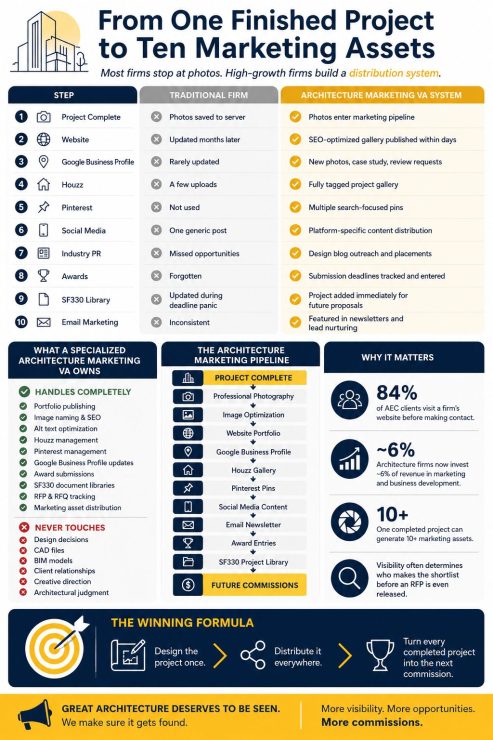
Picture a residential firm finishing a waterfront renovation outside Austin. The architect does the final walkthrough, and the photographer delivers forty images. In most firms, those photos get saved to a server, a handful go up on Instagram, and the rest never see daylight again. With a coordinator running the pipeline, that folder turns into this instead:
| Asset | What gets published |
|---|---|
| Website portfolio page | A tagged, compressed gallery lives within two days of handover |
| Houzz project gallery | Twenty images with material and fixture tags attached |
| Pinterest board | Multiple pins are split across the facade, materials, and layout |
| Instagram carousel | Real material and design notes instead of a generic caption |
| Google Business Profile | Updated location, case summary, and fresh photos |
| Local design blog feature | A short write-up framed around the permitting challenge solved |
| Email newsletter | The project featured the firm’s existing client and lead list |
| Award entry | Logged for the next relevant cycle with images pre-assembled |
| SF330 library update | Project examples pulled into Section F for future submissions |
| Blog post | A piece answering what a project like this actually costs in that area |
That’s ten distinct pieces of distribution from one project, none of which required the architect to write a line of marketing copy or spend an evening compressing files at midnight.
Hiring for This Without Guessing
If you’re convinced this role belongs on your team, the vetting matters more than the rate.
- Test the file naming. Hand a candidate one unoptimized image and ask what file name and alt text they’d write before it goes near your website. A generic answer means they don’t have the skill you need.
- Test the platform knowledge. Ask whether they’ve worked inside Houzz Pro or Pinterest’s business tools, not just a generic social scheduler, and ask them to explain why a Pinterest pin and an Instagram post get treated differently.
- Test the document discipline. Ask how they’d track a multi-stage SF330 submission or an award entry deadline without needing daily check-ins from you.
- Run a single-project trial. Hand over one recently completed commission and watch how they handle it end to end, from the raw photo folder to the published gallery to the local listing update.
The firms pulling ahead aren’t doing fundamentally better design work than everyone else. They’ve just stopped letting finished projects sit in a folder while competitors turn theirs into the next commission.
Take Your Architecture Firm to the Next Level
Stop letting marketing hold you back from focusing on what you do best—designing extraordinary spaces. Hire a virtual marketing assistant today to manage your inbound marketing, create engaging content, and attract qualified clients without adding to your workload.
- Save time and focus on design.
- Increase your online visibility and leads.
- Access specialized marketing skills at a fraction of the cost
Book a free consultation today and discover how a skilled virtual assistant can transform your firm’s marketing, freeing you to create while your business grows.
Frequently Asked Questions
How can a virtual marketing assistant improve my architecture firm’s online visibility?
A virtual marketing assistant can increase your architecture firm’s online visibility by managing key inbound marketing activities such as SEO, blogging, social media, and email campaigns. They optimize your website for relevant keywords like “modern eco-friendly home design” or “residential architect near me,” ensuring your firm appears higher in search results. According to HubSpot, inbound leads cost 61% less than outbound leads, showing that consistent, optimized content drives cost-effective traffic. By having a VA maintain fresh content and engage with social media followers, architects can attract more qualified leads without adding extra workload.
What tasks can a virtual assistant handle for architecture inbound marketing?
A virtual assistant can take over repetitive and time-consuming marketing tasks, allowing architects to focus on design work. This includes blog research and writing, SEO optimization, social media posting, email newsletter management, and lead tracking. For example, a VA can create blog posts like “5 Mistakes to Avoid in Your First Renovation” or manage Pinterest boards that showcase completed projects, attracting potential clients. According to the American Institute of Architects, 84% of clients check a firm’s website before making contact, so having a VA ensure your content is relevant and engaging can directly influence client acquisition.
How do I choose the right virtual assistant for my architecture firm?
Selecting the right VA requires evaluating both marketing skills and industry knowledge. Look for assistants with experience in digital marketing, content creation, and social media, preferably with some familiarity with architecture or design. Start with a trial project and ask for writing samples or case studies that demonstrate measurable results. Use collaboration tools like Slack, Loom, and Google Docs to monitor performance and provide feedback. Hiring a skilled VA can save you time, improve lead management, and allow your firm to grow its online presence efficiently.
