

The 4-day work week has moved from a theoretical concept to a practical business strategy. Companies across the United Kingdom, the United States, and Iceland have tested reduced working hours with measurable results. The core principle behind this shift is the 100:80:100 Rule, where employees receive 100 percent of their pay for 80 percent of the time while maintaining 100 percent of the output. This model does not reduce work; it forces companies to eliminate inefficiencies and focus on what actually drives results.
Many leaders assume that fewer hours will reduce productivity. Evidence from 4 Day Week Global challenges that assumption and shows that output often remains stable or improves. Organisations that succeed do not ask employees to work faster. They redesign how work happens by removing low-value tasks and tightening workflows. A shorter week exposes operational weaknesses that a traditional 5-day structure often hides.

The Real Constraint Is Not Time, It Is Efficiency
Time does not determine productivity. Focus, clarity, and execution determine productivity. Professor John Pencavel of Stanford University demonstrated that output declines significantly after 50 hours per week, and productivity collapses beyond 70 hours. Longer workweeks do not increase results; they introduce fatigue, errors, and diminishing returns.
A 4-day work week forces businesses to prioritise. Teams must decide what work actually matters and what work exists only because it always has. This shift replaces time-based work with outcome-based work. Companies stop measuring effort and start measuring impact.
As Peter Drucker stated, “There is nothing so useless as doing efficiently that which should not be done at all.” The 4-day work week operationalises this principle. It removes unnecessary work and sharpens focus on meaningful output.

Parkinson’s Law and the Illusion of Busyness
The traditional 5-day work week encourages inefficiency through Parkinson’s Law, which states that work expands to fill the time available. When employees have 40 hours, tasks stretch to fill 40 hours. Meetings become longer, communication becomes slower, and low-priority work gains unnecessary attention. This creates the illusion of productivity without delivering meaningful results.
A 4-day work week introduces constraints that force efficiency. Teams must define priorities, reduce unnecessary communication, and execute tasks with greater clarity. Time-boxing replaces open-ended work, and deadlines become more intentional. Work no longer expands; it compresses.
However, this shift creates pressure on teams that still handle administrative work. If employees continue to spend hours on emails, scheduling, and coordination, they will struggle to maintain output within fewer hours. The problem does not come from fewer days. The problem comes from how time is used.
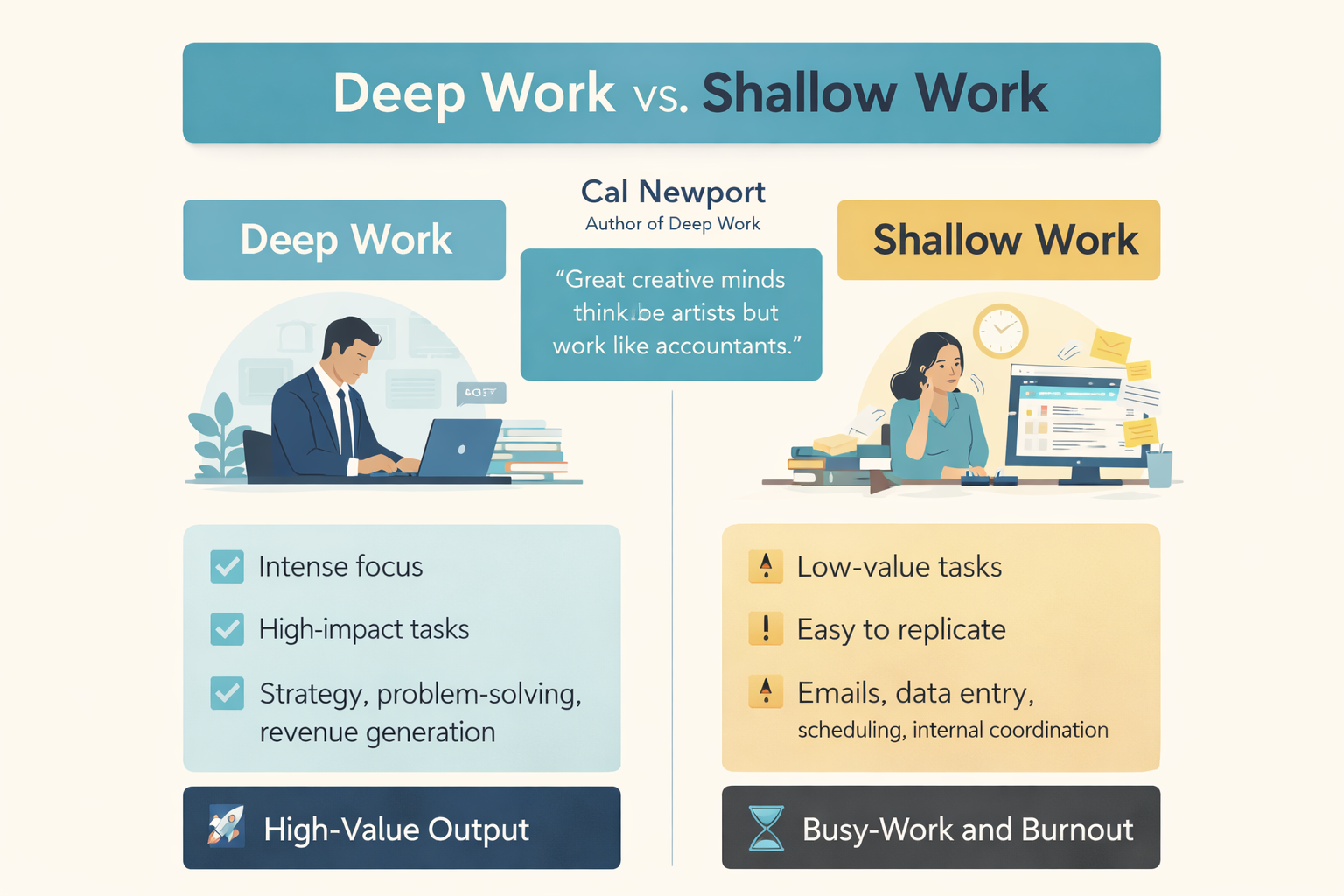
Deep Work vs. Shallow Work
Not all work produces equal value. Cal Newport, author of Deep Work, defines deep work as focused, high-impact activity that drives real results. He defines shallow work as low-value tasks such as email management, scheduling, reporting, and administrative coordination. Most professionals spend a large portion of their day on shallow work without recognising its cost.
A 4-day work week makes this imbalance visible. Companies cannot maintain output if their teams spend hours on low-impact tasks. They must protect time for deep work, where strategy, problem-solving, and revenue generation happen. This shift becomes essential rather than optional.
A sales executive should focus on closing deals, not updating a CRM. A business owner should focus on strategy, not managing an inbox. High-performing organisations separate deep work from shallow work and assign each to the appropriate role.
Reduced Burnout and Improved Retention
The strongest argument for a 4-day work week lies in long-term performance, not short-term output. The Icelandic trials, one of the largest studies on reduced working hours, showed that productivity remained stable or improved while burnout decreased significantly. Employees reported higher energy levels, improved concentration, and better work-life balance. These factors directly influence performance over time.
Lower burnout leads to stronger retention. Companies reduce hiring costs and maintain institutional knowledge when employees stay longer. Teams perform more consistently when they operate with energy and focus rather than fatigue. This creates a more stable and predictable business environment.
The conversation should focus on sustainability, not comfort. A system that reduces burnout while maintaining output creates a competitive advantage. The 4-day work week achieves this when implemented correctly.
The Operational Challenge: Compressing Work Into 4 Days
A 4-day work week does not reduce the volume of work required to run a business. It compresses it into fewer hours. This creates an operational challenge that many companies underestimate. Teams must deliver the same results in less time without compromising quality.
Businesses cannot achieve this by working faster. They must redesign how work flows through the organisation. They must reduce meetings, streamline communication, and implement clear processes. They must also remove or delegate low-value tasks.
Companies that treat the 4-day work week as a scheduling change fail. Companies that treat it as an operational redesign succeed. The difference lies in how they structure their work.
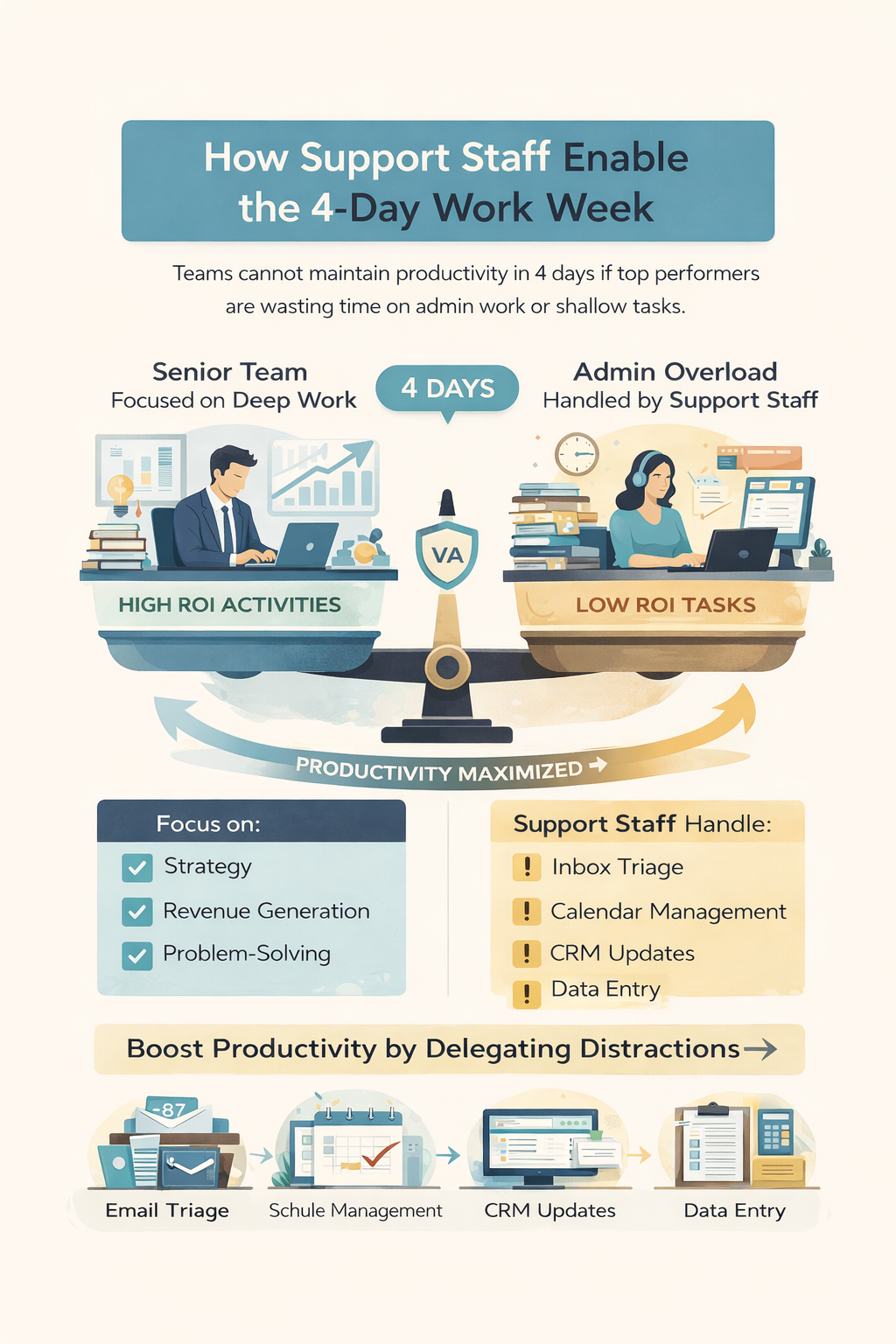
How Support Staff Enable the 4-Day Work Week
The biggest threat to a successful 4-day work week is administrative overload. When skilled professionals spend hours on inbox management, scheduling, data entry, and follow-ups, they lose time for high-impact work. This problem becomes more severe when available working hours decrease. Businesses must solve this to maintain productivity.
Forward-thinking companies shift shallow work to Virtual Assistants and support staff. They do not reduce the workload; they redistribute it. A Virtual Assistant manages repetitive, process-driven tasks so that core team members can focus on strategic execution. This creates a structured division between high-value and low-value work.
For example, a Virtual Assistant can handle email triage, calendar management, CRM updates, and reporting. These tasks require consistency, not senior expertise. When support staff manages them, professionals regain uninterrupted time for deep work. This shift improves output without increasing hours.
Businesses that want to implement a 4-day work week often need to hire a virtual assistant for administrative support. This approach removes bottlenecks and protects productivity. It does not reduce work; it ensures that the right people perform the right tasks.
A Practical Example of Productivity Shift
Consider a business owner who spends two hours per day on administrative tasks. Over a 5-day week, this equals 10 hours of low-value work. When the company moves to a 4-day work week, those 10 hours create pressure. The workload remains the same, but the available time decreases.
If the business owner continues to handle these tasks, strategic work suffers. Growth slows, and the 4-day model becomes unsustainable. However, if a Virtual Assistant takes over these responsibilities, the business owner regains 10 hours of high-value time. This allows the business to maintain or increase output within fewer hours.
This example highlights a key principle. Productivity improves when businesses align tasks with skill level. The 4-day work week works best when companies optimise how work gets done.
Distraction Killers That Make the Model Work
Companies that succeed with a 4-day work week remove distractions at a structural level. They do not rely on motivation or discipline alone. They build systems that protect focus and reduce interruptions. This creates consistency across the organisation.
Effective strategies include:
- Standard Operating Procedures (SOPs) for repetitive tasks
- Structured communication systems
- Inbox and calendar management through support staff
- Clear prioritisation frameworks
- Fewer, more intentional meetings
These systems reduce decision fatigue and improve execution. Teams spend more time on meaningful work and less time on coordination.
The Strategic Conclusion
The 4-day work week does not automatically increase productivity. It forces companies to become more intentional about how they operate. Businesses that remove inefficiencies, protect deep work, and delegate shallow tasks outperform those that simply reduce hours. The model rewards clarity, structure, and discipline.
Companies that succeed do not reduce work. They redesigned it. They align tasks with skill levels, reduce administrative drag, and create systems that support focus. This approach improves both performance and scalability.
The 4-day work week becomes a strategic advantage when businesses optimise how work gets done. It becomes a liability when they do not.
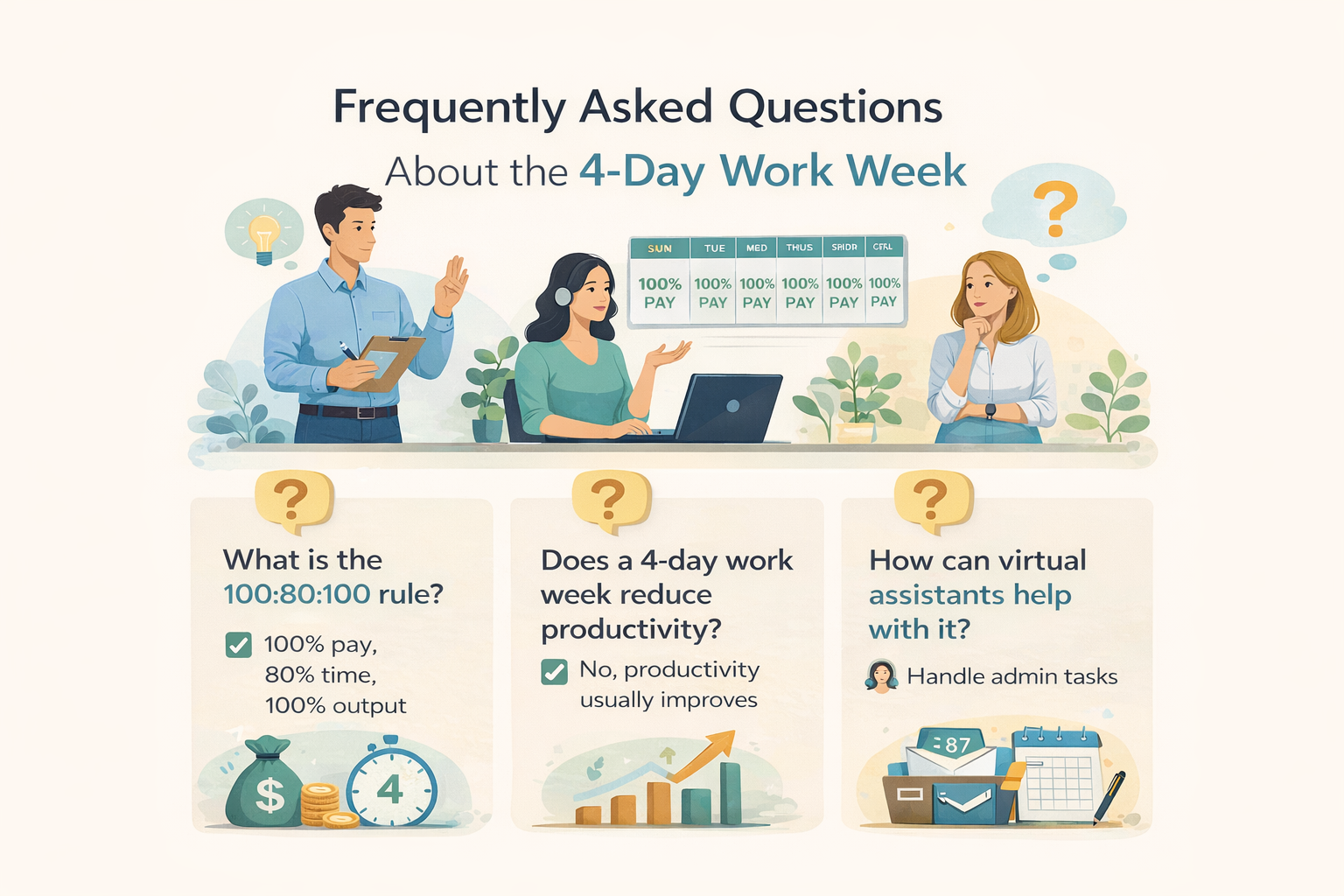
Frequently Asked Questions About the 4-Day Work Week.
What is the 100:80:100 rule?
The 100:80:100 rule defines how companies structure a 4-day work week. Employees receive 100 percent of their pay while working 80 percent of the time, but they must maintain 100 percent of their output. Companies achieve this by improving efficiency, removing low-value work, and focusing on outcomes. Organisations such as 4 Day Week Global have shown that this model works when businesses redesign workflows rather than compress existing inefficiencies.
Does a 4-day work week reduce productivity?
A 4-day work week does not reduce productivity when companies implement it correctly. Research from 4 Day Week Global and national trials in Iceland shows that productivity remains stable or improves in most cases. Businesses achieve these results by eliminating unnecessary tasks, reducing meetings, and focusing on high-value work. The model fails only when companies try to maintain the same processes within fewer hours.
Does a shorter work week increase burnout?
A shorter work week reduces burnout in most cases. The Icelandic trials showed that employees experienced lower stress levels, improved focus, and better work-life balance. Reduced burnout leads to higher retention and more consistent performance. Companies benefit from a more stable and engaged workforce.
How can virtual assistants support a 4-day work week?
Virtual Assistants support a 4-day work week by handling low-value administrative tasks. They manage inboxes, schedules, data entry, and coordination, which frees up time for deep work. This allows core team members to focus on strategy, revenue generation, and problem-solving. Businesses maintain productivity by ensuring that the right people perform the right tasks.
Final Insight
The 4-day work week does not reduce the demands of running a business. It changes how those demands must be managed. Companies that continue to operate with traditional workflows will struggle to maintain performance. Companies that redesign their operations will gain a clear advantage.
The real question is not whether a 4-day work week works. The real question is whether your business is structured to support it.
Book your free consultation, let’s talk about how hiring a virtual assistant can benefit you and your business.
