

You built the business by answering every email yourself. You knew every client’s name, caught every shipping delay before the customer noticed, and closed the loop on every complaint within the hour. That personal attention was the actual product for a long stretch of the business’s early life, not a nice extra sitting on top of it.
Then the account list crossed 200, the calendar filled with calls that couldn’t move, and the support inbox turned into a queue nobody has time to clear. The founder still answers every ticket personally, not because it’s the best use of that founder’s time anymore, but because handing the inbox to someone else feels like handing over the relationships that built the business in the first place.
That instinct is the exact thing quietly killing response times. Customers who wait more than ten minutes for a reply are 50 percent more likely to churn within six months, and the average email first response time across industries now sits between seven and twelve hours, even though roughly 46 percent of customers expect a reply within four. A founder who is the sole person answering support tickets is not protecting those relationships. That founder is the bottleneck standing between the business and every customer waiting on a reply, and US companies lose an estimated US$168 billion a year to exactly this kind of preventable churn.
A twelve-person skincare brand hit this wall at almost exactly 200 active subscribers. The founder had answered every support email personally since launch, and email FRT held steady around 45 minutes for the first eighteen months. By month twenty, with the same founder now also managing two new hires, a supplier renegotiation, and a paid ad campaign, FRT had drifted to just under nine hours without anyone deciding that was acceptable. It just happened, one delayed reply at a time. Churn among customers who filed a support ticket in a given month ran nearly double the churn rate of customers who never contacted support at all, the same pattern the research above predicts, playing out inside one specific business’s own numbers.
The fix isn’t working faster inside the same inbox. It’s building a support system that a trained Customer Success Virtual Assistant can run, with the founder’s judgment and voice built into the system itself rather than living only inside the founder’s own replies.

Why Response Speed Is a Retention Lever, Not a Soft-Skill Trope
Response speed gets treated as a nice-to-have in most operational conversations, and the research doesn’t support that framing at all. First response time, FRT, correlates directly with churn: 64 percent of customers avoid brands with hold times over 30 minutes, and 85 percent of customers who reach a missed call never try the business again. Industry FRT benchmarks for 2026 sit at under 40 seconds for live chat, under 4 hours for email, and under 60 minutes for social media, standards that a single founder juggling a full calendar cannot consistently hit, no matter how committed that founder is to the inbox.
Customer Effort Score, CES, matters even more than the industry conversation usually credits. CES measures how much effort a customer has to spend resolving an issue, typically captured through one question after an interaction: “How easy was it to resolve your issue today?” The data behind it is stark. Ninety-four percent of customers who have a low-effort experience repurchase, against just 4 percent of customers who had a high-effort one, and 96 percent of customers who go through a high-effort interaction report becoming measurably less loyal to the brand afterward. CES now predicts loyalty roughly 1.8 times more reliably than CSAT and twice as reliably as NPS for service interactions specifically, which makes it the metric most founders have never heard of, and most need to be tracking.
The economics behind all of this settle the argument on their own. Acquiring a new customer costs five to twenty-five times more than retaining an existing one, and a five percent improvement in retention rate lifts profit by 25 to 95 percent. Selling to an existing customer succeeds 60 to 70 percent of the time; selling to a new prospect succeeds 5 to 20 percent of the time. Every ticket a founder lets sit for six hours is a direct hit against the cheapest, highest-probability revenue the business has.

The Metrics That Actually Tell You Whether the System Is Working
A support operation without measurement is a founder’s gut feeling wearing a job title. Five metrics turn “the VA seems to be doing fine” into an actual answer.
| Metric | What It Measures | Target |
|---|---|---|
| First Response Time (FRT) | How fast the first reply reaches the customer, by channel | Under 40 seconds chat, under 4 hours email, under 60 minutes social |
| First Contact Resolution (FCR) | Percentage of tickets closed without a second customer message | Above 70 percent |
| Customer Effort Score (CES) | How much effort did the customer spend resolving the issue | Low effort on 90 percent+ of interactions |
| Net Promoter Score (NPS) | The likelihood that a customer recommends the brand after an interaction | Tracked and trending, not a single snapshot |
| Customer Churn Rate | Percentage of customers lost over a defined period | Inside the 5 to 7 percent annual benchmark for the industry |
Customer Retention Cost, CRC, the total cost of the people, tools, and time spent keeping an existing customer, belongs in this same dashboard, even though most founders never calculate it directly. A CRC that runs meaningfully below the business’s customer acquisition cost, which it almost always will given the five-to-twenty-five-times gap between the two, is the single number that justifies the investment in a dedicated support hire to a skeptical co-founder or board member.
The math works out concretely for a small business, not just in aggregate industry statistics. A subscription box brand paying a Customer Success VA US$1,400 a month, fully loaded, and retaining an extra 40 customers a year purely from faster response times and proactive check-ins, at an average customer lifetime value of US$310, generates roughly US$12,400 in retained revenue against US$16,800 in annual VA cost. That ratio looks unremarkable on its own. It stops looking unremarkable once the same founder calculates that acquiring those same 40 customers through paid ads, at a blended CAC running 5 to 25 times higher than the cost of keeping an existing one, would have cost anywhere from US$8,000 to well over US$40,000. Retention doesn’t just save the customer. It saves the acquisition budget that the customer would otherwise have to be replaced with.
The Operational System: Consolidate, Document, Automate
Four structural pieces turn a founder’s personal inbox habits into a system a virtual assistant can actually run without the founder standing behind every reply.
Consolidate onto a real helpdesk platform, not a shared inbox. A shared Gmail or Outlook login creates a collision risk, two people replying to the same customer with contradictory answers, and leaves no data trail for the metrics above. Zendesk, Freshdesk, Intercom, and Gorgias, the ecommerce-specific option that connects directly to Shopify order data, all provide collision detection, tagging, and reporting out of the box. HubSpot Service Hub suits a business already running HubSpot for sales and marketing, since it keeps support history in the same record as the deal and marketing timeline. The platform matters less than the discipline of moving off shared personal inboxes entirely.
Build a Customer Intelligence SOP that the VA follows on every ticket. Every interaction gets logged within 15 minutes, the customer’s profile gets updated with anything relevant to future contact, patterns that suggest churn risk get flagged explicitly rather than left in the VA’s memory, and any ticket involving a complaint or a delay triggers an automatic 48-hour follow-up to confirm the issue actually stayed resolved. This SOP is what separates a VA who closes tickets from a VA who protects relationships, since closing a ticket and confirming the customer is actually satisfied are two different outcomes that look identical in a ticket queue.
Write a Brand Voice Playbook instead of a script. A script tells a VA what to say. A playbook tells a VA how the founder thinks, which holds up in situations no script anticipated. The playbook needs a tone definition stated in opposites, “warm but not casual,” “direct but not curt”, a vocabulary list of words the brand uses and words it avoids, response templates organized by scenario rather than by channel, explicit escalation triggers defining exactly when a ticket has to reach the founder or a senior team member, and channel-specific adjustments, since the tone that works in a two-line chat reply reads oddly stretched across a formal email.
Name the escalation triggers before the first ticket arrives, not after the first mistake. A VA needs an explicit answer to “what do I do if I’m not sure,” written down in advance: billing disputes above a stated dollar threshold, any mention of legal action or public complaint, and any request involving data the VA isn’t authorized to change all route to a named person, not a vague “use your judgment” instruction that leaves the VA guessing during the exact moment judgment matters most.
Omnichannel Execution Without Losing Consistency
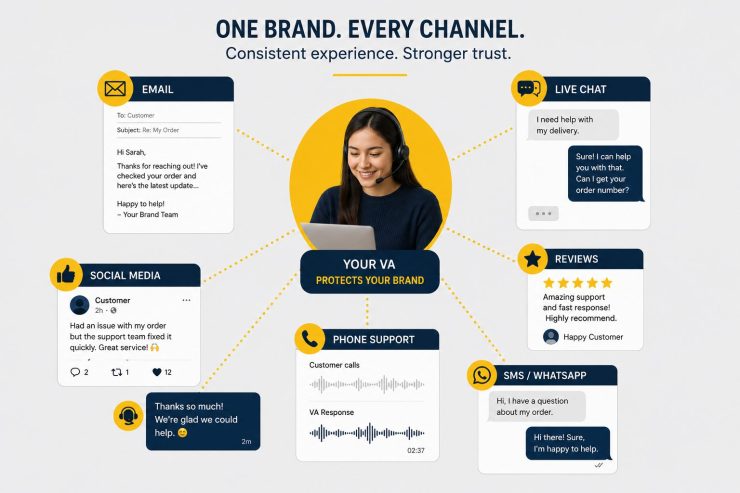
A customer who emails on Monday, doesn’t hear back fast enough, and DMs the brand’s Instagram account on Tuesday is not being difficult. That customer is testing which channel actually gets a response, and a business running email through one tool, Instagram through the app itself, and phone calls through nobody’s system at all will answer that same customer two different ways without either responder knowing the other conversation happened.
A B2B software company selling project management tools ran into exactly this gap before consolidating channels. A customer emailed support about a billing discrepancy, got a promise of a credit within 48 hours from the email-handling VA, then messaged the same question through the in-app chat widget two days later when the credit hadn’t appeared, reaching a different team member with no visibility into the email thread at all. That second responder, unaware that a credit was already promised, apologized and offered a discount instead, effectively doubling the concession over a single billing question. The fix wasn’t hiring a more careful VA. It was routing email, chat, and social messages into the same helpdesk record tied to that customer’s account, so any team member opening the ticket sees the full history regardless of which channel the customer used to reach out. Modern helpdesk platforms merge these channels into a single customer timeline by default; the failure almost always sits in setup, not capability, when a business runs each channel through a separate, disconnected tool.
Moving From Reactive to Proactive: The Retention Calendar
A support system that only reacts to incoming tickets misses the retention opportunities that never generate a ticket at all. A structured retention calendar puts specific touchpoints on the schedule instead of leaving them to whoever happens to remember: a day-30 onboarding check-in confirming the customer is actually getting value, a day-90 satisfaction survey that surfaces problems before they turn into cancellations, a renewal conversation initiated 90 days ahead of the actual renewal date rather than the week before, congratulatory outreach tied to genuine customer milestones, and an annual review invitation that turns a transactional relationship into one the customer experiences as a partnership. None of this requires the founder’s personal involvement to execute once the calendar and the trigger logic exist; it requires someone consistently running it, which is precisely the structured, recurring work a trained VA handles better than a founder pulled in six directions.
A marketing agency running retainer clients through this calendar caught a churn risk eleven days before the client would otherwise have given notice. The day-90 satisfaction survey, sent automatically by the VA rather than left to the account lead’s memory, came back with a lukewarm score and a comment about slow campaign reporting. The VA flagged it per the Customer Intelligence SOP rather than treating a mediocre survey score as routine, the account lead called the client within 24 hours, and the reporting cadence changed before the client’s own internal frustration ever escalated into a cancellation conversation. Nobody on the team would have caught that signal without a system forcing the day-90 checkpoint to happen on schedule, regardless of how busy the account lead was that particular week.
The Quality Assurance Framework That Keeps the Founder’s Judgment in the Loop
Handing off the inbox does not mean disappearing from it. A weekly QA review, reading a random sample of ten tickets the VA closed that week, catches drift in tone, technical accuracy, and empathy before it compounds into a pattern customers notice. This review is coaching, not surveillance: The goal is refining the playbook based on real tickets the playbook didn’t anticipate, not auditing the VA for mistakes after the fact.
A direct-to-consumer furniture brand’s QA review surfaced a gap the playbook had never addressed: what tone to use when a customer’s furniture arrived damaged during a house move rather than during shipping. This distinction changes whose responsibility it is, but not how upset the customer sounds in the first message. The VA had been treating every damage report identically, following the shipping-damage script even when the ticket clearly described a moving-related issue that the brand had no obligation to cover. The founder used that specific ticket in the next QA session to add a new scenario to the playbook rather than issuing a general instruction to “read more carefully,” a fix specific enough that the same misclassification never recurred. A founder who runs this review consistently for the first eight to twelve weeks of a new VA’s tenure, then tapers it to a lighter monthly spot-check once the pattern stabilizes, keeps the brand’s actual voice in the system long after stepping back from answering tickets personally.
When a Founder Should Keep Support In-House a Little Longer
None of this means every business benefits from handing off support immediately, and a genuinely useful answer here has to include the cases where the advice above doesn’t apply yet.
A business still searching for product-market fit gets more value from the founder personally reading every support message than from any efficiency gain a VA provides, because those raw, unfiltered customer signals are actively shaping the product roadmap at that stage. Delegating support too early can mean the founder stops hearing the exact complaints that should be changing the product. A business with a small number of very high-value enterprise accounts, six or seven-figure annual contracts where the client explicitly expects direct access to a senior person, should keep those specific accounts on a founder or senior-team escalation path even after building out broader support infrastructure for everyone else; the relationship itself is part of what that client is paying for, and routing it through a general ticket queue undermines the exact thing retaining the account. A business generating fewer than roughly 20 support interactions a week may also find that the time spent building a full SOP, playbook, and QA cadence exceeds the time it would take to keep answering those tickets personally for another two or three months, until volume actually justifies the setup cost.
The pattern across all three exceptions is the same: Delegate the volume, not the judgment. Even a business handing off 95 percent of its ticket queue should keep a clear, written escalation path for the specific accounts, complaints, or moments where the founder’s direct involvement is the actual value being delivered, not an inefficiency waiting to be automated away.
How Aristo Sourcing Vets for This Specific Role
Technical fluency with a helpdesk platform is trainable in days. Empathy under pressure, the ability to de-escalate a frustrated customer without a script to fall back on, is the harder trait to source, and it’s the one that actually determines whether a Customer Success VA protects the relationships this article is about or quietly damages them.
Aristo Sourcing runs every candidate for this role through a three-stage vetting process before that candidate ever reaches a client shortlist, evaluating communication style and problem-solving under realistic pressure rather than relying on a resume alone. Clients typically receive a shortlist within 7 to 10 days, drawn from talent across South Africa, the Philippines, and Eastern Europe, and placements run 50 to 70 percent below the cost of hiring the equivalent role locally in the US, UK, Europe, Australia, or New Zealand. Every placement includes a replacement guarantee through the first three months, and clients hire the assistant directly, with no ongoing agency fee sitting on top of the relationship once the placement is made. That structure comes from what the pattern actually looks like across more than 500 placements: the businesses that treat this hire as infrastructure, not a gamble, are the ones whose customers never notice the handoff happened at all.
Book a free 30-minute consultation and have someone running this system before the end of the month.
