
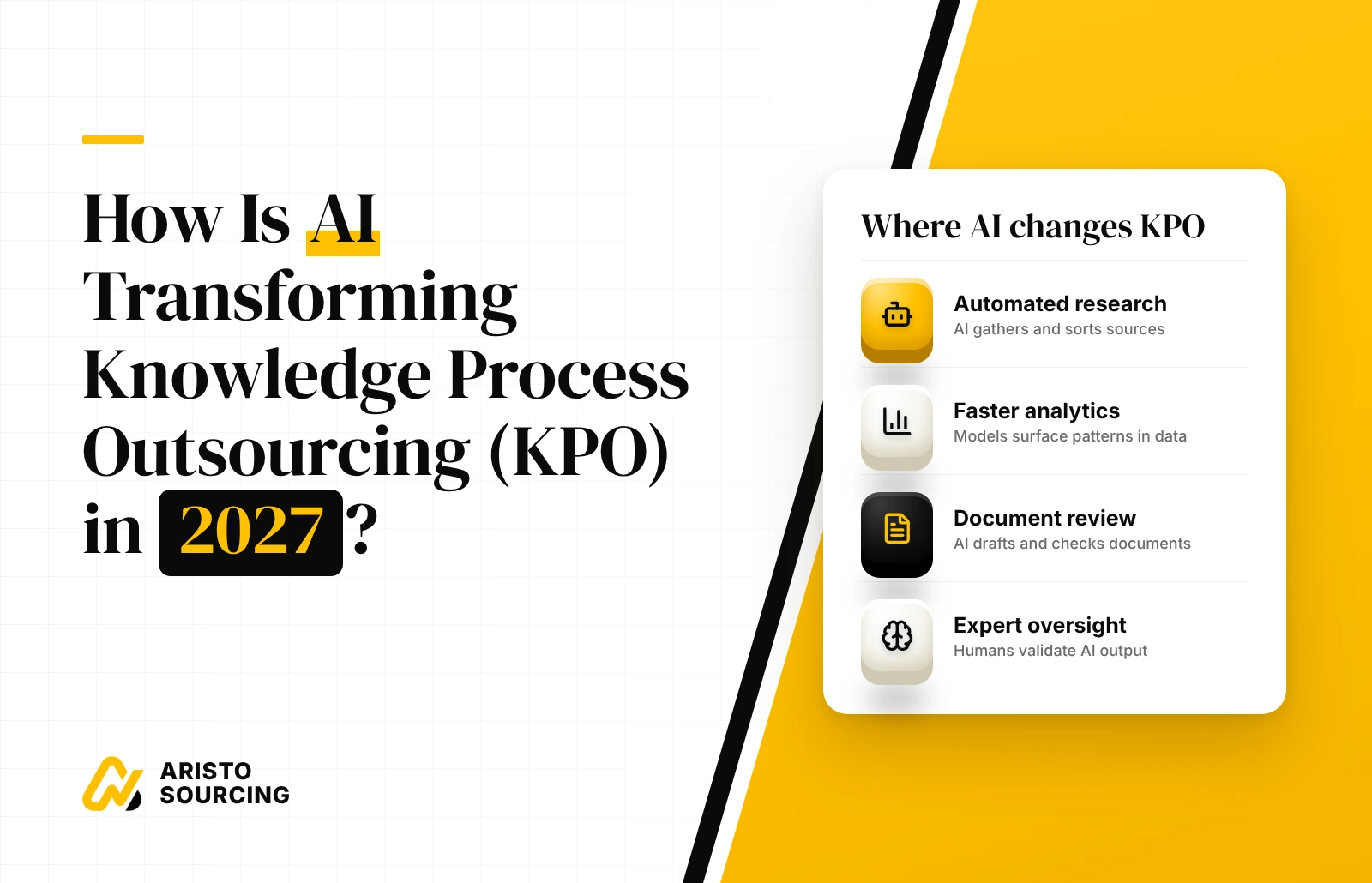
In 2027, AI is transforming knowledge process outsourcing basically by automating repetitive tasks, accelerating analytics, and augmenting human expertise. AI in KPO is the use of machine learning, natural language processing, and generative AI to perform or support outsourced knowledge work. The shift from traditional KPO to AI-enabled KPO replaces manual, labor-heavy research and analysis with workflows where AI handles volume and experts handle judgment.
The main benefits of AI in KPO are faster turnaround, higher productivity, easier scaling, and more consistent output. The main risks are data security gaps, privacy violations, inaccurate AI output, and compliance exposure in regulated industries such as healthcare, finance, and legal services.
The right AI-powered KPO partner supports this shift by supplying trained professionals who already use AI inside real client workflows.
What Is Knowledge Process Outsourcing (KPO)?
Knowledge Process Outsourcing (KPO) is the delegation of judgment-based knowledge work, such as research, analytics, financial analysis, and legal review, to external providers with specialized expertise.
KPO differs from Business Process Outsourcing (BPO) because BPO covers rule-based, high-volume tasks such as data entry, customer support, and payroll, while KPO covers analytical work that depends on expert judgment. AI now supports both models, but AI has a stronger effect on KPO because it reaches the analytical core of knowledge work, not only its administrative tasks.
How Is AI Transforming Knowledge Process Outsourcing?
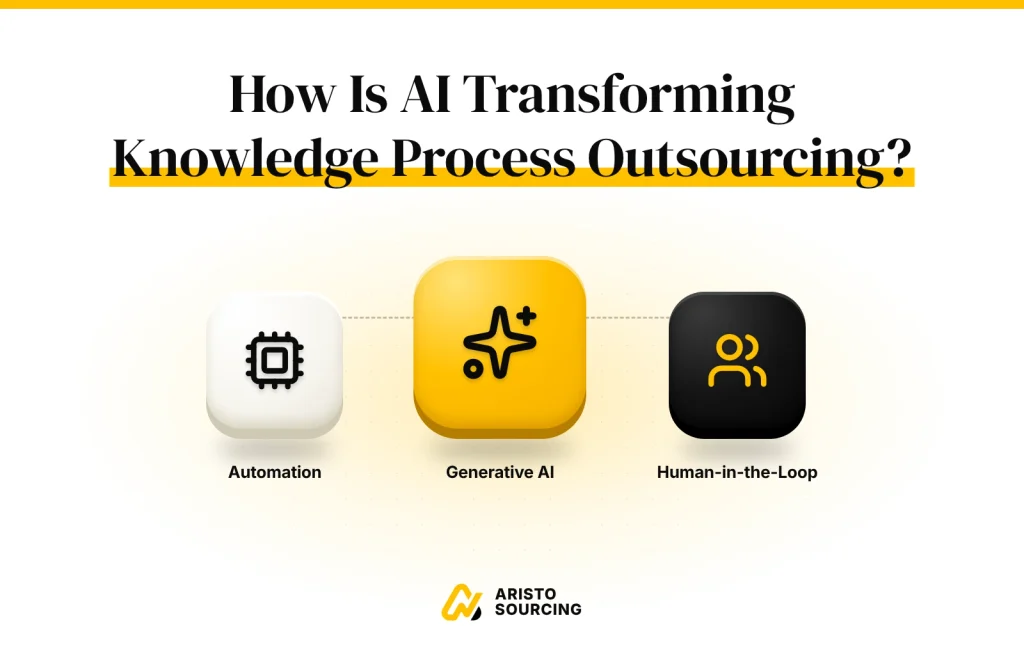
AI is transforming knowledge process outsourcing by automating repetitive knowledge tasks, processing large volumes of data in minutes, and helping KPO professionals make faster, better-informed decisions. Artificial Intelligence moves the KPO delivery model from capacity based on analyst hours to capacity based on combined human and AI systems.
AI automation takes over the repetitive steps inside knowledge work. Typical examples include extracting data from documents, classifying records, summarizing long reports, drafting first-pass research notes, and checking figures against source files. These steps used to consume a large share of an analyst’s day. Automating them shortens turnaround and reduces manual errors.
AI also changes data processing at scale. Machine learning models can read thousands of documents, transactions, or survey responses in the time a manual team needs to review a small sample. AI-driven analytics then surface correlations, outliers, and trends that a manual spreadsheet review would likely miss.
KPO professionals work faster and decide with more confidence when AI prepares the groundwork. An analyst who receives a structured data summary, a list of flagged anomalies, and a draft report can spend more time on interpretation, client context, and recommendations. Human-AI collaboration is a division of labor in which AI provides speed and coverage while people provide judgment and accountability.
The combined result is intelligent operations. Intelligent operations are KPO workflows in which AI tools, data pipelines, and human experts run as one connected system, with AI handling volume and specialists validating every output. The applications of AI inside intelligent operations span many different KPO service areas.
In Which Areas of KPO Is AI Used?
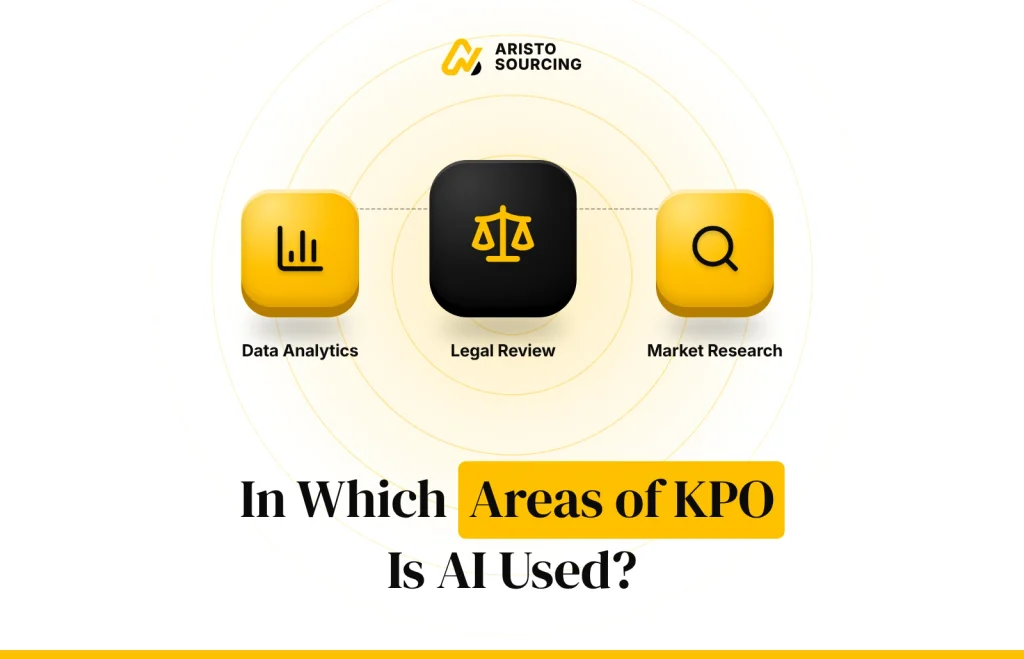
AI is used in knowledge process outsourcing across several key areas, including data processing and analysis, document and contract review, financial forecasting, healthcare data analysis, and market research.
The main applications of AI in KPO are listed below below.
- Data Processing and Analysis
- Document and Contract Review
- Financial Forecasting
- Healthcare Data Analysis
- Market Research
Data Processing and Analysis
AI supports data processing and analysis in KPO by cleaning, structuring, and interpreting large datasets faster and more consistently than manual teams. Data processing in KPO covers two data types. Structured data includes spreadsheets, databases, and transaction records. Unstructured data includes emails, PDFs, scanned forms, call transcripts, and social media posts. AI tools use natural language processing and optical character recognition (OCR) to convert unstructured content into structured, searchable fields.
Machine learning models then run data analysis on the prepared datasets. Pattern recognition algorithms identify recurring behaviors, anomalies, and trends, such as seasonal demand shifts, unusual transactions, or early signs of customer churn. KPO analysts review each finding, confirm its business relevance, and turn it into a report that clients can act on.
Document and Contract Review
AI supports document and contract review by reading, classifying, and extracting key information from large document sets in a fraction of the time manual review requires. Automated document analysis identifies each document type, extracts parties, dates, amounts, and obligations, and flags missing or unusual information. AI-assisted contract review compares each agreement against a standard template or clause library and highlights deviations, such as non-standard indemnity terms, auto-renewal provisions, or uncapped liability.
AI also supports legal compliance checks by screening contracts and policies against regulatory requirements and internal standards. Human review remains essential at every stage. Lawyers and trained legal analysts verify AI findings, interpret context, and make the final decision on risk, because one missed clause or misread obligation can create legal and financial consequences.
Financial Forecasting
AI supports financial forecasting in KPO by analyzing historical financial data, market signals, and operational drivers to project future revenue, costs, and cash flow. Predictive analytics models learn from past performance and test multiple scenarios at once, such as changes in pricing, interest rates, or customer demand.
Financial analysis teams use these outputs to build budgets, rolling forecasts, and variance reports in less time. AI models also update as new data arrives, so forecasts stay current between quarterly reviews. Financial analysts still validate the assumptions behind each model, because a forecast is only as reliable as its inputs.
Healthcare Data Analysis
AI supports healthcare data analysis in KPO by processing clinical, claims, and operational records to find patterns that improve care quality, billing accuracy, and operational efficiency. AI tools analyze medical data such as electronic health records, lab results, medical codes, and insurance claims. Common healthcare analytics applications include detecting coding errors, predicting readmission risk, flagging potential claims fraud, and measuring provider performance.
Data privacy is a core requirement in healthcare KPO. In the United States, government protects patient health information, so KPO providers that handle this data must safeguard it through access controls, encryption, and, where possible, de-identification. Human oversight remains necessary because clinical context, coding judgment, and patient safety decisions should never rest on an algorithm alone.
Market Research
AI supports market research in KPO by collecting, analyzing, and summarizing data from surveys, reviews, social media, news, and industry reports at a scale manual research teams cannot match. AI-assisted research tools run sentiment analysis on customer feedback, group open-ended survey responses into themes, and condense long reports into key findings. Trend analysis models track changes in demand, pricing, and consumer behavior over time. Competitive research tools monitor competitor product launches, price changes, and marketing messages.
KPO researchers combine these outputs into market intelligence and business intelligence reports that guide product, pricing, and expansion decisions. The best benefit of AI in market research is speed to insight, because projects that once took weeks can often be delivered in days. Speed, however, is only one of several benefits AI brings to knowledge process outsourcing as a whole.
What Are the Benefits of AI in Knowledge Process Outsourcing?
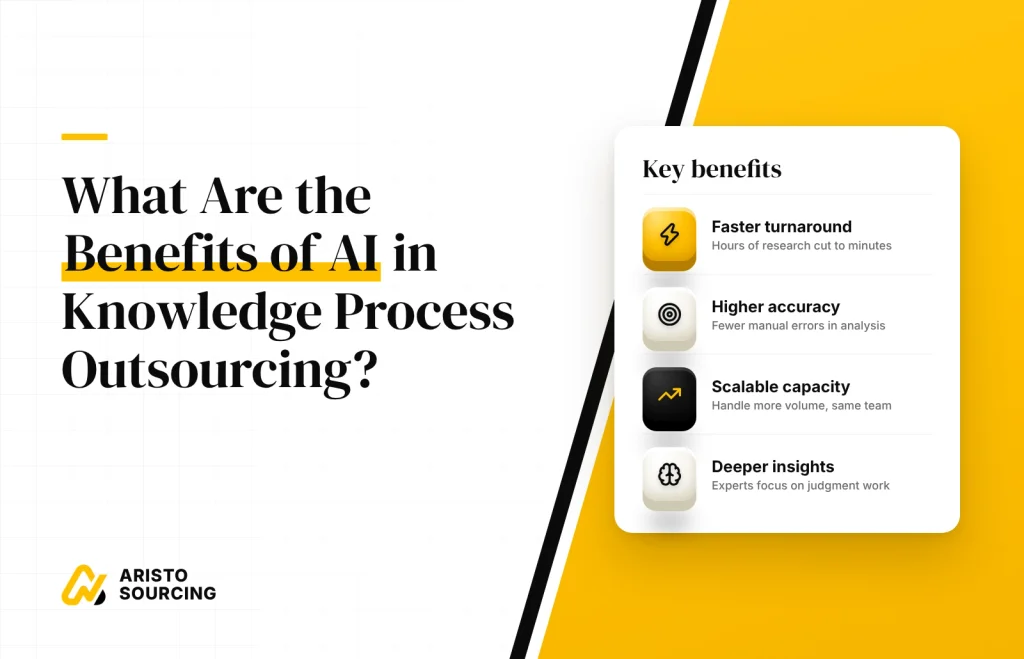
The benefits of AI in knowledge process outsourcing include higher productivity, faster insights, greater scalability, improved efficiency, and more consistent output quality.
The five main benefits are listed below.
- Productivity: Automation removes repetitive steps such as data extraction, formatting, and first-pass summarization, so each analyst completes more high-value work per day.
- Speed: AI processes documents, datasets, and research inputs in minutes, which produces faster insights and shorter project turnaround times.
- Scalability: AI-enabled workflows absorb volume spikes without a matching increase in headcount, so a KPO team can take on larger projects or seasonal peaks with less ramp-up time.
- Efficiency: Fewer manual handoffs lead to fewer errors, less rework, and a lower cost per deliverable.
- Consistency: AI applies the same rules to every record, which reduces quality variation between analysts, shifts, and projects.
Automation also lets experts focus on higher-value work. Senior analysts, researchers, and legal specialists spend less time gathering and cleaning information and more time on interpretation, strategy, and client advice. Clients receive the same domain expertise, applied to the decisions that matter most instead of to preparation tasks. Unlike traditional KPO, which grows mainly by adding people, AI-enabled KPO grows by adding better tools around the same experts.
How Does AI in KPO Differ from Traditional KPO?
AI in KPO differs from traditional KPO in how work is performed, how fast it is delivered, and how capacity scales. Traditional KPO relies on manual workflows, in which analysts collect, clean, review, and report on data by hand. AI-powered KPO uses automation and analytics to handle data-heavy steps, while experts focus on validation, interpretation, and recommendations.
A traditional KPO provider usually needs weeks to hire and train analysts for a new project, while an AI-powered KPO provider can expand automated capacity and assign existing experts to review the output. Processing speed improves because AI handles extraction and first-pass analysis in parallel rather than one file at a time. Expert productivity rises because specialists apply their knowledge to more cases per day.
These changes move KPO toward intelligent operations, where data, AI tools, and specialists work as one system and every deliverable still passes human review. The AI-powered model delivers clear gains, but it also introduces some risks that every KPO buyer should understand before adoption.
What Are the Risks and Challenges of AI in KPO?
The main risks and challenges of AI in KPO include data security threats, data privacy obligations, AI accuracy problems, compliance requirements in sensitive industries, and workforce concerns about job loss.
The main risks and challenges of AI in KPO are listed below.
- Data security: KPO providers handle sensitive client data, such as financial records, contracts, and patient information. AI tools add new exposure points, including third-party AI platforms, data pipelines, and system integrations. Access controls, encryption, and vendor security reviews reduce this exposure.
- Data privacy: Some public AI tools may store prompts or use them to improve their models, depending on the vendor’s terms. KPO providers must confirm where data is processed, who can access it, and whether personal data is anonymized before it reaches an AI tool.
- AI accuracy: AI models can produce incorrect, outdated, or fabricated outputs, often called hallucinations. A confident but wrong figure in a financial model or contract summary can lead to costly decisions. Human oversight, source verification, and regular output testing keep AI accuracy at an acceptable level.
- Compliance: Sensitive industries carry strict regulatory requirements, such as HIPAA for US health information, the General Data Protection Regulation (GDPR) for personal data of people in the EU, and sector rules for banks and investment firms. The EU AI Act adds further obligations for AI systems classified as high-risk. AI-enabled KPO workflows must document how data is handled and how AI-assisted decisions are reviewed.
- Workforce concerns: Many KPO professionals worry that automation will make their roles unnecessary. Left unaddressed, this concern can slow adoption and lower team morale.
Does AI Replace KPO Professionals?
No, AI does not replace KPO professionals because AI automates tasks, not the expertise, judgment, and accountability that knowledge work requires. AI performs well at speed and volume, but AI lacks business context, ethical judgment, and responsibility for outcomes. AI primarily automates individual tasks inside a workflow rather than eliminating the need for expertise. AI augmentation describes this model: AI increases what each professional can deliver instead of removing the professional.
Human-AI collaboration places domain expertise at the decision points and AI at the processing points. Human oversight stays mandatory for any output that affects money, legal rights, health, or a client’s reputation. KPO roles do change, as analysts spend less time on manual preparation and more time on validation, AI tool supervision, and advisory work. The value of these roles depends on the proper implementation of AI, which follows a clear, step-based process.
How to Implement AI in KPO?
Implementing AI in KPO involves a step-by-step approach that balances efficiency with control. Start by finding the repetitive or data-heavy processes where workflow automation brings the most value, such as data extraction, report generation or document review. Next, check data quality and security, because AI is only as reliable as the data it learns from, and sensitive client information needs strong protection.
Then roll out AI with human oversight so that experts review outputs, handle exceptions and keep accuracy high. Before scaling, test the new workflow on a small set of tasks, measure the results and set clear AI governance rules on how models are used, monitored and updated. Working with an experienced KPO outsourcing partner can make this AI implementation smoother, since they bring proven frameworks to deploy AI securely and responsibly.
How Can Aristo Sourcing Help Implement AI in Knowledge Process Outsourcing?
Aristo Sourcing can help implement AI in Knowledge Process Outsourcing by providing skilled, tech-literate professionals who integrate AI into existing KPO workflows and keep every AI-assisted output accurate, secure, and aligned with your business.
The human role in AI implementation stays central. AI-generated data, drafts, and insights still require human oversight for accuracy, safety, and brand alignment. Aristo Sourcing professionals review AI outputs, verify facts and figures against source data, and edit drafts to match your brand voice and quality standards.
Aristo Sourcing acts as an AI-augmented staffing partner rather than a traditional software vendor. A software vendor sells a platform your team must learn and manage alone. Aristo Sourcing instead supplies specialized remote talent who already use AI tools in daily knowledge work.
These professionals work directly within your existing processes, tools, and reporting structures. This approach helps your team adopt and use AI effectively without rebuilding operations from scratch. If you are still deciding which work to outsource, Aristo Sourcing’s guide to KPO explains the model and its core services.
AI is transforming KPO, but the results still depend on people with specialized expertise who know how to direct, check, and apply AI inside real knowledge work.