

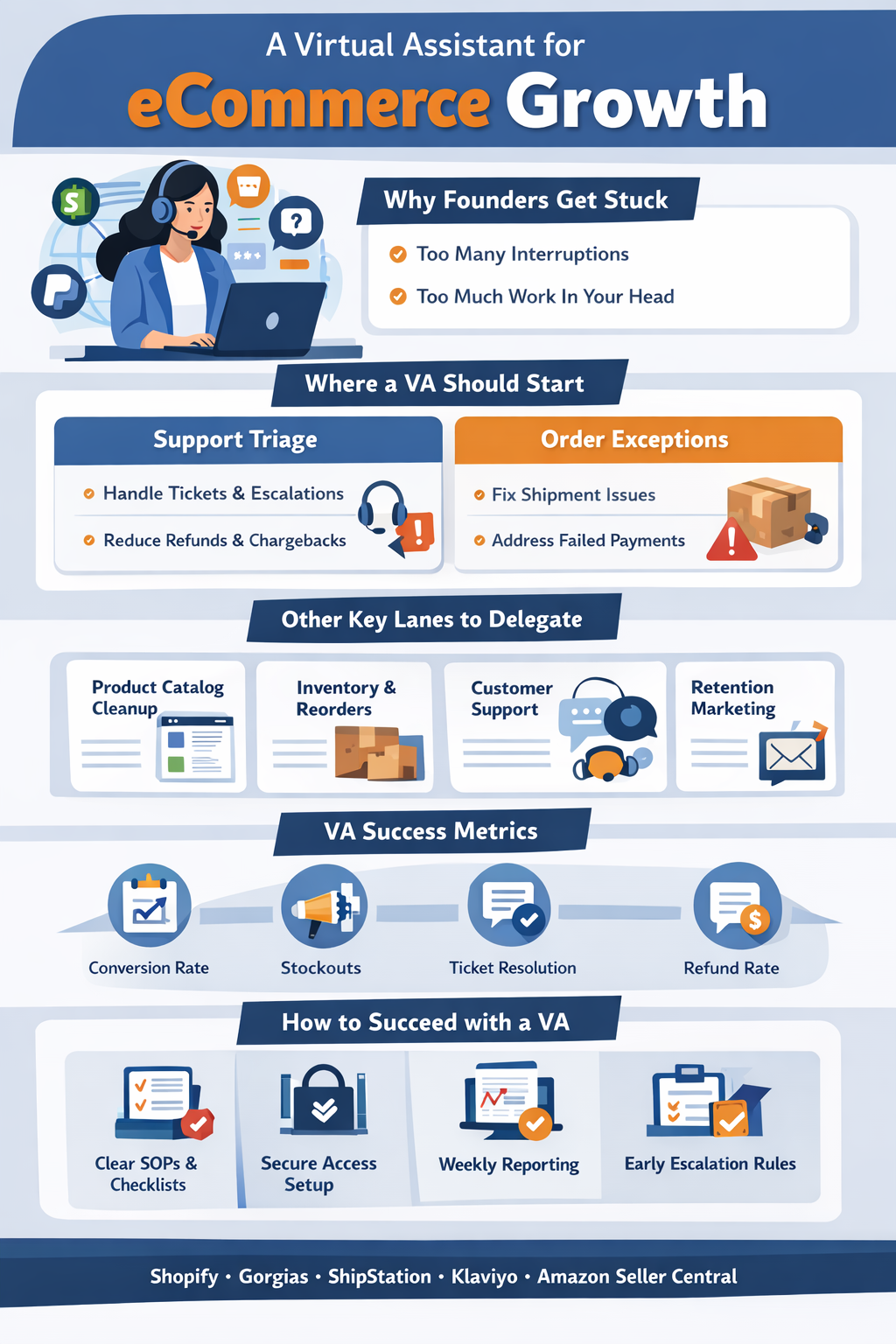
Scaling an eCommerce store creates operational work that does not slow down. Shopify updates, SKU and variant cleanup, Gorgias tickets, and Stripe or PayPal reconciliations need daily ownership to stay accurate. Stockouts, returns, and chargebacks quietly damage margin when nobody is watching the process. A capable eCommerce VA runs these workflows, flags issues early, and keeps the store stable while you focus on growth decisions.

If your store is growing but your calendar is getting worse, this is why
Most founders do not run out of motivation; they run out of bandwidth. Product data becomes inconsistent, support gets reactive, and inventory decisions happen too late. Promotions take longer to launch because every update depends on you. The goal is not to do more work; it is to assign ownership to repeatable store systems.
What changes when a VA owns your store operations
You stop being the “last stop” for every minor fix. Work stops living in your head because tasks move through checklists, templates, and escalation rules. The store becomes easier to run because the same lanes operate the same way each week. Growth becomes more predictable because issues show up early, not after they hit revenue or reviews.

What an eCommerce VA can handle by workflow lane
A strong eCommerce VA is most valuable when they own a lane, not when they take random tasks. Lanes create clear accountability and make onboarding faster. You can start with two lanes and expand once the system is stable. This is how you avoid “delegation chaos” and constant rework.
Lane 1: Product catalog, listings, and merchandising
Product pages and collections break quietly when nobody owns them. Small mistakes in options, tags, pricing, and images reduce conversion and create support tickets. A VA can run catalog hygiene weekly, so your store stays clean as you add products. This lane also keeps your promotions and merchandising moving on schedule.
Typical responsibilities include:
- SKU management, variants, bundles, and attribute cleanup
- Product uploads and listing QA inside Shopify or WooCommerce
- Collection setup, filters, tags, navigation updates, and internal search hygiene
- Product page improvements, such as benefits, specs, FAQs, and comparison tables
- Image coordination, alt text, and basic product-page SEO support
- Marketplace listing support when relevant, including Amazon Seller Central coordination and A+ Content assets
- Promo setup including discount rules, bundles, and free shipping thresholds
Standard tools:
- Shopify
- WooCommerce
- Amazon Seller Central
- Google Sheets
- Airtable
- Canva
- Notion
- ClickUp.
Lane 2: Inventory, supplier follow-ups, and order operations
Inventory is not just operations; it is margin protection. Stockouts kill momentum, while over-ordering ties up cash and forces discounting later. A VA can support forecasting, reorder tracking, and supplier follow-ups so you are not reacting late. This lane reduces the daily “where is that shipment” noise.
Typical responsibilities include:
- Inventory tracking and forecasting support using sales velocity and simple reorder logic
- Reorder point tracking, supplier follow-ups, and lead time monitoring
- Purchase order admin and inbound shipment coordination
- 3PL coordination, shipping exceptions, and delivery issue tracking
- Order exception handling, such as address changes, failed payments, or partial shipments
- Returns and exchanges workflow management with clear rules and tracking
- Payment gateway reconciliation support for Stripe and PayPal
- Dispute and chargeback admin support, including evidence collection and timelines
Standard tools:
- ShipStation
- AfterShip
- Shopify Shipping
- 3PL portals
- Stripe
- PayPal
- Google Drive.
Lane 3: Customer support that runs as a system
Support should be a system, not heroics. Without templates and triage rules, the same questions repeat, and the inbox stays permanently full. A VA can run the support lane with macros, SLAs, and escalation rules. That improves customer experience while reducing refunds and chargeback risk.
Typical responsibilities include:
- Ticket triage, first response, resolution, and escalations
- Macro and template creation for repetitive questions
- Help Center and FAQ maintenance to reduce ticket volume
- Refund and return policy enforcement based on your rules
- Review response support and internal issue tagging
- Fraud or suspicious order triage based on your SOPs
Common tools:
- Gorgias
- Zendesk
- Help Scout
- Shopify Inbox
- Gmail
- Meta inbox.
Lane 4: Retention and growth execution support
Most stores do not have a strategy problem; they have an execution and consistency problem. The tools are in place, but flows drift, segments get messy, and reporting becomes unreliable. A VA can support retention operations so your email and lifecycle marketing stay current. This lane is where you build steady, compounding improvement.
Typical responsibilities include:
- Klaviyo flow support and maintenance (welcome, abandon cart, browse abandon, post-purchase)
- List hygiene, segmentation support, and suppression rule setup
- Campaign scheduling support, asset coordination, and QA
- UGC and influencer outreach admin, tracking, and follow-ups
- Affiliate program support, including applications and payout tracking
- Weekly reporting and action notes based on key KPIs
Common tools:
- Klaviyo
- GA4
- Looker Studio
- Triple Whale
- Google Sheets
- Slack.

The metrics and signals your VA should track weekly
Operations should be visible, not guessed. A VA does not need to be a finance lead to track numbers, but they do need to report trends consistently. When issues are flagged early, you can fix them before they become expensive. This is how you protect margin while scaling.
Common weekly metrics include:
- Conversion rate, AOV, refund rate, and return rate
- Stockout frequency, inventory cover, reorder status, and supplier lead times
- Support SLAs, top ticket reasons, escalation count, and backlog trend
- Chargeback rate, dispute status, and high-risk order trends
- Delivery exceptions, 3PL issue trends, and recurring shipping problems
- ROAS or blended efficiency snapshots when you provide access and definitions
What we do not recommend a VA owns without senior oversight
A VA can support growth work, but some areas require senior decision-making. Paid media strategy, offer architecture, pricing, and margin decisions can become expensive quickly. The safest model is having the VA handle execution and reporting while a senior lead owns direction. This keeps quality high and reduces the risk of “silent mistakes.”
Tasks that should stay with you or a senior lead:
- Ad strategy and budget allocation decisions
- Pricing architecture and discount rules without clear approval thresholds
- Legal, tax, compliance, and payment policy decisions
- Supplier negotiation without scripts, guardrails, and approval rules

How to choose the right eCommerce VA
The best eCommerce VA is not the person who says yes to everything. You want someone who follows SOPs, spots anomalies, and communicates clearly. They should be comfortable in dashboards, spreadsheets, and support tools. Most importantly, they should report issues early and escalate cleanly.
Look for these signals:
- Strong written English and structured updates
- Detail orientation with product data, order exceptions, and support workflows
- Comfort with Shopify, Gorgias, and Google Sheets
- A habit of documenting work and improving templates
- Clear escalation behavior, not “guessing” or hiding problems
A simple onboarding plan that works in the real world
Onboarding fails when everything is delegated at once. It also fails when “good” is not defined and approval rules are unclear. A staged rollout avoids rework and makes performance measurable. The goal is stable execution first, then expansion.
A practical 30-day approach:
- Week 1: access setup, SOP walkthrough, shadowing, and test tasks
- Week 2: ownership of one lane, such as support triage or catalog updates
- Week 3: add a second lane and introduce weekly reporting
- Week 4: tighten templates, remove friction, and formalize escalation rules

How AristoSourcing places eCommerce VAs
We do not match you with a generic admin profile, and we hope it works. We scope the lanes first and hire for the workflows that matter in your business. You get candidates who fit your platform, tool stack, and communication style. This leads to faster onboarding and cleaner execution.
Our placement process typically includes:
- A short scoping call focused on store bottlenecks and lane ownership
- A role brief with tools, responsibilities, approval rules, and success metrics
- Shortlisting candidates with relevant eCommerce experience
- A practical test task, such as catalog QA, support triage, or reporting cleanup
- A structured onboarding plan with weekly checkpoints and reporting templates
Get a Store Ops Audit with an eCommerce Specialist
If you are not sure what to delegate first, start with clarity. We will map your operational bottlenecks across catalog, support, inventory, and reporting. You will leave with a prioritized delegation plan and the exact workflows a VA should own first. Book a call and ask for an eCommerce Store Ops Audit.

What should be delegated first when hiring a VA for 10 to 20 hours per week?
Support triage and order exceptions should be delegated first. These tasks cause frequent daily interruptions and break focus. If support is stable, catalog hygiene should be delegated next. Catalog hygiene improves conversion rates and reduces support tickets. Tasks should be prioritized by weekly financial impact and interruption cost.
Can a VA work safely inside Shopify, Amazon Seller Central, or a 3PL portal?
A VA can work safely in Shopify, Amazon Seller Central, and 3PL portals with correct access setup. Separate user accounts and role-based permissions must be used. Passwords should be stored in a manager like 1Password. Approval thresholds must be defined for high-risk actions, including refunds, pricing changes, and bulk edits. A written access policy prevents common security issues.
Does a VA need to understand the entire business to be useful?
A VA does not need to understand the entire business. A VA must understand the lane they own. Repeatable workflows, documented SOPs, and clear definitions of task completion make a VA effective without constant supervision. Lane-based delegation enables scale without chaos.
Can a VA manage paid ads and ROAS reporting?
A VA can manage ROAS reporting and paid ad execution tasks. A VA should not own an ad strategy. A VA can pull performance data, maintain dashboards, track testing schedules, and manage UTM hygiene. Strategic ad decisions require oversight by an internal lead or marketing specialist.
How is VA success measured in the first month?
VA’s success in the first month is measured by task execution and reduced interruptions. Support tickets are resolved faster with fewer escalations. Catalog updates are accurate on the first attempt. Reports identify early-stage risks, including stock issues, rising returns, and chargeback trends.
Which platforms do eCommerce VAs typically support?
eCommerce VAs most commonly support Shopify and WooCommerce. VAs also use Gorgias, Klaviyo, ShipStation, and AfterShip. Amazon listing coordination and catalog hygiene are included for some roles. VA platform access is scoped to match the assigned operational lane.