
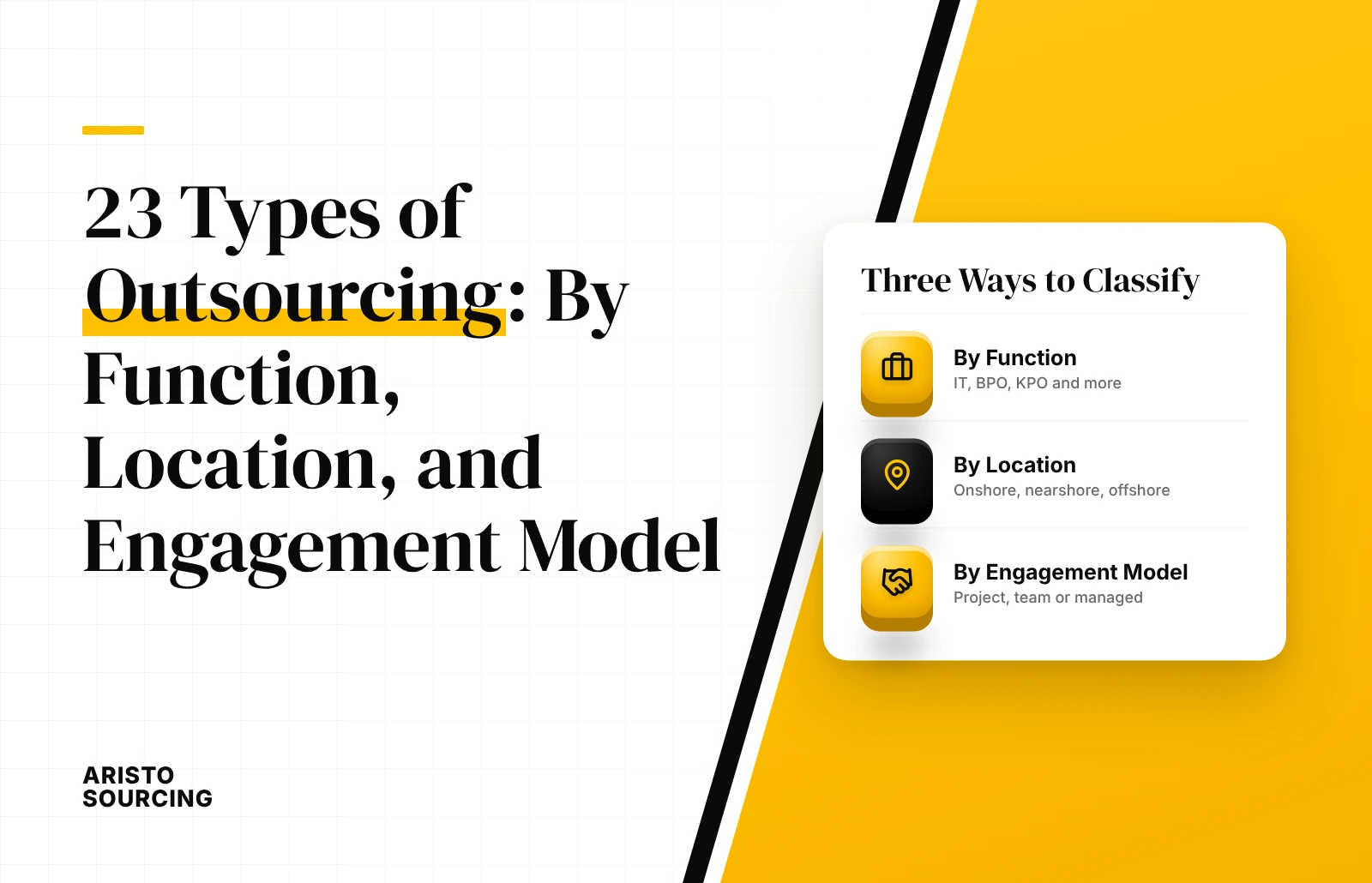
Types of outsourcing are the categories used to classify outsourcing arrangements by what work is outsourced, where the provider sits, and how the work is managed and paid. Outsourcing is the practice of contracting an external provider to perform business work that a company would otherwise handle internally. This page lists 23 types of outsourcing across three axes: 12 types by business function, 4 types by location, and 7 types by engagement model.
The page covers what the types of outsourcing are, the 12 function types, the 4 location types, the 7 engagement models, which type of outsourcing costs the least, how outsourcing differs from insourcing and reshoring, and how to choose the right type of outsourcing. Business owners and operations leaders use these outsourcing types to decide what to outsource, where to outsource it, and how much control to keep.
Outsourcing adoption keeps broadening beyond back-office work. According to Deloitte’s 2024 Global Outsourcing Survey of more than 500 business and technology leaders, 56% of organizations outsource front-office functions and 46% outsource research and development. Deloitte also reports that improved access to talent (42%) has overtaken cost reduction (34%) as the most cited reason for outsourcing.
What Are the Types of Outsourcing?
The types of outsourcing are the classification of outsourcing arrangements by business function, location, and engagement model. The function axis answers what work is outsourced, the location axis answers where the provider sits, and the engagement axis answers who manages the work and how it is paid. The three axes build on the basic definition of what outsourcing means for a business, and every outsourcing arrangement carries one type on each axis at the same time. A US company that hires a team in the Philippines to run customer support under a monthly per-person fee is buying offshore, business process outsourcing, under a dedicated team model.
The three axes of outsourcing types are presented in the table below.
| Axis | Question It Answers | Types Included | Example |
| Business function | What work is outsourced? | BPO, ITO, software development, KPO, RPO, LPO, HRO, FAO, customer service, manufacturing, logistics, professional services | Outsourcing payroll processing to an accounting firm |
| Location | Where does the provider sit? | Onshore, nearshore, offshore, onsite | Outsourcing software development to a provider in India |
| Engagement model | Who manages the work and how is it paid? | Staff augmentation, dedicated team, project-based, managed services, multisourcing, BOT, outcome-based | Paying a monthly fee per dedicated team member |
What Are the Types of Outsourcing by Business Function?
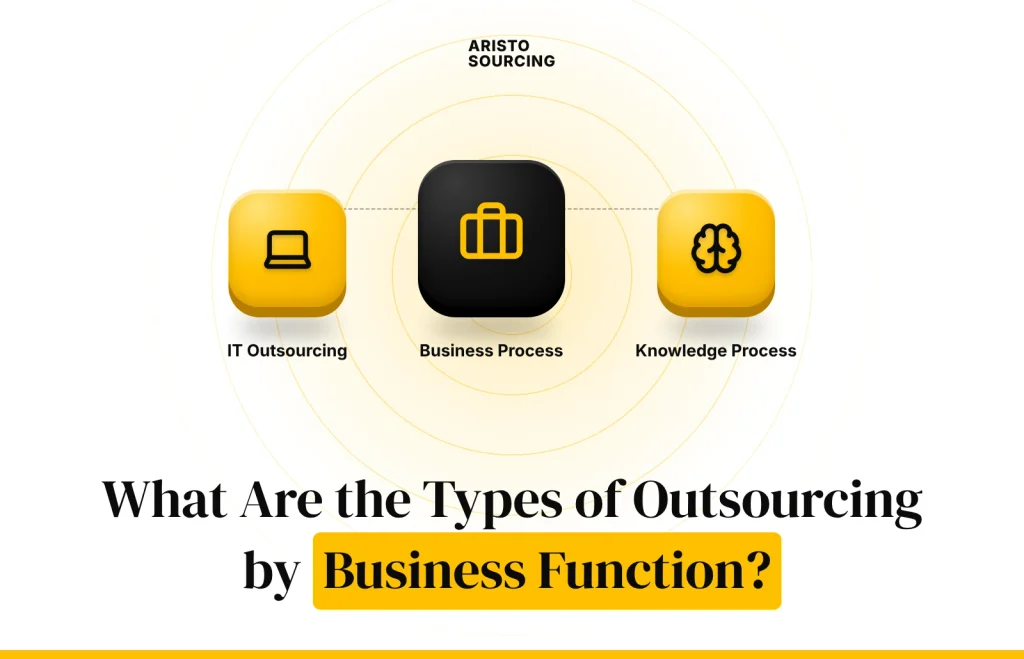
The types of outsourcing by business function are business process outsourcing, information technology outsourcing, software development outsourcing, knowledge process outsourcing, recruitment process outsourcing, legal process outsourcing, human resources outsourcing, finance and accounting outsourcing, customer service outsourcing, manufacturing outsourcing, operational and logistics outsourcing, and professional services outsourcing. The function axis answers what work is outsourced, and each function type maps to a specific department or process inside the client company.
The 12 types of outsourcing by business function are listed below.
- Business Process Outsourcing (BPO)
- Information Technology Outsourcing (ITO)
- Software Development Outsourcing
- Knowledge Process Outsourcing (KPO)
- Recruitment Process Outsourcing (RPO)
- Legal Process Outsourcing (LPO)
- Human Resources Outsourcing (HRO)
- Finance and Accounting Outsourcing (FAO)
- Customer Service Outsourcing
- Manufacturing Outsourcing
- Operational and Logistics Outsourcing
- Professional Services Outsourcing
1. Business Process Outsourcing (BPO)
Business process outsourcing (BPO) is the contracting of a specific, repeatable business process to a third-party provider that runs it against agreed service levels. BPO covers back-office work such as data entry, payroll, and document processing, and front-office work such as customer support and order handling. Banks, insurers, telecom companies, healthcare organizations, and growing small and mid-sized businesses buy BPO most often. BPO providers, contact center operators, and business process outsourcing services firms typically deliver this type of outsourcing. BPO differs from KPO in knowledge level: BPO handles rule-based, transactional processes, while KPO handles judgment-based analytical work.
2. Information Technology Outsourcing (ITO)
Information technology outsourcing (ITO) is the contracting of IT operations, infrastructure, and application support to an external technology provider. ITO covers help desk support, network and server management, cloud infrastructure, cybersecurity monitoring, and application maintenance. Mid-sized and large enterprises in finance, healthcare, retail, and manufacturing buy ITO most often. Managed IT service providers and global IT services firms typically deliver ITO. ITO divides into two sub-types: application outsourcing covers maintaining and supporting existing software, and infrastructure outsourcing covers running servers, networks, data centers, and cloud environments.
3. Software Development Outsourcing
Software development outsourcing is the contracting of new software product builds to an external development team. Software development outsourcing covers web applications, mobile apps, enterprise software, SaaS products, and quality assurance testing. Startups, SaaS companies, and enterprises launching digital products buy software development outsourcing most often. Software development agencies and offshore development centers typically deliver software development outsourcing. Software development outsourcing differs from ITO in purpose: ITO runs and maintains existing IT, while software development outsourcing builds new products.
4. Knowledge Process Outsourcing (KPO)
Knowledge process outsourcing (KPO) is the contracting of research, analysis, and expert judgment work to specialist providers. KPO covers market research, financial analysis, data analytics, equity research, and medical transcription and review. Investment firms, consulting firms, pharmaceutical companies, and large enterprises buy KPO most often. Specialist research firms and analytics providers with domain-qualified staff typically deliver KPO. KPO differs from BPO in skill level: KPO staff apply expertise and interpretation, while BPO staff follow defined process rules.
5. Recruitment Process Outsourcing (RPO)
Recruitment process outsourcing (RPO) is the contracting of all or part of a company’s recruiting function to an external recruiting specialist. RPO covers workforce planning, candidate sourcing, screening, interview scheduling, and offer management. Large enterprises with continuous hiring and fast-growing companies with hiring spikes buy RPO most often. RPO providers such as Korn Ferry, Randstad Sourceright, and PeopleScout typically deliver RPO. RPO differs from HRO in scope: RPO covers recruiting only, while HRO covers payroll, benefits, and HR administration.
6. Legal Process Outsourcing (LPO)
Legal process outsourcing (LPO) is the contracting of legal support work to external legal service providers. LPO covers document review, contract drafting and management, legal research, eDiscovery, and paralegal support. Law firms, corporate legal departments, and insurers buy LPO most often. Legal process outsourcing firms and alternative legal service providers typically deliver LPO. LPO is a sub-sector of KPO because legal work requires qualified professionals applying legal judgment rather than following fixed process rules.
7. Human Resources Outsourcing (HRO)
Human resources outsourcing (HRO) is the contracting of HR administration and compliance work to an external HR provider. HRO covers payroll administration, benefits administration, HR records management, compliance reporting, and employee relations support. Small and mid-sized businesses without full HR departments and multinationals running multi-country payroll buy HRO most often. Professional employer organizations (PEOs), employer of record (EOR) providers, and HR outsourcing firms typically deliver HRO, and these three providers also represent the main types of HR outsourcing. HRO differs from RPO in scope: recruiting sits under RPO, while HRO covers the HR administration that follows a hire.
8. Finance and Accounting Outsourcing (FAO)
Finance and accounting outsourcing (FAO) is the contracting of bookkeeping, accounting, and transactional finance work to an external finance provider. FAO covers bookkeeping, accounts payable and receivable, payroll processing, financial reporting, and month-end close. Small businesses, e-commerce brands, and enterprises with shared finance operations buy FAO most often. Accounting firms, finance BPO providers, and offshore bookkeeping teams typically deliver FAO. FAO differs from professional services outsourcing in task type: accounting, bookkeeping, payroll processing, and AP/AR sit under FAO, while consulting and engineering services sit under professional services.
9. Customer Service Outsourcing
Customer service outsourcing is the contracting of customer support interactions to an external support team. Customer service outsourcing covers phone support, email support, live chat, help desk ticketing, and social media responses. E-commerce companies, SaaS businesses, telecom providers, and retailers buy customer service outsourcing most often. Contact center providers and BPO firms typically deliver customer service outsourcing. Customer service outsourcing differs from BPO in level: BPO is the wider category of outsourced processes, while customer service outsourcing is the support function itself.
10. Manufacturing Outsourcing
Manufacturing outsourcing is the contracting of product production to an external manufacturer. Manufacturing outsourcing covers contract manufacturing, component production, product assembly, packaging, and quality testing. Consumer electronics brands, apparel companies, medical device makers, and automotive suppliers buy manufacturing outsourcing most often. Contract manufacturers, original equipment manufacturers (OEMs), and original design manufacturers (ODMs) typically deliver manufacturing outsourcing. An OEM builds products to the client’s design, while an ODM designs and builds products that the client sells under its own brand.
11. Operational and Logistics Outsourcing
Operational and logistics outsourcing is the contracting of order fulfillment, warehousing, and distribution to an external logistics provider. Operational and logistics outsourcing covers order processing, pick-and-pack fulfillment, warehousing, inventory management, and last-mile distribution. E-commerce brands, retailers, and consumer goods manufacturers buy operational and logistics outsourcing most often. Third-party logistics (3PL) providers typically deliver operational and logistics outsourcing. Operational and logistics outsourcing differs from manufacturing outsourcing in stage: manufacturing outsourcing produces the goods, while logistics outsourcing stores and moves them.
12. Professional Services Outsourcing
Professional services outsourcing is the contracting of specialist advisory and creative services to external firms. Professional services outsourcing covers engineering services, architecture, management consulting, and marketing services. Companies that need specialist expertise for defined projects buy professional services outsourcing most often. Consulting firms, engineering firms, architecture practices, and marketing agencies typically deliver professional services outsourcing. Professional services outsourcing differs from LPO and FAO in task type: legal work sits under LPO and accounting work sits under FAO, while professional services outsourcing covers engineering, architecture, consulting, and marketing only.
What Are the Types of Outsourcing by Location?
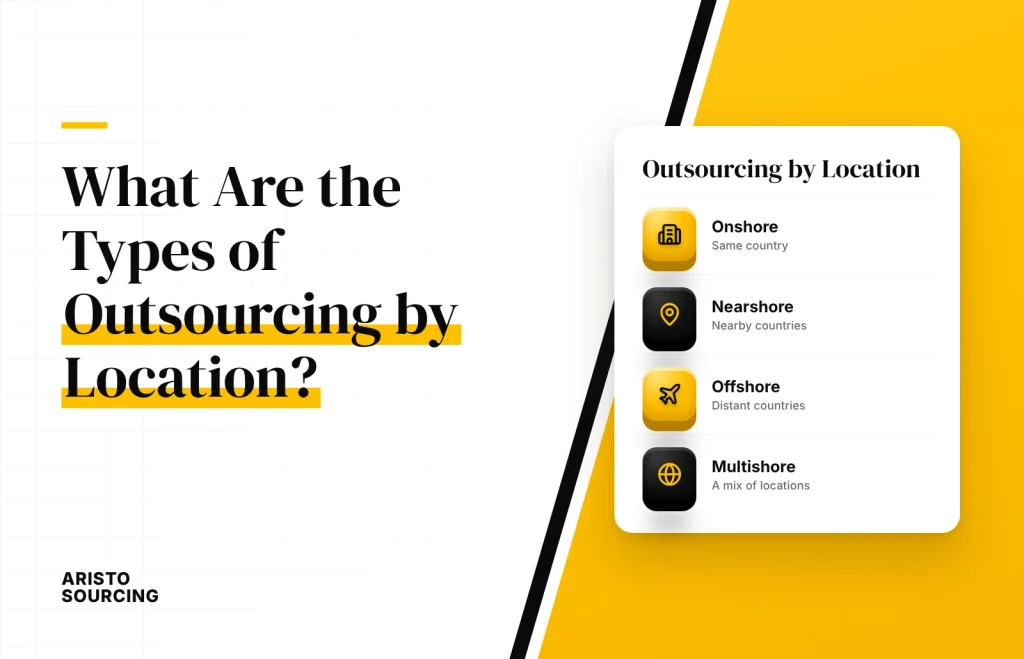
The types of outsourcing by location are onshore outsourcing, nearshore outsourcing, offshore outsourcing, and onsite outsourcing. The location axis answers where the provider sits, and the location types are also called outsourcing delivery models or outsourcing location models. Global outsourcing and international outsourcing are umbrella terms for any arrangement in which the provider sits in another country, which covers both nearshore and offshore outsourcing.
The comparison of the four location types by cost, time-zone overlap, and communication is presented in the table below.
| Type | Typical Cost Position | Time-Zone Overlap | Communication | Best For |
| Onshore | Highest | Full | Same language and business culture | Regulated, sensitive, or highly collaborative work |
| Nearshore | Medium | High | Similar culture, often shared language | Agile projects needing real-time collaboration |
| Offshore | Lowest | Low to none | Requires structured processes | Cost-driven, documented, or 24/7 work |
| Onsite | High | Full | Direct, face to face | Work tied to the client’s premises or systems |
The four types of outsourcing by location are listed below.
- Onshore Outsourcing
- Nearshore Outsourcing
- Offshore Outsourcing
- Onsite Outsourcing
1. Onshore Outsourcing
Onshore outsourcing is the contracting of work to a provider located in the same country as the client. A US company hiring a payroll provider in Texas is an example of onshore outsourcing. Onshore outsourcing carries the highest cost of the location types because the provider pays domestic wages and overheads. Onshore outsourcing gives full time-zone overlap and shared language, legal system, and business culture, which removes most communication friction. Onshore outsourcing fits regulated work, sensitive data handling, and tasks needing frequent in-person meetings, and the full trade-offs are covered in the guide to the onshore outsourcing model.
2. Nearshore Outsourcing
Nearshore outsourcing is the contracting of work to a provider in a nearby country, usually in the same or an adjacent time zone. A US company hiring a software team in Mexico or Costa Rica is an example of nearshore outsourcing. Nearshore outsourcing costs less than onshore outsourcing and more than offshore outsourcing. Nearshore outsourcing gives high time-zone overlap and close cultural alignment, which supports real-time meetings and agile collaboration. Nearshore outsourcing fits development and support work that needs same-day communication, and the regional options are compared in the guide to nearshore outsourcing.
3. Offshore Outsourcing
Offshore outsourcing is the contracting of work to a provider in a distant country, usually across several time zones. A US company hiring a customer support team in the Philippines or a software development team in India is an example of offshore outsourcing. Offshore outsourcing carries the lowest labor cost of the location types because wage levels in major offshore destinations sit well below US and Western European levels. Offshore outsourcing gives little time-zone overlap, so communication depends on documented processes, set overlap hours, and asynchronous tools. Offshore outsourcing fits cost-driven, documented, and round-the-clock work, and the destination countries and risks are covered in the guide to offshore outsourcing.
4. Onsite Outsourcing
Onsite outsourcing is the contracting of work to a provider whose staff work on the client’s premises. A US bank bringing an external IT team into its own office to run a data center migration is an example of onsite outsourcing. Onsite outsourcing carries high cost because the provider staff work at client locations, often with travel or relocation expenses. Onsite outsourcing gives full time-zone overlap and direct face-to-face communication with internal teams. Onsite outsourcing fits work tied to physical systems, secure facilities, or close supervision. Onsite outsourcing differs from staff augmentation because onsite describes where the work happens, while staff augmentation describes how the work is managed.
What Are the Types of Outsourcing by Engagement Model?
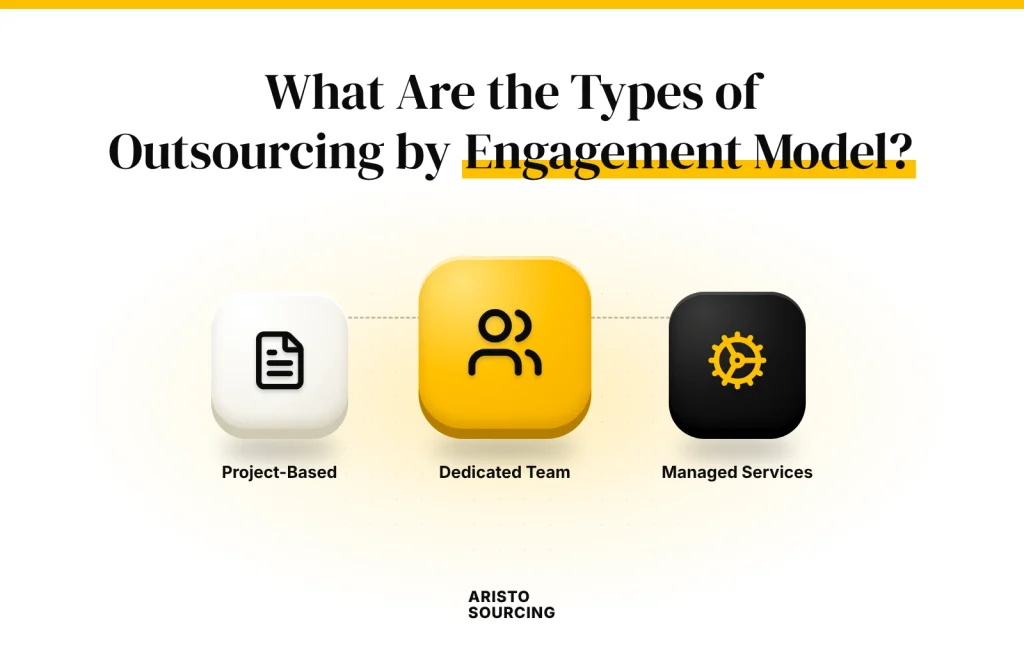
The types of outsourcing by engagement model are staff augmentation, dedicated team, project-based outsourcing, managed services, multisourcing, build-operate-transfer (BOT), and outcome-based outsourcing. The engagement axis answers who manages the work and how it is paid, and engagement types are also called outsourcing models, IT outsourcing models, or software outsourcing models. Out-tasking is a narrower form of engagement that outsources single tasks rather than a whole function. Co-sourcing, hybrid models, and captive centers are variants outside the seven main engagement models, where internal staff and external providers share work or the company owns its offshore center.
The seven types of outsourcing by engagement model are listed below.
- Staff Augmentation
- Dedicated Team
- Project-Based Outsourcing
- Managed Services
- Multisourcing
- Build-Operate-Transfer (BOT)
- Outcome-Based Outsourcing
1. Staff Augmentation
Staff augmentation is the engagement model in which a provider supplies external professionals who join the client’s team and work under the client’s direction. The client manages the daily work, priorities, and output of augmented staff. Staff augmentation is priced hourly or as a monthly fee per person. Staff augmentation typically covers individual roles for periods from a few months to several years. Staff augmentation fits companies that have management capacity but lack specific skills or headcount, which is the model used by remote staffing providers such as Aristo Sourcing.
2. Dedicated Team
A dedicated team is the engagement model in which a provider assembles a full-time team that works exclusively for one client. The client directs the team’s work, while the provider handles recruitment, payroll, equipment, and HR administration. A dedicated team is priced as a monthly fee per team member. A dedicated team typically covers ongoing functions such as customer support, development, or back-office operations for one year or longer. A dedicated team fits companies that want long-term, stable capacity with control over daily work.
3. Project-Based Outsourcing
Project-based outsourcing is the engagement model in which a provider delivers a defined project with a fixed scope, timeline, and deliverable. The provider manages the project team, methods, and delivery. Project-based outsourcing is priced as a fixed price or milestone-based fee. Project-based outsourcing typically covers one-off work such as a website build, an app launch, or a data migration lasting weeks or months. Project-based outsourcing fits companies with clear requirements and no need for ongoing support, and the scoping and contract details are covered in the guide to project-based outsourcing contracts.
4. Managed Services
Managed services is the engagement model in which a provider takes full responsibility for running a function against service level agreements. The provider manages the people, tools, and processes, and the client manages the provider relationship. Managed services are priced as a recurring SLA-based fee, usually monthly. Managed services typically cover whole functions, such as IT operations or security monitoring, under multiyear contracts. Managed services fit companies that want predictable outcomes without managing staff directly.
5. Multisourcing
Multisourcing is the engagement model in which a client splits work across several specialist providers instead of one vendor. The client, or a service integrator appointed by the client, manages coordination between providers. Multisourcing is priced separately per provider under each provider’s own fee model. Multisourcing typically covers large IT or business service portfolios run under several multiyear contracts at once. Multisourcing fits large enterprises that want best-of-breed providers and lower dependence on any single vendor.
6. Build-Operate-Transfer (BOT)
Build-operate-transfer (BOT) is the engagement model in which a provider sets up and runs an offshore operation for a client, then transfers ownership of that operation to the client. The provider manages the build and operate phases, and the client manages the operation after transfer. BOT is priced through setup fees, monthly operating fees, and a transfer fee. BOT typically covers offshore centers built over two to five years before transfer. BOT fits enterprises that want their own offshore center without taking on the startup risk alone.
7. Outcome-Based Outsourcing
Outcome-based outsourcing is the engagement model in which the client pays the provider for agreed business results rather than for hours or headcount. The provider manages the methods and resources used to reach the agreed results. Outcome-based outsourcing is priced through performance-based fees tied to metrics such as resolved tickets, qualified leads, cost savings, or uptime. Outcome-based outsourcing typically covers measurable processes under multiyear contracts with shared risk. Outcome-based outsourcing fits mature processes where results can be measured and attributed clearly.
Which Type of Outsourcing Costs the Least?
The cheapest type of outsourcing is usually offshore outsourcing of transactional business processes under a staff augmentation or dedicated team model. By location, offshore outsourcing carries the lowest labor cost, onshore outsourcing carries the highest, and nearshore outsourcing sits between them. By function, transactional BPO work such as data entry and support costs less than knowledge process outsourcing, which requires qualified analysts and domain experts. By engagement model, staff augmentation and dedicated teams carry lower direct fees than managed services and outcome-based contracts, which price in the provider’s management layer and performance risk. Total cost of ownership matters more than the headline rate, because management time, transition costs, and quality rework can erase a low hourly fee. Cost has also become a smaller driver of outsourcing decisions: Deloitte reports that the share of executives naming cost reduction as a primary outsourcing objective fell from 70% in 2020 to 34% in 2024.
Outsourcing vs Insourcing vs Reshoring: What Is the Difference?
The difference between outsourcing, insourcing, and reshoring is that outsourcing moves work to an external provider, insourcing brings previously outsourced work back in-house, and reshoring moves offshore work back to the home country. Outsourcing means an external provider performs the work; insourcing means the company performs the work again with its own staff; reshoring means the work returns to the home country, whether in-house or with a domestic provider. A US company hiring a Philippine team for customer support is outsourcing; moving that support back to its own US staff is insourcing; moving its Asian factory production back to Ohio is reshoring. Nearshoring is the middle path, moving offshore work to a closer country rather than all the way home. The three strategies are not opposites of outsourcing as a whole, and Deloitte reports that 70% of organizations selectively insourced parts of previously outsourced scope over the past five years. The full comparison of control, cost, and risk is covered in the guide to outsourcing vs insourcing.
The comparison of outsourcing, insourcing, and reshoring is presented in the table below.
| Factor | Outsourcing | Insourcing | Reshoring | Explanation |
| Who does the work | External provider | Company’s own staff | Company or domestic provider | Ownership of the work separates outsourcing from insourcing |
| Where the work happens | Anywhere | Inside the company | Home country | Geography separates reshoring from the other two |
| Main driver | Talent access and cost | Control and quality | Supply chain risk and proximity | Each strategy answers a different business problem |
| Typical direction | Out of the company | Back into the company | Back to the home country | Insourcing and reshoring often reverse earlier outsourcing |
How Do You Choose the Right Type of Outsourcing?
You choose the right type of outsourcing by deciding what work to outsource, where the provider should sit, and how much control to keep, then matching budget, compliance needs, and vendor fit to those choices. An outsourcing strategy that settles each axis in order makes model selection faster and keeps the shortlist focused.
The seven steps to choose the right type of outsourcing are listed below.
- Decide what to outsource by separating core work from non-core work, which sets the function type.
- Decide where the provider should sit based on cost, time-zone overlap, and compliance, which sets the location type.
- Decide how much control to keep over daily work, which sets the engagement model.
- Set the budget and the pricing model, whether hourly, monthly per person, fixed price, SLA fee, or outcome fee.
- Check security and compliance requirements, including SOC 2, ISO 27001, and GDPR.
- Shortlist vendors against the outsourcing vendor selection criteria that match your function and location type.
- Pilot one function with the chosen provider, then scale.
The 23 types of outsourcing by function, location, and engagement model combine into one decision. A company that names its function type, location type, and engagement model before contacting providers compares like-for-like proposals and avoids paying for a model it does not need.
Which Type of Outsourcing Fits a Small Business?
The best type of outsourcing for a small business is usually offshore staff augmentation or a dedicated assistant for administrative work, customer support, and bookkeeping. Offshore staff augmentation gives a small business full-time capacity at a monthly cost below a domestic hire, while the owner keeps direct control over daily priorities. Project-based outsourcing fits one-off builds such as a website or app, where a fixed price and defined deliverable limit financial risk. Enterprise managed services and build-operate-transfer arrangements rarely fit small budgets because both require multiyear contracts and large minimum scope. Aristo Sourcing supplies dedicated offshore staff from the Philippines and South Africa that the owner directs day to day, which places Aristo Sourcing in the staff augmentation model rather than BPO, managed services, or project delivery.