

Offshore software outsourcing refers to hiring a development company in another country to build, test, or maintain your software remotely. Businesses outsource software development to overseas providers to lower development costs, access skilled engineers, and release products faster than local hiring allows. The main types of offshore software outsourcing are staff augmentation, dedicated development teams, project-based outsourcing, and the build-operate-transfer (BOT) model.
Offshore software outsourcing offers cost reduction, access to a global talent pool, and scalability, but it carries risks such as communication barriers, inconsistent code quality, and vendor lock-in. Choosing the right provider and managing the offshore team with clear processes determine whether the benefits outweigh the risks. The right outsourcing provider for offshore development handles recruiting, vetting, and onboarding, so your team stays focused on product direction.
What Is Offshore Software Outsourcing?
Offshore software outsourcing is a business practice in which a company contracts a third-party provider in another country to design, build, test, or maintain its software. The client organization defines the project requirements and completes vendor selection, after which the chosen provider assigns developers to work across the software development lifecycle.
Once onboarding is complete, the provider handles design, coding, quality assurance (QA), and deployment, while the client reviews progress, approves releases, and owns the delivered code. For example, a US e-commerce company uses offshore software outsourcing when it hires a development team in the Philippines to build and maintain its web platform.
Offshore software development is the broader term that includes any software work performed in another country, whether through an outsourcing vendor, a company-owned offshore center, or directly hired remote employees. Offshore software outsourcing is the vendor-based form of offshore software development, and the types of offshore software outsourcing differ in how much control the client organization keeps.
What Are the Types of Offshore Software Outsourcing Models?
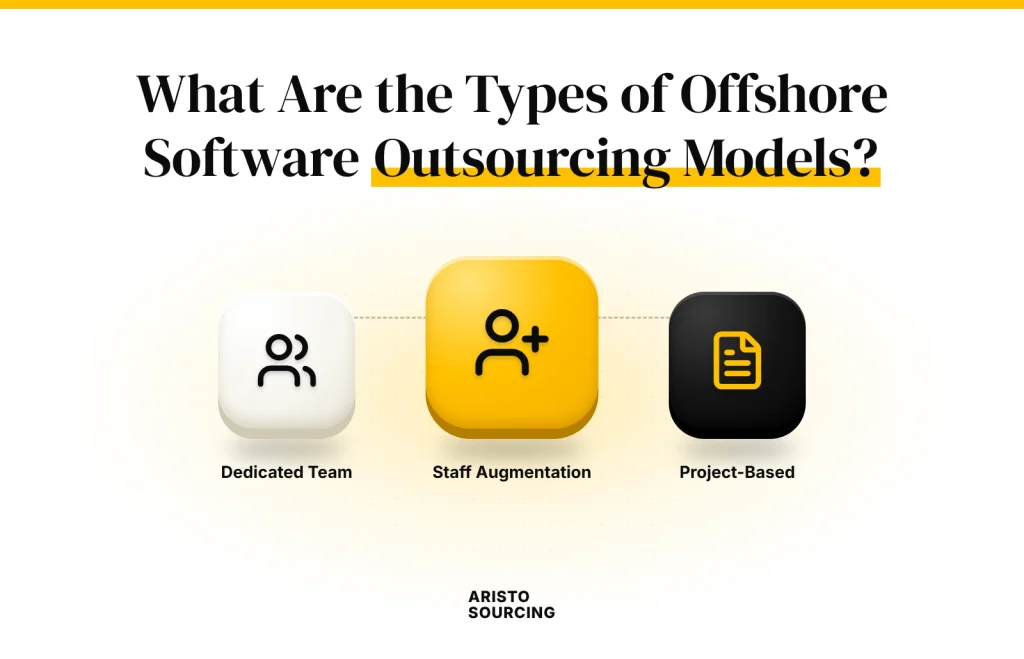
The types of offshore software outsourcing models include staff augmentation, the dedicated development team model, project-based outsourcing, and the build-operate-transfer (BOT) model.
The types of offshore software outsourcing models are listed below.
- Staff Augmentation
- Dedicated Development Team
- Project-Based Outsourcing
- Build-Operate-Transfer (BOT) Model
1. Staff Augmentation
Staff augmentation refers to a capacity-extension outsourcing model in which a client organization adds externally employed developers to its in-house team for a defined period to fill skill gaps. The augmented developers join the client’s daily stand-ups, work in the client’s repositories and tools, and follow the same coding standards as internal engineers. The client manages daily work, sets priorities, and reviews output, while the provider handles recruitment, payroll, equipment, and HR administration. Staff augmentation suits companies that have strong technical leadership but need extra capacity without long local hiring cycles.
2. Dedicated Development Team
A dedicated development team refers to a long-term, full-time team that an offshore provider assembles to work exclusively on one client’s product under the client’s direction. A typical dedicated development team includes developers, QA engineers, and a project manager who coordinates sprints, tracks progress, and reports to the client. The engagement is open-ended, so team members build deep product knowledge and stay stable across releases. The provider handles hiring, payroll, and retention, while the client sets the product roadmap and priorities.
3. Project-Based Outsourcing
Project-based outsourcing refers to an engagement model in which a client hands a clearly defined software project to an offshore provider for delivery at an agreed price and deadline. The contract fixes the project scope, divides the work into milestones, and lists the deliverables, such as source code, documentation, and a tested release. The provider is responsible for planning, staffing, and delivering the project, while the client approves each milestone. Project-based outsourcing works best for stable requirements because scope changes trigger change requests that add cost and time.
4. Build-Operate-Transfer (BOT) Model
The build-operate-transfer (BOT) model refers to a three-phase outsourcing arrangement in which a provider builds, runs, and then hands over an offshore development team to the client. During the build and operate phases, the provider recruits staff, sets up the offshore development center, and delivers development services under its own management. In the transfer phase, the client takes ownership of the team, processes, and infrastructure at a time set in the contract. The BOT model is closely associated with offshore development center (ODC) setup because the client finishes the engagement with its own ODC in another country.
What Software Development Services Can Be Offshored?
The software development services that can be offshored include custom software development, web development, mobile app development, UI/UX design, software testing, DevOps and cloud services, and maintenance and support.
The software development services that can be offshored are listed below.
- Custom Software Development: Custom software development is the design and build of software tailored to one company’s workflows, such as internal tools, customer portals, booking systems, or software-as-a-service (SaaS) products.
- Web Development: Web development is the creation of websites and web applications, covering front-end interfaces, back-end logic, databases, and application programming interfaces (APIs), with technologies such as React or Node.js.
- Mobile App Development: Mobile app development is the creation of native or cross-platform apps for iOS and Android, covering interface design, API integration, testing, and publication on the App Store and Google Play.
- UI/UX Design: UI/UX design is the planning of user interface (UI) layouts and user experience (UX) flows through wireframes, clickable prototypes, and design systems before developers write production code.
- Software Testing: Software testing is the process of verifying that software works as intended through manual, automated, performance, and security tests run before and after each release.
- DevOps and Cloud Services: DevOps and cloud services cover cloud infrastructure setup, continuous integration and continuous delivery (CI/CD) pipelines, containerization, and monitoring on platforms such as Amazon Web Services, Microsoft Azure, and Google Cloud.
- Maintenance and Support: Maintenance and support is the ongoing service of fixing bugs, applying security patches, monitoring performance, and releasing feature updates that keep software stable after deployment.
Companies offshore these services separately or combine them in one engagement, and the benefits of offshoring are strongest when the work has clear requirements and measurable deliverables.

What Are the Benefits of Offshore Software Outsourcing?
The benefits of offshore software outsourcing include cost reduction, access to a global talent pool, scalability, specialized expertise, faster time-to-market, a stronger focus on core work, and lower hiring risk.
The benefits of offshore software outsourcing are listed below.
- Reduces Development Costs: Reducing development costs means paying lower hourly rates for comparable engineering work because labor costs in offshore destinations sit below US and Western European levels. Cost reduction also comes from lower recruitment, office, and benefits expenses, which the provider covers within its rates.
- Expands Access to Talent: Expanding access to talent means hiring from a global talent pool instead of competing only for local engineers. A global talent pool shortens hiring time for in-demand roles such as cloud, mobile, and data engineers.
- Improves Scalability: Improving scalability means adding or removing developers as project demand changes, without long hiring or layoff cycles. Established offshore providers keep pools of vetted engineers, so team size changes follow contract notice periods instead of local recruiting timelines.
- Provides Specialized Expertise: Providing specialized expertise means accessing skills such as cloud architecture, cybersecurity, or machine learning without hiring full-time specialists. Specialized expertise fills short, high-skill project phases that do not justify a permanent in-house role.
- Accelerates Time-to-Market: Accelerating time-to-market means releasing products sooner by adding development capacity and running follow-the-sun work, where tasks continue across time zones overnight. A faster time-to-market helps companies reach customers before competitors and start earning revenue earlier.
- Frees In-House Teams for Core Work: Freeing in-house teams for core work means internal engineers focus on product strategy, architecture, and customer-facing features while the offshore team handles defined tasks. The split keeps senior engineers on high-value decisions instead of routine tickets.
- Lowers Hiring Risks: Lowering hiring risks means shifting recruitment, payroll, compliance, and replacement duties to the provider instead of carrying long-term employment commitments. Clear service-level agreements and replacement clauses help companies avoid risks tied to turnover, mis-hires, and fluctuating demand.
The benefits of offshore software outsourcing hold only when the client organization manages the risks that come with distance, vendor dependence, and code quality.
What Are the Risks and Disadvantages of Offshore Software Outsourcing?
The risks and disadvantages of offshore software outsourcing are listed below.
- Communication Barriers: Communication barriers are gaps in language, culture, and working style that cause misunderstood requirements, missed details, and slow feedback between the client and the offshore team. Avoid communication barriers with written specifications, one shared communication channel, and weekly video calls that confirm priorities.
- Time Zone Delays: Time zone delays occur when working hours barely overlap, so questions, code reviews, and approvals wait a full day for answers. Prevent time zone delays by agreeing on 2 to 4 overlapping hours daily and using asynchronous updates for the remaining work.
- Inconsistent Code Quality: Inconsistent code quality occurs when offshore developers follow coding standards, testing habits, or review practices that differ from those of the client’s in-house team. Define shared coding standards before development starts and require peer code reviews and automated tests before every merge.
- Technical Debt: Technical debt is the future rework cost created when developers choose quick fixes over maintainable code to meet deadlines or fixed budgets. Track technical debt in the backlog and reserve a fixed share of each sprint for refactoring.
- Vendor Lock-In: Vendor lock-in happens when a client depends so heavily on one provider’s people, tools, or undocumented knowledge that switching providers becomes costly and slow. Require full documentation, client-owned code repositories, and clear intellectual property and exit clauses in the contract.
- Data Security Gaps: Data security gaps are weaknesses in the provider’s access controls, devices, or networks that can expose source code, customer data, or intellectual property. Sign non-disclosure agreements, enforce role-based access, and choose providers aligned with recognized security frameworks such as ISO/IEC 27001 or SOC 2.
- Hidden Costs: Hidden costs are expenses outside the quoted rate, such as onboarding, management time, rework, and change requests, that reduce the expected savings. Calculate the total cost of ownership and define change-request pricing in the contract before work begins.
- Unchecked AI-Generated Code: Unchecked AI-generated code is output from AI coding assistants that ships without human review and can introduce bugs, security flaws, or licensing problems. Build risk mitigation into the contract by requiring the provider to disclose AI tool usage and review every AI-assisted change.
Is AI Replacing Offshore Software Outsourcing?
No, AI is not replacing offshore software development, but it is changing how offshore teams write, test, and review code. Artificial intelligence (AI) coding assistants such as GitHub Copilot generate boilerplate code, draft unit tests, and explain legacy code, so AI-assisted software development shortens routine tasks. A 2023 study by researchers from GitHub, Microsoft Research, and MIT found that Copilot users finished a coding task 55.8% faster than non-users.
Engineering oversight remains essential because AI output still requires human review for security, architecture, and business logic before it reaches production. As providers in different countries adopt AI tools, routine coding costs fall, vendor evaluation shifts toward AI governance, and demand grows for senior engineers with system design skills.
What Are the Best Countries for Offshore Software Development?
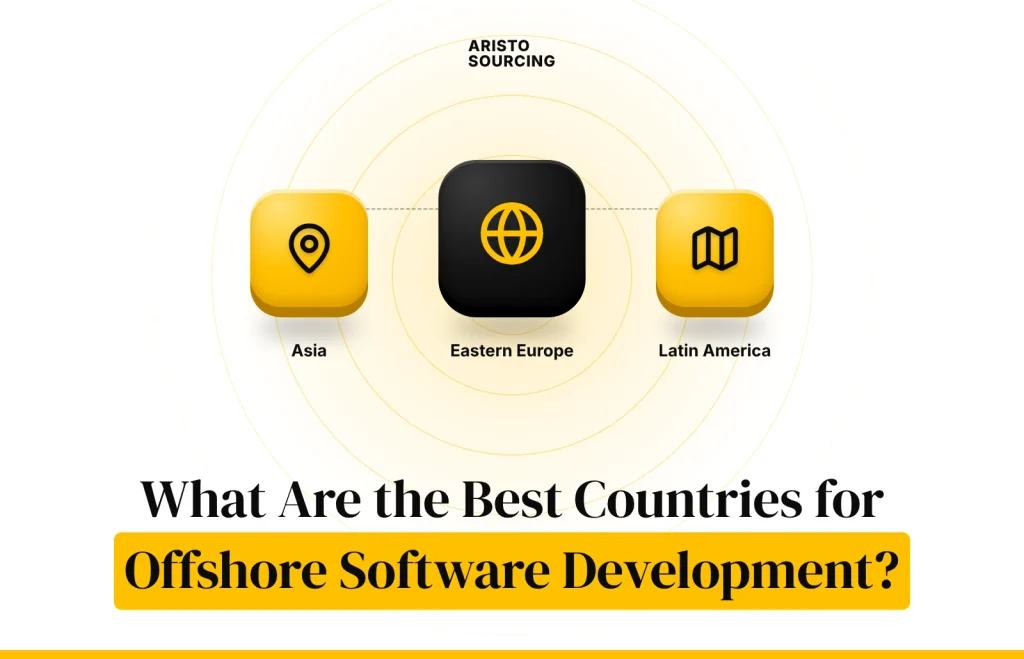
The best countries for offshore software development include India, the Philippines, and countries in Eastern Europe. Each of these offshore development countries offers a different balance of cost, talent, and time zone fit, so the right choice depends on the project.
The best countries for offshore software development are listed below.
- India: India is a major South Asian offshore software development destination with deep technical expertise and an estimated tech industry workforce of 5.8 million people in FY2025, according to NASSCOM. India’s low labor costs suit large, long-term teams, but a 9.5- to 10.5-hour gap with US Eastern Time requires planned overlap hours and clear written communication.
- Philippines: The Philippines is a Southeast Asian offshore software development destination known for high English proficiency, ranking 28th of 123 countries and regions in the 2025 EF English Proficiency Index. The Philippine developer pool is smaller than India’s, but competitive labor costs and common night-shift coverage for Western clients offset a 12- to 13-hour time difference with US Eastern Time.
- Eastern Europe: Eastern Europe is an offshore software development region, including Poland, Romania, and Ukraine, known for strong technical expertise at rates higher than those in most Asian destinations. Eastern Europe’s time difference of 2 hours or less with Western Europe makes the region nearshore for Western European clients, while US clients treat it as offshore.
How to Choose an Offshore Software Development Country?
Choosing an offshore software development country involves comparing talent availability, labor costs, technical expertise, time zones, and communication quality against your project requirements. Talent availability shows how quickly a country can staff your technology stack, while labor costs set the hourly budget for each role. Technical expertise determines whether engineers can handle complex work; time zones and communication determine how much real-time collaboration is possible.
Project requirements decide the destination: a cost-sensitive, well-documented build suits India or the Philippines, while daily collaboration with Western European stakeholders favors Eastern Europe. Other notable destinations include Vietnam for cost-competitive engineering and Latin America for close time zone alignment with US clients. No single country is the best choice for every project, so shortlist 2 or 3 countries that match your stack, budget, and collaboration needs before comparing vendors.
How Much Does Offshore Software Outsourcing Cost?
Offshore software outsourcing costs depend on the provider’s country, developer seniority, technology stack, team composition, and the pricing model you agree on when choosing the right offshoring partner. Hourly pricing bills an agreed rate for each hour worked and suits projects with changing scope or short engagements. Monthly pricing charges a fixed fee per full-time developer or team and is standard for staff augmentation and dedicated development teams. Project-based pricing sets one fixed price for a defined scope and deliverables, which protects the budget when requirements are stable.
Offshore software development costs rise with developer seniority, niche technology stacks such as machine learning, and team compositions that add architects or project managers. According to Accelerance’s 2026 Global Software Development Rates & Trends Guide, hourly rates run $24-$41 in Asia, $31-$76 in Europe, and $33-$75 in Latin America, from junior to senior developers.

How to Choose an Offshore Software Development Company?
To choose an offshore software development company, evaluate its technical expertise, industry experience, portfolio and case studies, client references, technical assessment results, team management approach, security practices, and contract terms.
The criteria for choosing an offshore software development company are listed below.
- Technical Expertise: Technical expertise is the provider’s proven skill in your technology stack, architecture patterns, and engineering practices, shown through senior engineer profiles, certifications, and code samples.
- Industry Experience: Industry experience is the provider’s track record in your sector, which shortens onboarding and reduces compliance errors in regulated fields such as healthcare, finance, and insurance.
- Portfolio and Case Studies: A portfolio and case studies document the provider’s completed projects, including scope, technologies, team size, timelines, and measurable results, which reveal whether the provider has delivered similar work.
- Client References: Client references are contacts at current or former clients who describe the provider’s delivery quality, communication, deadline performance, and handling of problems in real engagements.
- Technical Assessment: A technical assessment is a structured test of the provider’s engineers, such as a coding exercise, architecture review, or paid pilot sprint, that verifies their skills before contract signing.
- Team Management Approach: The team management approach is the provider’s method for managing a team across time zones, including reporting cadence, escalation paths, collaboration tools, and developer retention practices.
- Security Practices: Security practices are the provider’s controls for protecting code and data, including non-disclosure agreements, access management, secure devices, and alignment with frameworks such as ISO/IEC 27001.
- Contract Terms: Contract terms are the legal conditions that define pricing, intellectual property ownership, confidentiality, service levels, termination rights, and knowledge transfer duties between the client and the provider.
How to Manage an Offshore Software Development Team?
To manage an offshore software development team effectively, businesses should define clear roles, set communication protocols, and run the work through Agile methodology with built-in quality checks. Assign a product owner and a technical lead, document who approves requirements and releases, and agree on channels, response times, and meeting cadence with the offshore development team.
Schedule 2 to 4 overlapping hours daily for stand-ups and sprint planning, keep requirements and decisions in shared documentation, and track progress through sprint reviews and weekly reports. Mandatory code review catches defects before merges, automated testing in a continuous integration pipeline blocks regressions, and a release process with staging approval protects production.
How Does Aristo Sourcing Help Manage an Offshore Software Development Team?
Aristo Sourcing helps businesses manage offshore software development teams by recruiting remote professionals who work alongside in-house teams and follow the client’s established workflows. A software development VA from Aristo Sourcing is a remote virtual assistant who supports engineering delivery through backlog management, sprint ceremony support, QA coordination, release readiness, and documentation. Engineering delivery support is one of the services that can be outsourced to an offshore software outsourcing team, while in-house engineers keep ownership of architecture and code.
Aristo Sourcing provides ongoing support through candidate vetting, onboarding, and dedicated account management, which gives businesses one point of contact after each hire. Businesses retain control over daily tasks, project priorities, communication, and performance expectations, so they gain the benefits of offshore software outsourcing without losing oversight of the work. For companies choosing the right partner, the Aristo Sourcing model adds remote delivery capacity while management decisions stay in-house.