
A hybrid team model basically is a workforce structure that combines in-house employees with remote professionals in one coordinated team. Businesses combine internal employees with remote professionals because the combination keeps strategic control in-house while extending capacity beyond the limits of the local hiring market. The main benefits of a hybrid team model are flexibility in scaling capacity, cost efficiency in staffing, and access to specialized skills that are scarce or expensive locally.
This guide explains the roles of in-house and virtual staff, how to decide which tasks to delegate, and when the model fits a business. The guide also covers the step-by-step setup process, the tools needed to manage a hybrid team, the main costs and ROI, and the best practices that keep hybrid teams productive. An outsourcing partner can help a business set up a hybrid team by sourcing, vetting, and onboarding the remote professionals.
What Is a Hybrid Staffing Model?
A hybrid staffing model is a workforce strategy that combines in-house employees with virtual staff, such as virtual assistants, freelancers, or outsourced professionals, to cover a business’s operational needs. In-house employees and virtual staff work together through shared workflows, defined roles, and common communication tools, so both groups contribute to the same business goals.
In most hybrid staffing models, in-house employees keep core functions such as leadership, strategy, and client relationships, while virtual staff handle delegated tasks such as administration, research, and customer support. A hybrid staffing model is different from hybrid work, which describes where employees work rather than who makes up the workforce.
What Is the Difference Between Hybrid Staffing and Hybrid Work?
The difference between hybrid staffing and hybrid work is that hybrid staffing defines who makes up the workforce, while hybrid work defines where employees do their jobs. Hybrid staffing is a workforce structure that combines in-house employees with virtual staff or outsourced professionals who work remotely for the business. Hybrid work is a work location arrangement in which employees split their working time between the office and remote locations, such as their homes. A business can use both at the same time, so the process of hybrid team model planning should define where in-house employees work and which tasks go to virtual staff.
How Does a Hybrid Team Model Work?
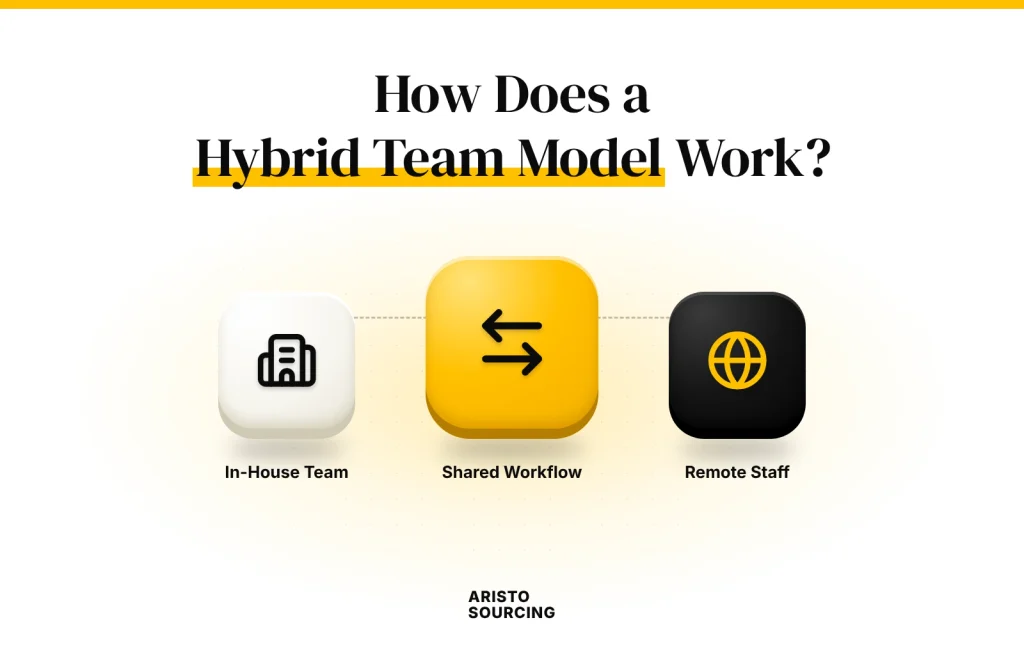
A hybrid team model works by assigning strategic, high-impact work to the in-house team and delegating repeatable, well-defined tasks to remote professionals such as a virtual assistant (VA). Task delegation starts with a task inventory, in which managers sort each activity by complexity, confidentiality, and business impact before assigning it to an internal or virtual team member. Workflow management connects the two groups through shared project boards, documented procedures, and clear handoff points, so every task moves from request to completion without confusion.
Team collaboration happens through scheduled check-ins, real-time messaging, and shared files, which keep the in-house team and each VA working from the same information. Accountability is managed by naming one owner for every task, setting deadlines and quality standards, and reviewing completed work against agreed metrics. A repeatable review process lets managers see who owns each task, when it is due, and whether the result meets the agreed standard.
What Do In-House Employees Handle in a Hybrid Team?
In-house employees in a hybrid team handle leadership, business strategy, important decisions, and client relationships. Leadership includes setting goals, managing people, and approving the work that virtual staff delivers. Business strategy covers planning, budgeting, product direction, and market positioning, which require deep company knowledge and long-term commitment.
Important decisions, such as hiring, pricing, and partnerships, stay with internal staff because those choices carry legal and financial responsibility. Client relationships remain in-house as well, since key accounts depend on trust, continuity, and direct access to the people who run the business. This in-house core is what makes a hybrid team different from a virtual team, in which every member, including management, works remotely.
What Do Virtual Assistants Handle in a Hybrid Team?
Virtual assistants in a hybrid team handle administrative tasks, scheduling, research, customer support, and other delegated work that follows a repeatable process. Administrative support includes email management, data entry, document preparation, and CRM updates. Scheduling covers calendar management, meeting coordination, and appointment booking for executives and sales teams. Research tasks include market research, lead generation, competitor tracking, and data collection for internal reports.
Customer support includes answering emails, live chat messages, and phone inquiries, as well as processing orders and resolving basic account issues. Other delegated work can include bookkeeping, social media management, and content scheduling, depending on each virtual assistant’s skills. Delegating tasks to virtual assistants frees in-house employees to focus on strategy, client relationships, and growth.
How to Decide Which Tasks to Delegate?
To decide which tasks to delegate, a business should evaluate each task by the expertise it requires, the confidentiality of the information involved, and its importance to the business. Tasks that need specialized skills the internal team lacks, such as graphic design or bookkeeping, are strong candidates for task delegation to qualified virtual staff. Repetitive, rule-based tasks that are easy to document are also suitable, because a virtual assistant can follow a written process with minimal supervision.
Confidentiality matters because tasks involving trade secrets, sensitive financial data, or legal matters carry a higher risk when shared outside the company. Business importance determines ownership, so core business functions such as strategy, key client management, and final approvals usually stay in-house. Highly confidential work, including executive payroll, mergers, and proprietary product development, remains with internal employees in most cases. A business gains the full benefits of delegation when it moves time-consuming, low-risk work to virtual staff and keeps high-risk, high-impact work in-house.
What Are the Benefits of a Hybrid Staffing Model?
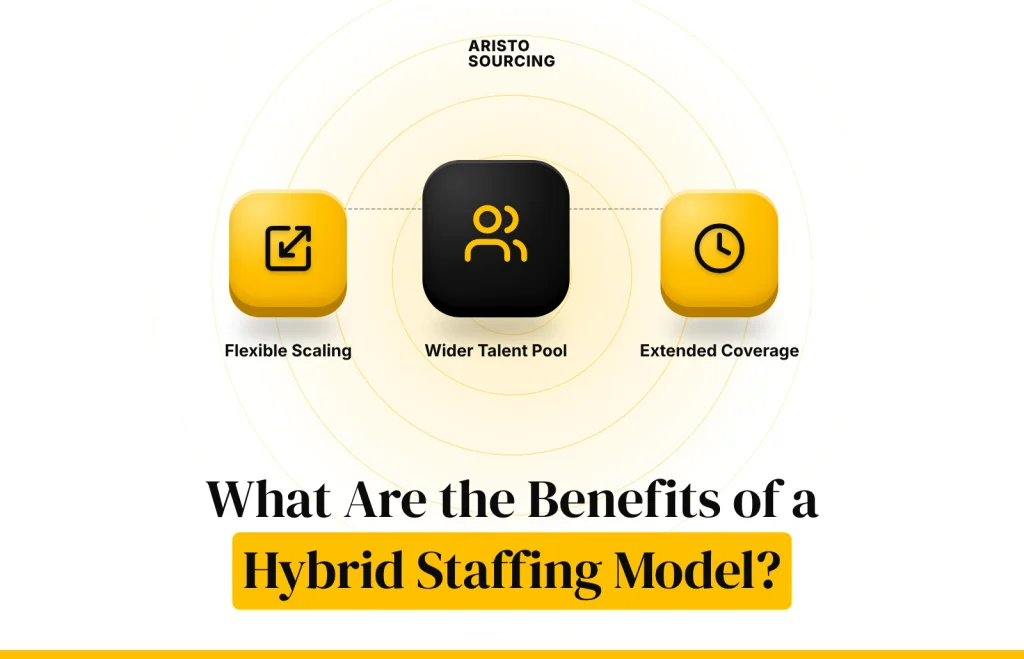
The benefits of a hybrid staffing model include cost efficiency, scalability, access to global talent, increased productivity, extended business hours, and business continuity.
The benefits of a hybrid staffing model are listed below.
- Reduces Staffing Costs: Reducing staffing costs means a business pays virtual staff only for delegated work and avoids the office space, equipment, and benefits packages required for additional in-house hires.
- Improves Scalability: Improving scalability means a business can add or reduce virtual staff as workloads change, allowing the team to handle busy periods without long-term, full-time hiring commitments.
- Expands Access to Global Talent: Expanding access to global talent means a business can hire skilled professionals from other countries to fill skill gaps that the local hiring market cannot address quickly or cost-effectively.
- Increases Productivity: Increasing productivity means in-house employees can focus on high-value work because virtual staff handle time-consuming, repetitive tasks such as data entry, scheduling, and inbox management.
- Extends Business Hours: Extending business hours means a business can provide customer support and complete work across more hours of the day by assigning tasks to virtual staff in different time zones.
- Maintains Business Continuity: Maintaining business continuity means a business can keep operations running during staff absences, holidays, or local disruptions because virtual staff in other locations cover essential tasks and keep workflows moving.
To keep these benefits, a business needs to understand the weak points of the model and avoid challenges such as poor communication and unclear accountability.
What Are the Challenges of a Hybrid Staffing Model?
The challenges of a hybrid staffing model are listed below.
- Communication Barriers: Communication barriers occur when in-house and virtual staff miss updates or misread instructions, and a business can avoid them by setting standard channels, written briefs, and scheduled check-ins.
- Accountability Gaps: Accountability gaps appear when no one clearly owns a task, and a business can avoid them by assigning one owner, one deadline, and one approval step to every deliverable.
- Data Security Risks: Data security risks arise when remote workers access sensitive systems from unsecured devices, and a business can reduce them with role-based access, password managers, VPNs, and signed confidentiality agreements.
- Time-Zone Differences: Time-zone differences delay responses and handoffs between locations, and a business can manage them by setting overlapping working hours and documenting each handoff at the end of a shift.
- Trust Issues: Trust issues develop when managers cannot see how remote work gets done, and a business can build trust through transparent task tracking, regular feedback, and gradual increases in responsibility.
- Cultural Differences: Cultural differences affect communication styles and work expectations, and a business can bridge them by sharing company values during hybrid staff onboarding and including virtual staff in team meetings.
When Should a Business Use a Hybrid Staffing Model?
A business should use a hybrid staffing model when its workload grows faster than its in-house team can handle, but full-time hiring is too slow, costly, or risky. Common situations include growing workloads, high volumes of repetitive tasks suited to remote work, seasonal peak periods, a limited budget for full-time hires, and the need for skills that are hard to find locally. In each situation, workforce planning identifies the gap, and virtual staff fills it with a level of scalability and cost efficiency that permanent hiring rarely matches.
The model works best when core business functions, such as strategy, financial approvals, and key client relationships, stay in-house. A hybrid model may not fit a business whose work is highly confidential or requires on-site presence, such as hands-on manufacturing, laboratory work, or in-person patient care. When these conditions apply, a step-by-step implementation reduces the risk of the transition.
How to Build a Hybrid Team Step by Step?
To build a hybrid team, a business needs to identify which work to delegate, define who owns each responsibility, hire the right virtual staff, document its processes, set communication rules, and measure performance.
The steps to build a hybrid team are listed below.
- Identify Tasks and Staffing Needs
- Define Roles and Responsibilities
- Hire and Onboard Virtual Staff
- Create Standard Operating Procedures (SOPs)
- Establish Communication and Collaboration Rules
- Set KPIs and Performance Expectations
1. Identify Tasks and Staffing Needs
To identify tasks and staffing needs, a business should list every recurring activity, estimate the hours each one takes, and note the skills it requires. This workforce planning exercise shows which tasks require internal employees because of their strategic value or sensitivity and which tasks can be delegated to virtual staff. The resulting task allocation also reveals how many virtual staff members the business needs and which skill sets to hire first.
2. Define Roles and Responsibilities
To define roles and responsibilities, a business should assign an owner, an executor, and an approver for every recurring task and project. Clear role definition prevents duplicate work and shows virtual staff exactly which decisions they can make and which ones need in-house approval. Documented roles also create accountability, because every missed deadline or quality issue traces back to a named person.
3. Hire and Onboard Virtual Staff
To hire and onboard virtual staff, a business should select candidates through a skills assessment and then give new hires structured training and access to the resources they need. A skills assessment, such as a paid test task, a software proficiency check, or a writing sample, confirms that virtual assistants can perform the delegated work before they join the team. Onboarding should include a company overview, tool and system access, process documentation, and a named in-house contact for questions during the first weeks.
4. Create Standard Operating Procedures (SOPs)
Standard operating procedures (SOPs) are written, step-by-step instructions that explain how to complete a recurring task to a consistent standard. Process documentation helps in-house and virtual staff follow the same steps, which maintains consistency across locations and reduces mistakes caused by guesswork or verbal instructions. SOPs also shorten training time for new virtual staff, because each documented process doubles as a training guide.
5. Establish Communication and Collaboration Rules
To establish communication and collaboration rules, a business should define which channel the team uses for each type of message, how quickly members should respond, and when the team meets. Team communication works best when daily updates go to a shared channel, urgent issues go to direct messages or calls, and project details stay inside collaboration tools such as a project management platform. Shared workflows define how handoffs happen between in-house and virtual staff, including who passes the work, what information travels with it, and who confirms receipt.
6. Set KPIs and Performance Expectations
To set KPIs and performance expectations, a business should define measurable targets for each role and share them with virtual staff before work begins. Key performance indicators (KPIs) for a hybrid team usually measure work quality through error rates, deadlines through on-time completion rates, and results through outputs such as resolved tickets or qualified leads. Performance management becomes easier when managers use tools such as dashboards and time-tracking software to review KPIs every week or month.
What Tools Are Needed to Manage a Hybrid Team?
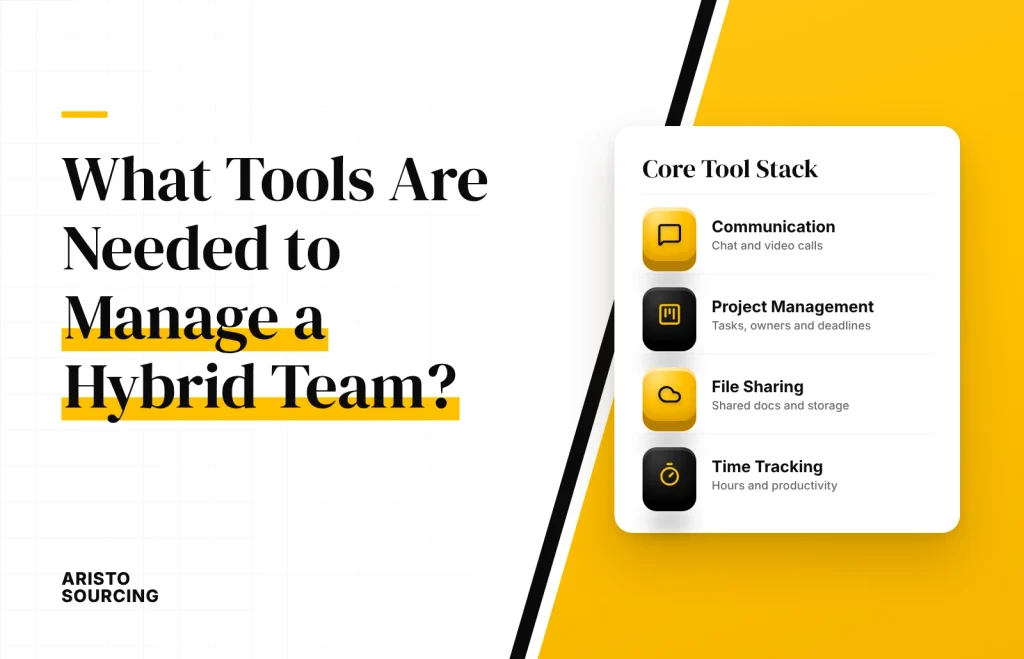
The tools needed to manage a hybrid team are listed below.
- Slack: Slack is a messaging platform that organizes team communication into channels, direct messages, and threads, which helps in-house and virtual staff share quick updates and files in real time.
- Microsoft Teams: Microsoft Teams is a collaboration platform that combines chat, video meetings, and file sharing within Microsoft 365, which suits businesses that already use Outlook, Word, Excel, and SharePoint.
- Video Conferencing Software: Video conferencing software, such as Zoom and Google Meet, supports face-to-face meetings, screen sharing, and recorded sessions, which help hybrid teams run check-ins, training, and performance reviews.
- Project Management Software: Project management software, such as ClickUp, Asana, and Trello, organizes tasks, deadlines, and assignees on shared boards, which shows every team member what is due and who owns it.
- File Sharing Tools: File sharing tools, such as Google Drive, Dropbox, and OneDrive, store documents in the cloud with permission controls, which gives in-house and virtual staff secure access to the same files.
- Password Managers: Password managers, such as 1Password and Bitwarden, store and share login credentials securely, which lets a business grant and revoke virtual staff access without sending passwords through email or chat.
Most of these tools offer free plans or free trials, while their paid tiers come with different pricing based on the number of users, storage limits, and advanced features. A business should choose a small set of tools that integrate with each other, so in-house and virtual staff do not switch between too many platforms.
How Much Does a Hybrid Staffing Model Cost?
A hybrid staffing model does not have a fixed cost, because the total depends on how many people the business employs in-house, how many roles it delegates, and where those professionals are based. The main cost factors are employee salaries, employee benefits such as health insurance and paid leave, contractor or agency fees, and the hourly or monthly rates of remote or offshore staff.
In-house employees usually carry the highest total staffing costs per role, offshore virtual staff often cost less because of lower regional wage levels, and contract workers are paid per project or per hour, which suits short-term or irregular needs. Virtual staff are not automatically cheap, because recruitment, training, management time, and software subscriptions reduce the cost efficiency of a poorly planned hybrid team. Total costs depend on the workforce structure, the sourcing method, such as direct hiring, freelance platforms, or an outsourcing provider, and the level of support the business requires.
Is a Hybrid Staffing Model Cheaper Than Hiring In-House Employees?
A hybrid staffing model can be cheaper than hiring only in-house employees, particularly when a business delegates repetitive, full-time workloads to offshore virtual staff instead of adding local full-time hires. The savings come from lower wage levels in offshore markets and from avoiding costs tied to each in-house hire, such as benefits, payroll taxes, office space, and equipment.
However, a hybrid staffing model is not cheaper in every case, because savings depend on the role, the location of the virtual staff, and the management effort the arrangement requires. Specialized roles with high global demand, poorly documented processes, and heavy supervision needs can reduce or eliminate the expected cost efficiency gains. Following best practices, such as maintaining clear documentation, streamlined workflows, and effective communication, helps minimize these risks. Comparing the fully loaded cost of an in-house employee with the total cost of a virtual staff member, including fees and management time, gives a business an accurate view of its staffing costs.
What Are the Best Practices for Managing a Hybrid Team?
The best practices for managing a hybrid team include clear expectations, documented workflows, regular feedback, secure access, consistent performance reviews, and team culture inclusion.
The best practices for managing a hybrid team are listed below.
- Clear Expectations: Clear expectations mean every in-house and virtual team member knows their responsibilities, deadlines, working hours, and quality standards from the first day.
- Documented Workflows: Documented workflows give the whole team one written reference for how each process runs, which keeps results consistent when work moves between locations.
- Regular Feedback: Regular feedback, delivered through weekly one-on-one meetings and task comments, helps virtual staff correct mistakes early and stay aligned with business goals.
- Secure Access: Secure access uses access control policies, such as role-based permissions, two-factor authentication, and prompt account removal when a contract ends, to protect business data.
- Consistent Performance Reviews: Consistent performance reviews evaluate in-house employees and virtual staff against the same KPIs on a fixed schedule, which keeps evaluations fair and measurable.
- Team Culture Inclusion: Team culture inclusion brings virtual staff into company meetings, announcements, and recognition programs, which builds loyalty and makes remote members feel part of the team.
Hybrid team management also depends on open communication between both groups, and outsourcing providers can support these practices by handling recruitment, onboarding, and HR administration for virtual staff.

How Do Outsourcing Providers Help Build a Hybrid Team?
Outsourcing providers help build a hybrid team by recruiting, vetting, employing, and managing the remote professionals who work alongside a company’s in-house team. A provider sources candidates, tests their skills, checks their backgrounds, and handles hiring, employment contracts, and payroll for the remote team.
The provider also supports onboarding and replaces staff members who do not meet performance expectations, which protects the business from long rehiring cycles. Outsourcing these administrative and HR responsibilities reduces the management burden on the in-house team, so managers can focus on directing work rather than handling hybrid staffing logistics.
How Can Aristo Sourcing Help Start a Hybrid Team?
Aristo Sourcing helps businesses build a hybrid team by recruiting, vetting, and placing offshore professionals who work alongside in-house employees and other external workers. As an outsourcing provider, Aristo Sourcing supports offshore staffing by matching each business with remote professionals, such as a dedicated VA, whose skills fit the delegated work in its hybrid staffing model.
The Aristo Sourcing support process covers candidate evaluation, background checks, onboarding, and dedicated account management, which keeps each placement aligned with the client’s workflows and data security requirements. Aristo Sourcing reduces hiring risks with a trial period of 30 to 60 days and a no-cost replacement policy, so a business can request a replacement at no extra cost if a placement does not fit.
With recruitment, vetting, and account management handled by one partner, businesses gain the scalability to add remote professionals as workloads grow. Aristo Sourcing gives companies the benefits of hybrid team staffing, including cost efficiency and access to skilled offshore talent, while simplifying the work of implementing hybrid team model processes.