
International outsourcing basically refers to a business practice in which a company contracts a provider in another country to perform specific tasks, services, or production work on its behalf. Businesses outsource work to foreign providers mainly to lower costs, access skilled talent, and extend operating hours without expanding their in-house teams.
The main types of international outsourcing include offshore and nearshore outsourcing, along with function-based models such as Business Process Outsourcing, IT outsourcing, and Knowledge Process Outsourcing. The key benefits include cost savings, access to global talent, and flexible scalability, while the main risks to avoid include communication barriers, data security gaps, and inconsistent quality. The success of each outsourcing arrangement depends largely on choosing the right outsourcing provider.
What Is International Outsourcing?
International outsourcing is a cross-border business arrangement in which a company hires a third-party provider located in another country to perform outsourced tasks that support its business operations. The company signs a contract with a foreign service provider that remains legally independent, and the provider supplies its own staff, tools, and management to deliver the agreed work.
The contract usually defines the scope of work, deliverables, pricing, timelines, and quality standards for each outsourced function.
Businesses delegate specific tasks to external providers to achieve cost reduction, gain specialized expertise, and free internal teams to focus on core activities. Business goals determine which of the different types of international outsourcing a company chooses.
What Are the Types of International Outsourcing?
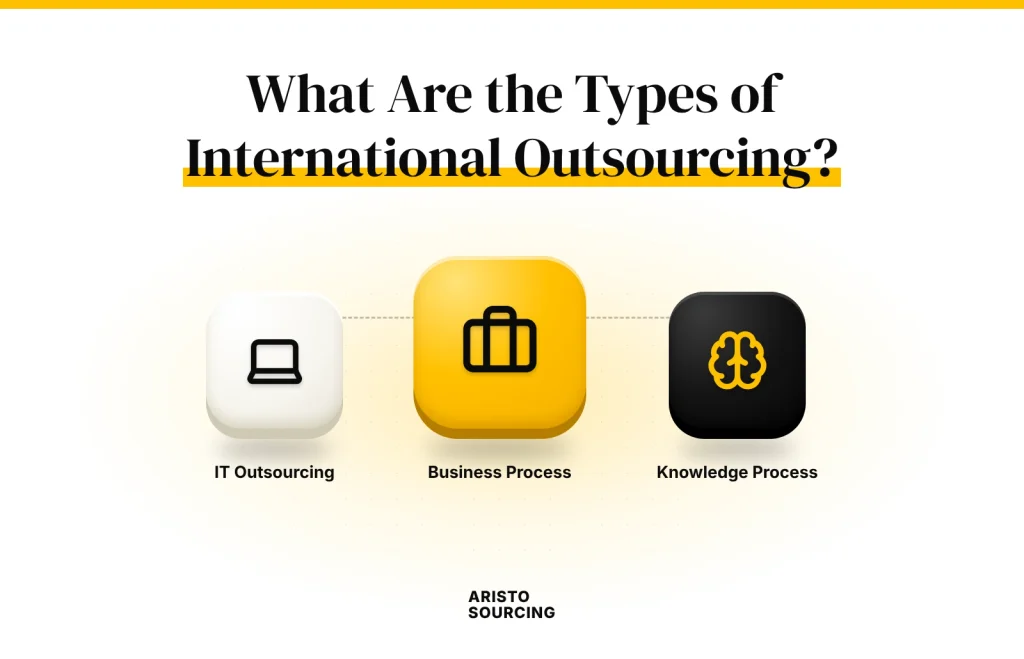
The types of international outsourcing based on geographical location include offshore outsourcing and nearshore outsourcing, while the types based on the scope of work include Business Process Outsourcing (BPO), Information Technology Outsourcing (ITO), Knowledge Process Outsourcing (KPO), and manufacturing outsourcing.
Offshore outsourcing moves work to a distant country, such as a US company hiring a team in India or the Philippines, where lower labor costs usually offset a larger time-zone gap.. Nearshore outsourcing moves work to a nearby country, such as a US company hiring a team in Mexico, where shorter distance and closer time-zone alignment support real-time collaboration at a moderately higher cost.
By work function, BPO covers customer support, data entry, and accounting services, while IT outsourcing covers software development, cloud management, and technical support. KPO covers market research, data analysis, and financial or legal analysis, and manufacturing outsourcing covers the production of goods in foreign factories, with each type delivering different benefits.
What Are the Benefits of International Outsourcing?
The benefits of international outsourcing include cost savings, access to global talent, higher operational efficiency, scalability, 24/7 coverage across time-zone differences, and a stronger focus on core business functions.
The benefits of international outsourcing are listed below.
- Lowers Operating Expenses: Lowering operating expenses means paying less for salaries, office space, equipment, and employee benefits than a local in-house team requires. Businesses typically reinvest these cost savings in growth areas such as product development, marketing, and sales.
- Fills Skill Gaps: Filling skill gaps means hiring qualified professionals from a worldwide labor pool instead of a single local market. Access to global talent helps companies staff specialized roles, such as software engineers and data analysts, that are scarce or expensive at home.
- Improves Productivity: Improving productivity means assigning repetitive or specialized processes to providers that already have trained teams, proven tools, and tested workflows. Higher operational efficiency lets internal staff spend more time on activities that generate revenue.
- Supports Business Growth: Supporting business growth means increasing or reducing team size as workload, seasonality, or market demand changes. Outsourcing providers usually add or remove staff faster than an in-house hiring process, which keeps scalability affordable and fixed costs low.
- Enables 24/7 Coverage: Enabling 24/7 coverage means assigning work to teams that operate while the in-house team is offline. Time-zone differences support round-the-clock customer support and faster project turnaround through a follow-the-sun workflow.
- Strengthens Competitive Advantage: Strengthening competitive advantage means leaving non-core tasks, such as bookkeeping and data entry, to an external provider. Leadership teams can then concentrate on strategy, innovation, and customer relationships.
International outsourcing carries some level of risk, so businesses should weigh the disadvantages before signing an outsourcing contract.
What Are the Risks and Disadvantages of International Outsourcing?
The risks and disadvantages of international outsourcing include communication barriers, cultural differences, data security threats, quality control problems, and regulatory compliance challenges. Communication barriers come from language gaps and time-zone differences, while cultural differences in work habits, hierarchy, and feedback styles can cause misunderstood instructions and missed deadlines.
Data security becomes a concern when a foreign provider stores or accesses sensitive customer, financial, or intellectual property data under weaker protection standards. Quality control is harder to maintain across borders because the business has less direct oversight of daily work, and regulatory compliance grows more complex when the laws of two countries apply to one contract.
Businesses reduce these risks through risk management practices such as detailed contracts, regular audits, and strict access controls, and a good example is starting with a small pilot project before expanding the engagement.
What Are the Common Examples of International Outsourcing?
Common examples of international outsourcing are listed below.
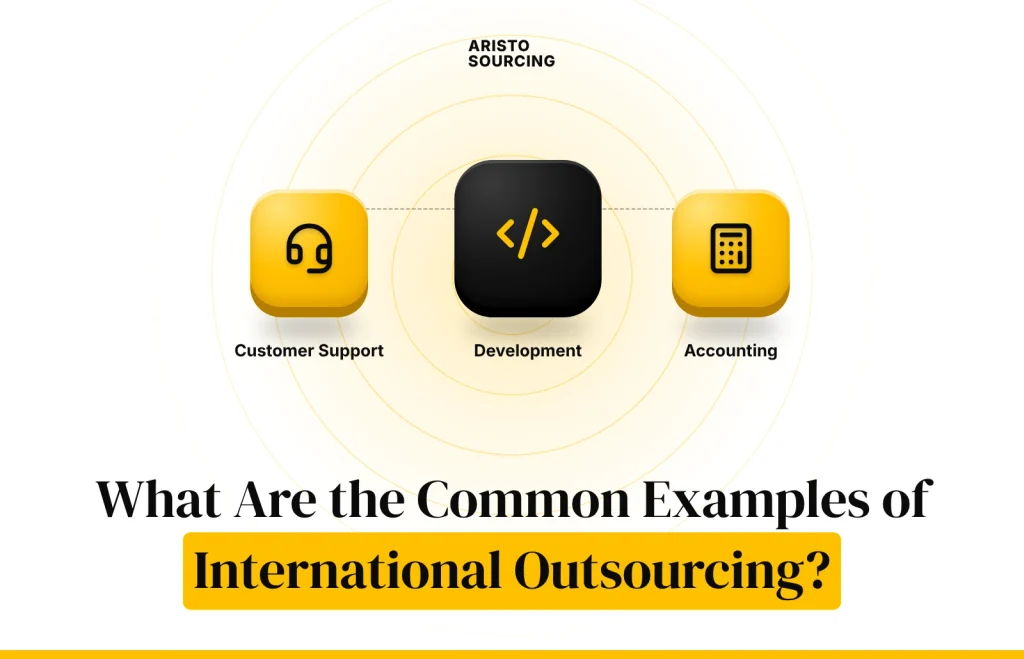
- Software Development: Companies hire offshore development teams to build websites, mobile apps, and custom software platforms. Software development is one of the most commonly outsourced functions because skilled developers in countries such as India, Vietnam, and Poland usually cost less than local hires.
- Overseas Call Centers: Businesses use overseas call centers to handle inbound customer inquiries, technical support, and outbound sales calls. The Philippines and South Africa are popular call center locations because of their strong English communication skills and customer service experience.
- Accounting Services: Firms outsource bookkeeping, payroll processing, accounts payable, and tax preparation to foreign accounting teams. Outsourced accounting services lower overhead costs and help businesses handle seasonal workload peaks, such as the tax filing season.
- Foreign Manufacturing: Companies contract factories in countries such as China, Vietnam, and Mexico to produce clothing, electronics, and consumer goods. Foreign manufacturing lowers production costs and gives businesses access to established supply chains and production capacity.
- Digital Marketing: Businesses hire foreign agencies and specialists for search engine optimization (SEO), social media management, content writing, and paid advertising. Digital marketing outsourcing provides specialist skills without the expense of a full in-house marketing department.
- Virtual Assistance and Data Entry: Companies outsource email management, scheduling, data entry, and online research to remote virtual assistants. Virtual assistance suits small and midsize businesses that need administrative support without hiring full-time office staff.
Businesses can legally outsource each of these functions when the contract and data handling comply with the laws of every country involved.
Is International Outsourcing Legal?
Yes, international outsourcing is generally legal, subject to applicable laws in both the client’s country and the provider’s country, which makes legal compliance a core part of every outsourcing agreement. Contract law governs the agreement’s scope, payment terms, intellectual property ownership, confidentiality, and the jurisdiction that resolves disputes.
Data protection laws, such as the EU General Data Protection Regulation (GDPR), and other international regulations on tax, labor, and export controls apply differently in different countries, so businesses should review local requirements before signing a contract.
Which Countries Are Best for International Outsourcing?
Countries that are best for international outsourcing include India, the Philippines, Bangladesh, South Africa, Vietnam, Poland, and Mexico. The strongest outsourcing destinations combine a skilled workforce, competitive labor costs, reliable infrastructure, and stable business regulations.
Countries that are best for international outsourcing are listed below.
- India: India offers a large English-speaking workforce skilled in software development, engineering, and BPO services, which makes it one of the largest outsourcing destinations in the world. NASSCOM’s Strategic Review 2026 estimated India’s technology industry revenue at $315 billion and export revenue at about $246 billion for fiscal year 2026.
- Philippines: The Philippines is a leading destination for customer support, virtual assistance, and back-office services because of its high English proficiency and strong cultural alignment with the US. The Philippine IT-BPM industry generated about $40 billion in revenue and employed 1.9 million people in 2025, according to the IT and Business Process Association of the Philippines (IBPAP).
- Bangladesh: Bangladesh offers low labor costs and a fast-growing pool of software developers, graphic designers, and digital marketing specialists. Bangladesh earned $724.6 million from telecommunications, computer, and information services exports in fiscal year 2024-25, according to the Export Promotion Bureau (EPB).
- South Africa: South Africa is a preferred destination for UK, US, and Australian companies that need English-speaking customer experience teams, and its time zone overlaps with European business hours. South Africa’s global business services sector created 26,346 new international jobs in 2025, its highest annual total since 2018, according to Business Process Enabling South Africa (BPESA).
- Vietnam: Vietnam is a fast-growing destination for software development and electronics manufacturing, supported by a young, technically trained workforce. Labor costs in Vietnam remain competitive with other Southeast Asian outsourcing markets.
- Poland: Poland is a leading nearshore destination for Western European companies, offering strong IT and engineering talent inside the European Union. Polish providers operate under the GDPR, which simplifies data protection compliance for EU clients.
- Mexico: Mexico is a popular nearshore destination for US companies because of overlapping time zones and short travel distances. Mexican providers support software development, customer service, and manufacturing at lower labor costs than most US markets.
The country sets the cost and talent baseline, but the individual outsourcing providers in that country determine the final quality of service.

How to Choose an International Outsourcing Provider?
Choosing the right international outsourcing provider depends on the provider’s industry experience, pricing model, service quality, data security practices, and ability to meet agreed performance expectations. During vendor selection, businesses should review case studies and client references, compare pricing against the full scope of work, and test service quality through a trial task or pilot project.
A clear contract, supported by a service-level agreement (SLA), defines deliverables, response times, quality benchmarks, and remedies when an outsourcing provider misses its performance targets. Data protection terms should cover access controls, confidentiality agreements, and compliance with laws such as the GDPR, especially when the provider handles customer or financial data.
What Does the Onboarding Process Include With an Outsourcing Partner?
The onboarding process with an outsourcing partner includes discovery and requirements gathering, contract and SLA sign-off, team selection, knowledge transfer and training, system access and security setup, a pilot phase, and performance review and scaling. During discovery, the client and the provider define goals, workflows, and deliverables in a statement of work (SOW), and then sign the contract and SLA that set quality and response standards.
After team selection, a kick-off meeting introduces stakeholders, and the client shares standard operating procedures (SOPs) and training materials while granting secure, role-based access to its systems. The pilot phase tests the new team on real tasks, and both parties measure results against key performance indicators (KPIs) before expanding the engagement. Onboarding timelines usually depend on the scope, team size, and complexity of the process, and Aristo Sourcing’s onboarding is designed to move through each stage with minimal disruption to daily operations.
How Does Aristo Sourcing Streamline Onboarding and Delivery?
Aristo Sourcing streamlines onboarding and delivery by vetting talent, matching each role to the client’s requirements, and training the team before work begins. Talent vetting screens candidates for skills, communication, and relevant experience. Role matching then places professionals whose background fits the client’s tools, industry, and workflows, so the team is ready to start quickly. Onboarding training covers the client’s SOPs, software, and quality standards, which supports smooth workflow integration with existing teams.
After launch, a dedicated account manager oversees daily delivery, resolves issues, and keeps communication consistent across time zones. Quality assurance checks and regular performance reporting track results against the agreed KPIs and SLAs, while data security practices, such as role-based access and confidentiality agreements, protect client information. Businesses can scale the team up or down as workload changes, and scalable teams keep costs aligned with real demand.
Aristo Sourcing’s outsourcing services support several of the different types of international outsourcing, including remote staffing and BPO roles. A dedicated, well-managed remote team is a good example of how a structured partner can deliver the benefits of international outsourcing and help avoid risks that often derail cross-border partnerships.