
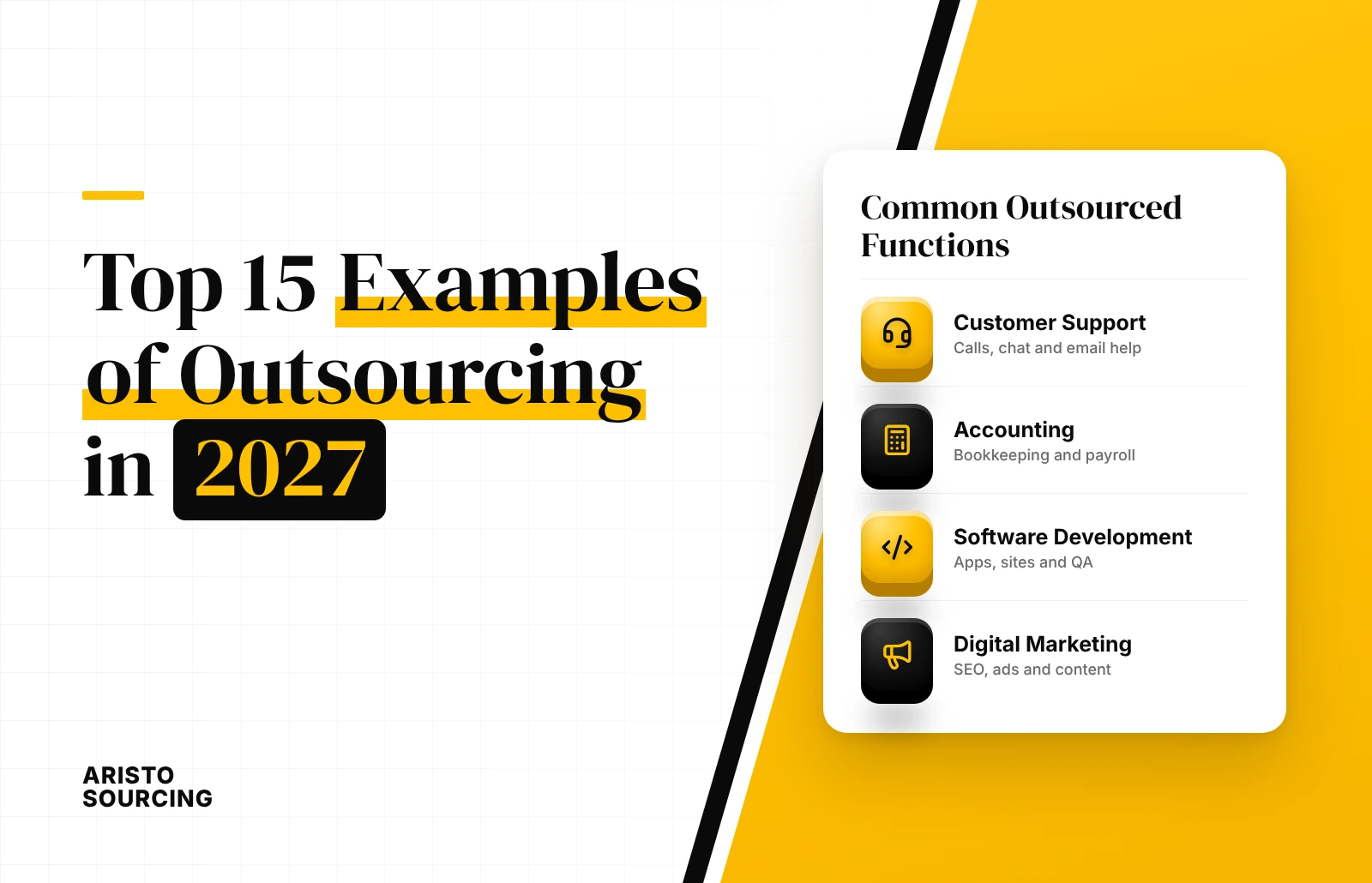
The top examples of outsourcing involve IT support, software development, customer service, manufacturing, accounting, and more, covering business functions from back-office work to production. Businesses outsource tasks to external service providers to access specialist expertise, add extra capacity without long hiring cycles, and keep costs under control.
These outsourcing examples apply to small businesses, startups, and large companies alike, since every organization has functions that a dedicated provider often runs more efficiently than an internal team. Major companies such as Nike, Apple, and Google outsource manufacturing, product assembly, and specialized services to external partners. Outsourcing providers make these arrangements work by supplying trained people, proven processes, and the management structure that a business would otherwise need to build in-house.
What Is Outsourcing?
Outsourcing is the practice of hiring an external provider to perform tasks, services, or business functions that a company would otherwise handle with its own employees and internal resources. In-house operations rely on staff that the company hires, trains, and manages directly, while outsourced services are delivered by a separate firm under a contract that defines scope, cost, and performance standards.
The outsourcing definition centers on who performs the work, not where the work happens, because an external provider may operate on-site, remotely, or from another country. For example, a company that hires an external firm for payroll processing, instead of employing an internal payroll team, is outsourcing its payroll function. The company keeps responsibility for the final result, while the external provider handles the day-to-day execution.
What Are the Top 15 Examples of Outsourcing?
The top 15 examples of outsourcing include IT support, software development, customer service, payroll, accounting, HR, digital marketing, content creation, manufacturing, logistics, administrative support, legal services, sales support, research, and facilities management.
The most common examples of outsourcing in 2027 are listed below.
- IT Support and Cybersecurity
- Software and Web Development
- Customer Service and Call Centers
- Payroll Processing
- Accounting and Bookkeeping
- Human Resources and Recruitment
- Digital Marketing and SEO
- Content Creation and Graphic Design
- Manufacturing and Product Assembly
- Logistics, Warehousing, and Fulfillment
- Data Entry and Administrative Support
- Legal Services and Compliance Support
- Sales Support and Lead Generation
- Research, Data Analysis, and Business Intelligence
- Facilities Management and Office Cleaning
1. IT Support and Cybersecurity
IT support and cybersecurity outsourcing involves hiring external specialists to maintain IT systems and protect them from threats, usually through managed IT services delivered under an ongoing contract. Providers handle technical support for employees, network maintenance, cloud infrastructure management, and continuous security monitoring. Businesses rely on these external specialists to keep systems running smoothly and to respond quickly when a cybersecurity incident occurs. For example, a small business with no IT department uses a managed IT provider to monitor its network, update devices, and respond to alerts outside office hours. The contract should set clear access controls and state who is responsible for each step of the response when a security incident happens.
2. Software and Web Development
Software and web development outsourcing involves hiring an external team to build, test, and maintain digital products such as websites, mobile apps, and internal business software. Common projects include web development, mobile app development, software testing, and ongoing maintenance after launch. Startups and established businesses use software development outsourcing to access specialized skills, such as expertise in a specific programming framework, without hiring a full engineering team. For example, a startup hires an outside team to design and build its first mobile app, then keeps the same team on a smaller retainer for updates. The contract should state that the business owns the source code and all related intellectual property once each payment is made.
3. Customer Service and Call Centers
Customer service outsourcing involves an external team handling customer inquiries on behalf of a business across channels such as phone, email, live chat, and social media. Outsourced customer support covers phone support, email support, live chat, and complaint handling, often through a call center or a business process outsourcing (BPO) provider. External support teams help businesses manage high inquiry volumes and extend support hours without expanding internal headcount. For example, an online store uses an outsourced team to answer chat and email messages during peak seasons such as the holiday shopping period. The provider should follow a documented brand voice guide, and the business should monitor quality through call reviews, ticket audits, and customer satisfaction scores.
4. Payroll Processing
Payroll outsourcing involves an external provider calculating and administering employee pay on behalf of a business, including wages, tax withholdings, benefit deductions, and the final payment to each employee. Payroll processing covers salary calculations, payslips, payroll records, deductions, and related administration such as year-end tax forms. Accuracy and confidentiality matter in every pay run, because payroll errors damage employee trust and salary data is highly sensitive. For example, a growing company hands payroll to a provider so its finance team no longer calculates deductions manually each pay period. Before signing, the business should confirm that the provider checks every calculation, protects employee data, and maintains payroll compliance with local regulations in every location where staff work.
5. Accounting and Bookkeeping
Accounting and bookkeeping outsourcing involves an external accountant recording and reporting a business’s financial activity, from daily transactions to monthly management reports and year-end accounts. Outsourced bookkeeping services cover transaction recording, bank reconciliation, accounts payable and receivable tracking, and financial reporting. Accounting outsourcing gives a business access to qualified accountants without the cost of a full internal accounting team. For example, a small business hires an outside bookkeeper to reconcile its bank accounts every month and prepare a profit and loss statement. The business should give the provider secure, role-based access to financial data and review each report for accuracy before using it for tax or lending decisions.
6. Human Resources and Recruitment
HR and recruitment outsourcing involves an external provider handling hiring and employee administration tasks that an internal HR department would manage, from job posting to a new hire’s first day. HR outsourcing covers candidate sourcing, recruitment administration, employee onboarding, and benefits administration, while recruitment process outsourcing (RPO) transfers all or part of the hiring process to a specialist provider. External HR specialists help businesses manage recruitment spikes and administrative workloads that would otherwise overwhelm a small internal team. For example, a company opening a new location outsources candidate sourcing and employee onboarding during a hiring surge. The provider should protect employee and candidate data, and the business should keep every final hiring decision in-house.
7. Digital Marketing and SEO
Digital marketing outsourcing involves a specialist agency running a business’s online promotion activities to attract qualified visitors, generate leads, and turn online attention into measurable sales. Outsourced services typically include SEO services, paid advertising on search and social platforms, social media marketing, and email marketing. Specialist agencies help businesses manage these channels with tools, data, and expertise that would be costly to build internally. For example, a local plumbing business hires an SEO agency to improve its visibility in local search results and map listings. The agreement should define clear performance goals, such as qualified leads or cost per acquisition, and require transparent monthly reporting.
8. Content Creation
Content and design outsourcing involves external creatives producing written, visual, and video material for a business that lacks the in-house capacity or creative skills to produce it. Common tasks include content writing for blogs, product descriptions, graphic design, video editing, and marketing materials such as brochures and presentations. Businesses work with freelancers or a creative agency to access specialized creative skills and scale content production when demand rises. For example, an e-commerce brand outsources product descriptions and ad creatives before a new product launch. A detailed brand guide keeps outsourced content consistent, and the contract should require original work that passes plagiarism checks.
9. Manufacturing and Product Assembly
Manufacturing outsourcing involves a contract manufacturer producing or assembling products for another company, which typically designs, markets, and sells the finished products under its own brand name. Outsourced work ranges from full product manufacturing to component production, final assembly, and packaging. Contract manufacturing lets companies scale production without building, staffing, and operating every factory themselves. For example, a consumer electronics brand designs a product in-house and has a contract manufacturer produce it to agreed specifications. The brand should enforce strict quality control through audits and inspections, and it should reduce supply chain dependency by qualifying a backup supplier.
10. Logistics, Warehousing, and Fulfillment
Logistics outsourcing involves a third-party provider storing, packing, and shipping a business’s products, usually from shared warehouses that the provider operates and staffs for multiple clients. Third-party logistics (3PL) providers handle warehousing, inventory management, order processing, packaging, shipping, and returns. E-commerce businesses use 3PL providers to manage order fulfillment at scale and to reach customers faster through warehouses in several regions. For example, an online seller sends its stock to a 3PL warehouse, which then picks, packs, and ships each order directly to customers. The seller should require real-time inventory visibility through the provider’s software and track delivery performance against agreed shipping times.
11. Data Entry and Administrative Support
Data entry and administrative support outsourcing involves external staff handling routine office tasks for a business, so that internal employees can focus on higher-value work. Data entry outsourcing covers database updates and record-keeping, while broader administrative support includes appointment scheduling, document processing, inbox management, and other routine tasks. A virtual assistant or an administrative service provider supports these day-to-day operations remotely, often on a full-time or part-time basis. For example, a medical clinic uses a virtual assistant to schedule patient appointments and process intake documents. The business should run regular data accuracy checks and confirm that the provider handles sensitive information, such as patient or customer records, under the relevant privacy rules.
12. Legal Services and Compliance Support
Legal services outsourcing involves external legal professionals performing defined legal tasks for a business or law firm, from routine document work to specialized research projects. Legal process outsourcing (LPO) covers contract drafting and contract review, legal research, document preparation, and compliance support such as regulatory filings and policy checks. LPO work demands qualified professionals, strict confidentiality, and jurisdiction-specific expertise, because legal requirements differ from one country or state to another. For example, a company’s legal team outsources high-volume contract review to an LPO provider while keeping final legal judgment in-house. Before engaging a provider, the business should verify each reviewer’s credentials, sign a confidentiality agreement, and confirm experience in the relevant jurisdiction.
13. Sales and Lead Generation
Sales support outsourcing involves an external team finding and qualifying potential customers for a business, so the internal sales team spends more time closing deals. Sales outsourcing typically covers prospect research, lead generation, appointment setting, customer relationship management (CRM) administration, and sales development activities such as cold outreach. External sales support teams help businesses identify and qualify potential customers through consistent outreach and accurate CRM records. For example, a B2B software company outsources prospect research and appointment setting to fill its account executives’ calendars with qualified meetings. The business should define what counts as a qualified lead and approve the scripts and messaging that the provider uses to represent the brand.
14. Research, Data Analysis, and Business Intelligence
Research and data analysis outsourcing involves external analysts producing insights that support business decisions, such as market sizing estimates, customer behavior trends, and performance reports. Outsourced work includes market research, survey analysis, data visualization, recurring reporting, and dashboard development for business intelligence tools. External analysts give businesses specialist research capabilities and decision-support information without a permanent in-house analytics team. For example, a company preparing a product launch outsources market research and dashboard development to track early sales and customer feedback. The business should check data quality and ask the provider to document the methodology, sources, and assumptions behind every finding.
15. Facilities Management
Facilities management outsourcing involves external contractors maintaining a business’s workplace and building services, so the premises stay clean, safe, and fully functional for employees and visitors. Common services include office cleaning, routine maintenance services, building management, and general facilities support such as waste removal and pest control. Businesses use external contractors to maintain workplace facilities because contractors bring trained staff, specialized equipment, and safety certifications that most offices do not keep in-house. For example, an office hires a contractor for daily cleaning and routine maintenance, with the contract setting service schedules, safety standards, and proof of contractor insurance. Well-known companies apply the same outsourcing logic on a much larger scale, as the examples in the next section show.
What Are Some Well-Known Companies That Outsource?
Well-known companies that outsource include Nike, Apple, Google, WhatsApp, and Slack, which rely on external partners for manufacturing, product assembly, specialized services, app development, and product design.
Well-known companies that outsource are listed below.
- Nike: Nike designs, markets, and sells athletic footwear, apparel, and equipment, while independent contractors manufacture nearly all of its products, almost entirely outside the United States, according to Nike’s fiscal 2026 Form 10-K. Nike shows how contract manufacturing lets a brand concentrate on design and marketing while specialist factories handle production.
- Apple: Apple designs its products in-house, while outsourcing partners located primarily in China mainland, India, Japan, South Korea, Taiwan, and Vietnam perform a significant majority of its manufacturing, according to Apple’s fiscal 2025 Form 10-K. Apple shows that even a company with vast resources relies on outsourcing partners for production while keeping product design and supplier oversight under its own control.
- Google: Google works with suppliers and staffing partners on a contractual basis to provide specialized services or cover short-term needs, and their staff, together with independent contractors, form what Google calls its extended workforce. Google shows that third-party service providers give large companies flexible access to specialized skills without adding permanent headcount.
- WhatsApp: In 2009, WhatsApp co-founder Jan Koum wrote the app’s backend himself and brought in Igor Solomennikov, an iPhone developer in Russia whom a friend had found on the freelance site RentACoder.com, as Forbes reported in 2014. WhatsApp shows that a startup can bring in a remote specialist to fill one skill gap while the founders focus on the parts of the product they know best.
- Slack: In 2013, Slack hired MetaLab, a design agency based in Victoria, Canada, to turn its early prototype into a polished product, and MetaLab designed the logo, marketing site, and web and mobile apps in about six weeks. Slack shows that speed is one of the clearest benefits of outsourcing, because a specialist agency often delivers expert work faster than a company could build the same capability internally.
What Are the Benefits of Outsourcing?
The benefits of outsourcing include specialized expertise, additional capacity, cost efficiency, operational flexibility, and faster access to skills that are hard to hire locally.
The benefits of outsourcing are listed below.
- Provides Specialist Expertise: Providing specialist expertise means you get trained professionals who already handle the work every day, such as bookkeeping, customer support, or IT. You gain specialized expertise without building it in-house, which is typically slow and expensive.
- Builds Additional Capacity: Building additional capacity means an outsourced team takes on the overflow that stretches your staff thin. Your people stop firefighting routine tasks and get back to the work only they can do.
- Improves Cost Management: Improving cost management means you pay for the output you need instead of the full cost of salaries, benefits, office space, and equipment. For small businesses especially, this cost efficiency usually frees up budget for growth.
- Increases Operational Flexibility: Increasing operational flexibility means you scale support up or down as demand shifts, without long hiring cycles or layoffs. That scalability helps you handle seasonal peaks, launches, or market changes with less risk.
- Delivers Faster Access to Skills: Delivering faster access to skills means you can often have a qualified resource working within weeks, compared with the longer recruiting cycle of a local hire. You move on projects now instead of waiting on recruitment.
Is Outsourcing Suitable for Small Businesses?
Yes, outsourcing is suitable for small businesses when a task is repeatable, clearly defined, and faster or more affordable to delegate than to handle internally. Small business outsourcing usually starts with bookkeeping services, outsourced IT, or a digital marketing agency, but owners should first evaluate the total cost, the provider’s track record, and how much control the business needs to keep over each task.
How to Choose the Right Outsourcing Provider?
To choose the right outsourcing provider, businesses should evaluate industry experience, service-level agreements, pricing transparency, communication, data security, scalability, and performance on a pilot project.
The key factors for choosing an outsourcing provider are listed below.
- Industry Experience: Strong vendor selection starts with confirming that the outsourcing provider has delivered similar work for businesses in the same industry, backed by case studies, client references, and measurable results.
- Service-Level Agreement (SLA): A service-level agreement (SLA) sets measurable standards for response times, work quality, and turnaround, and it defines the remedies that apply when the provider misses an agreed target.
- Pricing Transparency: Pricing transparency means the provider explains every fee before the contract starts, including setup costs, hourly or monthly rates, and charges for extra work, so the total cost stays predictable.
- Communication and Time Zones: Reliable communication depends on named contacts, regular progress reports, and enough working-hour overlap between the business and the provider to resolve most questions within the same business day.
- Data Security and Compliance: Data security covers how the provider stores, accesses, and protects sensitive information, including certifications such as ISO 27001 or SOC 2 and compliance with privacy laws such as GDPR.
- Scalability: Scalability shows whether the provider adds or reduces staff quickly as demand changes, without long notice periods or contract penalties that lock the business into capacity it no longer needs.
- Pilot Project: A pilot project lets a business test the provider’s quality, communication, and reliability on a small, low-risk assignment before committing to a long-term outsourcing contract or a larger scope.
How Does Aristo Sourcing Help With Outsourcing?
Aristo Sourcing helps businesses outsource by providing remote staffing and recruitment support tailored to their operational needs, from a single executive assistant to a team of specialist remote professionals. Remote staffing is the core service, with dedicated full-time professionals recruited primarily from the Philippines and South Africa working as part of each client’s team. Through Recruitment Process Outsourcing (RPO), Aristo Sourcing sources, screens, and shortlists candidates against each role’s requirements, so clients interview only the strongest matches.
Managed Service Provider (MSP) support covers the employment side of each placement, including payroll administration and ongoing support after the new team member starts. For AI outsourcing, Aristo Sourcing offers AI-augmented Knowledge Process Outsourcing (KPO) staffing, placing AI specialists and knowledge workers who use AI tools to speed up research, analysis, and reporting inside client teams.
Together, these services give SMBs, startups, and specialized agencies access to skilled professionals, a lighter recruitment workload, and flexible staffing support as their needs change. Aristo Sourcing acts as an outsourcing and remote staffing partner rather than a manufacturer, which makes it a good example of outsourcing applied to people and skills instead of physical products.