
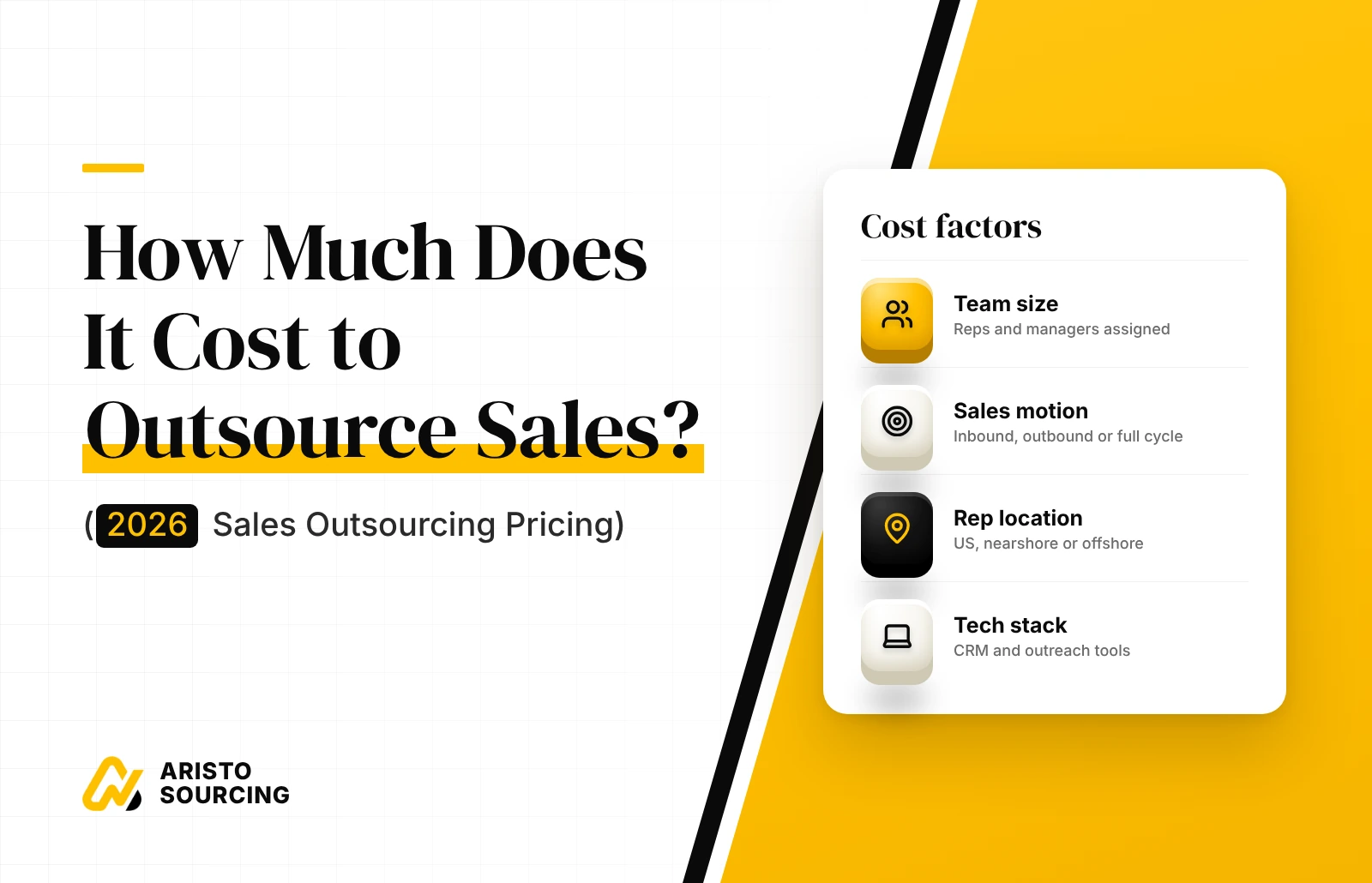
Outsourcing sales costs most B2B companies $3,000 to $15,000 per month as of 2026, with mid-market programs usually priced between $4,000 and $10,000 per month. This guide breaks down sales outsourcing pricing by pricing model, sales role and funnel stage, and geography, then covers cost per qualified meeting, cost drivers, hidden costs, the in-house cost comparison, small-business budgets, payback, and how to compare quotes.
The guide is written for founders, sales leaders, and small-business owners pricing outsourced SDR work, appointment setting, or full-cycle sales. Companies still weighing why businesses outsource sales support should decide which part of the funnel to hand off first, because the funnel stage changes the price more than the provider does. Most sales outsourcing agencies do not publish rate cards, so the ranges below reflect typical quoted prices as of 2026.
The in-house alternative sets the benchmark every quote is measured against. According to the Bridge Group’s 2025 SDR Metrics Report, the median sales development representative earns $80,000 in on-target earnings, takes 3.0 months to ramp, and stays an average of 1.9 years in the role.
How Much Does It Cost to Outsource Sales?
Outsourcing sales costs $3,000 to $15,000 per month for most B2B programs, and mid-market programs usually cost $4,000 to $10,000 per month. Performance options replace the monthly fee with a price per qualified meeting or a share of closed revenue. Dedicated offshore reps cost well below agency programs because the buyer pays for one person’s time rather than a managed program. Four factors move the number: the pricing model, the role and funnel stage, the geography of the reps, and the complexity of the target buyer. The pricing model has the largest effect, so the cost to outsource sales is broken down by model first.
What Are the Sales Outsourcing Pricing Models?
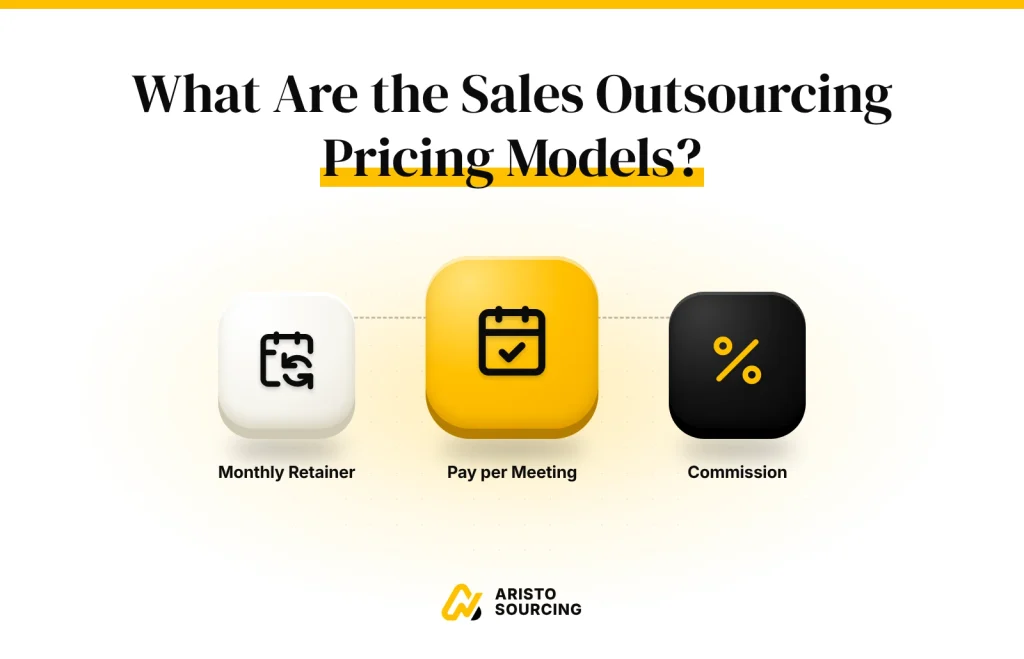
Sales outsourcing is priced in five main ways: a monthly retainer, pay-per-meeting, commission-only, a hybrid of base fee and performance, and per-rep staffing. The core split is between paying for capacity, through a retainer or a dedicated rep, and paying for results, through a meeting fee or commission, with hybrids in between.
The summary of sales outsourcing pricing models is presented in the table below.
| Pricing Model | How It Bills | Typical Range | Who Carries the Risk | Explanation |
| Monthly Retainer | Fixed monthly fee for a managed program | $3,000-$15,000 per month | Buyer | The provider runs the program and bundles data, tools, and management. |
| Pay-Per-Meeting | Fee per held qualified meeting | About $50-$1,500+ per meeting by buyer seniority | Provider | The buyer pays only for meetings that happen. |
| Commission-Only | Share of closed revenue | Negotiated per offer | Provider | Rare from reputable firms outside transactional offers. |
| Hybrid | Lower base fee + meeting fee or commission | Below a full retainer on the base | Shared | Both sides have money tied to results. |
| Per-Rep Staffing | Fixed monthly fee per dedicated rep | About $9,500 per month onshore; far lower offshore | Buyer | The buyer manages the rep and supplies data and tools. |
The 5 sales outsourcing pricing models are listed below.
- Monthly Retainer
- Pay-Per-Meeting
- Commission-Only
- Hybrid (Base Fee + Performance)
- Per-Rep Staffing (Dedicated SDR)
Monthly Retainer
With monthly retainer pricing, a business pays a fixed monthly fee for a managed outbound program run by the provider. The fee covers SDRs, prospect data, email sending infrastructure, dialers, the messaging playbook, and program management. Monthly retainers typically run $3,000 to $15,000, with mid-market programs usually between $4,000 and $10,000. The buyer carries the performance risk under a retainer, because the fee is owed whether or not meetings are booked.
The pros and cons of monthly retainer pricing are listed below.
- Advantage: The provider supplies the full program, so the buyer gets a working outbound engine without building one.
- Disadvantage: Spend continues during slow months and the ramp period.
Best fit: Companies with a clear ideal customer profile (ICP), a proven offer, and budget for at least three months.
Pay-Per-Meeting
With pay-per-meeting pricing, a business pays a set fee for each qualified meeting that is held. Payment is triggered by a meeting that takes place with a prospect matching the agreed qualification criteria. Per-meeting rates are commonly quoted at roughly $50 to $300 for SMB buyers, $300 to $600 for enterprise buyers, and $600 to $1,500 or more for C-suite meetings. The provider carries most of the performance risk under pay-per-meeting pricing, because unproductive outreach is not billed.
The pros and cons of pay-per-meeting pricing are listed below.
- Advantage: Spend tracks output from the first month.
- Disadvantage: Meeting quality depends entirely on how tightly “qualified” is defined in writing.
Best fit: Pilots, new markets, and buyers who need to prove demand before committing to a program.
Commission-Only
With commission-only pricing, a business pays the provider a share of closed revenue and no fixed fee. Payment is triggered by a closed deal, usually as a percentage of first-year contract value. Commission rates are negotiated per offer, and reputable firms rarely accept commission-only terms outside transactional offers with short sales cycles. The provider carries the full performance risk under commission-only pricing, which is why few established firms offer it.
The pros and cons of commission-only pricing are listed below.
- Advantage: The buyer pays nothing until revenue arrives.
- Disadvantage: Providers that accept the model tend to cherry-pick easy deals or drop the account when results lag.
Best fit: Transactional offers with short cycles and a high, proven close rate.
Hybrid (Base Fee + Performance)
With hybrid pricing, a business pays a lower monthly base fee plus a per-meeting fee or a commission on closed deals. The base covers data, infrastructure, and program management, while the performance component pays for held meetings or revenue. Hybrid base fees sit below full retainers, and hybrid performance fees sit below pure per-meeting rates. The buyer and provider share the risk under hybrid pricing, because each side has money tied to results.
The pros and cons of hybrid pricing are listed below.
- Advantage: Incentives align without asking the provider to carry all the risk.
- Disadvantage: Two fee components make the monthly total harder to forecast.
Best fit: Companies scaling a pilot that has proven the ICP and messaging.
Per-Rep Staffing (Dedicated SDR)
With per-rep staffing, a business pays a fixed monthly fee for a dedicated SDR or appointment setter who works only on its pipeline under its direction. The fee covers the rep’s employment, payroll, and HR when a company places a dedicated remote appointment setter through a staffing provider, while the business supplies strategy, prospect data, tools, and coaching. A dedicated onshore SDR costs about $9,500 per month fully loaded, based on the Bridge Group’s 2025 median on-target earnings of $80,000, while PayScale reports an average base salary of ₱372,115 per year for an SDR in the Philippines in 2026. The buyer carries the performance risk under per-rep staffing, because the business manages the rep’s output.
The pros and cons of per-rep staffing are listed below.
- Advantage: Dedicated offshore reps cost a fraction of an onshore rep or a managed program, and all the pipeline knowledge stays with the business.
- Disadvantage: The offshore price is unbundled, so data, tools, playbook, and management are the buyer’s job.
Best fit: Companies with a working sales process that needs more execution capacity.
What Does It Cost by Sales Role and Funnel Stage?
The cost of outsourcing sales depends on which part of the funnel you hand off: lead research costs the least, SDR and appointment setting sit in the middle, closing and field sales cost the most, and fractional sales leadership is priced as a monthly retainer. Each stage needs a different skill level, so each stage is priced differently.
The cost of outsourcing sales by role and funnel stage is presented in the table below.
| Role / Funnel Stage | Scope | Typical Pricing Shape | Explanation |
| Lead research and list building | Building and enriching prospect lists | Lowest tier; per list, per record, or per researcher | Research work needs the least selling skill. |
| SDR / appointment setting | Outreach and meeting booking at the top of the funnel | Retainer, per meeting, or per rep | The most outsourced stage and the most competitively priced. |
| Inside sales / account executive | Running demos and closing deals | Higher base, often with a commission component | Closing skill and product knowledge raise the rate. |
| Field / outside sales | In-person selling in a territory | Per rep plus travel expenses | BLS reports a May 2025 median wage of $104,920 for technical and scientific sales reps and $72,080 for other wholesale and manufacturing reps. |
| Fractional sales leadership | A part-time VP of sales or sales manager | Monthly retainer | Buys leadership hours without a full-time executive salary. |
Most buyers start with the SDR and appointment-setting stage, because it is the easiest to measure through held meetings and the easiest to hand back to an internal closer.
What Does It Cost by Geography? US vs Nearshore vs Offshore
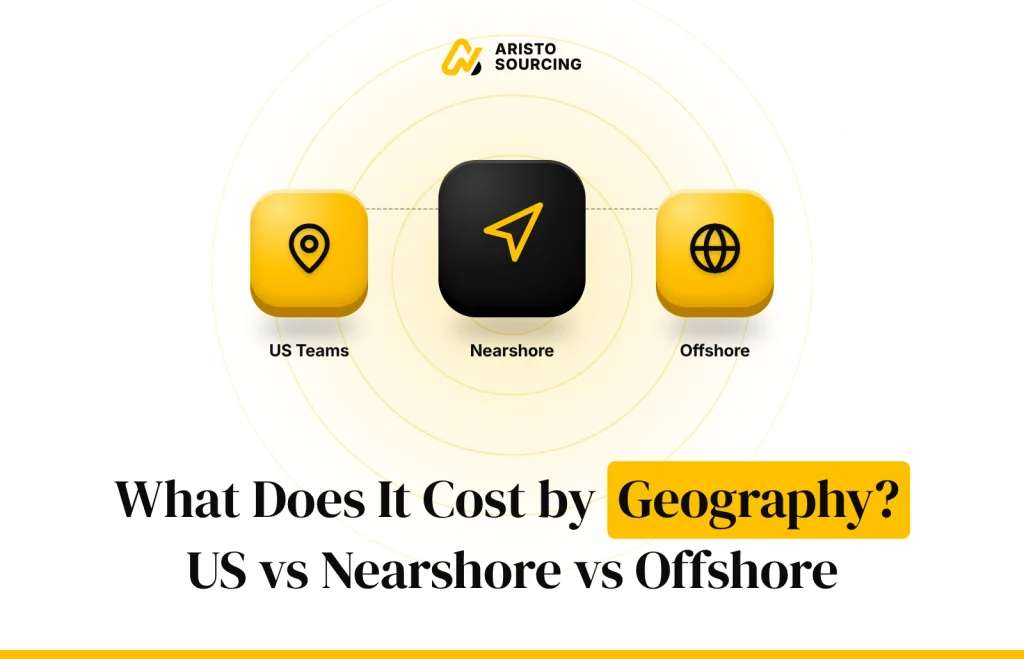
Sales outsourcing costs vary by where the reps are based: US onshore programs cost the most, nearshore reps in Latin America and Eastern Europe cost less, and offshore programs and dedicated offshore reps in the Philippines cost the least. Geography changes labor cost, time-zone overlap, and what the provider bundles into the price.
The cost of outsourcing sales by geography is presented in the table below.
| Model | Typical Monthly Cost | Time-Zone Fit | Bundled vs Not | Explanation |
| US onshore managed program | $3,000-$15,000 | Full overlap | Data, tools, playbook, and management bundled | Best for complex or enterprise buyers. |
| US dedicated rep | About $9,500 fully loaded | Full overlap | Rep only; buyer supplies tools and coaching | Best for core roles kept long-term. |
| Nearshore (Latin America / Eastern Europe) | Below US rates; quoted per rep or program | Strong overlap with US hours | Varies by provider | Best for real-time calling with lower labor cost. |
| Offshore managed program (e.g. Philippines) | Lowest managed-program retainers | Shifted schedules cover US hours | Usually bundled | Best for high-volume, scripted outreach. |
| Dedicated offshore rep (staff augmentation) | Philippine SDR average base of ₱372,115 per year plus provider fee and tools | Shifted schedules cover US hours | Rep only; buyer supplies ICP, scripts, data, and coaching | Best when the sales process already works. |
Offshore saves the most, but quality depends on ICP clarity, scripts, vetting, and management, and offshore programs most often fail on lead quality rather than cost. Aristo Sourcing places dedicated offshore SDRs, appointment setters, lead researchers, and CRM and sales-operations staff from the Philippines and South Africa through a 7-step vetting process, with retention above 93%. <!– EDITOR: confirm whether the $400/mo Aristo fee is on top of rep salary or all-in before adding a price here. –> A dedicated rep is execution capacity, so the business still supplies the ICP, scripts, data, tools, and coaching, and the two talent markets differ in ways explained in how the Philippines and South Africa compare for outsourced staff.
How Do You Compare Quotes? Cost Per Qualified Meeting
The best way to compare sales outsourcing quotes is cost per qualified meeting, calculated as the monthly fee plus tools and data, divided by the number of held qualified meetings. The formula turns retainers, per-meeting deals, and dedicated reps into one comparable number.
Formula: Cost per qualified meeting = (monthly fee + tools and data) ÷ held qualified meetings
A worked example of two retainer quotes is presented in the table below.
| Quote | Monthly Fee | Tools and Data | Held Qualified Meetings | Cost per Meeting | Explanation |
| Provider A | $5,000 | $500 billed separately | 8 | $687.50 | The cheaper retainer costs more per meeting. |
| Provider B | $8,000 | Included | 20 | $400 | The pricier retainer wins on unit cost. |
Cost per meeting is highest in year one while targeting and messaging ramp, then falls once the program reaches steady volume, so quotes need comparing at steady-state volume as well as month one. A fair price per qualified meeting rises with the target buyer, from the low hundreds of dollars for SMB buyers to $600 or more for C-suite buyers. The metric only works when “qualified” is defined in writing before outreach starts, including ICP fit, buyer seniority, and a show-up requirement.
What Drives the Cost of Sales Outsourcing?
Beyond the pricing model, role, and geography, the cost of sales outsourcing is driven by target-buyer seniority, channel mix, deal size and industry, campaign scope, contract length, and data and technology inclusions. Role, funnel stage, and geography are covered in the sections above.
The 6 additional cost drivers of sales outsourcing are listed below.
- Target-Buyer Seniority: C-suite and enterprise buyers cost more per meeting than SMB managers, because they are harder to reach and qualify.
- Channel Mix: Multi-channel programs combining cold calling, email, and LinkedIn cost more than single-channel email campaigns.
- Deal Size and Industry: High-value, regulated, and technical offers, such as enterprise SaaS, need more skilled reps and cost more.
- Campaign Scope: Programs targeting several regions or segments cost more than a single-market campaign.
- Contract Length: Longer terms lower the monthly rate, while short pilots carry a premium.
- Data and Technology: Prospect lists, enrichment, sending infrastructure, and dialers raise the price when bundled and add separate bills when not.
What Hidden Costs Should You Expect?
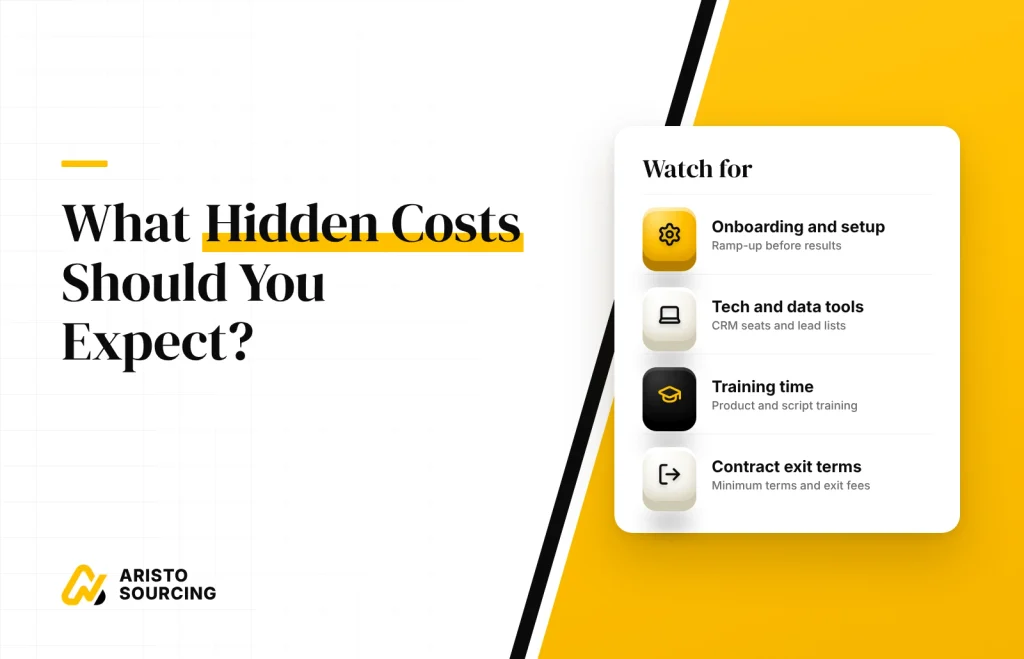
Hidden costs of sales outsourcing include setup fees, separately billed data, sending infrastructure, the buyer’s own tool seats, minimum terms, billing for unqualified meetings, and the buyer’s own management time. These costs sit outside the headline monthly fee.
The hidden costs of sales outsourcing are listed below.
- Setup and Onboarding Fees: One-time charges for infrastructure, lists, and scripts range from roughly $500 to $10,000 depending on scope.
- Data and Prospect Lists: Some providers bill lists and enrichment separately from the program fee.
- Sending Infrastructure: Email domains, inbox warm-up, and sending tools can carry their own monthly charges.
- Tool Seats: Dedicated reps need CRM, dialer, and sales-engagement seats paid by the buyer.
- Minimum Terms: Contracts commonly require 3 to 6 months, so the buyer pays through the ramp months.
- Unqualified Meetings: Per-meeting deals without a written definition bill for poor-fit and no-show meetings.
- Management Time: Dedicated reps need weekly coaching and review from the buyer’s own team.
Outsourced vs In-House Sales Team: The True Cost Comparison
An outsourced sales program costs roughly 40% to 70% less than an in-house SDR at the same meeting volume, because the provider spreads tools, management, and recruiting across many clients and the buyer skips ramp and turnover costs. The in-house figure only makes sense when every component is listed, which also answers how much it costs to hire a sales rep.
The fully loaded in-house SDR cost is presented in the table below.
| Cost Component | Annual Cost | Explanation |
| Base salary | $55,000 | Bridge Group 2025 median SDR base. |
| Commission (variable pay) | $25,000 | Bridge Group 2025 median on-target earnings of $80,000. |
| Payroll taxes and benefits | $34,286 | BLS reports benefits at 30.0% of private-industry compensation costs in June 2026. |
| Tools (CRM, data, dialer, sales engagement) | $6,000 | Assumed seat and data budget. |
| Recruiting | $1,200 | SHRM 2025 median nonexecutive cost per hire. |
| Total | $121,486 | Before management time and ramp drag. |
At the Bridge Group’s 2025 median quota of 10 held meetings per month, a fully ramped in-house SDR produces 120 meetings a year, which puts the cost at about $1,012 per meeting. With a 3.0-month ramp in year one, the same rep produces roughly 90 meetings, which raises the cost to about $1,350 per meeting. An outsourced program producing the same 10 meetings per month at $300 to $600 per meeting costs $36,000 to $72,000 a year, which is 41% to 70% below the in-house total.
Turnover shifts the comparison further, because the Bridge Group reports a median annual SDR attrition rate of 40%, and the buyer absorbs every new hire’s recruiting and ramp cost in-house while the provider absorbs rep churn in an outsourced program. In-house wins when the sales motion is proven, deal values are high, the product needs deep knowledge, and selling is a long-term core function the company wants to own.
The cost to outsource sales in 2026 is lower than building an SDR team for most companies testing or scaling outbound, but sales outsourcing pricing only beats in-house when the meetings convert. The same logic applies to any role, and the trade-offs of hiring through an agency versus hiring directly follow the same cost components.
How Much Should a Small Business Budget for Outsourced Sales?
A small business should budget roughly $1,500 to $5,000 per month for outsourced sales, depending on whether it starts with a pay-per-meeting pilot, a hybrid program, or a single dedicated offshore rep.
The starter budget bands for a small business are presented in the table below.
| Starter Model | Monthly Budget | Explanation |
| Pay-per-meeting pilot | $1,500-$3,000 | 10 SMB meetings at $150 to $300 each. |
| Hybrid program | $3,000-$5,000 | Lower base plus performance fees. |
| Single dedicated offshore rep | Rep salary plus provider fee and tools | Lowest cost per hour of outreach, but the owner supplies the playbook. |
A pay-per-meeting pilot fits a small budget and an unproven ICP, because it shows within one quarter whether the market responds. The minimum realistic spend to get a signal is three months of a program, since minimum terms and ramp take that long. A small business should not outsource sales yet if it has no defined ICP or offer, and the wider budgeting for outsourcing as a small business shows how sales fits alongside other outsourced functions.
When Does Outsourcing Sales Pay Off?
Outsourcing sales pays off when the pipeline value created by qualified meetings exceeds the total monthly cost. The payback math multiplies held meetings by close rate and deal size: 10 meetings a month at a 20% close rate and a $10,000 average deal create $20,000 in new contract value against a $6,000 monthly program. Outsourcing works when testing new markets, filling pipeline fast, or covering a hiring gap, and it fails when the ICP or offer is unclear, the sale needs deep product knowledge, or no internal closer takes the meetings. The two questions below cover pay-for-performance pricing and how fast meetings start, and the benefits of outsourcing sales beyond cost cover the non-financial return.
Is Pay-for-Performance Sales Outsourcing Cheaper?
Pay-for-performance sales outsourcing is cheaper only when meeting volume is low or uncertain, because the buyer pays for held meetings or closed deals rather than effort. Per-meeting rates usually exceed a well-run retainer’s cost per meeting at steady volume, so the lower risk comes with a higher unit price. Without a written qualified-meeting definition, the buyer pays for volume instead of fit, and commission-only terms are rare from reputable firms outside transactional offers. Pay-for-performance works best for pilots, new markets, and small budgets.
How Quickly Can Outsourced Sales Start Producing Meetings?
Outsourced sales programs usually start producing meetings within a few weeks of signing, once infrastructure, domain warm-up, prospect lists, and scripts are in place. First meetings arrive before steady-state volume, and cost per meeting improves over the first months as targeting and messaging improve. In-house SDRs take an average of 3.0 months to ramp, according to the Bridge Group. Dedicated offshore reps start as fast as the business can onboard them with the ICP, scripts, and tools.
How Do You Choose a Sales Outsourcing Provider and Compare Quotes?
You choose a sales outsourcing provider by matching the pricing model to your stage, getting every quote as cost per qualified meeting at your target volume, and checking the terms that decide quality and continuity. A pilot fits per-meeting pricing, while scaling fits a retainer or dedicated reps.
The 8 checks for choosing a sales outsourcing provider are listed below.
- Match the pricing model to the company’s stage.
- Convert every quote to cost per qualified meeting at the target volume.
- Agree a written qualified-meeting definition before outreach starts.
- Confirm the handoff process and the notes that reach the closer.
- List what is bundled, including data, infrastructure, playbook, and management, and what costs extra.
- Ask what happens when an assigned rep leaves.
- Confirm reporting visibility, data ownership, and exit terms.
- Call references in the same industry and deal size.
The next step is to request three quotes, convert each to cost per qualified meeting, and start with a three-month pilot. A shortlist of sales outsourcing companies compared narrows the field. For dedicated offshore sales-support staff that the business manages, including SDRs, appointment setters, lead researchers, and CRM support, Aristo Sourcing fits; if strategy, data, and management need to come bundled, a managed agency fits better. The question below covers whether closing can be outsourced as well.
Can You Outsource Closing, or Only Appointment Setting?
You can outsource closing as well as appointment setting, but most providers focus on the top of the funnel and closing works only for certain offers. Most sales outsourcing providers research prospects, run outreach, and book meetings, while outsourced closers and account executives exist and usually work with a commission component.
Outsourced closing works best for transactional offers and shorter sales cycles with a clear price, while complex, high-value, or technical deals usually keep closing in-house. Either way, the handoff between outsourced setters and the company’s closers needs a defined process for notes, context, and follow-up.