
Payroll outsourcing costs most small businesses between $50 and $250 per month as of 2026, paid to a payroll service that calculates wages, files and deposits payroll taxes, and sends employee pay. The price matters most to owners who still close each month with a payroll scramble of spreadsheets, manual bank transfers, and tax deposits made on the deadline. This guide breaks the payroll outsourcing cost down by service model, company size, pricing structure, popular provider rates, hidden fees, cost drivers, ways to lower costs, the in-house cost comparison, and whether outsourced payroll is worth the cost.
The guide is written for business owners pricing a payroll service before requesting quotes. Owners still weighing what outsourcing payroll involves should settle how much of the work to hand off first, because the scope of the handoff sets the price more than any other factor. Every payroll services pricing figure below comes from published vendor rate cards as of October 2026, and rate cards change, so each quote needs rechecking on the day of purchase.
According to Mordor Intelligence, the global payroll outsourcing market is valued at $13.21 billion in 2026 and is projected to reach $17.83 billion by 2031, a compound annual growth rate of 6.19%. That growth reflects a shift of small and mid-size employers from spreadsheet payroll to cloud payroll services, full-service providers, and professional employer organizations.
How Much Does It Cost to Outsource Payroll?
Outsourcing payroll costs $50 to $250 per month for most small businesses, based on a monthly base fee plus a per-employee fee. Published 2026 rate cards set the base fee between $17 and $180 per month and the per-employee fee between $4 and $22 per month, with quote-based providers pricing above that range for managed service. A professional employer organization (PEO) is the outlier, charging $40 to $160 per employee per month or 2% to 12% of total payroll, because a PEO bundles benefits and HR compliance with payroll. Three factors move the final number: the service model, the headcount, and the pay frequency and complexity of each payroll run. The service model has the largest effect, so the cost breakdown starts there.
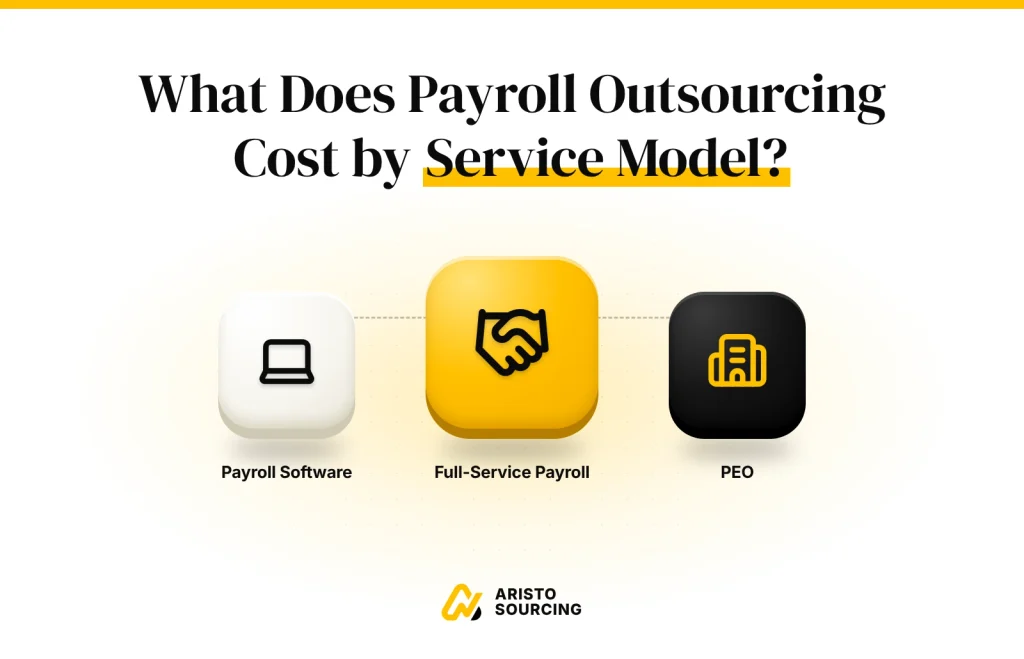
What Does Payroll Outsourcing Cost by Service Model?
Payroll outsourcing costs $20 to $80 per month plus $4 to $12 per employee for self-service software, $40 to $250 per month plus $6 to $25 per employee for full-service managed payroll, $40 to $160 per employee per month for a PEO, and $800 to $1,600 per month for a dedicated offshore payroll specialist. Cost depends mostly on how much of the payroll work the business hands off, ranging from software the owner runs to a dedicated operator who runs it for the business.
The cost of each payroll service model is presented in the table below.
| Service Model | Pricing | Monthly Cost at 10 Employees | Best For | Explanation |
| Self-Service Payroll Software | 20-80/mo + 4-12 per employee | 60-200 | 1-20 employees, single state | The employer enters hours and approves each run; the software calculates pay and usually files taxes. |
| Full-Service Managed Payroll | 40-250/mo + 6-25 per employee | 100-500 | 10-100 employees, hourly or multi-state | The provider’s payroll team processes runs, files taxes, and fixes errors. |
| PEO | 40-160 per employee/mo or 2-12% of payroll | 400-1,600 | 5-100 employees needing benefits | The PEO co-employs staff and bundles payroll, benefits, workers’ compensation, and HR. |
| Dedicated Offshore Payroll Specialist | 800-1,600/mo | 909-1,709 including software | 30+ employees or payroll plus bookkeeping | A full-time remote specialist operates the employer’s own payroll software. |
The 4 payroll outsourcing service models are listed below.
- Self-Service Payroll Software (20-80/mo + 4-12 per employee)
- Full-Service Managed Payroll (40-250/mo + 6-25 per employee)
- PEO (40-160 per employee/mo or 2-12% of payroll)
- Dedicated Offshore Payroll Specialist (800-1,600/mo)
Self-Service Payroll Software (20-80/mo + 4-12 per employee)
Self-service payroll software is a cloud payroll platform that calculates gross-to-net pay, where the employer enters hours and approves every payroll run. The self-service model costs $20 to $80 per month plus $4 to $12 per employee, and the number of states and the need for time tracking move the price within that range. Gusto lists its Simple plan at $49 per month plus $6 per person as of October 2026, which totals $109 per month for 10 employees.
The inclusions of self-service payroll software are listed below.
- Included: Gross-to-net calculation, direct deposit, pay stubs, and automatic federal, state, and local tax filing on most platforms.
- Not Included: Data entry, run approval, new-hire setup, and error correction stay with the employer, and Patriot Software’s Basic plan at $17 per month plus $4 per worker also leaves tax filing to the employer.
Self-service payroll software fits single-state businesses with 1 to 20 salaried or simple hourly employees and an owner or office manager who is comfortable approving each run. The employer carries full liability for tax-filing accuracy and penalties, because the IRS holds the employer ultimately responsible for federal tax deposits even when software submits them.
Full-Service Managed Payroll (40-250/mo + 6-25 per employee)
Full-service managed payroll is a payroll provider arrangement where the provider’s payroll team processes each run, files and deposits taxes, and handles corrections and year-end forms. The full-service model costs $40 to $250 per month plus $6 to $25 per employee, and dedicated support, HR tools, and multi-state filing move the price within that range. Gusto lists its Premium plan, which adds a named advisor and compliance support, at $180 per month plus $22 per person as of October 2026, which totals $400 per month for 10 employees.
The inclusions of full-service managed payroll are listed below.
- Included: Payroll processing, tax calculation, tax filing and deposit, W-2 and 1099 preparation, and a named support contact or payroll specialist.
- Not Included: Approving hours, reporting new hires and pay changes on time, and funding the payroll bank account stay with the employer.
Full-service managed payroll fits businesses with 10 to 100 employees, hourly or multi-state workforces, and no in-house payroll staff. Most full-service providers publish a tax-filing guarantee that covers penalties caused by provider error, but the IRS states that the employer remains liable for all taxes, penalties, and interest if a provider fails to deposit.
PEO (40-160 per employee/mo or 2-12% of payroll)
A professional employer organization (PEO) is a co-employment arrangement where the PEO becomes the employer for tax and benefits purposes and bundles payroll with health insurance, workers’ compensation, and HR compliance. The PEO model costs $40 to $160 per employee per month or 2% to 12% of total payroll, and benefits quality, workers’ compensation risk, and HR service depth move the price within that range. Justworks lists its PEO Basic plan at $79 per employee per month as of October 2026, which totals $790 per month for 10 employees.
The inclusions of a PEO are listed below.
- Included: Payroll, tax filing, access to large-group health insurance, workers’ compensation administration, and HR compliance support.
- Not Included: Hiring decisions, daily management, and benefit premiums stay with the business, and premiums are billed on top of the PEO fee.
A PEO fits businesses with 5 to 100 employees that need competitive benefits and have no HR department. Under Internal Revenue Code Section 3511, an IRS-certified PEO (CPEO) is treated as the employer for federal employment taxes on the wages it pays, while a non-certified PEO leaves that liability with the client.
Dedicated Offshore Payroll Specialist (800-1,600/mo)
A dedicated offshore payroll specialist is a full-time remote employee, usually placed through a staffing agency in the Philippines or South Africa, who operates the employer’s own payroll software. The dedicated offshore specialist model costs $800 to $1,600 per month, and experience level, software certifications, and the agency’s management fee move the price within that range. PayScale reports an average Philippine payroll specialist base salary of ₱345,577 per year in 2026, and adding agency fees plus a $109 Gusto Simple subscription brings the total to $909 to $1,709 per month for 10 employees.
The inclusions of a dedicated offshore payroll specialist are listed below.
- Included: Timesheet collection, payroll data entry, run preparation, reconciliation, and related bookkeeping across a full-time schedule.
- Not Included: The payroll software subscription, the tax-filing guarantee, and final run approval stay with the employer and the software provider.
A dedicated offshore payroll specialist fits businesses with 30 or more employees, frequent pay changes, or payroll combined with bookkeeping and accounts payable work that fills a full-time role. The employer and the payroll software provider carry tax-filing liability, because a staffing agency supplies the operator rather than a tax-filing service.
What Does Payroll Outsourcing Cost by Company Size?
Payroll outsourcing costs scale with headcount: $40 to $150 per month for 1 to 10 employees, $150 to $600 per month for 11 to 50 employees, and $600 to $2,500 per month for 51 to 200 employees on software and full-service plans. PEO fees sit above these bands because they are charged per employee at a higher rate and include benefits administration.
The payroll outsourcing cost by company size is presented in the table below.
| Company Size | Typical Monthly Cost | Typical Cost per Employee | Explanation |
| 1-10 employees | 40-150 | 10-40 | The base fee dominates the bill, so per-employee cost is highest. |
| 11-50 employees | 150-600 | 7-14 | Per-employee fees overtake the base fee as the main cost. |
| 51-200 employees | 600-2,500 | 6-12 | Volume spreads the base fee thin, and quote-based providers start to negotiate. |
Every PEPM rate card follows one formula: monthly cost = base fee + (per-employee fee × employees paid). The worked examples at 10, 25, and 50 employees using published October 2026 rate cards are presented in the table below.
| Plan (Rate Card) | 10 Employees | 25 Employees | 50 Employees | Explanation |
| Patriot Software Full Service ($37 + $5) | $87 | $162 | $287 | Lowest published full-service rate card. |
| Gusto Simple ($49 + $6) | $109 | $199 | $349 | Single-state payroll only. |
| QuickBooks Workforce Payroll ($50 + $7) | $120 | $225 | $400 | Payroll-only plan; accounting bundles start at $88 base. |
| Gusto Plus ($80 + $12) | $200 | $380 | $680 | Adds multi-state payroll and a mixed workforce. |
| Justworks PEO Basic ($79 per employee) | $790 | $1,975 | $3,950 | No base fee; benefit premiums billed separately. |
Per-employee cost falls as headcount grows because the base fee is spread across more employees. On Gusto Simple, the effective cost is $10.90 per employee at 10 employees, $7.96 at 25 employees, and $6.98 at 50 employees. Quote-based providers such as ADP and Paychex apply the same logic through volume discounts above roughly 50 employees.
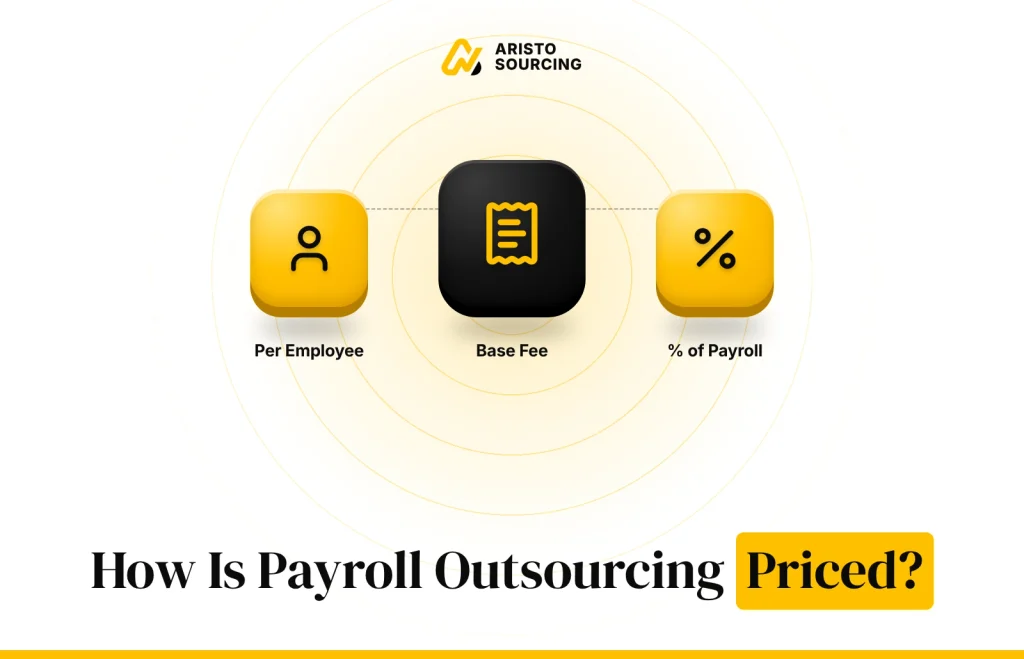
How Is Payroll Outsourcing Priced?
Payroll processing charges are billed in four ways: per employee per month (PEPM), per payroll run, a flat monthly fee, or a percentage of payroll. The same service can look up to 12 times more or less expensive depending on whether a provider quotes it per employee per month, per run, per year, or as a percentage, so every quote needs converting to a monthly total before comparison.
The conversion of each quote format into a monthly total is presented in the table below.
| Quote Format | Conversion to Monthly Total | Explanation |
| Per employee per month | Base fee + (rate × employees) | Already monthly; add the base fee. |
| Per payroll run | Run fee × runs per month (weekly 4.33, biweekly 2.17, semimonthly 2, monthly 1) | Weekly pay costs twice as much as semimonthly on the same rate. |
| Per year | Annual fee ÷ 12 | Annual quotes look 12 times larger than monthly quotes. |
| Percentage of payroll | Gross monthly wages × rate | The fee rises with every raise, bonus, and overtime hour. |
The 4 payroll pricing structures are listed below.
- Per Employee Per Month (PEPM)
- Per Payroll Run
- Flat Monthly Fee
- Percentage of Payroll
Per Employee Per Month (PEPM)
With PEPM pricing, a business pays a monthly base fee plus a fixed charge for every employee paid that month.
Formula: Monthly cost = base fee + (PEPM rate × employees paid)
OnPay charges $49 per month plus $6 per person as of October 2026, so 10 employees cost $109 per month. PEPM pricing stays predictable when headcount is stable, and it swings when seasonal hires or contractors join a run. Self-service software, full-service providers, and most PEOs use PEPM pricing.
Per Payroll Run
With per-run pricing, a business pays a fee each time payroll is processed, often plus a charge for each check or deposit.
Formula: Monthly cost = (run fee + per-check fee × employees) × runs per month
A provider charging $30 per run plus $3 per check bills $60 per run for 10 employees, which equals $130 per month on a biweekly schedule and $260 per month on a weekly schedule. Per-run pricing stays predictable on a semimonthly or monthly schedule, and it swings when the business pays weekly or adds off-cycle runs for bonuses and corrections. Local payroll bureaus, accounting firms, and some legacy full-service providers use per-run pricing.
Flat Monthly Fee
With flat monthly pricing, a business pays one fixed fee each month regardless of headcount or run count, up to a plan limit.
Formula: Monthly cost = flat fee (within the plan’s employee cap)
A $150 flat plan that covers up to 15 employees costs $150 per month for 10 employees, which equals $15 per employee. Flat pricing stays predictable while headcount sits inside the cap, and it swings when the business crosses a tier boundary into the next plan. Accounting firms that bundle payroll with bookkeeping and agencies that bill a dedicated payroll specialist at a fixed monthly rate use flat pricing.
Percentage of Payroll
With percentage-of-payroll pricing, a business pays a fixed share of total gross wages each month.
Formula: Monthly cost = gross monthly payroll × percentage rate
A PEO charging 3% on a $50,000 monthly payroll for 10 employees bills $1,500 per month, which equals $150 per employee. Percentage pricing stays predictable when wages are stable, and it swings with raises, overtime, bonuses, and commissions because the fee rises with every dollar paid. PEOs and some employer-of-record providers use percentage-of-payroll pricing.
What Do Popular Payroll Providers Charge?
Published payroll service prices range from $17 per month plus $4 per worker to $124 per employee per month as of October 2026, while ADP, Paychex, and Paycom quote custom prices. Self-service and full-service software sits at the low end, and PEO plans sit at the high end because they include benefits administration.
The published payroll service prices are presented in the table below.
| Provider | Model | Starting Price | Per Employee | Explanation |
| Patriot Software | Self-service / full-service software | $17/mo (Basic); $37/mo (Full Service) | $4 (Basic); $5 (Full Service) | Basic leaves tax filing to the employer; Full Service files taxes. |
| SurePayroll | Full-service software | $29/mo | $7 | Multi-state payroll costs an extra $9.99 per month. |
| Gusto | Full-service software | $49/mo (Simple); $80/mo (Plus); $180/mo (Premium) | $6; $12; $22 | Simple covers one state; Premium adds a named advisor. |
| OnPay | Full-service software | $49/mo | $6 | Includes unlimited runs, multi-state payroll, W-2s, and 1099s with no implementation fees. |
| QuickBooks Workforce Payroll | Full-service software | $50/mo | $7 | Accounting bundles start at $88 per month plus $6.50 per employee. |
| Justworks | Payroll / PEO | $50/mo (Payroll); no base fee (PEO) | $8 (Payroll); $79 (PEO Basic); $124 (PEO Plus) | PEO fees exclude health insurance premiums. |
| ADP | Full-service / PEO | Custom | Custom | Quote-based pricing. |
| Paychex | Full-service / PEO | Custom | Custom | Quote-based pricing. |
| Paycom | Full-service | Custom | Custom | Quote-based pricing. |
Quote-based providers price by headcount, service tier, and add-ons, so a buyer gets a comparable number only after requesting a written quote. Published rate cards also change through promotions, such as Patriot Software’s 50% discount for the first 3 months, so the comparison uses list prices. Buyers comparing payroll services ranked for small businesses apply the same all-in monthly conversion to every shortlisted provider.
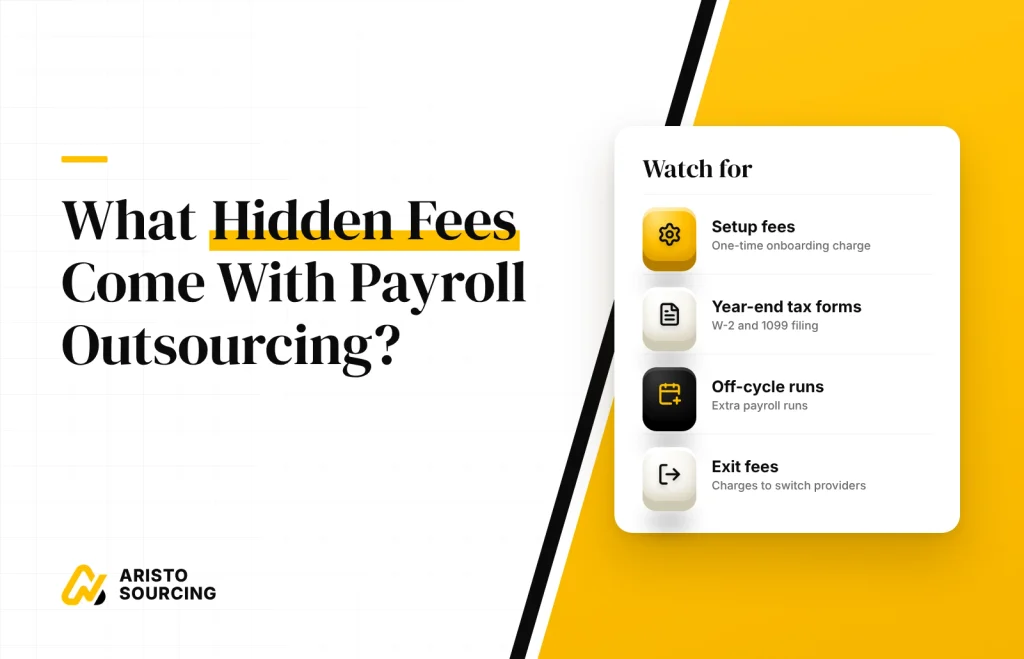
What Hidden Fees Come With Payroll Outsourcing?
The hidden fees that come with payroll outsourcing include year-end W-2 and 1099 form charges, multi-state tax filing fees, off-cycle run fees, and setup or implementation fees. These fees rarely appear in the headline price, and each one can add to the monthly bill on quote-based plans.
The hidden fees of payroll outsourcing are presented in the table below.
| Fee | How It Is Charged | Explanation |
| Year-end W-2 and 1099 forms | Per form on some quote-based plans | OnPay includes W-2s and 1099s in its base price. |
| Multi-state tax filing | Monthly add-on or higher tier | SurePayroll charges $9.99 per month; Gusto requires the Plus plan. |
| Off-cycle runs | Per extra run on per-run plans | OnPay includes unlimited pay runs. |
| Setup and implementation | One-time fee on some quote-based plans | OnPay and Gusto advertise no setup fees. |
Buyers should also check for charges on tax amendments and corrections, wage garnishment processing, paper check printing and delivery, accounting and timekeeping integrations, and mid-year plan changes. The reliable defense against hidden fees is an all-in quote in writing that lists every recurring and one-time charge.
What Drives the Cost of Payroll Outsourcing?
The cost of payroll outsourcing is driven by number of employees, pay frequency, payroll complexity, additional services, software integration, and service level. These six factors explain why two businesses with similar revenue receive different quotes.
The 6 cost drivers of payroll outsourcing are listed below.
- Number of Employees: Every employee and contractor paid adds a per-employee fee, so headcount is the main variable on PEPM plans.
- Pay Frequency: Weekly payroll creates 52 runs per year against 24 on a semimonthly schedule, which more than doubles the bill on per-run pricing.
- Payroll Complexity: Multi-state employees, hourly overtime, tips, commissions, and garnishments add calculation and filing work that higher tiers price in.
- Additional Services: Benefits administration, time tracking, HR support, and workers’ compensation are sold as add-ons or bundled into higher tiers.
- Software Integration: Connections to accounting, timekeeping, and ERP systems are free on some plans and billed as setup work on others.
- Service Level: Self-service software costs least, full-service managed payroll costs more, and co-employment through a PEO costs most.
How Can You Lower Payroll Outsourcing Costs?
You can lower payroll outsourcing costs by right-sizing the plan, reducing pay frequency, bundling payroll with bookkeeping, negotiating billing terms, using a hybrid model, and avoiding tax penalties. These tactics reduce the bill without switching to the cheapest provider on the market.
The ways to lower payroll outsourcing costs are listed below.
- Right-Size the Plan: Choose the tier that matches current needs instead of paying for HR and benefits features the business does not use.
- Reduce Pay Frequency: Moving from weekly to biweekly pay cuts run-based fees by half where state pay-frequency laws allow it.
- Bundle Payroll With Bookkeeping: Buying payroll and bookkeeping from one provider removes duplicate base fees and integration charges.
- Negotiate Billing Terms: Ask for annual billing discounts and request that setup fees be waived before signing.
- Use a Hybrid Model: Pair an affordable software plan with a dedicated offshore operator instead of paying for a full-service tier and a part-time internal coordinator.
- Avoid Penalties: Deposit and file on time, because one late federal deposit can cost more than a year of service fees.
Bundling saves the most for businesses that already pay a bookkeeper or accountant, because the same provider can reconcile payroll entries against the general ledger. Comparing payroll quotes against what outsourced accounting costs shows whether one combined finance provider beats two separate contracts.

In-House vs Outsourced Payroll: The True Cost Comparison
Outsourced payroll costs $2,400 to $22,560 per year for 10 to 150 employees on a full-service plan, while an in-house payroll specialist costs about $87,500 per year before software, because the in-house figure includes salary, benefits, and employer taxes. Robert Half’s 2026 Salary Guide places the US payroll specialist salary between $53,000 and $77,250, with a midpoint of $61,250. Based on data from the Bureau of Labor Statistics, benefits made up 30.0% of private-industry employer compensation costs in June 2026, which lifts the $61,250 midpoint salary to a fully loaded cost of about $87,500.
The in-house vs outsourced payroll cost comparison is presented in the table below.
| Headcount | In-House Annual Cost | Outsourced Annual Cost | Explanation |
| 10 employees | $88,808 | $2,400 | Specialist at $87,500 plus Gusto Simple at $1,308; outsourced at Gusto Plus rates. |
| 50 employees | $91,688 | $8,160 | Software cost rises with headcount on both sides. |
| 150 employees | $98,888 | $22,560 | Outsourcing remains cheaper on published rate cards. |
The in-house figure also hides costs that never appear on a salary line: payroll errors and corrections, missed filing deadlines, training on tax-rate changes, management time, and coverage when the specialist is out. At Gusto Plus rates, the annual outsourced fee reaches the $87,500 fully loaded specialist cost only at roughly 600 employees, and at quote-based rates of $20 to $25 per employee, break-even falls to roughly 290 to 365 employees. Outsourcing wins on cost for almost every small business, and in-house payroll only starts to compete once headcount reaches the low hundreds and the specialist also absorbs HR and benefits work.
The fair comparison sets the fully loaded in-house cost against the all-in outsourced fee, never salary against a base fee. Read together, the payroll outsourcing cost figures and 2026 payroll services pricing in this guide show that price is only half of the decision, and the benefits a payroll provider delivers beyond price complete it.
Is Outsourcing Payroll Worth the Cost?
Outsourcing payroll is worth the cost when the fee is lower than the value of the owner’s time, the penalty risk the provider removes, and the compliance work it covers. Every pay run handed to a provider returns hours to the owner or finance team. IRS Publication 15 sets failure-to-deposit penalties at 2% of the unpaid deposit for 1 to 5 days late, 5% for 6 to 15 days late, 10% for more than 15 days late, and 15% when the deposit remains unpaid more than 10 days after the first IRS notice. A $20,000 payroll tax deposit made 16 days late draws a $2,000 penalty, which exceeds 18 months of Gusto Simple fees for 10 employees. Outsourcing payroll is not worth the cost for very small, single-state, salaried-only teams whose owner is comfortable running payroll software alone.
How Do You Choose a Payroll Provider and Compare Quotes?
You choose a payroll provider by picking the service model first, converting every quote to an all-in monthly total, and asking the same contract questions of every provider. Model comes first because software, full-service payroll, a PEO, and a dedicated operator solve different problems. The all-in monthly total adds the base fee, per-employee fees, per-run fees, and add-ons into one comparable number. Security matters as much as price, so buyers should request the provider’s SOC 1 or SOC 2 report, confirm support hours, and call two references.
The 6 questions to ask a payroll provider are listed below.
- Does the provider guarantee tax-filing accuracy?
- Who pays penalties caused by provider errors?
- Is multi-state filing included in the quoted price?
- Are year-end W-2 and 1099 forms included?
- Which accounting and timekeeping integrations are included?
- What is the contract length and the exit notice period?
Businesses that choose the hybrid model can place a dedicated remote payroll administrator through Aristo Sourcing, which recruits vetted full-time payroll and bookkeeping staff from the Philippines and South Africa to operate the employer’s existing payroll software. Aristo Sourcing supplies the operator, not a payroll provider with a tax-filing guarantee, so the hybrid model still needs a reputable payroll platform that files and deposits the taxes. The next step is to shortlist one model, request three written all-in quotes, and compare them on the six questions above.
What Percentage of Companies Outsource Payroll?
No current primary-source survey publishes a verified percentage of companies that outsource payroll. Figures repeated on vendor blogs trace back to undated or unverifiable surveys, so this guide does not cite them. The service-model section above shows which form of outsourcing fits each company size, and the payroll outsourcing process explains how the handoff works step by step.
Are Payroll Service Fees Tax-Deductible?
Yes, payroll service fees are generally deductible as an ordinary and necessary business expense under Internal Revenue Code Section 162, because they are a cost of operating the business. This is general information rather than tax advice, so a tax professional should confirm the treatment for a specific business.
Is Direct Deposit Included in Most Payroll Services?
Yes, direct deposit is included in most payroll services at no extra charge, because it is the default payment method on the published plans compared above. Faster deposit speeds, such as next-day or same-day deposit, often sit on higher tiers, and printed check delivery is a common add-on fee.
How Often Can Payroll Be Run With a Payroll Service?
A payroll service runs payroll weekly, biweekly, semimonthly, or monthly, and most published software plans include unlimited runs. OnPay includes unlimited pay runs and schedules, while per-run providers bill each extra run, which is why pay frequency appears among the cost drivers above. State pay-frequency laws set the minimum frequency for many types of employees.
How Much Does a Payroll Service Cost per Employee?
A payroll service costs $4 to $22 per employee per month on published 2026 rate cards, on top of a monthly base fee of $17 to $180. PEO plans cost more, with Justworks charging $79 to $124 per employee per month. The effective cost per employee falls as headcount grows, from $10.90 at 10 employees to $6.98 at 50 employees on Gusto Simple.