
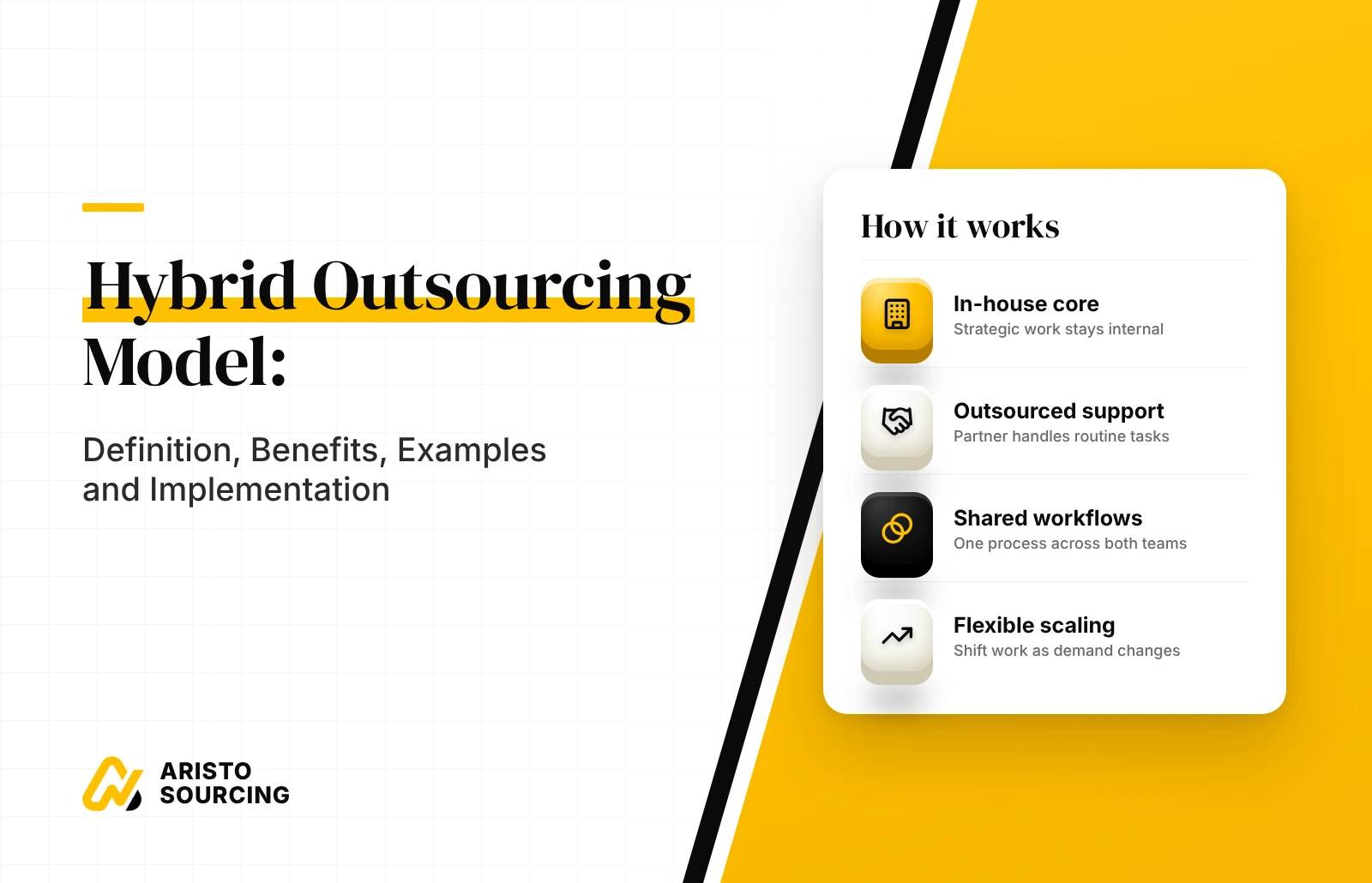
A hybrid outsourcing model basically refers to splitting work between a company’s own staff and an outside provider. The model combines an in-house team with one or more external outsourcing providers inside a single operating structure. Businesses typically keep strategic, sensitive, and relationship-critical functions in-house, while they outsource routine, specialized, or capacity-driven work such as IT support, customer service, and bookkeeping. The outsourced work can be delivered through onshore, nearshore, or offshore teams, depending on budget, time zone, and language needs.
The hybrid model offers benefits such as cost optimization, operational control, scalability, specialized expertise, and flexibility, but it also brings challenges in management, data security, communication, vendor dependency, and quality control. Getting those benefits depends on how a business decides what to outsource and how it implements the model, starting with a clear assessment of each business function. Choosing the right outsourcing partner matters just as much, because the provider’s expertise, security practices, and management approach shape the results of the entire arrangement.
What Is a Hybrid Outsourcing Model?
A hybrid outsourcing model is an operating structure where a business keeps strategic or sensitive functions with its in-house team and delegates routine or specialized functions to an outsourcing provider. The model combines the company’s knowledge of the in-house team with the extra capacity and skills of an external partner. Businesses use this approach to lower operating costs, fill skill gaps, and scale capacity without giving up control over the work that defines their competitive position.
The outsourcing provider usually delivers its work as a managed service or through dedicated remote staff who work alongside the client’s employees, follow the client’s processes, and report through agreed channels. The external work can be handled by onshore teams in the same country, nearshore teams in a nearby country with a similar time zone, or offshore teams in a more distant country, often at lower labor costs.
How Does a Hybrid Outsourcing Model Work?
A hybrid outsourcing model works by assigning each business function to an internal team or an external team based on its strategic value, sensitivity, and skill needs, under agreed governance. The internal team handles business functions that require deep company knowledge, such as strategy, product decisions, and client relationships, while the external team handles defined, repeatable, or specialized tasks. Internal ownership means the company sets the goals, standards, and final approvals for every function, even when the external team performs the day-to-day execution.
Resource distribution works under a matching principle, where organizations dedicate internal personnel to critical operational goals while leveraging external providers to manage heavy workloads or access specialized expertise. Governance, in the form of documented processes, service level agreements, and regular reviews, connects both sides. For example, an e-commerce company might keep marketing strategy and supplier negotiations in-house while an outsourcing provider handles order processing, returns, and first-line customer emails. The arrangement is beneficial because managers keep control of the decisions that shape the brand, while routine tasks get done at a lower cost. That division of work is the source of the model’s main benefits.
What Are the Benefits of a Hybrid Outsourcing Model?
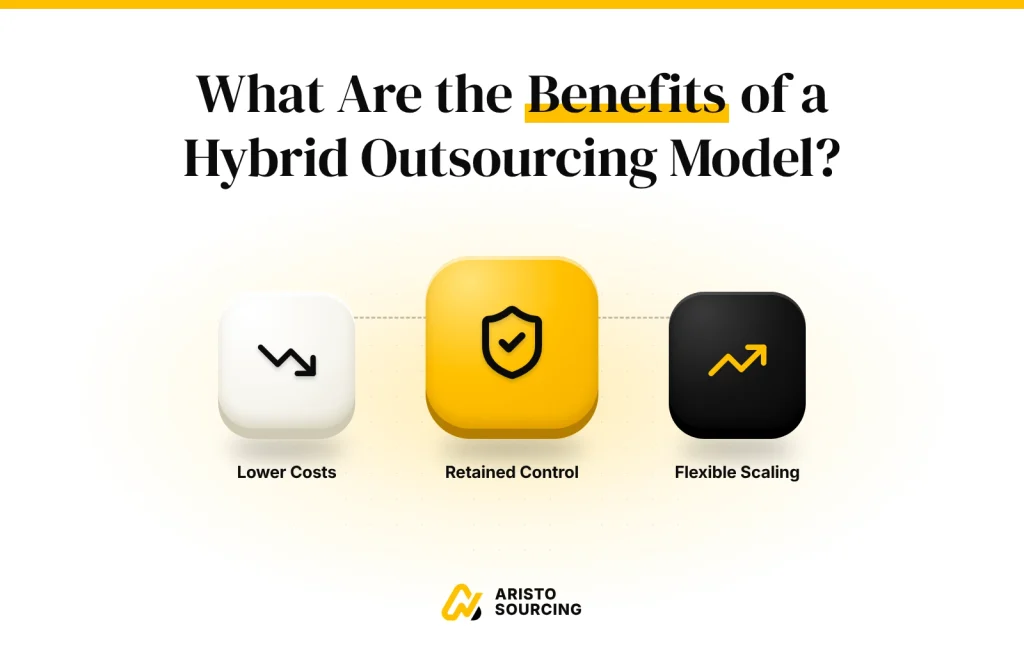
The benefits of a hybrid outsourcing model include cost optimization, operational control, scalability, specialized expertise, and flexibility, which together let a business grow capacity without losing ownership of its core work.
The benefits of a hybrid outsourcing model are listed below.
- Streamlines Cost Optimization: Streamlining cost optimization means reducing the total cost of running business functions by matching each task with the most cost-effective resource, without lowering quality or slowing delivery. A hybrid model helps balance internal staffing costs, such as salaries, benefits, office space, and training, against external outsourcing costs that are usually billed per hour, per role, or per task. The business pays full employment costs only for roles that need to stay internal and buys the rest as flexible capacity.
- Strengthens Operational Control: Strengthening operational control means keeping authority over how work is planned, performed, and approved, so a business can enforce its own standards, priorities, and decisions across every function. Keeping core functions in-house preserves direct oversight of strategy, sensitive data, and customer relationships. Other work is delegated to the outsourcing provider under documented processes, so managers still see the progress of every task without supervising it directly.
- Supports Scalability: Supporting scalability refers to the ability of a business to increase or decrease its working capacity quickly in response to demand, without long hiring cycles or costly layoffs. Outsourcing providers maintain pools of trained talent, so a business can add team members during a busy season or product launch and release them when volume drops. The in-house team stays stable while external capacity absorbs the peaks and dips.
- Secures Specialized Expertise: Securing specialized expertise means gaining access to professionals with niche skills, certifications, or industry experience that a business needs for specific work but cannot easily hire or develop internally. A hybrid model gives a business access to skills such as cybersecurity, data analysis, tax compliance, or multilingual support through the outsourcing provider. The in-house team learns from these specialists while it stays focused on the work it knows best.
- Sustains Flexibility: Sustaining flexibility refers to the freedom to change which functions stay internal and which move to an external provider as business priorities, budgets, and market conditions shift over time. It can be challenging to predict which functions will need more support next year, so a hybrid model avoids locking the business into one fixed structure. A company can bring an outsourced function back in-house once it becomes strategic, or outsource a function that has become routine.
What Are the Challenges of Hybrid Outsourcing?
The challenges of hybrid outsourcing include management complexity, data security issues, communication challenges, vendor dependency, and quality control hardship, all of which come from running internal and external teams side by side.
Management Complexity: Hybrid outsourcing increases the effort needed to coordinate in-house teams and external providers. Different tools, schedules, and reporting lines complicate shared deadlines and conflict resolution, adding management work.
- Data Security Issues: Sharing sensitive business and customer information with external providers increases exposure to unauthorized access, loss, or misuse. Role-based access, confidentiality agreements, and security checks help protect data.
- Communication Challenges: Unclear instructions and poorly managed handoffs between internal and external teams cause rework, missed deadlines, and errors. Time zone differences and language barriers increase these risks, making clear communication channels and written processes essential.
- Vendor Dependency: Heavy reliance on one outsourcing provider makes switching suppliers or bringing work in-house difficult and costly. Price increases, service disruptions, and lost process knowledge can follow. Documented processes, clear exit terms, and regular performance reviews reduce dependency.
- Quality Control Hardship: Differences between internal and external work methods can cause inconsistencies in accuracy, style, and format. Shared quality standards, checklists, and regular audits help maintain consistent output.
What Is the Difference Among Hybrid Outsourcing, In-House, and Full Outsourcing?
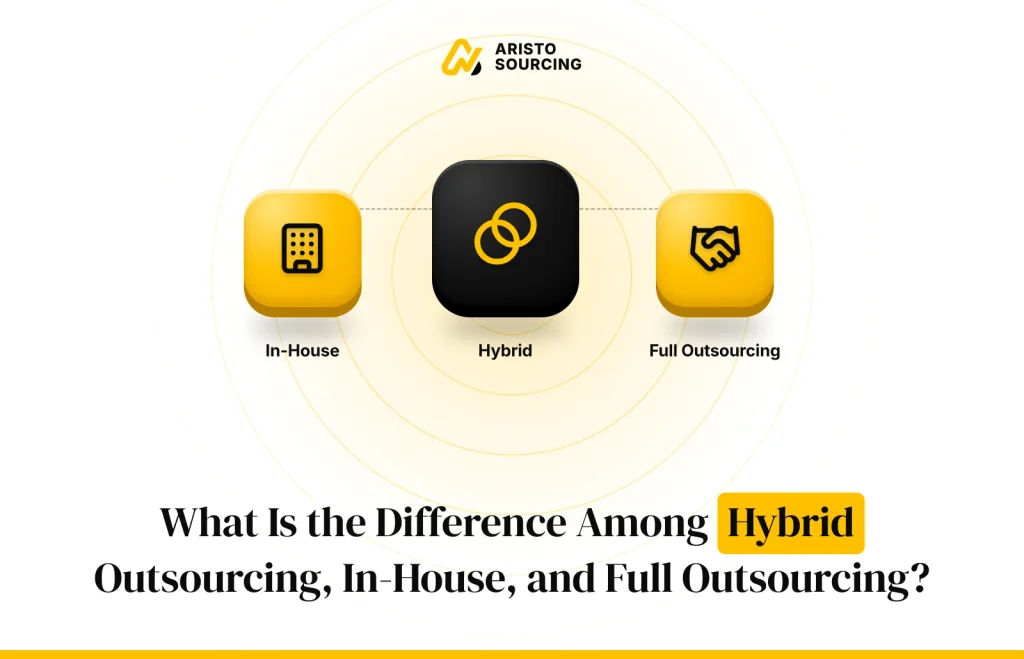
The difference among hybrid outsourcing, in-house, and full outsourcing is who performs and manages the work: hybrid outsourcing combines internal teams with external providers, in-house operations keep all work within the company, and full outsourcing transfers most or all of a function to an external provider. In-house operations offer the most direct control but carry the highest fixed costs and the least flexibility, so they suit functions where a company needs direct control over every step. Full outsourcing usually lowers costs and adds ready access to expertise, but it shifts responsibility for managing the work to the provider, so it suits functions that a company wants an external provider to manage. Hybrid outsourcing balances internal control with external expertise and flexible costs, because the company keeps management of core functions while a provider supplies capacity and specialized skills. A good example is a growing company that keeps product strategy in-house, fully outsources payroll to a specialist firm, and uses a hybrid model for customer support, where internal leads manage outsourced agents.
What Are the Examples of Hybrid Outsourcing?
The examples of hybrid outsourcing are presented below.
- IT: In IT, a hybrid model often means a company’s internal team owns the technology roadmap and security decisions, while an external provider runs day-to-day support and infrastructure monitoring. Cybersecurity policy, system architecture, and access to sensitive data typically stay internal. Help desk tickets, network monitoring, cloud maintenance, and software updates typically get outsourced.
- Software Development: In software development, a hybrid model often means in-house product managers and senior engineers define the product and architecture, while outsourced developers build features, run tests, and fix bugs. Product vision, core architecture, code review, and intellectual property decisions typically stay internal. Front-end development, quality assurance testing, maintenance, and mobile app builds typically get outsourced to an external development team.
- Customer Support: In customer support, a hybrid model often means an internal team handles escalations, key accounts, and support strategy, while an outsourced team answers routine tickets, emails, and calls. Complaint escalations, high-value client relationships, and support policies typically stay internal. First-line inquiries, order tracking, after-hours coverage, and multilingual support typically get outsourced.
- Finance: In finance, a hybrid model often means internal finance leaders control budgeting, forecasting, and final approvals, while an outsourcing provider handles bookkeeping, invoice processing, payroll, and account reconciliation. Financial strategy, cash management, and audit sign-off typically stay internal, while accounts payable, accounts receivable, and data entry typically get outsourced. A company implementing the model in finance should also define who reviews outsourced work before reports reach leadership.
How to Implement a Hybrid Outsourcing Model?
Implementing a hybrid outsourcing model generally follows a few steps, starting with assessing business functions, then dividing work, selecting a provider, setting responsibilities and expectations, and monitoring results over time.
The steps to implement a hybrid outsourcing model are listed below.
- Assess Business Functions
- Decide What Stays Internal and What Moves Externally
- Select an Outsourcing Provider
- Establish Responsibilities and Communication
- Set Performance Expectations
- Monitor and Optimize
1. Assess Business Functions
Assessing business functions means reviewing every activity a company performs to understand its importance, risk level, and resource needs before deciding who should perform it. A company should score each business function against five criteria: strategic value, sensitivity, expertise, scalability, and cost. Functions with high strategic value or sensitive data usually score as internal priorities. Functions that are repetitive, highly specialized, or subject to volume swings usually score as candidates for outsourcing.
2. Decide What Stays Internal and What Moves Externally
Deciding what stays internal and what moves externally means using the function assessment to assign each task to the internal team or an external provider based on clear criteria. Strategic, sensitive, and relationship-critical functions should stay with the internal team. Routine, specialized, or capacity-driven functions can move to an external provider. A written responsibility map prevents overlap and makes the split easy to revisit later.
3. Select an Outsourcing Provider
Selecting an outsourcing provider means choosing an external partner whose skills, security standards, location, and working model fit the functions a business has decided to outsource. The evaluation should cover the provider’s expertise in the relevant field, its security practices for handling sensitive data, and its delivery model, whether onshore, nearshore, or offshore. A provider such as Aristo Sourcing, which sources talent directly from the Philippines and South Africa and handles employment and payroll, is an example of a partner built for hybrid arrangements. Reference checks and a short pilot project help confirm the fit before a long-term commitment.
4. Establish Responsibilities and Communication
Establishing responsibilities and communication means defining who owns, performs, and approves each task, and how internal and external teams share updates, questions, and feedback during daily work. Clear governance sets decision rights, escalation paths, and reporting lines between the internal team and the outsourcing provider. A responsibility matrix, a shared project management tool, and scheduled check-ins keep both sides aligned. Regular meetings during overlapping work hours reduce delays in handoffs across time zones.
5. Set Performance Expectations
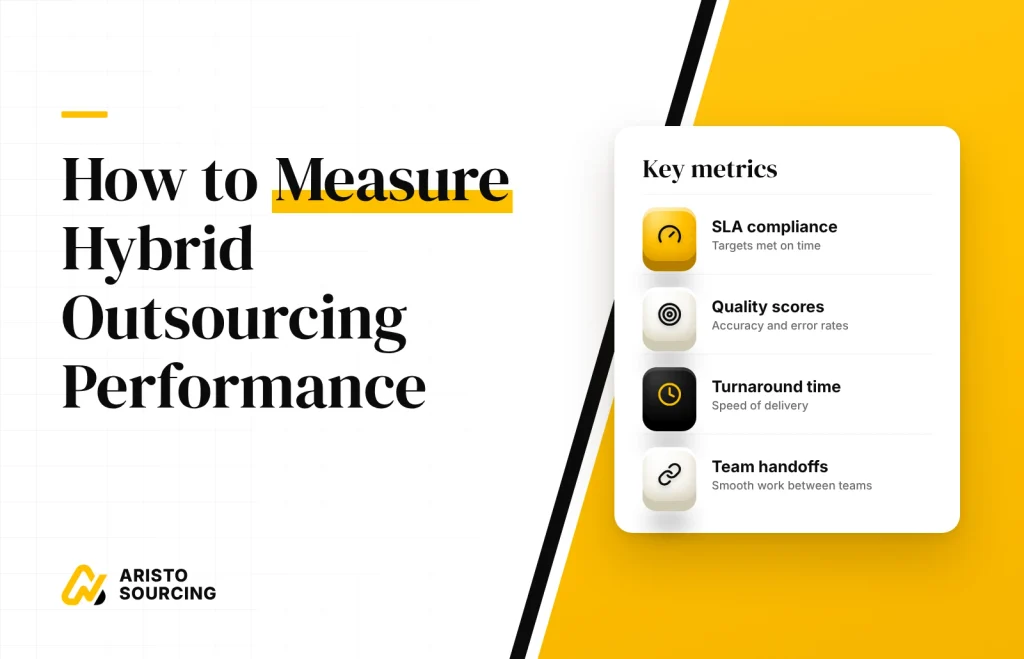
Setting performance expectations means agreeing on measurable targets for quality, speed, output, and cost that the outsourced team must meet, and documenting them before the work begins. The business and the outsourcing provider should agree on KPIs up front, such as accuracy rate, average turnaround time, first-response time, and cost per task. Each KPI needs a target value, a measurement method, and a review schedule. Shared expectations prevent disputes because both teams judge the work by the same numbers.
6. Monitor and Optimize
Monitoring and optimizing means reviewing how the hybrid model performs on a regular schedule and making changes that improve results, reduce costs, or close gaps in coverage. Monthly or quarterly reviews should compare KPI results against targets for both internal and external work. The business can then adjust the internal-to-external split over time, outsourcing more work that runs well externally or bringing a function back in-house when it becomes strategic. Those reviews depend on a clear set of performance measures.
How to Measure Hybrid Outsourcing Performance
Measuring hybrid outsourcing performance involves tracking cost, quality, productivity, and SLA results for outsourced work and comparing them with agreed targets and with similar work done by the in-house team.
The common ways to measure hybrid outsourcing performance are listed below.
- Cost: Cost, as a performance measure, refers to the total amount a business spends to complete outsourced work, including provider fees, management time, tools, and any rework caused by errors. Cost should be tracked alongside quality and output, not on its own, because a cheaper arrangement that produces more errors or less work often costs more overall. Cost per task or cost per ticket gives a fair comparison with in-house work.
- Quality: Quality, as a performance measure, refers to how accurately, consistently, and completely outsourced work meets the standards a business has defined for its customers and internal processes. Accuracy is tracked through error rates, audit scores, and rework requests, while consistency is tracked by comparing output across team members and over time. Customer satisfaction scores add an outside view of quality for client-facing work.
- Productivity: Productivity, as a performance measure, refers to the amount of useful work a team completes within a given period, relative to the time, people, and resources assigned to it. Output volume is tracked through counts such as tickets closed, invoices processed, or features delivered per week. Turnaround time measures how long each task takes from assignment to completion, which shows whether the outsourced team keeps pace with internal demand.
- SLA Performance: SLA performance refers to how consistently an outsourcing provider meets the service levels, such as response time, resolution time, uptime, and accuracy, defined in the service level agreement. Each service level is tracked as the percentage of cases that meet the target, such as the share of tickets answered within two hours. Historical SLA results are also a key factor when choosing hybrid outsourcing model partners, because they show how reliably a provider delivers.
When to Partner With an Outsourcing Provider for Hybrid Outsourcing?
The right time to partner with an outsourcing agency for hybrid outsourcing is when business growth outpaces the capacity of the internal team, but core functions still need to stay under direct company control. Hybrid outsourcing makes sense when internal teams should handle core functions, such as strategy, product decisions, and key client relationships, while an external provider manages specialized or repetitive work. A talent shortage is another clear trigger, because an outsourcing provider can supply specialized expertise that is slow or expensive to hire locally.
Retaining internal control remains important for functions that involve sensitive data, regulatory responsibility, or a direct effect on brand reputation, so those functions should stay in-house. The decision should follow business objectives: a company focused on rapid growth needs scalability, while a company focused on compliance or quality needs strong operational control. Partnering with a remote staffing company like Aristo Sourcing can give businesses faster scaling, improved operational efficiency, reduced operational risks, and greater control over structural costs.
How Does Aristo Sourcing Help Businesses with Hybrid Outsourcing?
The way Aristo Sourcing helps businesses with hybrid outsourcing is by acting as the managed recruitment and infrastructure backbone for remote teams, so companies can add skilled remote staff without building hiring and employment systems themselves. Aristo Sourcing recruits and supports remote workers for its clients and handles their employment and payroll, rather than simply connecting businesses with freelancers. Those remote professionals work alongside the company’s internal team, follow its processes, and become part of core operations instead of sitting outside the business as short-term contractors.
The arrangement delivers the benefits of hybrid outsourcing model structures, such as scalability and specialized expertise, while the client keeps operational control over priorities and decisions. Unlike a freelancer platform, which takes a hands-off approach once a match is made, Aristo Sourcing actively manages and structures the outsourcing relationship. A good example is a business that keeps account management in-house while a remote assistant recruited through Aristo Sourcing handles scheduling, data entry, and customer follow-ups under the same team leads. For companies implementing a hybrid outsourcing model for the first time, Aristo Sourcing also shares practical guidance on managing remotely, including how to coordinate across time zones and work with virtual assistants.