
Outsourced marketing usually refers to hiring an external agency, freelancer, or fractional team to handle some or all of a company’s marketing work. It works either as a single outsourced function, like SEO or paid ads, or as an entire outsourced marketing department, and it comes in a few distinct engagement models depending on how much control and involvement a business wants to retain.
Outsourced marketing typically costs between $2,000 and over $10,000 a month, depending on scope and model. The benefits include lower overhead, faster execution, and access to senior-level expertise, though there are real risks too, brand misalignment and reduced day-to-day visibility chief among them. Choosing the right outsourced marketing partner comes down to finding one that understands the business, prices transparently, and reports on results clearly.
What Is Outsourced Marketing?
Outsourced marketing is the practice of contracting an external agency, freelancer, or fractional team to handle all or part of a company’s marketing strategy and execution.
The engagement can cover a single function, such as social media management alone, or an entire marketing department, strategy, content, paid media, and reporting together under one partner. The modern outsourced marketing model began gaining traction in the late 1990s as digital marketing agencies and business-function outsourcing became more common. Today’s fractional marketing model emerged later as a distinct approach to executive marketing leadership.
Even though marketing agencies themselves date back much further, many of today’s fractional marketing team arrangements descend directly from that shift toward ongoing, outsourced strategic support.
What Does an Outsourced Marketing Company Do?
An outsourced marketing company acts as an external specialist team, functioning as an alternative to building an internal marketing department from scratch. It typically handles strategy development, campaign execution, and performance reporting, covering the full loop from planning to results rather than just one piece of it.
Work is delivered through defined processes, shared tools, and reusable templates, which lets a small team of specialists serve many clients efficiently without rebuilding a workflow from zero each time. The specific functions a company hands off usually depend on where the most immediate gap sits, whether that’s execution capacity, senior strategy, or a skill the internal team simply doesn’t have.
Which Marketing Functions Can You Outsource?
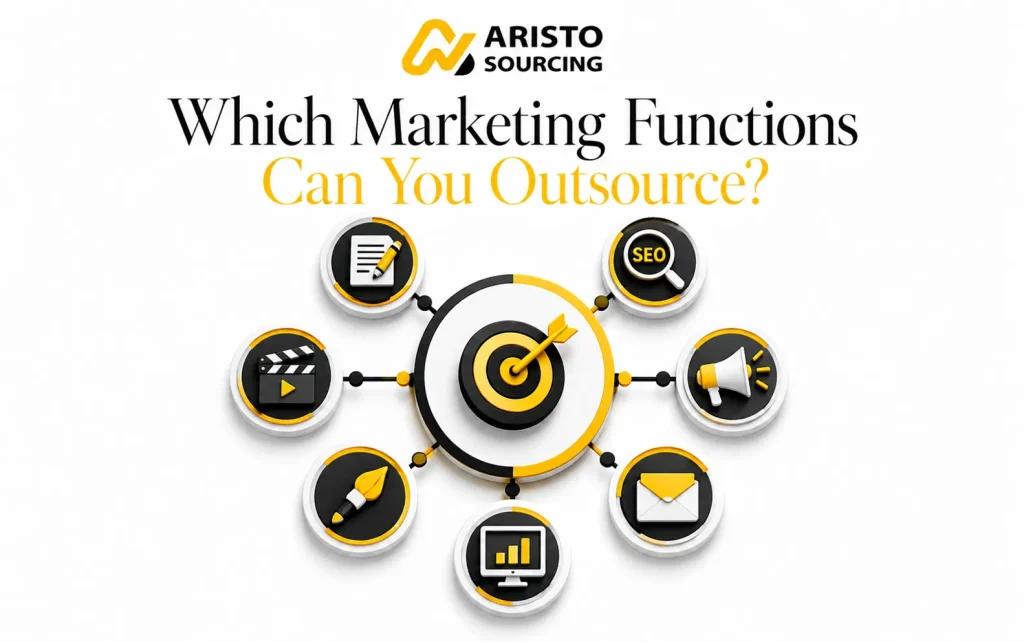
Marketing functions that can be outsourced include SEO, content creation, paid advertising, email marketing, and social media management, spanning most of what a modern marketing department does.
Marketing functions that can be outsourced are listed below.
- SEO strategy: SEO strategy is the process of improving a website’s visibility in search results through keyword research, technical optimization, and content planning aimed at organic traffic growth.
- Brand and messaging strategy: Brand and messaging strategy is the work of defining how a company positions itself and communicates its value to customers across every channel and touchpoint.
- Marketing plan creation: Marketing plan creation is the process of building a documented roadmap of marketing goals, channels, budget, and timeline that guides a company’s efforts over a set period.
- Market research: Market research is the systematic gathering and analysis of information about customers, competitors, and market conditions, used to inform marketing and business decisions.
- Content creation (blogs, video, white papers): Content creation is the production of written, visual, or video material, blog posts, videos, white papers, used to attract, inform, and engage an audience.
- PPC and paid advertising: PPC and paid advertising is the practice of running paid campaigns on search engines and social platforms, paying per click or impression to drive targeted traffic.
- Email marketing and automation: Email marketing and automation is the use of email campaigns and automated sequences to nurture leads, retain customers, and drive repeat engagement over time.
- Social media management: Social media management is the ongoing creation, scheduling, and moderation of content across social platforms to build audience engagement and brand presence.
- Web development and UX: Web development and UX is the design and technical building of a company’s website, focused on both visual experience and functional performance for visitors.
- Analytics and reporting: Analytics and reporting is the tracking and interpretation of marketing performance data, used to measure results and guide decisions about where to adjust strategy.
Outsourcing digital marketing tasks like these individually, rather than handing off an entire department, is common among companies that already have some internal capacity and just need to fill specific gaps.
Which functions to outsource first usually maps to whichever of the marketing models a company chooses.
What Are the Three Outsourced Marketing Models?
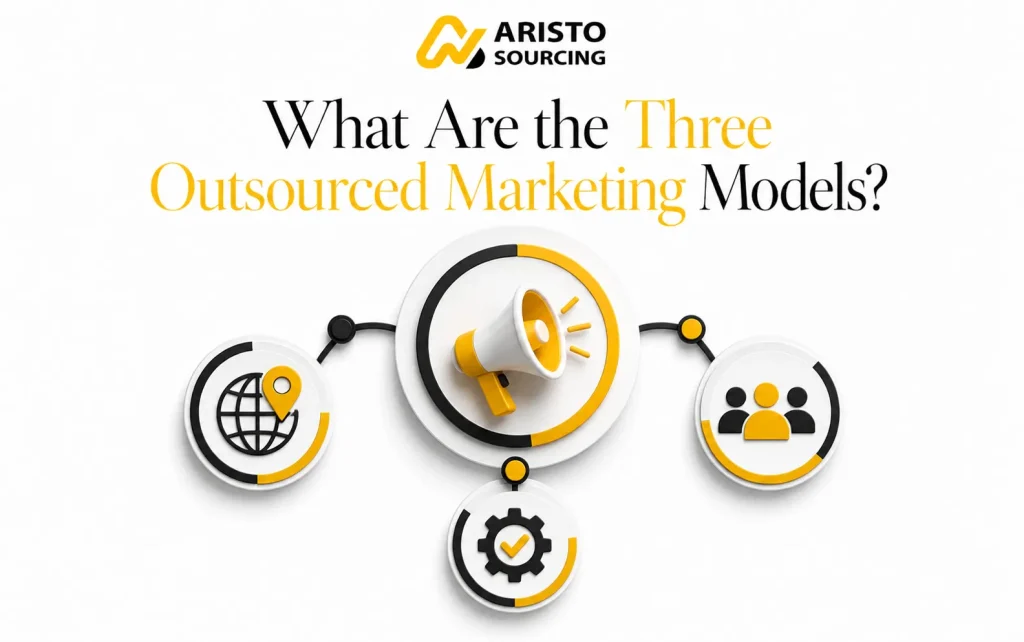
The three outsourced marketing models are project-based outsourcing, specialized retainers, and fractional CMO or full-service outsourcing, each suited to a different level of ongoing involvement.
The three outsourced marketing models are listed below.
- Project-Based Outsourcing
- Specialized Retainer
- Fractional CMO and Full-Service Outsourcing
1. Project-Based Outsourcing
Project-based outsourcing is a one-off engagement scoped around a single, defined deliverable rather than an ongoing relationship. Typical examples include a website build, a single campaign launch, or a full brand rebrand, with a clear start and end point rather than continuous management.
2. Specialized Retainer
A specialized retainer is a recurring monthly fee arrangement covering continuous management of a single marketing channel over time. The most common retainer channels are SEO and social media, ongoing work that benefits from continuous management rather than a one-time project.
3. Fractional CMO and Full-Service Outsourcing
A fractional CMO or full-service outsourcing arrangement is a model where the external partner effectively acts as the company’s entire marketing department, providing both strategy and execution rather than just one or the other. It works by embedding a senior marketing leader, the fractional CMO, who sets direction and oversees an execution team, often the same partner’s own specialists or coordinated freelancers, handling the day-to-day campaign work underneath that strategy. This model typically costs more than a single retainer, since it covers leadership and execution together, but it replaces the need to hire a full-time CMO at a fraction of the cost of that salary.
How Much Does Outsourced Marketing Cost?
Outsourced marketing costs between $2,000 and over $10,000 monthly, depending on the scope of work, the model chosen, and whether the engagement includes strategic leadership or execution alone, which is often a fraction of a fully-loaded in-house marketing salary.
Outsourced marketing cost ranges are presented in a table below.
| Tier | Typical Cost | What It Covers |
|---|---|---|
| Tactical support (content, social, email) | $2,000–$6,000/month | Execution of specific channels without strategic leadership |
| Basic package, small firms | $3,000–$7,500/month | A lighter bundle of core channels suited to smaller budgets |
| Fractional CMO | $8,000–$15,000/month | Senior strategic leadership paired with a team handling execution |
| Full marketing department | $10,000–$30,000/month | Complete outsourced replacement for an entire in-house marketing function |
| Project-based | Flat fee or retainer from $5,000 | One-off deliverables like a rebrand, website build, or campaign launch |
How Does Outsourced Marketing Cost Compare to In-House Salaries?
Outsourced team costs roughly 1-2 full-time salaries versus a full in-house department because a single outsourced fee replaces multiple specialist hires, their salaries, and everything that comes with employing them directly.
Hidden in-house costs add up quickly, such as recruitment fees to fill each specialist role, training time before a new hire is fully productive, benefits and payroll taxes on top of base salary, the marketing tools and software each function needs, and the cost of turnover when a hire doesn’t work out and the search starts over.
An outsourced arrangement absorbs most of these hidden costs into a single predictable fee, which is a large part of why the total often lands well below what an equivalent in-house department would cost to build and maintain.
What Are the Benefits of Outsourcing Marketing?
The benefits of outsourcing marketing include lower overhead, access to specialized expertise, faster execution, and the flexibility to scale support up or down as needs change.
The benefits of outsourcing marketing are listed below.
- Lower overhead and HR burden: Outsourcing removes the cost of recruiting, training, and managing marketing staff directly, replacing multiple salaries and benefits packages with one predictable monthly fee.
- Access to senior-level and specialized expertise: A single outsourced partner can bring specialists across SEO, paid media, content, and design that a smaller company couldn’t justify hiring individually in-house.
- Speed and agility of execution: Outsourced teams typically run on established workflows and tools refined across many clients, which lets campaigns launch faster than building the same process internally.
- Scalability up or down with demand: Outsourced support can expand during a product launch or slow down during a quieter period without the disruption of hiring or laying off internal staff.
- Objective outside perspective: A partner outside daily company politics can flag messaging or strategy issues that an internal team, too close to the brand, might miss entirely.
- Reduced turnover risk: Since the outsourced team isn’t a direct employee, a single person leaving the partner agency doesn’t leave the client’s marketing function suddenly unstaffed.
These gains come with some risk, but it can be easily mitigated with a proper understanding of the process.
What Are the Risks of Outsourced Marketing?
The risks of outsourcing marketing are listed below.
- Brand misalignment and inconsistent messaging: A partner unfamiliar with brand nuance can produce content that feels off-tone or inconsistent with prior messaging.
- Less day-to-day visibility: Work happens outside the building, so leadership sees results less immediately than with an internal team down the hall.
- Onboarding and alignment time: A new partner needs real time to learn the business before output reaches full quality and speed.
- Misdirection risk without clear KPIs and check-ins: Without defined metrics and regular check-ins, a partner can execute well against the wrong priorities entirely.
How Do You Choose an Outsourced Marketing Partner?
To choose an outsourced marketing partner, look for one that understands your business, market, and goals, offers strategic guidance rather than just tactical execution, prices transparently, and reports on results clearly.
A good partner takes the time to understand the business, its market, and its actual goals before proposing tactics, rather than pitching a standard package regardless of fit. The strongest partners offer strategic guidance, not just tactical execution, helping decide what to do and why, not simply running whatever campaign is requested.
Transparent pricing and a clearly defined scope prevent the kind of quiet scope creep that erodes value over a long engagement, and results-driven reporting, tied to the metrics that actually matter to the business, keeps the relationship accountable. Cultural and communication fit matters more than it might seem: a partner whose working style clashes with the internal team’s pace and expectations will struggle regardless of how skilled the work is.
Red flags worth watching for include vague scope language, no defined KPIs, and no set reporting cadence, all signs that accountability will be hard to enforce once the contract is signed. For businesses that want outsourced marketing talent without a full agency relationship, a remote staffing engagement, hiring a dedicated remote marketing specialist through a provider like Aristo Sourcing, is another route worth considering alongside a traditional agency or fractional CMO arrangement.
Is Outsourced Marketing Better Than In-House Marketing?
No, outsourced marketing isn’t universally better than in-house marketing, but it depends on the company’s budget, control needs, and growth stage.
Outsourced marketing tends to win on cost, speed, and access to a wider specialist range than most companies could hire internally at a comparable price. In-house marketing tends to win on control, deep brand immersion, and immediate availability, since an internal team lives inside the company’s daily rhythm rather than checking in on a schedule.
Which one fits better usually comes down to where a business sits. An early-stage or resource-constrained company often leans outsourced for its marketing, while a larger company with the budget for a full internal team may prioritize the control and immersion in-house work provides.
What Is the Difference Between Outsourced Marketing and Outsourced Sales and Marketing?
The difference between outsourced marketing and outsourced sales and marketing is that marketing outsourcing covers demand generation and brand-building work, while sales and marketing outsourcing adds the revenue-generating activities that follow.
Outsourced marketing on its own covers demand generation, brand-building, and content, the work that builds awareness and generates interest, typically through SEO, paid media, content, and social channels. Outsourced sales and marketing adds prospecting, outreach, appointment setting, and closing support on top of that, extending the engagement into parts of the revenue cycle that marketing outsourcing on its own doesn’t touch.
Businesses that want leads generated and nurtured, but not the sales conversations that turn them into customers, typically stick with marketing alone, with sales outsourcing as a separate, sometimes bundled, add-on for the piece that follows. AI increasingly blurs this line, since AI-assisted lead scoring and outreach tools now sit on both sides of that scope boundary.
How Is AI Changing Outsourced Marketing?
AI is changing outsourced marketing by speeding up content and ad production, automating reporting, and shifting delivery toward a hybrid of human strategists and AI-driven execution.
AI-assisted content and ad optimization now handles first-draft copy, ad variant testing, and creative iteration far faster than a human team working alone, freeing strategists to focus on direction rather than production. Automation of reporting and campaign management means dashboards update and campaigns adjust bids or budgets in near real time rather than waiting for a weekly manual review.
The overall shift is toward hybrid human plus AI agency delivery, where AI in outsourcing handles the repetitive, high-volume work and human strategists handle judgment, brand nuance, and client relationships. This shift is already changing outsourcing marketing models and cost structures together: providers that lean on AI can often deliver more output at a similar or lower cost, and the benefits of that efficiency are increasingly passed through to clients as either lower pricing or more output for the same fee.