
The Philippines closed 2025 with over $40 billion in IT-BPM export revenue and roughly 1.9 million workers in the sector, growth that outpaced the 3% global industry average, according to IBPAP. That scale makes it the world’s largest single destination for outsourced customer support.
Businesses choose it for a specific combination: large pools of English-fluent, culturally Western-aligned agents at rates well below onshore hiring. This page covers why the Philippines leads in customer service specifically, which tasks fit best there, what it costs, the delivery models available, the risks worth knowing upfront, and how to choose a provider. The starting point is the country’s specific advantage over other outsourcing destinations.
What Does Customer Service Outsourcing to the Philippines Cover?
Customer service outsourcing to the Philippines means hiring a Philippine-based provider or team to handle buyer support functions like phone, chat, email, and social media on a business’s behalf.
It’s a specific application of the broader customer service outsourcing model, delivered through the country’s contact center infrastructure rather than a general Philippines outsourcing arrangement covering other functions like IT or back-office work.
What makes this destination worth a dedicated page comes down to a specific mix of scale, language fluency, and cost that few other countries combine at the same level.
Why Is the Philippines the Top Destination for Customer Service Outsourcing?
Seven factors combine to make the Philippines the default choice for outsourced support: cost, language, culture, time zone, talent, infrastructure, and compliance. Together, they explain a lead that few competitors can match.
1. Cost Savings
Cost savings in the Philippines come from lower labor costs than in many onshore markets, while maintaining a large English-speaking workforce. The U.S. Bureau of Labor Statistics reports a median hourly wage of $20.59 for customer service representatives in the United States. Philippine-based customer service providers generally offer lower fully loaded operating costs, making the country a popular destination for outsourced support.
Small and mid-sized businesses gain the most here, since the savings often decide whether outsourcing is financially viable at all. That same low-cost base holds up specifically because agents don’t need extensive English training first.
2. English Proficiency and Neutral Accent
English proficiency and a neutral accent describe how naturally Filipino agents communicate with Western customers without a heavy language barrier. The Philippines ranked 28th out of 123 countries in EF’s 2025 English Proficiency Index, scoring 569, well above the global average of 488, and second in Asia behind Malaysia.
Businesses serving US and UK customers benefit most, since miscommunication is one of the fastest ways to damage a support interaction. Language fluency alone doesn’t build trust, though; cultural familiarity does that next.
3. Cultural Alignment with Western Markets
Cultural alignment with Western markets refers to shared reference points, from media to workplace norms, that make interactions feel natural rather than scripted. Decades of exposure to American media, education, and business practices give Filipino agents an intuitive grasp of US and UK customer expectations that few other outsourcing regions replicate as closely.
Consumer brands with a strong US customer base gain the most from this fit. That familiarity becomes even more valuable once paired with round-the-clock time-zone coverage.
4. 24/7 Time-Zone Coverage
24/7 time-zone coverage allows Philippine teams to support customers during U.S. business hours by working daytime shifts that overlap with overnight hours in parts of the United States. Zendesk’s CX Trends 2026 report found that 74% of consumers expect support to be available around the clock, making distributed global teams a practical way to deliver continuous service without relying entirely on overnight staffing.
Global e-commerce brands benefit most from this natural overlap. Sustaining that coverage at scale depends on the size of the talent pool behind it.
5. Deep Talent Pipeline and Service Culture
A deep talent pipeline and service culture give the Philippines the scale to staff large accounts without running out of qualified agents. The IBPAP Roadmap 2028, developed with Everest Group, targets growing the sector to $59 billion in revenue and 2.5 million workers by 2028, building on an already-large existing workforce.
Enterprises with high-volume, multi-account needs benefit most from a pipeline this deep. None of that talent matters without the infrastructure to support it, which comes next.
6. Mature Infrastructure and Government Support
Mature infrastructure and government support describe the physical and regulatory backbone built specifically for the BPO industry, including dedicated economic zones and tax incentives. The Philippine Economic Zone Authority offers registered BPO companies income tax holidays and reduced corporate tax rates, reinforced further by the recently passed CREATE MORE law aimed at improving the ease of doing business.
Enterprise buyers weighing long-term stability gain the most from this backing. Strong infrastructure means little, though, without equally strong data protection behind it.
7. Compliance and Data Security Standards
Compliance and data security in the Philippines are governed by the Data Privacy Act of 2012 (Republic Act No. 10173), enforced by the National Privacy Commission. Although the law predates the GDPR, it is widely recognized as closely aligned with GDPR principles and international data protection standards. Many established BPO providers also maintain ISO 27001 certification and SOC 2 compliance to meet client-specific security requirements.
Regulated industries like healthcare and fintech benefit most from this combination of legal and operational safeguards.
What Customer Service Can You Outsource to the Philippines?
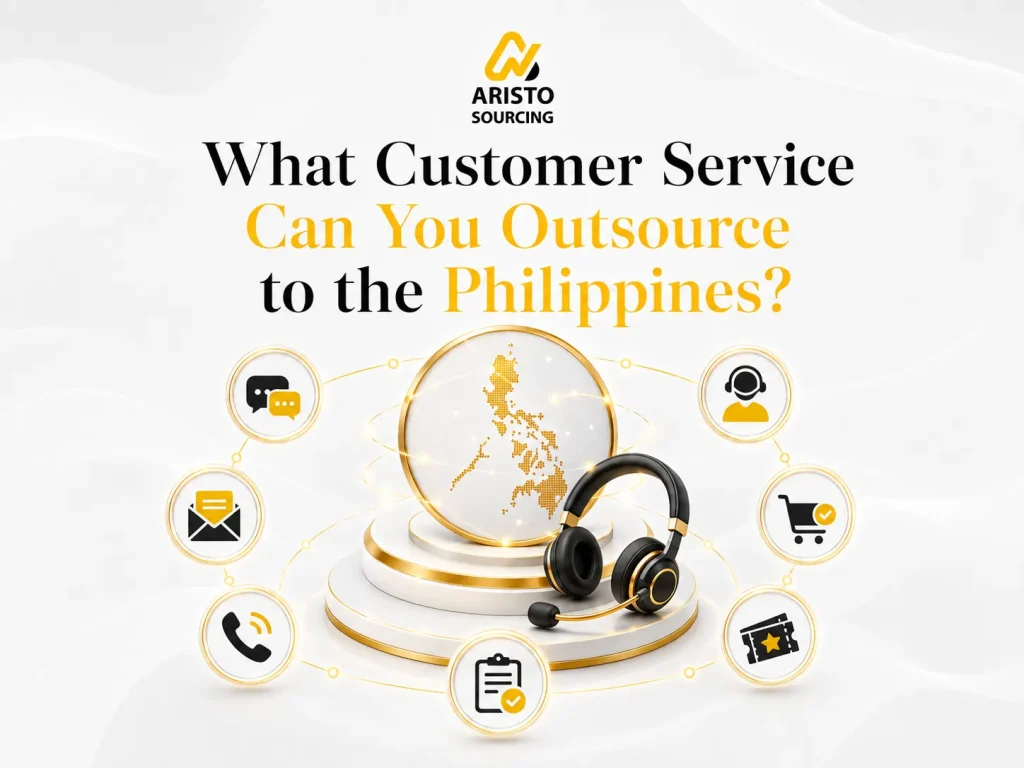
Philippine outsourcing spans three service types: voice support, digital support, and back-office work. Most businesses combine at least two of these under one provider rather than splitting them across separate vendors.
Voice Support
Voice support covers inbound customer care, Tier 1 technical troubleshooting, and telesales handled over the phone. Philippine teams deliver these services through agents trained on structured call flows and escalation procedures, supported by the country’s long-established call center industry. High-volume retail, telecom, and e-commerce businesses often rely on this model because phone support remains a preferred channel for urgent customer issues.
Digital Support (Chat, Email, Social)
Digital support covers live chat, email ticketing, and social media response across platforms like Instagram and X. Philippine teams handle this by routing messages through helpdesk tools such as Zendesk or Freshdesk, allowing one agent to manage several conversations at once rather than a single phone call. This work runs slightly lower, often $7-13/hr, since chat and email carry less real-time pressure than a live call. E-commerce and SaaS businesses need this most, given how much of their support volume already runs through digital channels by default.
Back-Office Support
Back-office support covers order processing, billing adjustments, and data entry tasks that sit behind the customer-facing conversation. Philippine teams handle this by pairing trained data-entry staff with the same CRM and order-management systems used by front-line agents, keeping records consistent across both. This work commands the widest rate range, often $6-12/hr depending on system complexity. Businesses with high order volume and frequent billing disputes need this most, since back-office errors directly create the front-line tickets that voice and digital teams then have to resolve.
How Much Does Customer Service Outsourcing to the Philippines Cost?
Customer service outsourcing to the Philippines typically runs $6-16 per hour depending on channel, skill level, and delivery model, a fraction of the $20.59 median hourly wage the U.S. Bureau of Labor Statistics reports for a domestic customer service representative. Voice support sits at the higher end of that range, non-voice channels like chat and email run slightly lower, and specialized technical or bilingual roles push above it. Rate surveys from BPO providers and recruitment platforms converge on this range consistently, though no single audited dataset tracks it the way government wage data does.
Rates by Channel and Model
Agency-based voice support typically costs more than non-voice channels such as chat and email because it requires real-time conversations and dedicated call handling. Businesses that hire Filipino customer service professionals directly often spend less than those working through a BPO provider, although costs vary based on experience, language skills, and employment model.
On a monthly full-time equivalent (FTE) basis, pricing depends on the agent’s experience, account complexity, and required skill set. Agency-managed teams generally include recruitment, training, quality assurance, and operational support in the overall cost, while direct hires require businesses to manage those responsibilities internally.
CSR Salary vs What Clients Pay
The gap between a Philippine CSR’s salary and what clients pay is substantial, and it’s worth breaking down honestly rather than glossing over. Local BPO salary surveys put base pay for a Philippine call center agent at roughly PHP 18,000-35,000 per month, or about $310-$605 at current exchange rates. According to industry vendor benchmarks, clients typically pay around $8-16 per hour for fully loaded Philippine call center services, which works out to roughly $1,384-$2,768 per month per agent based on full-time hours.
That margin isn’t pure profit. It covers recruitment and screening, initial and ongoing training, team leaders and QA staff overseeing quality, facilities and equipment, software licensing, and the agency’s own management overhead, on top of whatever margin the provider keeps. Understanding this breakdown matters when picking a provider, since a rate far below this range usually means one of those cost centers, most often training or QA, is being cut rather than absorbed efficiently.
What Are the Philippine Customer Service Delivery Models?
Setting up support in the Philippines involves three separate forks: how the team is structured, how it’s sourced, and where the agents physically work. Each choice shifts cost, control, and risk independently of the others.
Dedicated vs Shared Teams
Dedicated teams work exclusively on one brand’s account, building deep product and process knowledge over time, at a higher cost than a pooled alternative. Shared teams split their hours across multiple client accounts, which lowers cost but limits how deeply agents specialize in any single brand’s products or tone.
Businesses with steady, high-ticket volume tend to fit dedicated staffing best, since the cost is justified by consistency at scale. Smaller or seasonal operations usually fit shared teams better, since volume doesn’t yet justify a full-time dedicated hire.
Agency-Managed vs Direct Remote Hiring
Agency-managed outsourcing means a provider handles recruitment, training, quality assurance, payroll, and facilities on the client’s behalf, bundled into one hourly or monthly rate. Direct remote hiring means sourcing individual Filipino agents yourself, typically at a lower rate, but without any of that supporting infrastructure included.
The trade-off is workload, not just price. Agency clients pay more but hand off management entirely, while direct-hire clients save on rate but absorb recruiting, training, and day-to-day oversight themselves, work that’s easy to underestimate until it’s actually on your plate.
Home-Based vs Office-Based Teams
Home-based teams work remotely from their own residences, which lowers overhead cost and widens the available talent pool beyond agents willing to commute into a city center. Office-based teams work from a provider’s physical site, offering a controlled environment with stronger security oversight and built-in redundancy if an agent’s home internet fails.
Regulated or high-security work, such as healthcare data or financial account access, tends to require office-based teams specifically, since compliance frameworks often mandate monitored, access-controlled environments that a home setup can’t guarantee.
What Are the Risks of Outsourcing Customer Service to the Philippines?
The main risks of outsourcing customer service to the Philippines are accent and communication mismatches, attrition-driven quality variance, night-shift strain on agents, and data security exposure, the same BPO disadvantages that show up whenever a business skips proper vetting.
Some customers still notice accent or phrasing differences despite strong English proficiency, and quality swings noticeably between top-tier providers and bargain operators cutting corners on training. High attrition at weaker providers means constantly retraining new agents, while night-shift schedules built around US hours put real strain on agent wellbeing and, eventually, performance.
Data security exposure comes from sharing customer information with a third party operating under different regulatory oversight. None of these risks is fixed by geography. They’re fixed by provider quality, verified through certifications, enforced by SLAs, and undergo ongoing QA before signing anything.
Philippines vs India vs Latin America: Which Fits Your Business?
The difference between outsourcing customer service to the Philippines, India, and Latin America comes down to what each region does best, a split covered in more depth in types of BPO by location.
The Philippines leads in voice-based customer experience and Western cultural fit, at a mid-to-low rate. India offers the lowest rates overall alongside deep technical and back-office capability, suited to IT support and data-heavy work.
Latin America trades at a slightly higher rate for close US time-zone overlap and native English-Spanish bilingual coverage, ideal for businesses serving Hispanic markets.
A CX-focused retail brand fits the Philippines best, a technical SaaS product fits India, and a bilingual US business fits Latin America.
What Are the Top Philippine Customer Service Outsourcing Companies?
The top Philippine customer service outsourcing companies range from large enterprise-scale providers handling thousands of seats to boutique firms built for smaller, high-touch accounts. Enterprise providers suit large brands needing scale and multi-account infrastructure, while boutique firms suit startups and mid-market businesses wanting closer attention and more customization.
What separates the strongest providers isn’t size alone. It’s low attrition, verifiable CSAT performance, compliance certifications like ISO 27001, and the ability to scale a team up or down without a quality drop.
Shortlisting comes down to checking those four points directly with any provider before signing. A full breakdown of leading names by tier is covered in the Philippine Customer Service Outsourcing Companies.
Same placeholder note as before: that URL is built from the anchor text, not a confirmed live page. Send the real slug, and I’ll swap it in.
How Do You Choose a Philippine Customer Service Provider?
Choosing a provider comes down to quality signals, not the lowest hourly rate on the table. That means vetting compliance, retention, and ramp speed before price ever enters the conversation.
Aristo Sourcing’s Philippine support teams are built around exactly these vetting standards, if you’d rather skip the search and start with a pre-vetted option.
How Long Does It Take to Launch a Philippine Team?
A Philippine customer service team can typically be launched through a structured onboarding process that covers recruitment, training, knowledge transfer, and system integration. The exact timeline depends on the team size, hiring requirements, and operational complexity.
The first phase covers sourcing and contracting, followed by agent recruitment and product training, which commonly runs 2 to 4 weeks on its own. A supervised go-live period follows, where agents handle live interactions under monitoring before working independently.
Speed depends heavily on account complexity and compliance requirements. Simple, non-regulated accounts can launch faster, while healthcare or financial accounts often extend the timeline for certification and additional QA calibration.
How Do You Evaluate Attrition and Compliance Risk?
You evaluate a Philippine provider’s attrition and compliance risk by asking directly for their attrition rate, average agent tenure, and any career-pathing programs they run to retain staff.
Certifications matter just as much. Confirm ISO 27001, SOC 2, and, where relevant, GDPR, PCI-DSS, or HIPAA compliance before signing anything.
Beyond paperwork, check their QA process and ask for client references in your specific industry. If a provider hesitates on any of these four points, that’s the signal to keep looking rather than sign the contract.