
Budgeting for outsourced customer service usually starts with one blunt question: what’s this actually going to cost? The honest answer swings widely by region. Across multiple industry sources, offshore rates typically run $8-16 an hour, nearshore $12-30, and onshore $28-65, consistent with Clutch’s 2026 Pricing Guide, which puts the vetted-provider average at $25-49/hr with a market range of $8-65/hr. Individual vendor sources vary widely (some quote offshore as low as $5/hr, others $60+/hr onshore), so treat these as directional estimates, not fixed prices.
The clearest fixed anchor is the U.S. Bureau of Labor Statistics figure for a domestic customer service representative: a median hourly wage of $20.59 as of May 2024, useful as a baseline for comparing any outsourced quote against. From here, the breakdown runs through pricing full-time Per-minute pricing bills strictly for active talk time, typically $0.50-$1.75 per minute, and suits voice-heavy operations like inbound order su this at roughly don’t lead with, and how the number compares to keeping support in-house.
What Are the Customer Service Outsourcing Pricing Models?
Vendors bill for outsourced customer service in five main ways: by the hour, by the ticket, by the minute, as a flat monthly rate, or through a hybrid AI-plus-human structure. Each model shifts the risk between buyer and provider differently, so the “cheapest” option on paper isn’t always the cheapest in practice.
1. Per Hour, Per Agent (FTE)
The per-hour, per-agent model charges a fixed hourly rate for a dedicated or shared full-time Per-minute pricing bills strictly for active talk time, typically $0.50-$1.75 per minute, and suits voice-heavy operations like inbound order is roughly $8-16/hr offshore, $12-30/hr nearshore, and $28-65/hr onshore, figures broadly in line with Clutch’s 2026 Pricing Guide ($25-49/hr vetted-provider average, $8-65/hr market range), though individual vendor blogs vary well outside this band. This model suits businesses with steady, predictable volume, since idle time during slow hours is still billed in full. Steadier volume also makes per-ticket billing worth comparing directly against it.
2. Per Ticket / Per Resolution
Per-ticket pricing charges a flat fee for each resolved contact, commonly $0.50-$4.00 depending on complexity, rather than billing for agent time itself. This model fits businesses with unpredictable or seasonal volume, since cost scales directly with demand instead of sitting fixed. The tradeoff is an incentive risk: providers paid per ticket may close contacts quickly rather than thoroughly. That same incentive question shows up again, in a different form, under per-minute billing.
3. Per Minute
Per-minute pricing bills strictly for active talk time, typically $0.50-$1.75 per minute, and suits voice-heavy operations like inbound order support more than chat or email queues. It rewards fast resolution but can pressure agents to rush complex calls, the same quality-versus-speed tension seen in ticket-based billing. Businesses wanting to avoid that tension entirely often move toward a flat monthly rate instead.
4. Flat Monthly Rate
A flat monthly rate charges one fixed fee for a dedicated agent or team, regardless of ticket count or hours worked. This model suits businesses that want predictable budgeting above all else, trading potential per-ticket savings for cost certainty. As AI absorbs more routine volume, even flat-rate contracts are gradually shifting toward blended AI and human pricing.
5. AI and Hybrid (Human + AI) Pricing
Hybrid AI and human pricing combines a low-cost AI fee for routine customer interactions with human agent billing for escalated or complex cases. Many providers now use outcome-based pricing, charging per AI-resolved interaction rather than per seat or per hour, with published rates ranging from about $0.19 to $0.99 per resolved ticket depending on the platform.
How Much Does Customer Service Outsourcing Cost by Region?
Location drives the biggest swing in outsourcing cost, often more than pricing model, service complexity, or contract length combined. The same role can cost three to five times more depending purely on where the agent sits.
| Region Tier | Key Countries | Hourly Rate Range | Time-Zone Gap | Best Fit |
| Onshore | US, UK, Canada, Australia | $28-65/hr | None | Regulated industries (healthcare, finance, legal), data residency requirements |
| Nearshore | Mexico, Colombia, Poland, Romania | $12-30/hr | Minimal to moderate | Businesses wanting US/EU hour overlap without onshore pricing |
| Offshore | Philippines, India, South Africa | $8-16/hr | Widest | Cost-conscious, high-volume operations |
Onshore (US, UK, Canada, Australia)
Onshore customer service outsourcing costs the most of the three tiers, typically running $28-65/hr, since providers pay domestic wages, benefits, and infrastructure costs matched to local labor markets. The U.S. Bureau of Labor Statistics puts the median hourly wage for a domestic customer service representative at $20.59, a figure onshore vendor rates sit well above once overhead and margin are added. Businesses in regulated industries like healthcare, finance, and legal services choose onshore most often, since data residency rules and compliance expectations frequently require it. The trade-off is straightforward: onshore buys native-language fluency and zero time-zone gap, at the highest price of any region.
Nearshore (LatAm, Eastern Europe)
Nearshore outsourcing costs meaningfully less than onshore, typically $12-30/hr, with Mexico and Colombia commonly cited around $10-20/hr and Eastern European hubs like Poland and Romania in a similar band. Businesses choose nearshore when they want overlapping business hours with US or EU customers without paying full onshore rates. The trade-off here is a middle ground: meaningful savings over onshore, but not as deep as offshore, in exchange for closer time-zone alignment and stronger cultural fit than far-offshore delivery typically offers.
Offshore (Philippines, India, Africa)
Offshore outsourcing costs the least of the three tiers, typically $8-16/hr, with the Philippines and India anchoring the low end thanks to large English-speaking talent pools and lower cost-of-living wage bases. Cost-conscious businesses and high-volume operations choose offshore most often, since the savings compound sharply at scale. The trade-off is the widest of any tier: the deepest discount available, offset by a larger time-zone gap and, in some cases, an accent or cultural distance that onshore or nearshore buyers don’t have to manage.
Rate figures across all three tiers come from a cluster of industry vendor surveys rather than one audited dataset, so treat them as directional ranges rather than fixed prices.
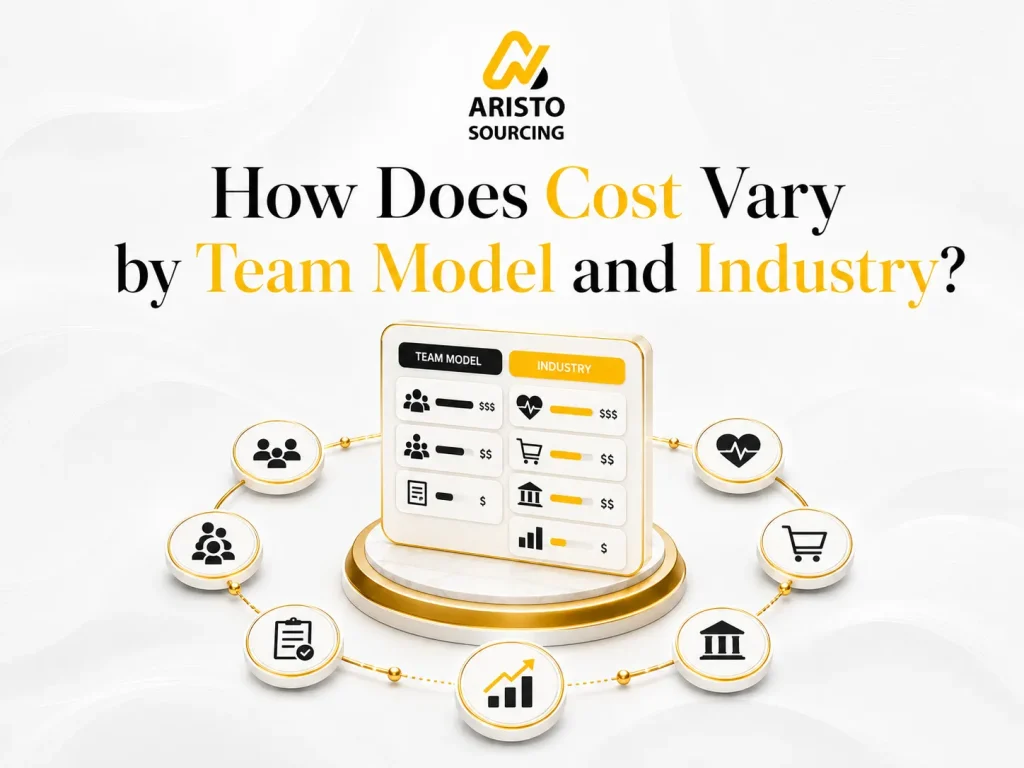
How Does Cost Vary by Team Model and Industry?
Beyond region, two other factors shift the final rate: whether agents are shared or dedicated to your brand, and how complex or regulated the support itself is.
| Team Model | Cost Impact | Customization | Best Fit |
| Shared Agents | Lower cost | Limited, split across multiple client accounts | SMBs, low or uneven ticket volume |
| Dedicated Agents | Higher cost | Deep, exclusive to one brand | Brand-critical operations, high sustained volume |
Shared vs Dedicated Agents
Shared agents split their working hours across multiple client accounts, which lowers cost since no single business pays for a full-time seat. The trade-off is customization: shared agents juggle several brands’ scripts and products, so depth of knowledge on any one account stays limited. Dedicated agents work exclusively on one brand, learning product details and edge cases in depth, at a meaningfully higher rate than a shared seat.
Small or unevenly volumed businesses tend to fit shared staffing best, since ticket counts don’t yet justify a full-time hire. Brand-critical operations, where consistency and deep product knowledge directly affect customer trust, typically graduate to dedicated agents once volume supports the cost.
Cost by Industry and Complexity
Support complexity shifts price sharply within any region tier. Basic Tier 1 inquiries, order status, simple FAQs, price toward the low end of a region’s range, while Tier 2 and Tier 3 technical support commands a premium, often running $25-50/hr even offshore, since it requires deeper product and troubleshooting expertise.
Regulated sectors like healthcare and fintech carry an additional premium on top of complexity, since agents need compliance training for frameworks like HIPAA or PCI-DSS, and providers price that risk and training investment into the rate. Multilingual support adds a further 20-40% in many cases, with rare-language coverage commanding the steepest premium of all, since the talent pool for less common languages is far smaller than for English or Spanish.
| Support Type | Typical Rate Impact | Why |
| Tier 1 (basic inquiries, FAQs) | Low end of region range | Simple, scriptable interactions |
| Tier 2/3 (technical support) | $25-50/hr even offshore | Requires deeper product and troubleshooting expertise |
| Regulated industries (healthcare, fintech) | Additional premium on top of complexity | Compliance training for HIPAA, PCI-DSS, and similar frameworks |
| Multilingual support | +20-40% | Smaller talent pool, added training |
| Rare-language coverage | Steepest premium of all | Very limited agent availability |
What Factors Affect Customer Service Outsourcing Cost?
Cost is shaped by how complex the support is, how many interactions come in, and how many hours a day need covering. Language and skill requirements, the region a provider operates from, the tools and SLAs built into the contract, and the depth of training and QA all move the price further, sometimes independently of region alone.
- Support type/complexity – Basic Tier 1 work costs far less than technical Tier 2/3 troubleshooting.
- Interaction volume – Higher volume can lower per-unit cost but raises total spend.
- 24/7 coverage – Round-the-clock staffing adds a premium over standard business hours.
- Languages/skills – Multilingual or specialized agents cost more to source and retain.
- Region/labor rates – The single biggest lever, shifting cost by 3-5x between tiers.
- Tools/SLA/training/QA – Stronger guarantees and oversight raise the built-in rate.
What Hidden Fees Should You Watch For?
Setup and onboarding costs vary by provider and project complexity and may range from a few hundred to several thousand dollars. Additional charges for quality assurance, account management, software, and transition services may also apply and should be reviewed before signing a contract.
- Setup/onboarding fees – One-time charges for training and account configuration.
- Software/tech surcharges – Per-seat licensing for helpdesk or CRM tools.
- Overtime/holiday premiums – Extra pay rates for off-hours coverage.
- Minimum commitments – Fixed monthly spend regardless of actual volume.
In-House vs Outsourced Customer Service: Cost Comparison
The cost difference between in-house and outsourced customer service comes down to what each number actually includes. According to the U.S. Bureau of Labor Statistics, the median hourly wage for a customer service representative was $20.59 in May 2024. An employer’s total cost is typically higher than wages alone because it also includes benefits, payroll taxes, insurance, equipment, workspace, and administrative overhead. Outsourced pricing, by contrast, usually bundles most of those costs into the quoted rate.
| Model | Estimated Monthly Cost (Per Agent) | What’s Included |
| In-house (US, fully loaded) | ~$4,450-$4,990 | Wage + benefits, taxes, and overhead (1.25-1.4x BLS median wage) |
| Outsourced, onshore | ~$4,840-$11,250 | Wage, overhead, and provider margin are bundled into the rate |
| Outsourced, offshore | ~$1,380-$2,770 | Wage, overhead, and provider margin bundled into rate |
The in-house figure is calculated directly from BLS wage data; the outsourced ranges come from industry vendor surveys, not one audited source, so treat them as directional rather than fixed.
How Do You Estimate and Reduce Customer Service Outsourcing Costs?
Getting a real number takes two steps: estimating what you’d actually spend, then finding where that spend can shrink without touching quality.
How Do You Calculate Your Cost?
You calculate customer service outsourcing cost by dividing monthly ticket volume by tickets handled per agent, then multiplying the result by the regional hourly rate and monthly hours. A worked example: 3,000 monthly tickets at 300 per agent need 10 agents; at $12/hr offshore across 173 hours, that’s $2,076 per agent, or $20,760 total. Add coverage hours, channel count, and hidden fees on top for the fuller picture.
How Can You Reduce Outsourcing Costs?
You reduce customer service outsourcing costs by right-shoring, blending offshore and nearshore agents instead of defaulting to one region, and choosing shared agents over dedicated where volume allows. Automating routine tickets through AI deflection cuts human-hour spend on repetitive queries. Tightening SLAs to match actual need, rather than paying for round-the-clock coverage nobody uses overnight, trims cost further. Aristo Sourcing’s cost-efficient support model is built around exactly this kind of right-sized staffing.
Is Outsourcing Cheaper Than In-House?
Outsourcing customer service is usually cheaper than maintaining an in-house team because providers spread recruitment, training, technology, and infrastructure costs across multiple clients. Organizations that adopt outsourced or shared service models often report meaningful cost savings. Deloitte’s 2025 Global Shared Services Survey found that approximately 55% of organizations with a global business services leader achieved more than 20% average annual cost savings. In-house support may still be preferable for organizations with strict compliance requirements or highly specialized customer interactions.