
Healthcare Business Process Outsourcing (BPO) refers to the practice of outsourcing healthcare-related administrative, financial, and operational processes to specialized third-party service providers. Healthcare organizations commonly outsource medical billing and coding, claims processing, revenue cycle management, patient support services, healthcare IT support, and medical data management to improve efficiency and reduce operational burdens.
The importance of healthcare BPO continues to grow as providers face increasing cost pressures, regulatory requirements, and staffing challenges. According to Grand View Research, the global healthcare BPO market was valued at USD 395.3 billion in 2024 and is expected to reach USD 626.6 billion by 2030. Healthcare organizations increasingly use outsourcing to improve operational performance, strengthen compliance, and allow clinical teams to focus more on patient care.
What Is Healthcare Business Process Outsourcing?
Healthcare Business Process Outsourcing (BPO) is the practice of outsourcing non-clinical, administrative, and financial healthcare functions to specialized third-party service providers. These functions commonly include medical billing and coding, claims processing, revenue cycle management, appointment scheduling, healthcare IT support, patient administration, and compliance-related operations. Clinical activities and direct patient care remain under the control of healthcare providers and are typically not outsourced.
Healthcare BPO is widely used by hospitals, clinics, physician groups, specialty practices, and health insurance companies to improve operational efficiency and reduce administrative burdens. Unlike in-house operations, outsourced services are managed by external experts with dedicated healthcare process capabilities.
Which Healthcare Services Should You Outsource?
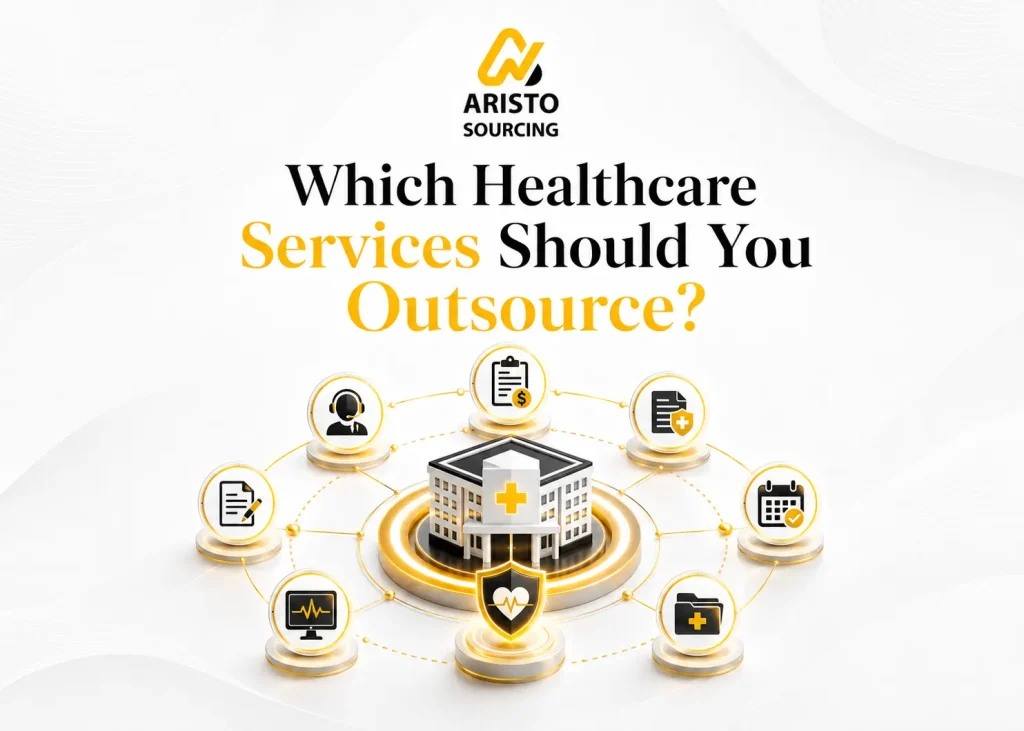
Healthcare organizations commonly outsource non-clinical functions to reduce administrative burdens, improve operational efficiency, and strengthen revenue performance. The following services represent the most frequently outsourced healthcare processes across hospitals, clinics, specialty practices, and health insurance organizations.
1. Revenue Cycle Management (RCM)
Revenue Cycle Management (RCM) outsourcing involves transferring healthcare revenue processes to specialized service providers. RCM covers the entire financial journey of a patient encounter, including eligibility verification, charge capture, claims generation, payment posting, collections, and denial management. Healthcare organizations use outsourced RCM services to improve reimbursement rates and reduce revenue leakage.
Specialized RCM providers often use dedicated billing teams, analytics tools, and workflow automation to improve claim accuracy and accelerate payment cycles. Effective revenue cycle management directly influences financial performance, which is why many healthcare organizations also outsource medical billing functions to support reimbursement operations more efficiently.
2. Medical Billing
Medical billing outsourcing focuses on managing claim preparation, claim submission, payment posting, and insurance follow-up activities. External billing specialists handle superbill generation, payer communication, reimbursement tracking, and patient billing processes to improve payment collection and reduce administrative workload for healthcare providers.
Outsourced billing teams also monitor payer requirements and regulatory changes that affect reimbursement outcomes. Their expertise helps reduce claim errors, improve collection rates, and streamline payment workflows. Since billing accuracy depends heavily on standardized medical coding, healthcare providers often outsource coding services alongside medical billing operations.
3. Medical Coding
Medical coding outsourcing involves translating medical diagnoses, procedures, and treatments into standardized codes required for billing and reimbursement. Coding professionals use systems such as CPT (Current Procedural Terminology), ICD (International Classification of Diseases), DRG (Diagnosis-Related Groups), and HCPCS (Healthcare Common Procedure Coding System).
Accurate coding supports compliance, reimbursement accuracy, and claim acceptance rates while reducing the risk of audits and denied claims. Because coding directly affects claim processing outcomes, many healthcare organizations also outsource claims processing and denial management to improve end-to-end revenue cycle performance.
4. Claims Processing and Denial Management
Claims processing and denial management outsourcing covers the complete insurance claim lifecycle. This includes claim intake, claim scrubbing, validation checks, submission to payers, denial identification, appeals management, and reimbursement follow-up. Healthcare organizations use these services to reduce payment delays and improve claim acceptance rates.
Specialized outsourcing providers often use automation and analytics tools to identify denial trends and prevent recurring reimbursement issues. Strong claims management improves cash flow and administrative efficiency. Beyond revenue-related operations, healthcare organizations frequently outsource patient-facing support services to improve accessibility and patient experience.
5. Patient Services, Scheduling, and Telehealth Support
Patient services outsourcing involves managing appointment scheduling, patient inquiries, registration assistance, reminder services, and telehealth support operations. External teams help healthcare providers maintain consistent patient communication while reducing front-desk workload and improving service availability.
Outsourced patient support can also improve scheduling efficiency, reduce no-show rates, and enhance the overall patient experience. As healthcare organizations continue expanding operational support functions, provider credentialing often becomes another important process that is outsourced to improve compliance and workforce management.
6. Provider Credentialing
Provider credentialing is the process of verifying the qualifications, licenses, certifications, education, training, and professional backgrounds of healthcare professionals. Many healthcare organizations outsource credentialing to specialized providers to ensure compliance with payer requirements, regulatory standards, and accreditation guidelines.
Outsourced credentialing teams manage documentation reviews, license verification, payer enrollment, re-credentialing activities, and ongoing compliance monitoring. This helps healthcare providers reduce administrative delays and accelerate practitioner onboarding. Since credentialing relies heavily on accurate documentation, many organizations also outsource medical transcription services to improve record management efficiency.
7. Medical Transcription
Medical transcription outsourcing involves converting voice-recorded clinical notes into structured digital text records. Physicians, specialists, and healthcare providers generate large volumes of documentation that must be accurately transcribed into patient records, consultation reports, discharge summaries, and treatment documentation.
Specialized transcription providers use trained medical transcriptionists and speech-recognition technologies to improve documentation accuracy and turnaround times. Proper documentation supports compliance, billing accuracy, and clinical record management. Because healthcare organizations handle large volumes of information daily, data entry and data capture services are often outsourced alongside transcription operations.
8. Data Entry and Data Capture
Data entry and data capture outsourcing focuses on collecting, processing, and maintaining healthcare information across multiple systems. Common tasks include entering patient demographics, updating electronic health records, processing forms, digitizing documents, and managing administrative databases.
Many providers also use OCR-assisted data capture technologies to improve speed and reduce manual entry errors. Accurate data management improves reporting, compliance, patient administration, and operational efficiency throughout healthcare organizations. As healthcare systems become increasingly digital, organizations often outsource IT and back-office support functions to maintain technology infrastructure and operational continuity.
9. IT and Back-Office Support
Healthcare IT and back-office outsourcing covers technology management, administrative support, and operational infrastructure services. Common functions include EHR system support, network management, cybersecurity monitoring, helpdesk services, cloud administration, accounts payable processing, and workflow automation support.
External providers help healthcare organizations maintain system reliability, strengthen data security, and reduce internal technology management burdens. These services also improve scalability and operational efficiency while supporting compliance requirements. Alongside technology support, many healthcare organizations outsource finance, accounting, and HR functions to streamline administrative operations further.
10. Finance, Accounting, and HR Support
Healthcare finance, accounting, and HR outsourcing involves transferring administrative business functions to specialized service providers. Common services include accounts payable, accounts receivable, bookkeeping, payroll processing, benefits administration, recruitment support, employee record management, and HR compliance activities.
Outsourcing these functions helps healthcare organizations reduce administrative costs, improve operational accuracy, and free internal teams to focus on patient care and strategic priorities. Specialized providers also bring expertise in healthcare regulations, workforce management, and financial reporting, making finance and HR outsourcing an important component of modern healthcare business operations.
What Are the Benefits of Healthcare BPO?
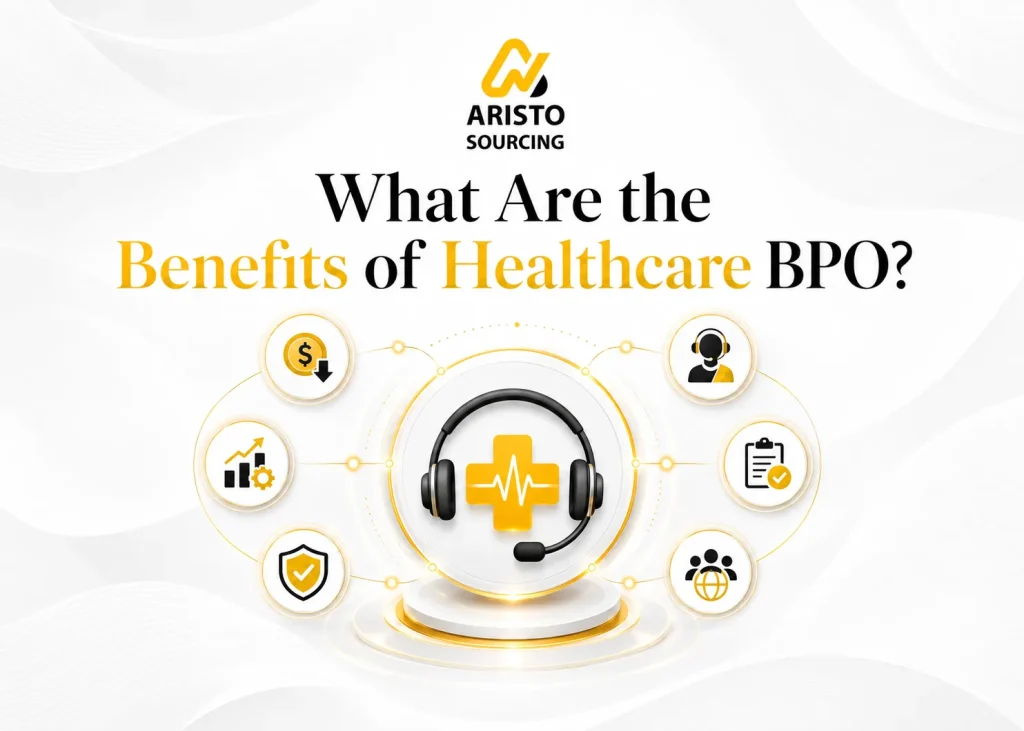
Healthcare organizations adopt BPO to reduce administrative burdens, improve financial performance, strengthen compliance, and increase operational efficiency. The following benefits explain why outsourcing has become a strategic solution for hospitals, clinics, physician groups, and healthcare payers.
1. Cost Savings
Cost savings are one of the primary reasons healthcare organizations outsource administrative functions. Healthcare BPO reduces expenses associated with recruiting, training, managing, and retaining internal staff. Organizations also avoid significant investments in office space, software platforms, hardware infrastructure, and operational support systems required to manage these functions internally.
Specialized outsourcing providers spread operational costs across multiple clients, creating economies of scale that individual healthcare organizations often cannot achieve independently. While reducing expenses is important, healthcare providers also need operational flexibility, making scalability another major advantage of healthcare BPO.
2. Scalable Operations
Scalable operations allow healthcare organizations to adjust administrative capacity based on patient demand, seasonal fluctuations, and organizational growth. Outsourcing providers can quickly increase or decrease staffing levels and operational resources without requiring healthcare organizations to hire or reduce internal personnel.
This flexibility helps providers maintain service quality during periods of rapid growth, open enrollment seasons, and unexpected demand surges. Scalability also supports long-term operational planning without creating excessive overhead costs. As healthcare operations expand, maintaining regulatory compliance becomes increasingly important for protecting patient information and organizational integrity.
3. Assured HIPAA Compliance
Assured HIPAA compliance is a key benefit of working with specialized healthcare outsourcing providers. Reputable vendors maintain dedicated compliance programs, security controls, audit trails, and workforce training processes designed to support HIPAA and HITECH requirements across healthcare operations.
These providers also implement structured access controls, data monitoring systems, and compliance reporting frameworks that help reduce regulatory risk. Strong compliance management protects sensitive patient information while improving operational confidence. Beyond regulatory protection, healthcare organizations also benefit from outsourcing partners that help reduce costly billing and documentation errors.
4. Reduced Billing Errors
Reduced billing errors occur because specialized healthcare outsourcing providers employ trained billing professionals who understand payer requirements, coding standards, and reimbursement regulations. Their expertise helps minimize claim inaccuracies, missing information, duplicate submissions, and documentation issues that commonly lead to payment delays.
Fewer billing mistakes reduce claim rejections, administrative rework, and revenue leakage throughout the reimbursement process. Improved accuracy also strengthens relationships with payers and supports operational efficiency. Since billing performance directly affects financial outcomes, many healthcare organizations outsource to improve revenue collection and reimbursement management.
5. Improved Revenue Collection
Improved revenue collection is achieved through specialized expertise in claims management, accounts receivable follow-up, denial resolution, and reimbursement optimization. Healthcare BPO providers use dedicated teams to track outstanding claims, manage appeals, and accelerate payment recovery from insurance companies and patients.
This proactive approach helps reduce days in accounts receivable and improves overall cash flow performance. Faster reimbursements strengthen financial stability and support organizational growth initiatives. Alongside revenue improvements, outsourcing also gives healthcare providers access to specialized skills and advanced technologies that may be difficult to develop internally.
6. Access to Specialized Expertise and Technology
Access to specialized expertise and technology allows healthcare organizations to benefit from experienced professionals, industry best practices, and modern operational platforms without making large internal investments. Outsourcing providers often maintain teams skilled in billing, coding, compliance, analytics, automation, and healthcare administration.
Many vendors also invest in advanced technologies such as workflow automation, AI-driven analytics, and secure cloud-based systems that improve operational performance. These resources help healthcare organizations remain competitive while controlling costs. As administrative responsibilities shift externally, clinical teams gain more time to focus on delivering quality patient care.
7. Increased Focus on Patient Care
Increased focus on patient care is often the most valuable long-term benefit of healthcare BPO. By outsourcing administrative, financial, and operational tasks, healthcare providers reduce the workload placed on physicians, nurses, and internal support teams.
With fewer administrative distractions, clinical staff can dedicate more time to patient treatment, care coordination, and healthcare outcomes. This improved focus enhances patient satisfaction, strengthens operational efficiency, and supports higher-quality healthcare delivery while allowing organizations to balance both clinical and business priorities more effectively.
What Are the Risks of Healthcare BPO?
Healthcare BPO offers significant operational benefits, but it also introduces challenges related to oversight, costs, and data protection. Healthcare organizations should evaluate these risks carefully before outsourcing critical administrative and financial processes.
1. Loss of Management Control
Loss of management control can occur because outsourced teams operate outside the healthcare organization’s direct supervision. Day-to-day workflow visibility, staff oversight, and process adjustments may become more difficult compared to managing internal teams.
Reduced control does not necessarily mean reduced performance, but it requires strong governance, reporting structures, and service-level agreements. Alongside oversight concerns, healthcare organizations should also evaluate the full financial impact of outsourcing arrangements.
2. Hidden Costs
Hidden costs can reduce the expected financial benefits of healthcare BPO if contracts are not carefully reviewed. Common examples include onboarding fees, technology integration costs, revenue-sharing arrangements, contract modification charges, termination penalties, and scope creep expenses.
Organizations should request transparent pricing structures and clearly defined service agreements before signing outsourcing contracts. Beyond financial considerations, healthcare providers must also address data security and regulatory compliance risks when sharing sensitive patient information.
3. Data Security and Compliance Risks
Data security and compliance risks arise because outsourcing providers often access protected health information (PHI), financial records, and patient data. A cybersecurity breach, unauthorized access incident, or compliance failure at the vendor level can create significant legal and reputational consequences.
Healthcare organizations can reduce these risks by selecting vendors with strong HIPAA compliance programs, encryption standards, access controls, audit trails, and cybersecurity certifications. When appropriate safeguards are in place, medical BPO can remain a secure and compliant operational strategy.
How Much Does Healthcare BPO Cost?
Healthcare BPO costs vary based on the service being outsourced, transaction volume, provider expertise, and contract structure. Organizations may pay per claim, per transaction, per employee, or through fixed monthly agreements. Understanding the pricing model is important because healthcare providers must balance operational savings with long-term return on investment. The two most common cost considerations are how BPO pricing compares with in-house operations and how quickly outsourcing delivers measurable financial returns.
Pay-Per-Use vs. Fixed In-House Overhead
Pay-per-use healthcare BPO pricing allows organizations to pay only for the services they consume. Costs typically increase or decrease based on claim volume, patient interactions, or transaction counts. This model eliminates many fixed expenses associated with recruiting, training, salaries, benefits, office space, software licenses, and administrative management.
In contrast, in-house operations require organizations to maintain staffing and infrastructure costs regardless of workload fluctuations. Pay-per-use pricing often provides greater flexibility because healthcare providers avoid paying for idle labor during slower periods while still maintaining the ability to scale services during peak demand.
Per-Claim Savings and ROI Payback Timeline
Per-claim savings are a common reason healthcare organizations outsource billing and revenue cycle functions. Industry studies show that outsourcing can reduce billing administration costs by 20% to 40% compared with inefficient in-house processes, depending on claim volume and operational complexity. Medical billing vendors commonly charge between 4% and 10% of collected revenue, creating a variable-cost structure tied to performance.
According to benchmarks cited by the Healthcare Financial Management Association (HFMA) and industry revenue cycle consultants, healthcare organizations often achieve measurable ROI within approximately 6 to 18 months through reduced denials, faster reimbursements, lower staffing costs, and improved collection rates.
How Is AI and Automation Changing Healthcare BPO?
AI and automation are changing healthcare BPO by improving operational efficiency, reducing manual work, and increasing accuracy across administrative processes. Robotic Process Automation (RPA) is commonly used for claims intake, claim scrubbing, payment posting, and claim resubmission, helping providers process transactions faster and with fewer errors. AI-powered tools also support patient scheduling, billing assistance, and customer service interactions through intelligent virtual assistants.
Healthcare BPO providers increasingly use predictive analytics to identify denial risks, improve provider performance, and optimize revenue cycle outcomes. Additionally, OCR and NLP technologies accelerate data capture, document processing, and medical record management while improving data accuracy and compliance.
How Big Is the Healthcare BPO Market?
The healthcare BPO market is a rapidly growing global industry driven by rising healthcare costs, regulatory complexity, workforce shortages, and increasing demand for operational efficiency. According to Grand View Research, the global healthcare BPO market was valued at USD 395.3 billion in 2024 and is projected to reach USD 626.6 billion by 2030, expanding at a compound annual growth rate (CAGR) of 8.0% from 2025 to 2030.
The United States remains the largest regional market due to its complex reimbursement systems, strict regulatory requirements, and widespread adoption of outsourced revenue cycle and administrative services. Key growth drivers include increasing healthcare expenditure, provider staffing shortages, digital transformation initiatives, HIPAA compliance requirements, and growing pressure to improve operational efficiency while reducing administrative costs.
Healthcare BPO vs. BPS: Which Is Better?
Healthcare BPO is better when organizations need support for specific healthcare functions such as medical billing, coding, claims processing, patient services, and revenue cycle management. It focuses on handling healthcare-related operational tasks more efficiently.
BPS is better when organizations want broader process improvement, automation, analytics, and business transformation across multiple departments. Healthcare BPO focuses on process execution, while BPS focuses on improving how those processes operate. The better option depends on whether the goal is outsourcing healthcare tasks or transforming business operations.
Onshore vs. Offshore Healthcare BPO: Which One Is Better?
The better model between onshore and offshore healthcare BPO depends on your compliance requirements, budget, and operational priorities. Onshore outsourcing offers easier regulatory compliance, stronger cultural alignment, and real-time collaboration, but usually comes with higher costs. Offshore outsourcing provides significant cost savings and access to larger talent pools, though it requires additional attention to data security and compliance controls.
Nearshore outsourcing sits between the two, balancing cost efficiency with closer time-zone alignment. Organizations handling highly sensitive patient data often prefer onshore providers, while cost-focused operations may benefit more from offshore delivery models.