
Healthcare IT outsourcing, the delegation of technology functions to external experts, is now critical as providers must simultaneously accelerate digitization, cut costs, and meet complex regulations. Healthcare IT outsourcing allows hospitals, clinics, and healthtech startups to offload specialized technology functions to expert external vendors, reducing overhead while accelerating digital health delivery. The most commonly outsourced healthcare IT services include EHR development, cloud infrastructure, cybersecurity, AI and analytics, HL7/FHIR integration, and medical coding and revenue cycle management.
Organizations benefit from cost savings, access to specialized expertise, and built-in compliance support, particularly for HIPAA-regulated environments. Pricing varies widely by engagement model and vendor location, with hourly rates spanning from $20 to $200 depending on the region. Choosing the right IT outsourcing partner requires evaluating technical credentials, compliance certifications, and delivery quality through a structured pilot before full commitment.
What Is Healthcare IT Outsourcing?
Healthcare IT outsourcing is the practice of contracting specialized external vendors to deliver technology services, infrastructure, and software solutions that support clinical and administrative operations.
It involves the delegation of IT functions to managed service providers (MSPs) or other external technology partners who assume responsibility for delivery, maintenance, and compliance. Engagements are structured as project-based (fixed scope and deadline), time-bound (covering a defined period), or ongoing (where the vendor acts as a continuous fulfillment partner for all IT needs). This flexibility allows healthcare organizations to scale their IT outsourcing relationships without committing to the full cost structure of an in-house team, giving access to specialized functions without permanent headcount.
What IT Functions Can You Outsource in Healthcare?
IT functions you can outsource in healthcare are listed below.
- EHR Management and Custom Software Development: Vendors handle common EHR configuration, custom builds, and integration with clinical workflows to meet regional compliance requirements.
- Cloud and Infrastructure Management: External providers manage cloud migration, server operations, and storage, eliminating the need for in-house hardware and supporting scalability.
- IT Helpdesk and Support (L1–L3): Outsourced helpdesk teams deliver end-user support across all three tiers, with round-the-clock resolution for clinical and administrative staff.
- Cybersecurity and Compliance: Partners manage vulnerability monitoring, incident response, and HIPAA compliance programs, reducing breach exposure and regulatory risk.
- Third-Party Integration (Labs, Imaging, Pharmacy): Vendors build integration layers that connect EHRs with labs, imaging systems, and pharmacies using HL7/FHIR standards.
- Data Analytics, AI Deployment, and Automation: Outsourced teams deploy predictive analytics models, implement AI tools in clinical settings, and automate repetitive workflows using RPA.
What Healthcare IT Services Are Most Commonly Outsourced?
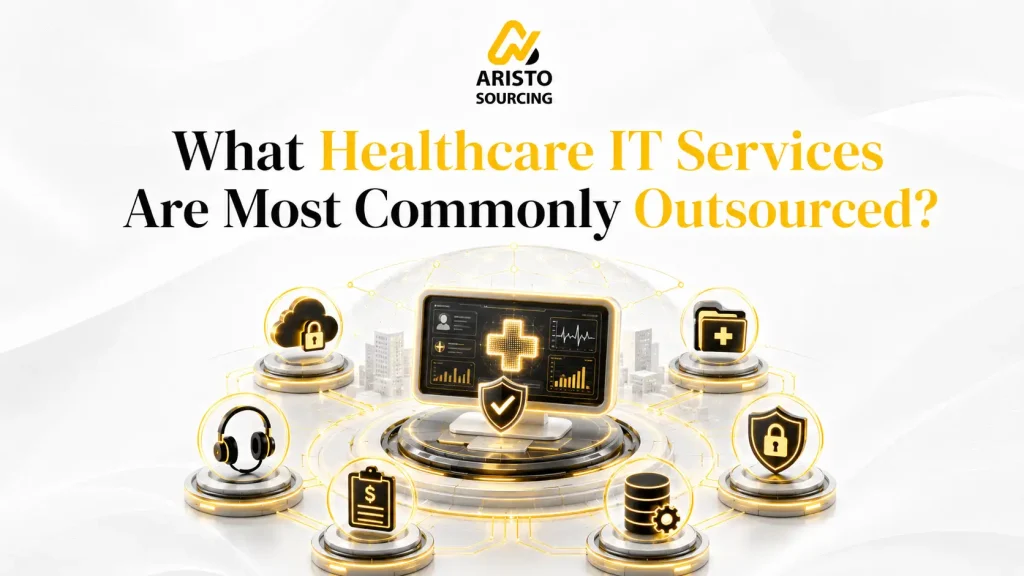
Healthcare IT services that are most commonly outsourced include EHR development and custom software, cloud and infrastructure management, cybersecurity and HIPAA compliance, AI, analytics, and RPA, HL7/FHIR integration, and medical coding, billing, and revenue cycle management.
Healthcare IT services that are most commonly outsourced are listed below.
- EHR Development and Custom Software
- Cloud and Infrastructure Management
- Cybersecurity and HIPAA Compliance
- AI, Analytics, and RPA
- HL7 / FHIR Integration
- Medical Coding, Billing, and RCM
EHR Development and Custom Software
EHR development and custom software outsourcing refer to the external, custom build of EHR/HIS platforms and specialized healthcare software tailored to clinical workflows and regulatory specifications.
Outsourced teams develop and configure EHR/EMR systems, hospital information systems (HIS), and patient portals aligned to institutional data standards and clinical workflow patterns. This scope commonly includes ePrescription modules, lab management systems, and telehealth features built to integrate with existing infrastructure. Solutions are designed to comply with regional regulatory frameworks, from HIPAA in the United States to GDPR in Europe, and are calibrated to the specific care delivery models of each organization.
Cloud and Infrastructure Management
Cloud and infrastructure management outsourcing covers the external delivery of cloud migration planning, infrastructure operations, and ongoing environment maintenance for healthcare organizations.
Vendors manage cloud migration projects across platforms such as AWS, Azure, and GCP, ensuring data integrity and operational continuity throughout the transition. Ongoing infrastructure monitoring, patch management, and DevOps/CI-CD pipeline configuration are included in most managed service engagements. Backup and disaster recovery systems are implemented and tested to meet HIPAA and HITECH standards, protecting patient data from loss, corruption, or unauthorized access.
Cybersecurity and HIPAA Compliance
Cybersecurity and HIPAA compliance outsourcing covers the external management of healthcare security programs and regulatory compliance obligations on behalf of covered entities and their business associates.
Vendors conduct risk assessments, audits, vulnerability scans, and penetration tests to identify and remediate security gaps across clinical environments. Endpoint detection and response (EDR), encryption, role-based access control (RBAC), and multi-factor authentication (MFA) are deployed as baseline technical safeguards. According to IBM’s Cost of a Data Breach Report 2024, the average cost of a healthcare data breach reached $9.77 million per incident, the highest of any industry. Making outsourced HIPAA audits and staff security training essential components of any compliance program.
AI, Analytics, and RPA
AI, analytics, and RPA outsourcing refers to the external delivery of machine learning models, clinical data analytics platforms, and robotic process automation solutions for healthcare organizations.
Outsourced AI teams build predictive models for clinical applications, including early diagnosis support, readmission risk scoring, and care pathway optimization. Natural language processing (NLP) is applied to unstructured clinical notes to surface actionable insights from physician documentation and discharge summaries. RPA bots automate high-volume administrative tasks such as claims submission, billing reconciliation, and appointment reminders, while AI-driven chatbots and triage agents streamline patient intake and reduce front-desk workload.
HL7 / FHIR Integration
HL7/FHIR integration outsourcing covers the external design and implementation of interoperability connections across labs, pharmacies, imaging centers, and health information exchanges.
Vendors develop FHIR- and HL7-compliant APIs to enable structured data exchange between EHRs and connected clinical systems. API development, testing, and version management are handled end-to-end, and middleware solutions are deployed to bridge legacy systems that lack native FHIR support. Data mapping and normalization services ensure that information arriving from disparate sources is formatted consistently before it enters the core EHR.
Medical Coding, Billing, and RCM
Medical coding, billing, and RCM outsourcing refers to the external management of revenue cycle functions, from clinical documentation coding through to payer remittance and denial resolution.
Vendors apply ICD-10 coding standards to clinical records and manage claim submissions to payers, reducing rejection and denial rates. Denial management workflows, including root cause analysis and payer-specific resubmission, are embedded within outsourced billing operations. Revenue cycle management (RCM) is further accelerated through RPA-driven claims scrubbing and automated eligibility verification, shortening collection timelines and improving the financial benefits that revenue cycle optimization delivers.
What Are the Benefits of Healthcare IT Outsourcing?
The benefits of healthcare IT outsourcing include reduced operational costs, access to specialized expertise, faster delivery timelines, continuous 24/7 coverage, built-in regulatory compliance, and the ability for clinical leadership to stay focused on patient care rather than technology management.
The benefits of healthcare IT outsourcing are listed below.
- Cost Savings: Healthcare IT outsourcing eliminates fixed pricing costs associated with full-time hires, salaries, benefits, office space, and hardware, converting them into flexible, controllable operating expenditure.
- Specialized Expertise: Outsourced teams bring pre-built domain knowledge in healthcare technology stacks, compliance frameworks, and clinical systems that would take years and substantial investment to develop in-house.
- Faster Time-to-Market: External vendors with established frameworks and reusable healthcare components compress development and deployment timelines, enabling organizations to go live with digital health tools significantly sooner.
- 24/7 Operations and Scalability: Outsourced partners, especially those operating across multiple time zones, provide continuous monitoring and support, with capacity that can scale up or down based on patient volume or project demand.
- Compliance Built-In: Reputable healthcare IT vendors maintain active HIPAA, HITRUST, and SOC 2 compliance programs, reducing the regulatory burden on internal staff and mitigating data breach exposure.
- Focus on Patient Care: Delegating technology functions to qualified external experts allows clinical leadership to redirect internal resources toward patient outcomes, care quality improvement, and operational efficiency.
How Much Can Outsourcing Actually Reduce Healthcare IT Costs?
Outsourcing can reduce healthcare IT costs by 30% to 60% compared to maintaining equivalent in-house capabilities in the United States or Western Europe, depending on the offshore destination, engagement model, and project scope.
Offshore and nearshore vendors in regions such as India, Eastern Europe, and the Philippines offer significantly lower hourly rates, which directly drives down the total outsourcing cost for sustained development and managed services engagements. The shift from capital expenditure (CapEx) to operating expenditure (OpEx) eliminates upfront costs for hardware, office space, and employee benefit programs, improving capital efficiency from day one of engagement. Faster delivery through outsourced teams also reduces the cost of delay, moving digital health projects into production sooner and generating measurable ROI earlier in the product lifecycle.
How Much Does Healthcare IT Outsourcing Cost?
The healthcare IT outsourcing cost ranges between $20 per hour and $400k per project, depending on the engagement model, vendor location, project complexity, compliance requirements, and the scope of IT functions being outsourced.
The healthcare IT outsourcing cost ranges are presented in the table below.
| Model | How It Works | Best For | US/N. America | W. Europe | E. Europe | India | Philippines | LATAM |
| Fixed Price | Scope, timeline, and budget locked before kickoff | Well-defined modules with frozen requirements (e.g., patient portal, billing widget, HL7/FHIR connector) | $25K–$400K+ per project | $20K–$350K+ per project | $8K–$150K per project | $5K–$80K per project | $4K–$60K per project | $7K–$120K per project |
| Time & Materials | Pay per hour as work progresses; billed weekly or monthly | Agile projects with evolving requirements; most common in healthcare | $120–$200/hr | $90–$150/hr | $25–$90/hr | $25–$60/hr | $20–$45/hr | $35–$75/hr |
| Dedicated Team | Full-time offshore team embedded in your workflow; acts as a remote staff extension | Long-term builds, EHR modernization, ongoing support, continuous iteration | $15K–$35K+/month per specialist | $12K–$25K/month per specialist | $4K–$14K/month per specialist | $4K–$10K/month per specialist | $3K–$7K/month per specialist | $5K–$12K/month per specialist |
The true cost of IT outsourcing that appears economical at signing can escalate quickly when vendor selection is poor, compliance gaps emerge late in development, or project scope is left ambiguous at the contract stage.
How Do You Choose the Right Healthcare IT Outsourcing Partner?
To choose the right healthcare IT outsourcing partner, evaluate vendors against healthcare-specific technical capabilities, regulatory compliance readiness, verifiable domain experience, and structured contractual protections before committing to a full engagement.
To choose the right healthcare IT outsourcing partner, follow the tips listed below.
- Non-Negotiables Checklist: Confirm that the vendor has active experience with healthcare technology stacks, deep familiarity with clinical workflows, and documented compliance readiness for HIPAA and applicable data protection laws.
- Certifications: Prioritize vendors holding HITRUST CSF certification, SOC 2 Type II attestation, and ISO 27001 accreditation, as these credentials demonstrate independently verified security controls and compliance governance.
- Portfolio and Client References: Review the vendor’s published healthcare work on platforms such as Clutch and G2, and request references from clients operating in comparable regulatory environments or with similar technical requirements.
- Vendor Interview Questions: During due diligence, ask explicitly about PHI handling protocols, intellectual property ownership, the use and oversight of subcontractors, and escalation procedures in the event of a security incident.
- Pilot Project: Structure a limited-scope initial engagement before full contract commitment, allowing your organization to evaluate delivery quality, communication standards, and compliance behavior under real working conditions, and to identify some risks early before they compound.
- Contracts: Require a Business Associate Agreement (BAA) for any vendor accessing protected health information, supplemented by a clearly defined SLA covering uptime, response time, and incident resolution, and an NDA protecting proprietary clinical data and intellectual property.
What Are the Risks and Disadvantages of Healthcare IT Outsourcing?
The main risks of healthcare IT outsourcing are data privacy exposure, vendor lock-in, communication gaps across time zones, and hidden costs that emerge from poorly defined contracts and scope creep.
The risks of healthcare IT outsourcing are listed below.
- Data Privacy and HIPAA Breach Risk: Sharing protected health information with an external vendor inherently increases healthcare data security exposure, particularly when the vendor’s access controls, audit trails, or incident response protocols are inadequate.
- Vendor Lock-In and Loss of Control: Over-reliance on a single outsourcing partner can compromise your ability to switch vendors or insource functions without significant transition costs and operational disruption.
- Communication and Time-Zone Gaps: Offshore engagements can create coordination friction when clinical urgency demands rapid decisions and the development team operates across a 10–12-hour time-zone difference.
- Hidden Costs and Scope Creep: Vaguely defined project scopes generate change orders, renegotiated rates, and budget overruns that erode the cost advantages that motivated outsourcing in the first place.
How Do You Stay HIPAA-Compliant When Outsourcing?
To stay HIPAA-compliant when outsourcing, you must execute a signed Business Associate Agreement (BAA) with every vendor that accesses, stores, processes, or transmits protected health information (PHI). This is a non-negotiable legal requirement before any patient data is shared.
Require vendors to implement encryption at rest and in transit, role-based access control (RBAC), multi-factor authentication (MFA), and comprehensive audit logging as baseline technical safeguards. Use anonymized or synthetic data in development, QA, and testing environments to limit PHI exposure during non-production activities. Vet all vendors against recognized compliance certifications, HITRUST CSF, SOC 2 Type II, and ISO 27001, and evaluate their artificial intelligence tools separately, since AI systems that process or learn from clinical data introduce additional governance, de-identification, and model transparency obligations under HIPAA.
How Is AI Changing Healthcare IT Outsourcing?
AI is changing healthcare IT outsourcing by shifting the vendor’s role from task-based execution to intelligent enablement. Outsourced teams now deliver AI agents, generative copilots, and predictive engines embedded directly within EHR workflows and clinical decision-support systems.
Cloud-native delivery architectures and FHIR-integrated data pipelines have become the standard framework through which outsourced AI capabilities are deployed and maintained in production environments. For any AI in a healthcare startup context, outsourcing AI development provides immediate access to pre-built clinical models and MLOps infrastructure that would otherwise require months of internal build time and significant capital investment. Rather than making outsourcing obsolete, AI has deepened its strategic value, making 2026 an especially compelling year to establish or expand an outsourced healthcare IT partnership.
Why Are Hospitals, Clinics, and Healthtech Startups Outsourcing IT?
Hospitals, clinics, and healthtech startups outsource IT because the combination of a widening healthcare staffing shortage, accelerating technology demands, and constrained operational budgets makes building and sustaining a full in-house IT team both prohibitively expensive and impractical.
The most outsourced healthcare IT services, EHR management, cybersecurity, and AI implementation, require skills that are scarce in local labor markets, and competition for qualified healthcare technology professionals has intensified as digital health investment has grown globally. Outsourcing compresses time-to-market for new clinical tools and patient-facing platforms, which is critical for startups competing on speed and for hospitals facing regulatory deadlines or interoperability mandates.
The pricing model flexibility and scalability that outsourcing delivers also allows organizations to expand capacity during patient surges or major system migrations without committing to permanent headcount, combining the benefits of on-demand expertise with the cost predictability that healthcare finance teams require. Choosing the right IT outsourcing partner remains the single most important decision in this process, as the quality of that relationship determines whether the full range of these advantages is actually realized.