
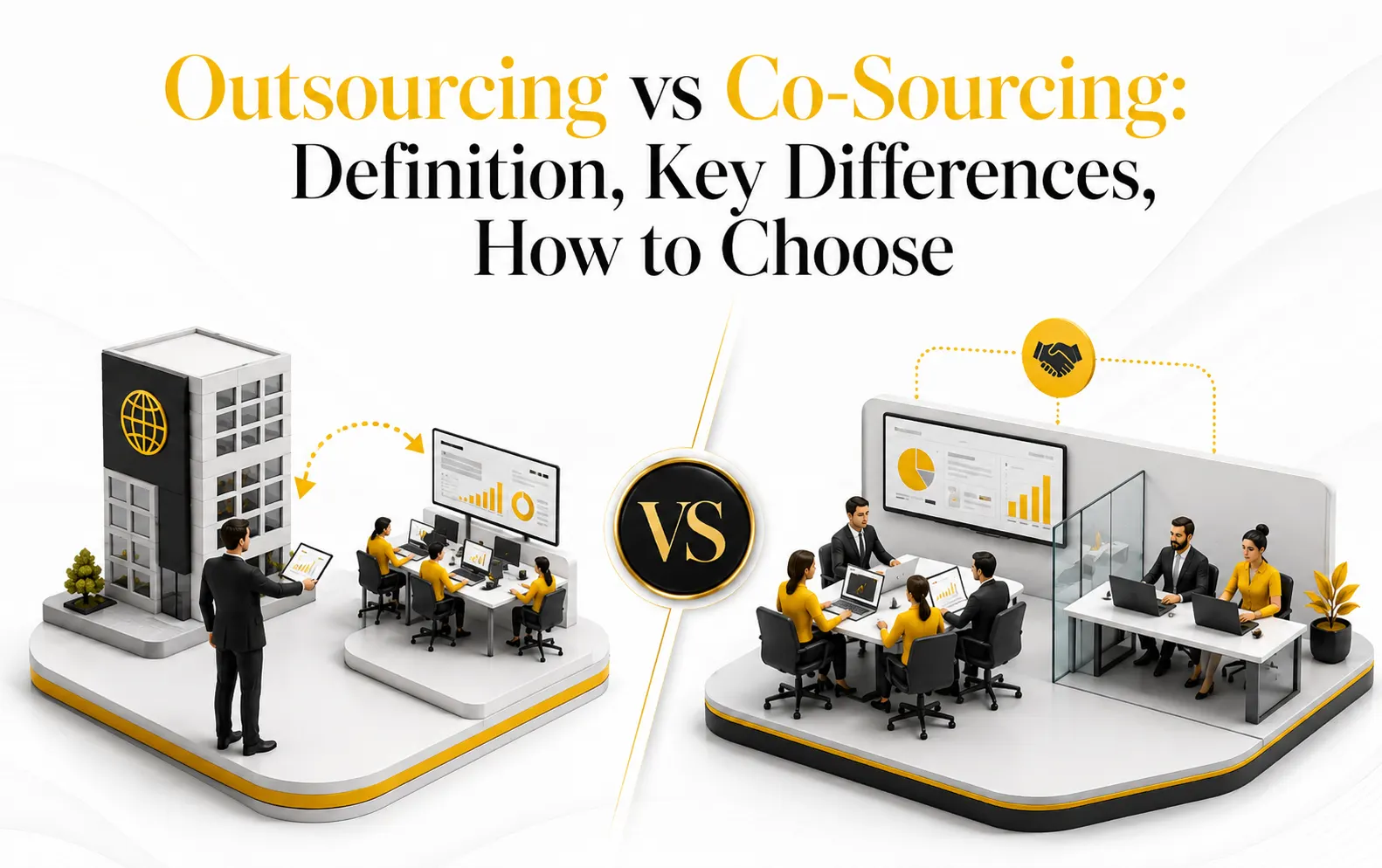
Outsourcing is a business model where a company transfers specific services, operations, or business processes to an external vendor that manages delivery independently. Co-sourcing is a collaborative model where external specialists work together with the client’s internal team under shared management responsibility.
The key differences between outsourcing and co-sourcing involve operational control, management structure, team integration, communication flow, and scalability. Outsourcing reduces internal involvement through vendor-led execution, while co-sourcing maintains stronger internal collaboration and oversight.
Businesses choose outsourcing when reducing workload, lowering operational costs, and accessing vendor expertise are the main priorities. Co-sourcing is more suitable when companies need external support while still retaining internal knowledge, visibility, and strategic control. According to research from KPMG and Statista, hybrid co-sourcing adoption continues growing as organizations seek more flexible workforce and operational models.
What is Outsourcing?
Outsourcing is a business strategy where a company delegates an entire function, service, or operational process to an external vendor that manages the work independently. The outsourcing provider handles staffing, workflows, delivery management, and final outcomes while the client mainly oversees performance through contracts and service-level agreements.
Businesses commonly use outsourcing for IT services, finance and accounting, human resources, customer support, manufacturing, and back-office operations. This model helps companies reduce operational workload, improve efficiency, and access specialized expertise without expanding internal teams.
Outsourcing typically operates through an arm’s-length relationship where the vendor controls daily execution and the client focuses on expected business outcomes. Performance is usually measured through KPIs, SLAs, and contractual delivery standards rather than direct internal supervision.
What are Common Types Of Outsourcing?
Common types of outsourcing are categorized by location, business function, and service structure. Location-based outsourcing includes onshore outsourcing within the same country, nearshore outsourcing to nearby countries with similar time zones, and offshore outsourcing to distant countries for lower operational costs and broader talent access.

Function-based outsourcing includes Business Process Outsourcing (BPO), Information Technology Outsourcing (ITO), and Knowledge Process Outsourcing (KPO). Businesses also use project-based outsourcing for specific deliverables, managed services for ongoing operational support, and staff augmentation for temporary workforce expansion. Managed services and staff augmentation are commonly compared with co-sourcing because they involve shared collaboration and operational flexibility.
What is Co-Outsourcing?
Co-outsourcing is a business model where a company and an external service provider work together to manage a specific function or process. Instead of fully handing over the work, both sides share responsibilities, resources, and decision-making throughout the engagement.

In a co-sourcing model, the client keeps partial ownership and stays actively involved in operations, while the external partner provides specialized expertise, technology, or additional workforce support. The biggest difference between co-sourcing and traditional outsourcing is collaboration. Co-sourcing focuses on partnership rather than complete delegation. Businesses commonly use co-sourcing for internal audit, compliance management, IT operations, cybersecurity, finance, and risk management functions.
What are Common Types Of Co-Outsourcing?
Common types of co-outsourcing are grouped by business function and engagement structure. Function-based co-sourcing includes internal audit co-sourcing, IT co-sourcing, finance co-sourcing, cybersecurity co-sourcing, and compliance co-sourcing. In these models, external specialists work together with internal teams to improve expertise, operational support, and process efficiency without fully replacing the company’s internal department.
Co-sourcing can also differ based on the level of collaboration and delivery structure. Advisory co-sourcing focuses on external guidance and strategic support while the client handles execution internally. Embedded co-sourcing places external professionals directly inside the client’s workflows and operations. Hybrid delivery combines internal management with shared operational responsibilities between both parties. Some co-sourcing models involve heavy client participation, while others allow the external partner to manage larger portions of the process.
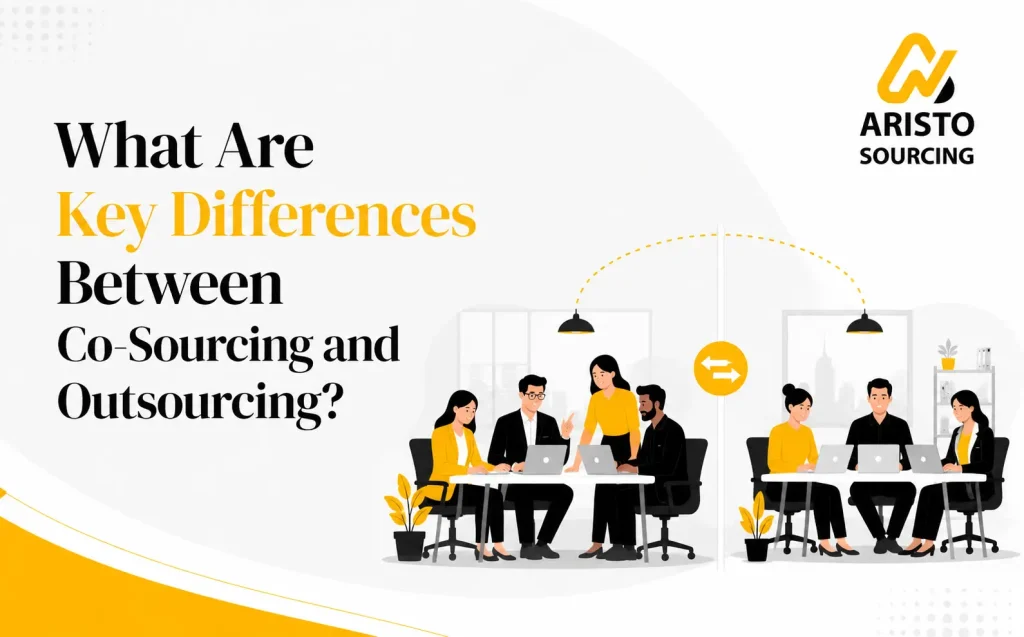
What Are Key Differences Between Co-Sourcing and Outsourcing?
The differences between co-sourcing and outsourcing involve management structure, operational control, collaboration depth, scalability, cost distribution, and long-term business strategy. While outsourcing transfers complete responsibility to an external vendor, co-sourcing creates a shared working relationship between the client and service provider.
| Area | Outsourcing | Co-Sourcing |
| Pricing Model | Fixed, T&M, outcome-based | Shared or blended costs |
| Management Cost | Vendor absorbs overhead | Client shares overhead |
| Cost Predictability | More predictable | Moderately flexible |
| Labor Cost | Lower vendor-based rates | Mixed internal + external costs |
| Infrastructure Cost | Vendor-managed | Shared responsibility |
| Setup Cost | Transition and migration costs | Integration and coordination costs |
| Short-Term Cost | Usually cheaper | Slightly higher |
| Long-Term Cost | Cost-effective at scale | Better for strategic collaboration |
| Hidden Costs | Scope creep, exit fees, governance | Coordination and supervision overhead |
| Higher Risk Area | Vendor dependency | Management complexity |
1. Management Structure
Management structure differs significantly between outsourcing and co-sourcing models. In outsourcing, the external vendor manages operations, staffing, workflows, and service delivery independently. The client mainly supervises outcomes through contracts, KPIs, and service-level agreements instead of participating in daily management activities.
Co-sourcing follows a shared management structure where both the client and external partner contribute to planning, execution, and operational oversight. Reporting responsibilities, decision-making authority, and accountability are often shared between both parties. According to EY, co-sourcing creates stronger collaboration and operational transparency compared to traditional outsourcing structures. Beyond management responsibilities, businesses also compare how deeply both models integrate with internal teams and workflows.
2. Integration Level
Integration level is much higher in co-sourcing than in traditional outsourcing models. Outsourcing vendors usually operate separately from the client’s internal departments and use their own management systems, workflows, and delivery processes. Communication mainly happens through scheduled reporting and governance channels rather than continuous daily collaboration.
Co-sourcing places external professionals directly inside the client’s operational environment, tools, and internal workflows. External specialists often collaborate closely with in-house employees across shared systems and business processes. According to KPMG, co-sourcing improves operational alignment and internal visibility because both sides work together more consistently. Along with integration depth, businesses also evaluate how both models affect knowledge sharing and long-term expertise retention.
3. Knowledge Transfer
Knowledge transfer works differently because outsourcing and co-sourcing follow separate collaboration models. In outsourcing, operational knowledge, technical expertise, and process management often remain concentrated within the vendor’s internal teams. This can create institutional knowledge dependency if the outsourcing relationship ends or changes unexpectedly.
Co-sourcing encourages continuous knowledge sharing between external specialists and internal employees throughout the engagement. External partners contribute technical expertise while internal teams share company-specific processes, systems, and operational insights. According to PwC, co-sourcing helps businesses retain more institutional knowledge internally while still benefiting from external expertise. Besides knowledge retention, companies also compare how outsourcing and co-sourcing support long-term flexibility and workforce scalability.
4. Flexibility and Scalability
Flexibility and scalability depend heavily on how operational responsibilities are structured between the client and external provider. In outsourcing, vendors usually scale resources internally without requiring deep client involvement. Businesses can increase or reduce service capacity through contract adjustments, making outsourcing more efficient for handling sudden workload fluctuations or rapid growth demands.
Co-sourcing requires closer coordination because both the client and external partner share operational responsibilities and resource planning. Scaling decisions often involve joint discussions around staffing, workflows, and internal process alignment. According to Gartner, outsourcing often responds faster to large volume changes, while co-sourcing provides more controlled and collaborative scaling. Alongside scalability, companies also compare how both models maintain service quality and operational standards.
5. Quality Control
Quality control operates differently because outsourcing and co-sourcing follow separate oversight structures. Outsourcing vendors are usually evaluated through service-level agreements, KPIs, compliance reviews, and performance audits. The client monitors results and delivery standards without directly supervising the vendor’s internal workflows or operational processes.
Co-sourcing creates more direct visibility into project execution because external specialists work closely with internal teams and systems. Quality management becomes a shared responsibility where both sides actively monitor workflows, communication, and operational performance together. According to McKinsey & Company, co-sourcing often improves real-time issue detection and collaboration during operational failures. Beyond quality oversight, businesses also evaluate how both models balance operational control with convenience.
6. The Control-Convenience Trade-Off
The control-convenience trade-off is one of the biggest differences between outsourcing and co-sourcing models. Outsourcing offers greater convenience because the vendor handles staffing, supervision, delivery management, and operational execution independently. This reduces internal workload but also limits the client’s direct involvement in daily processes and decision-making activities.
Co-sourcing provides stronger operational control because the client remains actively involved in workflows, planning, and execution alongside the external partner. However, this higher level of collaboration requires more internal time, management attention, and communication effort. According to IBM, businesses often choose co-sourcing when operational visibility matters more than management convenience. Besides control levels, companies also compare how accountability responsibilities are distributed between both models.
7. Control and Accountability
Control and accountability are distributed differently in outsourcing and co-sourcing relationships. In outsourcing, the vendor assumes primary responsibility for service delivery, operational performance, and agreed business outcomes. The client mainly remains accountable for vendor governance, contract management, and strategic oversight throughout the engagement.
Co-sourcing creates shared accountability because both the client and external partner participate directly in operational execution and decision-making. Responsibilities for performance, quality, compliance, and process improvement are often divided between both parties based on the engagement structure. According to BDO Global, co-sourcing can improve transparency but may require clearer communication frameworks to avoid accountability disputes. In addition to responsibility allocation, businesses also evaluate how outsourcing and co-sourcing differ in overall cost structures and financial management.
8. Cost Structures
Cost structures vary because outsourcing and co-sourcing distribute operational responsibilities differently. Outsourcing commonly uses fixed-price, time-and-material, or outcome-based pricing models where the vendor absorbs staffing, infrastructure, training, and operational management costs internally. This structure often gives businesses more predictable monthly or long-term operating expenses.
Co-sourcing follows a blended cost model where both the client and external partner share operational responsibilities and management involvement. The client usually continues covering part of the supervision, internal tooling, and workflow coordination costs. According to Accenture, outsourcing often delivers more predictable total cost structures, while co-sourcing provides greater operational flexibility and internal visibility. Beyond pricing models, businesses also compare the direct financial impact of both approaches.
9. Direct Cost Comparison
Direct cost comparison between outsourcing and co-sourcing depends on labor structure, operational scope, and internal resource involvement. Outsourcing may reduce labor costs because vendors operate with established delivery teams and lower-cost resource pools. Vendors also often manage infrastructure, software, and operational tooling within the service agreement itself.
Co-sourcing usually combines external service costs with internal operational expenses because the client remains partially involved in management and execution. Businesses may also invest more in collaboration systems, onboarding, and internal coordination processes. According to Forrester, outsourcing can be cheaper for large-scale long-term operations, while co-sourcing may offer better value for specialized or collaborative functions. Along with direct expenses, companies must also evaluate the hidden costs that emerge during long-term engagements.
10. Hidden Costs
Hidden costs often appear differently in outsourcing and co-sourcing relationships. Outsourcing may create additional governance expenses, contract renegotiation costs, scope expansion charges, and vendor transition fees over time. Businesses can also face operational disruption and higher exit costs when changing vendors or bringing outsourced functions back internally.
Co-sourcing hidden costs usually come from increased coordination time, dual-management responsibilities, and ongoing collaboration requirements between internal teams and external specialists. Businesses may also invest heavily in communication processes, knowledge transfer, and operational alignment activities. According to Protiviti, outsourcing often carries higher long-term vendor dependency risks, while co-sourcing may increase internal management overhead and coordination complexity.
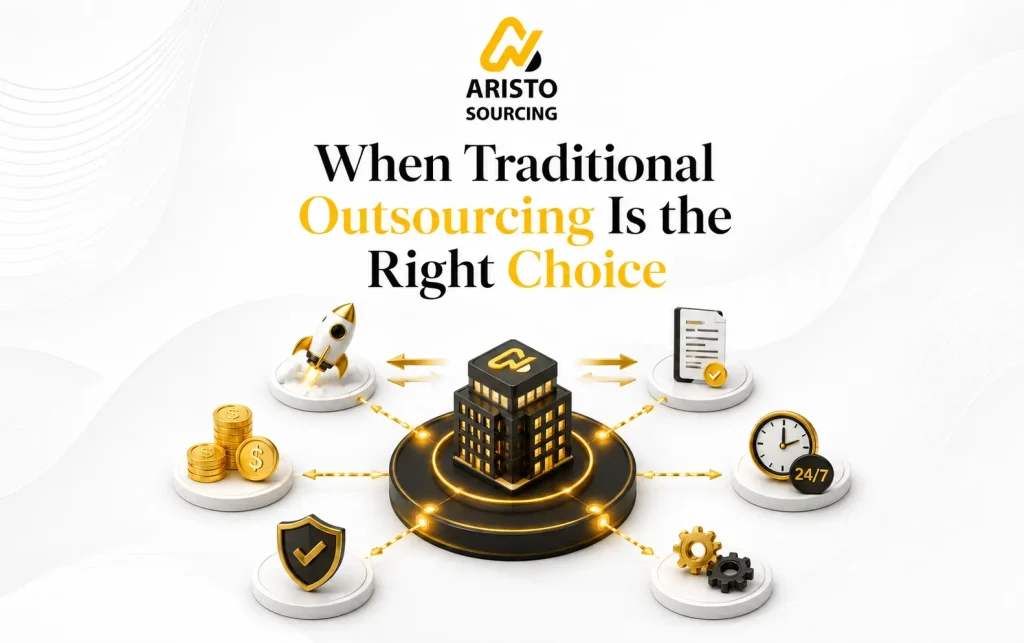
When Traditional Outsourcing Is the Right Choice
Traditional outsourcing works best when businesses want to reduce operational workload, access specialized expertise, improve scalability, and accelerate delivery without building or managing large internal teams and infrastructure independently.
1. Commodity Functions
Commodity functions are one of the most common reasons businesses choose traditional outsourcing. Tasks such as payroll processing, customer support, data entry, help desk services, and routine back-office operations usually follow standardized workflows and offer limited strategic value to the business. Since these functions are fully delegable, companies often prefer external vendors that already have trained teams, established systems, and operational processes in place.
Outsourcing commodity functions helps businesses reduce operational burden while allowing internal teams to focus more on revenue generation, innovation, and strategic planning. This model also improves efficiency because vendors can often deliver repetitive services at lower operational costs and greater scale. Besides routine operations, outsourcing also becomes highly effective when businesses face unpredictable or fluctuating workload demands.
2. Variable Workload
Variable workload situations often make traditional outsourcing the more practical option. Businesses that experience seasonal demand spikes, rapid growth periods, or temporary operational surges may not want to hire permanent employees for short-term capacity needs. Outsourcing gives organizations immediate access to scalable delivery teams without long-term staffing commitments or recruitment delays.
External vendors can quickly increase or reduce service capacity depending on changing business requirements. This flexibility helps companies control labor costs while maintaining operational continuity during busy periods. Outsourcing also reduces the administrative pressure associated with onboarding, training, and workforce management. Along with fluctuating workloads, many businesses outsource when they require highly specialized expertise for limited-duration projects.
3. Specialized Expertise You Need Temporarily
Specialized expertise you need temporarily is another strong reason to choose outsourcing. Some projects require advanced technical skills, industry certifications, or niche operational experience that the business does not need permanently. Instead of building a full internal department, companies often outsource these projects to vendors with existing expertise and proven delivery capabilities.
Traditional outsourcing works well for cybersecurity projects, cloud migration, compliance audits, software implementation, engineering support, and other specialized initiatives. Vendors already maintain trained professionals, operational frameworks, and supporting infrastructure, allowing businesses to access expertise faster and with lower setup costs. In some cases, however, businesses outsource not only because expertise is temporary, but because internal capability is completely unavailable.
4. Functions Where You Lack Internal Expertise
Functions where you lack internal expertise are often difficult to manage internally or through co-sourcing arrangements. Businesses may not have the technical leadership, operational knowledge, or internal resources needed to supervise specialized functions effectively. In these situations, traditional outsourcing allows the vendor to take full responsibility for delivery, staffing, compliance, and operational management.
This approach reduces the risk of internal mismanagement while giving companies access to experienced external teams that already understand the required processes and industry standards. Outsourcing also simplifies operations because the vendor manages workflows independently. Beyond expertise limitations, many organizations choose outsourcing when speed and rapid execution become the highest priority.
5. Speed-to-Value Priority
Speed-to-value priority makes outsourcing especially valuable for businesses that need rapid deployment and immediate operational support. External vendors already have delivery teams, infrastructure, operational systems, and standardized processes ready to launch quickly. This allows companies to begin projects or scale operations much faster than building internal capabilities from scratch.
Traditional outsourcing reduces setup delays related to recruitment, onboarding, infrastructure investment, and internal training. Businesses can accelerate implementation timelines while focusing internal resources on strategic growth activities. For companies operating in highly competitive or fast-moving industries, outsourcing often provides the fastest path to operational execution and measurable business results.
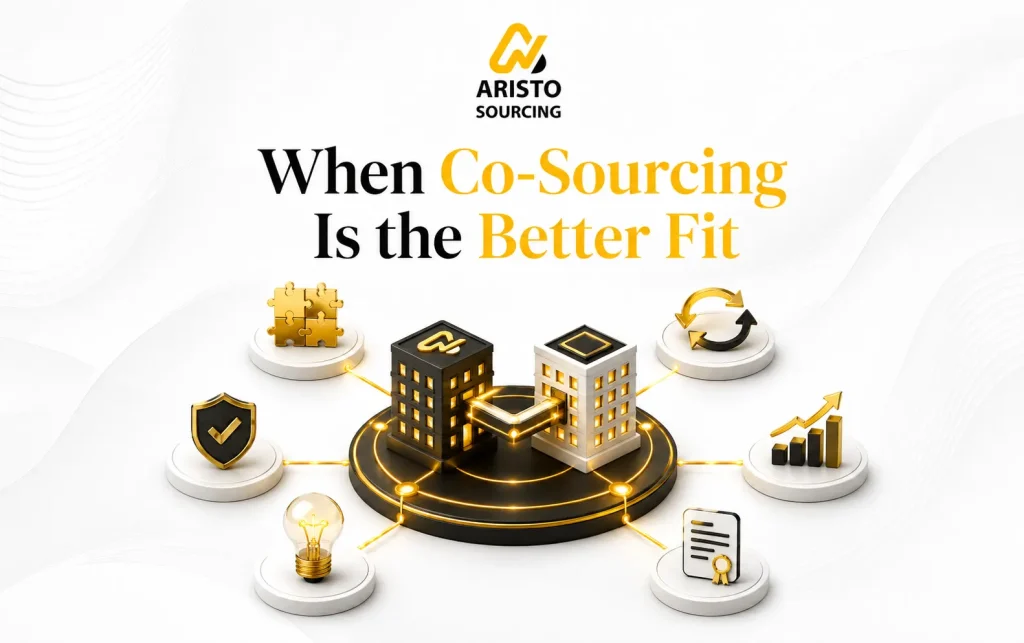
When Co-Sourcing Is the Better Fit
Co-sourcing works best when businesses need external expertise while still maintaining active involvement, operational visibility, and strategic control over important functions, processes, and long-term organizational capabilities.
1. Core Business Functions
Core business functions are often better suited for co-sourcing because they are too strategically important to fully delegate to an external vendor. Areas such as finance leadership, cybersecurity, compliance, internal audit, and strategic IT operations usually require ongoing internal oversight and close alignment with company goals.
Co-sourcing allows businesses to access external expertise while keeping internal leadership actively involved in decision-making and operational execution. This approach helps companies protect institutional knowledge and maintain stronger control over critical business activities. Beyond strategic importance, co-sourcing is also valuable when continuous collaboration between both sides is necessary for operational success.
2. Functions Requiring Real-Time Collaboration
Functions requiring real-time collaboration often benefit more from co-sourcing than traditional outsourcing models. Some business operations depend on constant communication, shared workflows, and immediate coordination between internal teams and external specialists. In these situations, a fully separated outsourcing structure may slow decision-making and operational responsiveness.
Co-sourcing creates a more integrated working relationship where external professionals collaborate directly inside the client’s processes, systems, and communication channels. This improves visibility, faster issue resolution, and day-to-day operational alignment. Besides collaboration needs, many organizations also choose co-sourcing when they want to strengthen internal capabilities over time instead of relying entirely on external vendors.
3. Long-Term Capacity Building
Long-term capacity building is another reason businesses prefer co-sourcing arrangements. Instead of fully transferring knowledge and responsibilities to an outside provider, companies use co-sourcing to develop internal expertise while receiving external operational support. This creates a more balanced relationship between internal growth and external assistance.
External specialists often train internal employees, introduce best practices, and help improve operational processes throughout the engagement. Over time, the organization strengthens its own internal capabilities while still benefiting from outside expertise. Along with internal development goals, co-sourcing also becomes highly valuable when businesses require direct oversight of service quality and operational standards.
4. Quality-Sensitive Work
Quality-sensitive work is commonly managed through co-sourcing because businesses need greater visibility into workflows, delivery processes, and operational performance. Industries such as healthcare, finance, cybersecurity, and compliance often require strict quality standards, continuous oversight, and immediate issue resolution throughout project execution.
Co-sourcing allows the client to remain actively involved in monitoring performance, reviewing outputs, and maintaining operational consistency alongside the external partner. Shared ownership over quality management also improves accountability and communication during complex or high-risk operations. In addition to quality concerns, many businesses prefer co-sourcing because it aligns more naturally with collaborative organizational cultures and internal work environments.
5. Cultural Alignment Requirements
Cultural alignment requirements make co-sourcing a strong option for businesses that prioritize teamwork, transparency, and collaborative decision-making. In co-sourcing models, external specialists work closely with internal employees and often become integrated into the company’s communication style, workflows, and organizational culture.
This embedded partnership structure helps create stronger trust, smoother collaboration, and better operational alignment between both sides. Businesses that value long-term partnerships and shared responsibility often find co-sourcing easier to integrate into their existing work culture than fully independent outsourcing relationships.
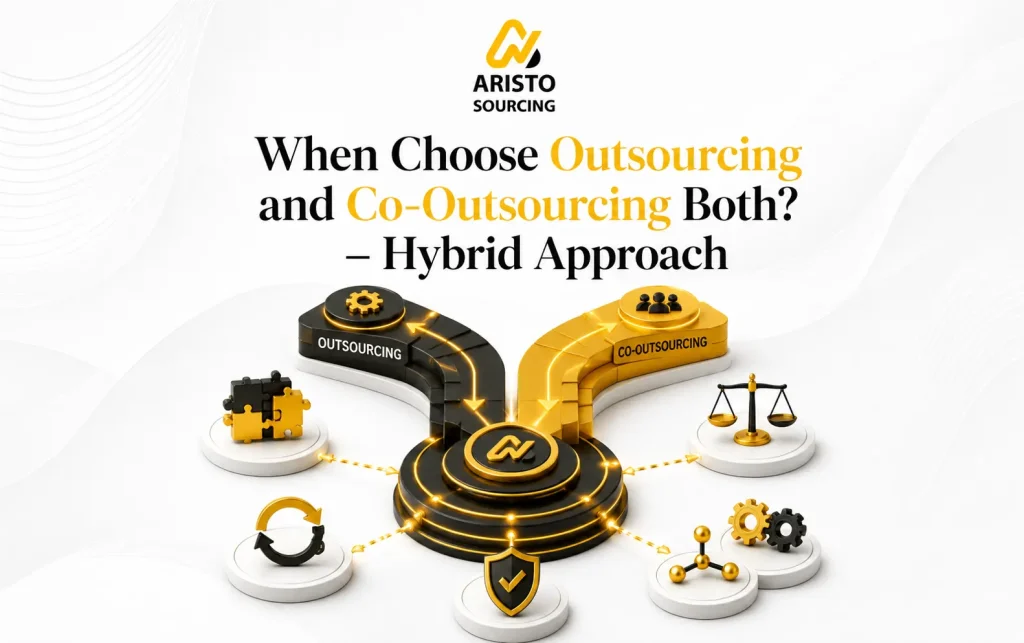
When Choose Outsourcing and Co-Outsourcing Both? – Hybrid Approach
A hybrid approach combines outsourcing and co-sourcing to balance operational efficiency, strategic control, scalability, and internal collaboration. Businesses often use this model when some functions can be fully delegated while others require ongoing internal involvement and shared decision-making.
1. Designing a Hybrid Model
Designing a hybrid model starts with identifying which business functions should be fully outsourced and which require co-sourcing support. Commodity or process-driven operations such as payroll, customer support, and routine IT services are often outsourced to reduce workload and operational costs. Strategic functions like cybersecurity, compliance, internal audit, and financial planning may remain co-sourced because they require closer collaboration and internal oversight.
This structure helps businesses maintain control over critical operations while improving efficiency in non-core areas. A well-planned hybrid model also reduces the risk of over-dependence on a single operational strategy. After defining responsibilities, companies usually create a practical structure that separates outsourced and co-sourced functions clearly.
2. Example Hybrid Structure
Example hybrid structures often combine multiple service models across different departments. A company may outsource help desk support, infrastructure maintenance, and payroll operations to external vendors while co-sourcing cybersecurity, compliance management, and internal audit functions with specialized partners. In this arrangement, the outsourced vendor handles day-to-day execution independently, while co-sourcing partners work closely with internal leadership teams.
This approach allows businesses to reduce operational pressure without losing visibility into high-priority functions. The hybrid structure also creates flexibility because companies can scale different functions independently based on operational needs. Once multiple models operate together, businesses must carefully manage coordination and governance across all service relationships.
3. Managing the Boundary
Managing the boundary between outsourcing and co-sourcing requires strong governance, communication, and operational clarity. Businesses must clearly define ownership, reporting responsibilities, escalation procedures, and performance expectations for each function. Without proper coordination, overlapping responsibilities may create workflow confusion, accountability gaps, or duplicated efforts between internal teams and external providers.
Organizations often use centralized governance frameworks, shared reporting systems, and regular operational reviews to maintain alignment across both models. Clear communication channels help ensure that outsourced and co-sourced functions support broader business goals without operational conflict. As business needs evolve, companies may also need to adjust how responsibilities are distributed between both approaches.
4. Evolving the Model
Evolving the model is important because business priorities, operational risks, and workforce needs change over time. Companies may initially outsource a function for speed and cost efficiency, then later shift it into a co-sourcing arrangement when internal involvement becomes more important. In other cases, a co-sourced function may eventually become fully outsourced after processes become standardized.
The hybrid approach gives businesses flexibility to adapt operational structures without completely redesigning service delivery models. This allows organizations to balance cost efficiency, scalability, control, and long-term capability development as strategic priorities continue changing.
What Is The Meaning Of Outsourcing Consulting?
Outsourcing consulting is an advisory service that helps businesses plan, evaluate, and manage outsourcing strategies more effectively. Outsourcing consultants guide organizations in selecting the right outsourcing model, choosing vendors, reducing operational risks, controlling costs, and improving service performance. They also help businesses design governance structures, negotiate contracts, manage transitions, and align outsourcing decisions with long-term operational and strategic goals.
What Is The Meaning Of Internal Audit Co-Sourcing?
Internal audit co-sourcing is a partnership model where a company’s internal audit team works together with an external audit or consulting firm to manage audit activities and compliance responsibilities. The external partner provides specialized expertise, additional resources, technical support, or industry knowledge while the client retains oversight and involvement in the audit process. This model helps businesses strengthen audit quality, improve risk management, and expand internal audit capabilities without fully outsourcing the function.