
The average business loses 12% of its annual resource capacity to poor coordination, fragmented communication, and tasks slipping through departmental gaps. When operations begin to stall, most founders blame effort.
The real problem is infrastructure.
Management thinker Peter Drucker summarized it clearly: “Until we can manage time, we can manage nothing else.” That insight sits at the center of why growing businesses plateau. The people responsible for strategic thinking are often the same people chasing updates, resolving delays, and manually holding projects together. A project management virtual assistant removes that operational burden permanently.
According to the 2024 Pulse of the Profession report from the Project Management Institute, organizations that undervalue project management waste an average of $97 million for every $1 billion invested. That is not a theoretical inefficiency. It is real capital disappearing through coordination failures that a skilled operator could prevent.
As a specialist virtual assistant company, Aristo Sourcing embeds experienced project management virtual assistants directly into growing businesses to transform operational chaos into scalable delivery systems.

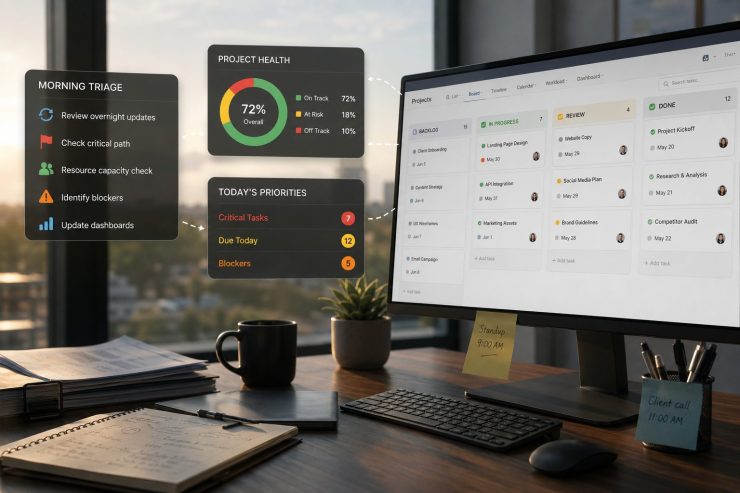
Morning Triage: Building the Daily Operational Rhythm
A project management virtual assistant begins the day inside the company’s project management platform, not inside an inbox. Whether the business runs on ClickUp, Asana, Monday.com, Jira, or a hybrid stack, the VA performs a full operational review of every active project before the core team logs in.
[PM VA] → [Overnight Triage] → [Critical Path Review]
        → [Capacity Check] → [Updated Dashboards Ready]
This daily routine typically includes:
Critical Path Analysis
The VA maps task dependencies and identifies delays before they cascade through the schedule. A small delay rarely stays small without active management.
Resource Leveling and Capacity Planning
Workloads are reviewed across active projects to identify overloaded team members before deadlines begin slipping. Task allocation is adjusted to maintain consistent throughput.
Blocker Identification
Any overnight issues, missing approvals, stalled deliverables, or communication gaps are documented and prioritized before the workday begins.
Dashboard Governance
Every active project board is updated before the first standup so teams begin the day with current information instead of outdated task statuses.
The Offshore Timing Advantage
Because Aristo Sourcing sources and vets talent across South Africa and the Philippines, much of this operational triage happens while US and UK leadership teams are offline. By the start of the business day, dashboards are updated, priorities are locked in, and blockers are already documented.
Over time, that daily head start becomes a structural operational advantage.
Communication Architecture: The System Most Businesses Never Build
Research from the Project Management Institute shows that organizations with highly effective communication practices complete 80% of projects on time and within budget, compared to 52% for teams with weak communication systems.
The difference is not talent.
It is whether communication operates as a structured system or a reactive scramble.
A project management virtual assistant owns the communication infrastructure behind every active project
┌─────────────────────────────────────────────┐
│         PM VA Communication Loop            │
└──────────────────────┬──────────────────────┘
                       │
    ┌──────────────────┼──────────────────┐
    ▼                  ▼                  ▼
[Daily Team       [Client Status     [Escalation
 Briefings]        Reports]           Protocols]
Asynchronous Team Communication
The VA sends structured daily updates before the workday begins so teams do not waste time figuring out project status.
Client Reporting
Client dashboards, weekly status reports, and post-meeting summaries are maintained consistently. Clients who receive proactive communication remain collaborative and easier to manage.
Escalation Management
When blockers appear, the VA routes them to the correct decision-maker with context, impact summaries, and recommended next steps already prepared.
Stakeholder Register Management
The VA tracks stakeholder influence levels, communication preferences, and approval authority to ensure the right information reaches the right people at the right time.
Systems Architecture, SOP Development, and Knowledge Management
Project management software is only as effective as the systems built inside it. A skilled PM VA does not simply update tasks. They build the operational infrastructure that makes delivery scalable and repeatable.
Platform-Specific Operations
| Platform | What the VA Manages | Business Outcome |
|---|---|---|
| ClickUp / Asana | Templates, dependencies, approvals, automation | Faster project launches |
| Jira | Sprint planning, backlog grooming, release tracking | Stable sprint velocity |
| Monday.com | Capacity dashboards, automation, executive reporting | Real-time project visibility |
| Trello | Pipeline visibility, WIP control, checklist workflows | Reduced bottlenecks |
SOP Development
The VA documents repeatable workflows into formal Standard Operating Procedures:
- Client onboarding
- Campaign launches
- QA review processes
- Internal escalation flows
- Delivery checklists
Documented systems reduce onboarding time, improve consistency, and eliminate repeated coordination problems.
Knowledge Management
Most businesses lose institutional knowledge constantly.
A PM VA captures and organizes:
- Decision logs
- Meeting notes
- Internal process documentation
- Client preferences
- Workflow updates
- Internal wikis
When employees leave, operational knowledge stays inside the business.
Agile, Waterfall, and Hybrid Framework Management
Different projects require different delivery methodologies. A skilled project management virtual assistant works across Agile, Waterfall, and hybrid frameworks depending on the business environment. They will also have typically certifications in PMP, CAPM, or PRINCE2.
Agile Methodology
For software, product, and marketing sprints, the VA manages:
- Sprint planning
- Daily standups
- Backlog grooming
- Burn-down tracking
- Retrospective documentation
- Velocity monitoring
Waterfall Methodology
For fixed-scope projects, the VA manages:
- Project charters
- Work breakdown structures
- Gantt chart dependencies
- Milestone approvals
- Formal change control
Typically Gantt chart, isual project management tool, would be used to illustrate a project schedule.
Hybrid Methodology
Many businesses run both structured client delivery and iterative internal development simultaneously. The VA maintains governance across both environments while ensuring alignment at the portfolio level.
For businesses operating under EOS or Traction frameworks, the PM VA often functions as the operational Integrator at the project level.
Proactive Risk Management
Projects rarely fail overnight.
They drift gradually through small delays, communication breakdowns, scope changes, and resource overload.
A project management virtual assistant continuously tracks project health indicators throughout the day:
- Budget burn rate
- Timeline performance
- Sprint velocity
- Resource utilization
- Stakeholder alignment
- Scope movement
The Live Risk Register
Identify
Potential risks are logged early, including dependency issues, vendor delays, unclear scope, or staffing gaps.
Assess
Each risk receives a probability and impact rating so leadership knows which issues require immediate action.
Mitigate
The VA prepares contingency plans before problems escalate.
Escalate
Leadership receives structured decisions with context and recommendations rather than operational chaos.
Scope Creep Prevention
When stakeholders request changes outside the agreed scope, the VA maps downstream impact immediately:
- Timeline implications
- Budget impact
- Resource requirements
- Dependency changes
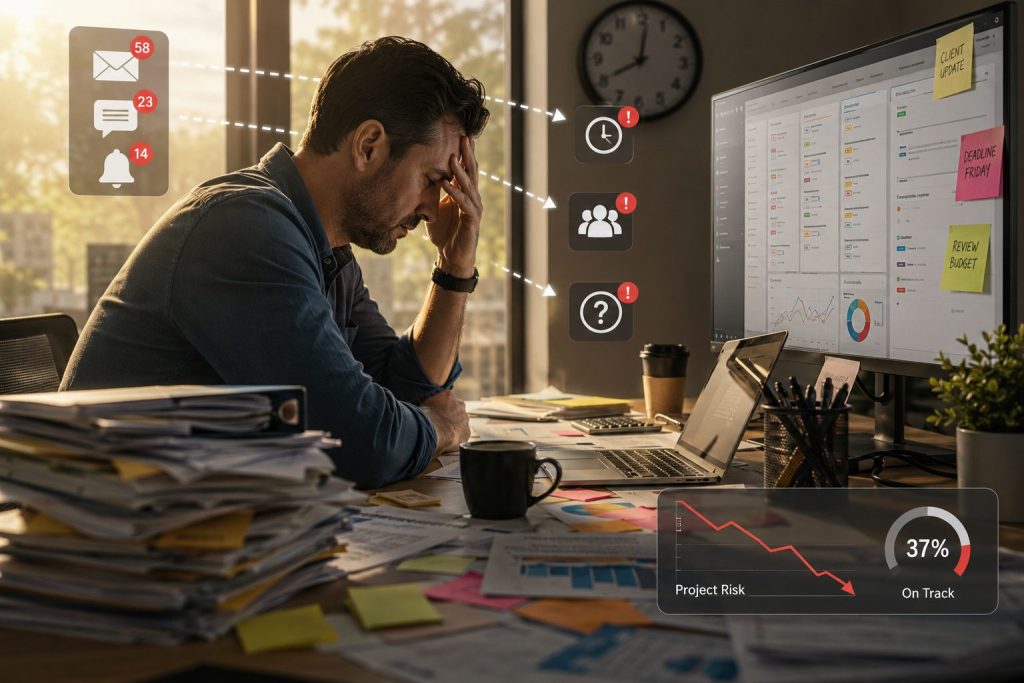
Nothing moves forward without documented evaluation.
Team Coordination and Cross-Functional Alignment
Operational misalignment usually appears quietly:
- Tasks stuck “almost done”
- Decisions buried in Slack threads
- Client expectations drifting from reality
- Teams operating with different assumptions
A PM VA prevents these issues by managing the coordination layer directly.
Daily Coordination Responsibilities
- Running standups
- Preparing agendas
- Sending meeting summaries
- Tracking action items
- Monitoring deadlines
- Following up on unresolved blockers
Capacity and Workload Management
The VA monitors team workload across concurrent projects to prevent burnout and delivery failures.
SLA Monitoring
For client-facing businesses, the VA tracks service-level agreements and flags deliverables at risk before deadlines are breached.
OKR and KPI Alignment
Project milestones are mapped against organizational goals so daily execution remains tied to strategic objectives.
The Financial Case for a Project Management VA
Hiring a full-time in-house project manager in the US often costs between $93,000 and $153,000 annually once salary, benefits, recruitment, and operational overhead are included.
A project management VA through Aristo Sourcing typically costs between $19,200 and $30,000 annually.
In-House PM: up to $153,000/yr
PM Virtual Assistant: up to $30,000/yr
78% cost reduction| Cost Category | In-House PM | PM VA |
| Salary | $65,000–$95,000 | $19,200–$30,000 |
| Benefits & Overhead | $15,000–$25,000 | None |
| Recruitment | $3,000–$8,000 | Included |
| Systems Setup | $4,000–$10,000 | Included |
| Performance Management | $5,000–$10,000 | Included |
| Total Annual Cost | $93,000–$153,000 | $19,200–$30,000 |
Many founders recover 12–15 hours of strategic focus per week once the coordination layer is delegated properly.
The value is not simply lower cost.
It is operational leverage.
What Changes When the Coordination Layer Works
- A high-performing PM VA changes how the entire organization operates.
- Sales teams onboard clients faster because delivery processes are standardized.
- Marketing teams execute more campaigns because operational overhead decreases.
- Product teams ship more consistently because sprint discipline is maintained.
Most importantly, founders recover cognitive bandwidth. Without someone managing the operational layer, coordination defaults silently to leadership. Every missed update, delayed task, or client concern eventually reaches the founder.
A dedicated PM VA removes that bottleneck.
“The bottleneck in most growing businesses isn’t strategy,” says Janus Basnov at Aristo Sourcing. “It’s the operational layer between strategy and execution. When that layer has a dedicated owner, the entire business moves differently.”
The infrastructure required for reliable project delivery either exists or it does not.
A project management virtual assistant builds that infrastructure, manages it daily, and scales it alongside the business.
Contact Aristo Sourcing to place your dedicated project management virtual assistant.
Frequently Asked Questions
What does a project management virtual assistant do differently from a general VA?
A PM VA manages the operational infrastructure behind project delivery, including risk tracking, communication systems, SOP documentation, sprint coordination, stakeholder reporting, and capacity planning. A general VA typically focuses on assigned administrative tasks.
Which project management methodologies can a PM VA support?
Most experienced PM VAs work across Agile, Waterfall, and hybrid delivery frameworks depending on the project environment.
How does a PM VA prevent scope creep?
The VA documents all requested changes, maps downstream impact, updates affected timelines, and routes formal change assessments to leadership before work begins.
How quickly can a PM VA be onboarded?
Most businesses can have a PM VA operational within two weeks, including platform setup, workflow orientation, and project handover.
Why do offshore PM VAs create a time-zone advantage?
Teams based in South Africa and the Philippines can complete project triage and reporting while US and UK leadership teams are offline, creating continuous operational momentum.
What separates a strong PM VA from someone who only updates task statuses?
A high-performing PM VA builds systems. They create governance structures, communication frameworks, SOP libraries, escalation protocols, and reporting systems that make delivery predictable and scalable.