

Many companies adopted HubSpot expecting immediate growth.
They purchased marketing automation, sales pipelines, AI tools, and analytics dashboards. They expected the platform to produce leads, nurture prospects, and move deals toward revenue automatically.
But most founders quickly discovered something frustrating.
Software does not produce revenue by itself. Systems produce revenue only when someone orchestrates them correctly.
In 2026, the role of a virtual assistant has changed dramatically. The old model focused on administrative tasks such as data entry, calendar management, and spreadsheet updates. That version of the role no longer matches the complexity of modern CRM platforms.
Today’s virtual assistant trained in HubSpot operates at a completely different level.
Instead of performing isolated tasks, this specialist orchestrates an ecosystem of AI tools, data flows, and automated revenue processes. They supervise HubSpot’s automation architecture, ensure that AI systems behave correctly, and maintain the data integrity that makes automation reliable.
This shift introduces a critical concept that modern revenue teams rely on: Human-in-the-Loop operations.
Human-in-the-Loop means a skilled operator supervises automated systems so the technology makes correct decisions in real business situations.
AI tools can move faster than humans. However, AI does not fully understand context.
For example:
- AI can draft a sales outreach sequence.
- AI can suggest lead scores.
- AI can generate marketing content.
- AI can route support tickets.
But without supervision, automation often creates problems such as:
- duplicate leads entering pipelines
- incorrect lifecycle stage assignments
- robotic messaging that damages brand credibility
- leads sitting untouched because workflows stopped
A trained operator prevents these failures.
Instead of acting as a support assistant, a HubSpot-trained VA functions as an AI operations manager. They monitor systems, maintain CRM integrity, and ensure that automation consistently pushes prospects toward revenue.
Companies that treat HubSpot like a static software tool rarely see strong ROI.
Companies that treat HubSpot as a revenue operating system build predictable growth.
The difference lies in orchestration.

Data Governance & Breeze Intelligence — The Foundation of Revenue Operations
Every advanced HubSpot implementation starts with a simple truth:
AI and automation only perform well when the CRM data is reliable.
If the system contains incomplete, duplicated, or conflicting information, automation makes poor decisions. Marketing campaigns misfire, sales teams pursue the wrong prospects, and reporting becomes meaningless.
This problem appears in most growing companies.
Typical CRM data issues include:
- duplicate contacts created by multiple forms
- incorrect lifecycle stage assignments
- inconsistent lead sources
- missing company domains
- unassigned deal ownership
When these issues accumulate, the CRM loses its ability to track the customer journey accurately.
Sales representatives may believe they have 200 qualified leads. In reality, 60 of those contacts may represent duplicates.
Marketing may report strong campaign engagement. However, half of the interactions may belong to outdated or inactive records.
This confusion damages forecasting and slows revenue teams.
HubSpot Data Hub and the Rise of Structured Data Governance
HubSpot introduced HubSpot Data Hub to centralize customer data across the CRM environment. Data Hub connects multiple data sources and allows companies to standardize contact information across marketing, sales, and service operations.
But the real breakthrough in 2026 comes from Breeze Intelligence.
Breeze Intelligence acts as the data enrichment layer within HubSpot. It automatically enhances CRM records by pulling verified information about contacts and companies. The system can enrich missing details such as company size, industry classification, and domain verification.
However, Breeze Intelligence still depends on clear governance rules.
Someone must configure:
- property validation rules
- duplicate management logic
- lifecycle stage definitions
- field formatting standards
Without these structures, enriched data quickly becomes disorganized.
An experienced HubSpot operator establishes these rules and continuously audits the CRM environment to maintain accuracy.
Before vs After Data Governance
| CRM Environment Without Governance | CRM Environment With Operational Oversight |
|---|---|
| Duplicate leads clutter pipelines | Automated deduplication keeps records clean |
| Sales teams chase incomplete contacts | Breeze Intelligence enriches missing details |
| Marketing reports inaccurate engagement | Lifecycle stages track the full buyer journey |
| AI agents operate on weak data | Automation runs on structured CRM intelligence |
Clean data transforms HubSpot from a contact database into a decision engine.
When governance structures remain strong, AI tools gain the context they need to perform effectively.

Managing the AI Workforce with Breeze Studio
Many teams underestimate the operational work required to manage AI systems.
HubSpot’s AI ecosystem now includes multiple tools that generate content, prospect leads, and assist customer support teams. These systems operate through the Breeze AI framework, which includes three core components:
- Breeze Intelligence for data enrichment
- Breeze Studio for building AI agents and automation logic
- Breeze AI Agents that execute tasks across marketing, sales, and service
Breeze Studio serves as the control center where operators design automated workflows and AI-driven processes.
Inside Breeze Studio, teams can build agentic systems that perform actions automatically.
For example:
- an AI content agent drafts campaign emails
- a prospecting agent identifies leads matching a target profile
- a customer support agent routes inquiries to the correct team
However, these agents require supervision.
Strategic AI Oversight
An experienced HubSpot operator continuously audits AI behavior.
They review:
- content quality produced by AI agents
- prospecting logic used to identify leads
- engagement patterns that could trigger spam filters
- ticket routing decisions inside customer service automation
This role transforms AI from an experimental tool into a controlled operational system.
Expert Insight
AI increases productivity only when someone manages its behavior. Companies that scale successfully with automation always maintain a dedicated system operator behind the scenes.
Without that oversight, AI tools often produce inconsistent messaging, misidentify leads, or overload marketing channels.
With the right supervision, AI becomes a powerful accelerator.
RevOps and the Leaky Funnel
Revenue Operations aligns marketing, sales, and customer success around a single goal: predictable revenue growth.
HubSpot provides the infrastructure to support that alignment. However, many companies still experience what operators call a leaky funnel.
A leaky funnel occurs when leads enter the CRM but fail to move through the pipeline.
A Real-World Revenue Leak
Consider this common scenario.
A potential customer visits your website and downloads a guide. They later attend a webinar and eventually submit a demo request.
At that point, the CRM should immediately push the lead to sales.
But the automation chain breaks.
The contact remains in the “Marketing Qualified Lead” stage. The CRM never assigns an owner. No one schedules the demo.
The lead waits.
Within hours, they search for alternatives and schedule a meeting with a competitor.
This situation may seem rare, but revenue teams experience it frequently.
Agentic Workflows Prevent Pipeline Breakdowns
HubSpot solves this problem through Agentic Workflows.
Agentic workflows represent automated decision systems that trigger actions based on CRM data signals.
For example:
When a demo request arrives, the system can automatically:
- create a deal record
- assign the contact to the correct sales representative
- send a scheduling link
- notify the sales team through Slack
- update the lifecycle stage to Sales Qualified Lead
Advanced workflows also integrate Predictive Deal Analytics.
Predictive analytics examines historical CRM data and estimates which deals are most likely to close. The system then prioritizes those prospects inside the pipeline.
Another advanced feature is Sentiment-Based Routing.
Sentiment routing analyzes the tone of customer emails or chat conversations. If the system detects frustration or urgency, it automatically escalates the conversation to a senior representative.
These capabilities transform HubSpot into an active revenue engine rather than a passive contact database.
Before vs After Funnel Automation
| Funnel Without Strategic Automation | Funnel With Agentic Workflows |
|---|---|
| Demo requests sit unnoticed | Automatic deal creation |
| Sales teams manually review leads | Leads routed instantly |
| Follow-ups depend on human memory | Automated sequences maintain momentum |
| Pipeline visibility remains limited | Predictive analytics highlights high-value deals |
When organizations design these systems correctly, leads move smoothly through the funnel and sales teams focus on closing deals instead of chasing administrative tasks.

The ROI of Fractional RevOps Support
As HubSpot environments grow more complex, companies often consider hiring a dedicated operations leader.
A full-time RevOps manager can design automation systems, oversee CRM governance, and align marketing with sales.
But this expertise comes with a cost.
A senior revenue operations manager typically earns more than $120,000 per year, excluding benefits and recruitment expenses.
For early-stage or mid-growth companies, that investment often exceeds operational needs.
This situation has created a new operational model: Fractional RevOps support.
Fractional RevOps allows companies to access specialized operational expertise without hiring a full-time executive.
A skilled HubSpot specialist can maintain the CRM environment, manage automation systems, and oversee AI tools at a significantly lower cost.
Cost Comparison
| Operational Role | Annual Cost Estimate | Typical Scope |
|---|---|---|
| Full-Time RevOps Manager | $120,000+ | Strategic oversight and team leadership |
| HubSpot Consultant | $200-$350 per hour | Short-term configuration and troubleshooting |
| Fractional HubSpot Operations Specialist | $2,000-$4,000 per month | Ongoing system orchestration |
Companies often begin with fractional support and later expand into a full operations department as revenue grows.
The Hidden Cost of Inaction
Operational gaps can produce surprising expenses.
For example, misconfigured AI agents may consume HubSpot AI Credits or API usage limits extremely quickly. An improperly monitored campaign can burn through monthly credit allocations within two days.
In 2026, this type of automation failure can easily waste $1,200 or more in platform credits within 48 hours.
Even more costly is the loss of potential customers who disappear because no workflow triggered a response.
Experience — Lessons from Real HubSpot Implementations
Operational experience reveals patterns that documentation rarely explains.
Below are several practical insights that experienced operators apply when managing HubSpot environments.
Pro Tip: Protect Your Domain Reputation
Email infrastructure now relies heavily on domain reputation.
If automation sends too many emails too quickly, spam filters can block entire campaigns.
A skilled operator monitors:
- sending volume
- bounce rates
- spam complaint rates
- domain health indicators
Maintaining healthy sending patterns protects long-term marketing performance.
Pro Tip: Audit Automation Every Quarter
Many companies accumulate dozens of workflows over time.
Some workflows become outdated. Others conflict with newer automation.
A quarterly workflow audit ensures that triggers, conditions, and lifecycle transitions continue to support the sales process.
Common Pitfall: Automation Without Ownership
Many organizations deploy automation tools but fail to assign clear operational responsibility.
When no one owns the system, workflows fail silently.
Leads stall. Notifications disappear. Campaign logic breaks.
An operator must continuously test and monitor the CRM environment.
Critical Thinking Still Matters
Technology can automate tasks, but it cannot replace judgment.
Organizations that hire specialized operational support often prioritize one trait above all others: critical thinking.
Strong operators analyze problems, investigate workflow failures, and identify unexpected edge cases.
AI can assist with execution.
Human operators provide the strategy.
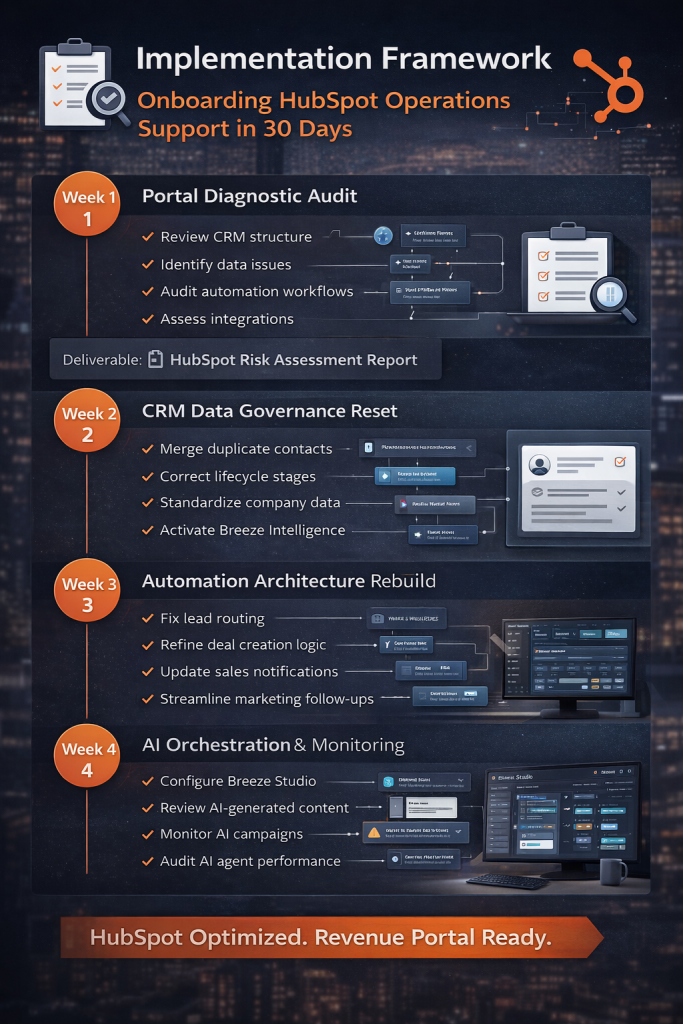
Implementation Framework: Onboarding HubSpot Operations Support in 30 Days
Organizations often assume that operational support requires a long implementation process.
In reality, a structured onboarding plan can stabilize most HubSpot environments within the first month.
Week 1: Portal Diagnostic Audit
The operator conducts a complete audit of the HubSpot environment.
Key areas include:
- CRM data structure
- lifecycle stage definitions
- pipeline configuration
- automation workflows
- integration health
Deliverable: a detailed system diagnostic report identifying operational risks.
Week 2: CRM Data Governance Reset
Next, the operator cleans and standardizes CRM records.
Tasks typically include:
- merging duplicate contacts
- correcting lifecycle stages
- standardizing company data
- activating Breeze Intelligence enrichment
This step establishes the structural foundation for reliable automation.
Week 3: Automation Architecture Rebuild
The operator reviews and rebuilds core automation systems.
Priority workflows include:
- lead routing
- demo scheduling
- deal creation
- internal notifications
- follow-up sequences
This phase eliminates bottlenecks inside the revenue funnel.
Week 4: AI Orchestration and Monitoring
The final stage integrates AI tools into daily operations.
Tasks include:
- configuring Breeze Studio AI agents
- refining prompts and workflow triggers
- monitoring AI-generated campaigns
- reviewing AI performance metrics
At this stage, HubSpot begins operating as a coordinated revenue platform.
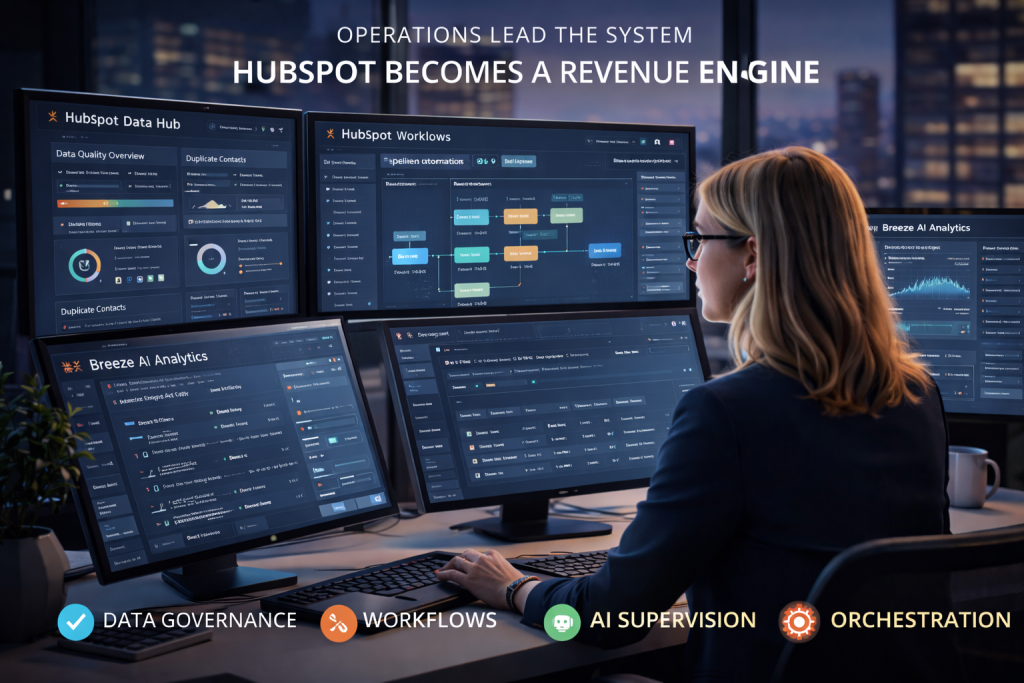
Conclusion: HubSpot Becomes Powerful When Operations Lead the System
HubSpot offers extraordinary capabilities.
It combines CRM management, marketing automation, sales pipelines, customer service tools, and AI systems within a single platform.
But the platform only reaches its full potential when someone orchestrates the entire ecosystem.
Data governance maintains the integrity of the CRM.
AI oversight ensures automation behaves intelligently.
Workflow architecture pushes leads smoothly toward revenue.
A specialized HubSpot operator connects these components into a single revenue engine.
Organizations that invest in operational orchestration consistently outperform those that rely solely on software.
Ready to Evaluate Your HubSpot Portal?
Many companies already possess the technology they need to grow. They simply lack visibility into where the system breaks.
A HubSpot Portal Risk Assessment can quickly reveal:
- CRM data governance weaknesses
- automation failures
- AI workflow inefficiencies
- hidden revenue leaks inside the funnel
If your team uses HubSpot but struggles to generate measurable ROI, a structured audit can identify where the system needs strategic orchestration.
Sometimes the fastest path to growth is not adding more tools.
It is fixing the operational engine you already have.
Frequently Asked Questions (FAQ)
How does a HubSpot-trained VA use Breeze Intelligence for lead enrichment?
In the current landscape, manual lead research is largely obsolete. A specialized VA configures Breeze Intelligence to automatically scan verified data to fill in missing properties like company revenue or LinkedIn URLs. The VA’s role is to verify the accuracy of this data and map it to your specific “Ideal Customer Profile” (ICP) so that your sales team targets the right accounts with enriched, high-context profiles.
Can a HubSpot VA manage custom objects in the Data Hub?
Yes. For Enterprise and Professional users, a trained VA uses the Data Hub to manage “Custom Objects” (such as Shipments, Subscriptions, or Real Estate Listings) that don’t fit into standard categories. They ensure these custom objects are correctly associated with contacts and deals,allowing for complex reporting and segmented automation that a standard setup cannot achieve.
Does using HubSpot AI (Breeze) compromise my data privacy or compliance?
HubSpot ensures that customer data used for Breeze AI features is not used to train global AI models. However, to remain compliant with regulations like GDPR, you must have human oversight for automated decisions. A HubSpot-trained VA provides this “Human-in-the-Loop” layer, documenting the logic behind AI decisions and providing a manual path for customers to contest automated outcomes.
What is the difference between an “Agentic Workflow” and a standard HubSpot automation?
Standard automation follows a linear “If X, then Y” path. Agentic Workflows, built within Breeze Studio, are dynamic. They use AI to “reason” based on the context of a lead’s behavior. For example, if a lead asks a specific pricing question, the Agentic Workflow can identify that intent and automatically pull a specific quote from your product library, rather than just sending a generic “thank you” email.
How do I prevent HubSpot AI from burning through my monthly credit limits?
Breeze AI agents consume HubSpot Credits for every task they perform. Without a trained VA to set “usage guardrails,” a misconfigured prospecting agent can deplete your monthly credits in days. A specialized assistant monitors these credit burn rates and adjusts automation frequency to ensure you don’t hit unexpected overage fees or pause your critical systems.
Can a virtual assistant help with “Sentiment-Based Routing” in HubSpot?
Absolutely. Using the latest Service Hub updates, a VA can configure AI to detect the “sentiment” of an incoming ticket or chat. If the AI detects high frustration or a “churn risk,” the VA builds a workflow that bypasses the standard queue and alerts a senior account manager immediately. This ensures high-stakes issues get immediate human attention.
How often should a HubSpot VA perform a “System Health Audit”?
To maintain Data Hygiene, we recommend a “mini-audit” weekly and a full portal audit quarterly. The VA checks for “Workflow Bloat” (conflicting automations),ensures your Breeze Assistant prompts are still aligned with your brand voice, and cleans up any “Zombie Records” that are inflating your marketing contact costs.
What is the best way to integrate third-party tools like Slack or Zoom?
Rather than just “connecting” the apps, a HubSpot-trained VA uses Connection Insights to see how data flows between them. They can set up Slack notifications that allow sales reps to update a Deal Stage directly from Slack without ever opening HubSpot, significantly increasing CRM adoption and data accuracy across your team.
