

Legal disclaimer: this article provides general information about data protection compliance and does not constitute legal advice. Data protection obligations vary by jurisdiction and by the specific personal data your business handles. Consult a qualified data protection lawyer before finalizing any Data Processing Agreement.
A Manchester-based ecommerce founder hands a virtual assistant access to Shopify and a customer support inbox on a Tuesday morning. The VA can now see customer names, shipping addresses, and order histories for the founder’s entire customer base. If no Data Processing Agreement exists before that access is granted, the founder has already committed a compliance breach under UK GDPR, regardless of whether the VA ever mishandles a single record. The European Data Protection Board’s Guidelines 07/2020 on the concepts of controller and processor, finalized in September 2021, states plainly that the absence of a written processing contract is itself an infringement of Article 28, independent of whether any data subject suffers actual harm.
That single fact answers the question most business owners ask backwards. The question is not “do I need a DPA if something goes wrong.” The question is whether personal data changes hands at all, and for a virtual assistant managing an inbox, a CRM, or a billing system, it almost always does.
Who Is the Data Controller, Processor, and Sub-Processor When You Outsource a Virtual Assistant?
Three parties sit inside every virtual assistant engagement that touches personal data, and each one carries distinct legal obligations under GDPR, UK GDPR, POPIA, and comparable state and national privacy laws.
| Role | Who Holds It | Legal Responsibility |
|---|---|---|
| Data Controller | Your business | Decides why and how personal data gets processed, and carries the primary legal liability if something goes wrong |
| Data Processor | The staffing or placement partner, such as Aristo Sourcing | Provides the contractual and operational framework the assistant works inside, acting on the controller’s documented instructions |
| Sub-Processor | The individual virtual assistant | Executes the actual data-handling tasks, inbox triage, CRM updates, order processing, strictly under the rules the controller sets |
Your business stays the controller no matter how many layers of outsourcing sit underneath it. Handing operational work to a staffing partner does not transfer legal liability away from the business whose customers the data belongs to. That single point gets lost most often, and it is the one worth remembering before signing anything.PR compliance requirement applies.
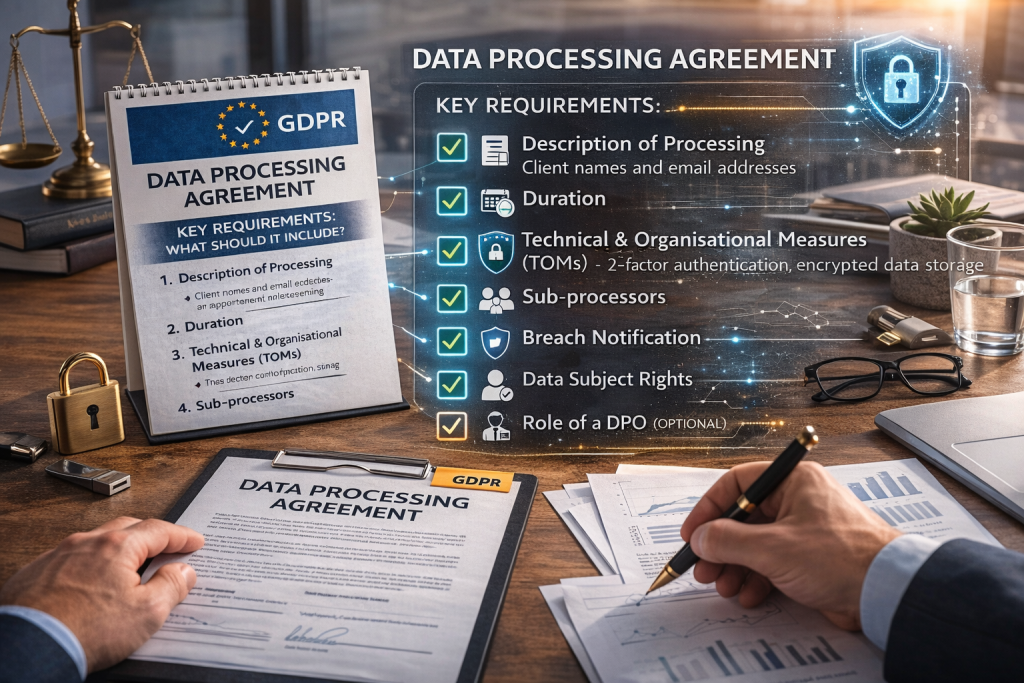
Do I Actually Need a Data Processing Agreement for a Virtual Assistant?
The trigger is not the job title “virtual assistant.” The trigger is the data. A VA who formats blog posts and never touches a customer record does not require a DPA. A VA who logs into a CRM like HubSpot, Salesforce, Zoho, or Pipedrive, manages a support inbox, processes ecommerce orders, handles HR administration, or schedules client appointments is processing personal data on the business’s behalf, and multiple overlapping laws now require a written agreement before that access begins.
Under UK GDPR and EU GDPR, Article 28 requires any contract between a controller and a processor to be in writing and to include a specific list of mandatory terms. The DLA Piper GDPR Fines Survey published in January 2026 recorded cumulative GDPR fines exceeding €7.1 billion since the regulation took effect in 2018, with regulators issuing a growing share of those penalties specifically for missing or inadequate processor agreements rather than for data breaches themselves. Two 2023 enforcement actions illustrate the point directly. Finland’s Data Protection Ombudsman fined a healthcare processor €608,000 partly because its DPA lacked adequate data deletion provisions. Belgium’s Data Protection Authority separately sanctioned a controller for reusing an identical DPA template across twelve different processors without adapting it to each one’s actual processing activities, a shortcut that regulators treated as a compliance failure in its own right.
Article 28 violations specifically fall under Article 83(4) of the GDPR, which caps fines at €10 million or 2 percent of an organization’s global annual turnover, whichever is higher. That sits below the €20 million or 4 percent ceiling reserved for the most severe GDPR breaches, but €10 million is still enough to end a small or mid-sized business, and the lower threshold does not require an actual data leak to trigger it.
In the United States, California’s CPRA sets its own penalty structure. The California Privacy Protection Agency’s 2026 recalibration puts civil penalties at up to US$2,663 per unintentional violation and US$7,988 per intentional violation or one involving a minor’s data, recalculated every odd-numbered year. Consumers also hold a private right of action allowing claims of US$100 to US$750 per incident, or actual damages if higher, when unencrypted personal data gets breached. A business with customers in California that hands consumer data to a virtual assistant without a compliant service provider agreement in place, the CCPA’s own version of a DPA, carries exposure on both fronts.
South Africa’s Protection of Personal Information Act, POPIA, matters directly for any business sourcing virtual assistants from South Africa, one of the largest talent markets for this work. POPIA requires a written agreement between a responsible party and an operator before personal data processing begins, and penalties for violations reach R10 million and, in the most serious cases, imprisonment of up to ten years for the individuals responsible. The Philippines carries an equivalent requirement under the Data Privacy Act of 2012, Republic Act 10173, enforced by the National Privacy Commission, with penalties reaching ₱5 million and potential imprisonment for responsible officers. A business sourcing virtual assistants from South Africa, the Philippines, or both, two of the most common markets for this kind of remote staffing, sits inside three overlapping compliance regimes simultaneously: its own domestic law, GDPR or UK GDPR if it serves EU or UK customers, and the assistant’s local data protection law.
One detail surprises most business owners: Hiring a virtual assistant based anywhere in the European Union or European Economic Area, common across Eastern Europe, triggers full GDPR obligations on that assistant automatically, regardless of where the business itself is based or where its customers live. Article 3(1) of the GDPR applies to any processing carried out in the context of an establishment in the Union, which means an Eastern Europe-based VA falls under GDPR simply by working from EU soil.This requirement prevents personal information from remaining in systems outside your control.
How Do I Onboard a Virtual Assistant Without Risking a Fine?
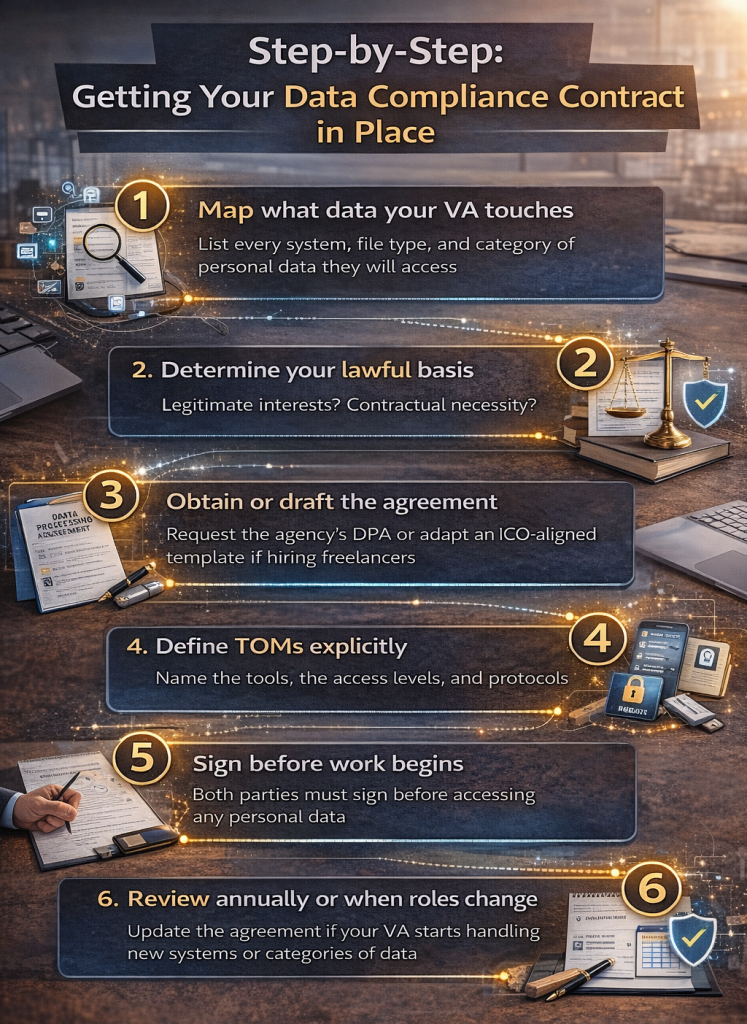
Run a data audit before the assistant’s first login. List every system containing personal data, the CRM, the support inbox, the billing platform, the scheduling tool, and confirm exactly which of those systems the assistant’s role actually requires. Most businesses discover during this step that they were planning to grant broader access than the role needs.
Apply least-privilege access from day one. Configure permissions so the assistant sees only the specific records and functions relevant to the assigned tasks. A support VA answering tickets does not need access to payroll data. A scheduling VA does not need CRM export permissions. Never hand out a shared administrator login; every access grant should trace back to a named individual.
Execute the DPA and, where required, the SCCs or IDTA before work begins, not after. If the virtual assistant works outside the UK or EEA, in South Africa or the Philippines for example, the transfer mechanism has to be in place alongside the core DPA before any personal data crosses the border, not retrofitted once the engagement is already running.
Use encrypted credential management instead of shared passwords. Tools like 1Password or LastPass let a business grant and revoke system access without the assistant ever seeing or storing a raw password, and they generate the access logs that Article 28’s security requirements and TOMs documentation actually call for.
How Aristo Sourcing Approaches This
Aristo Sourcing places virtual assistants across South Africa, and the Philippines, which means the compliance questions in this article come up in nearly every placement the company handles, not as an occasional edge case. The company provides clients with a DPA template covering the Article 28(3) mandatory content as a starting point for their own legal review, structures onboarding around least-privilege access from the first day of an engagement, and builds the cross-border transfer conversation, SCCs, the UK IDTA, or the relevant local equivalent, into the placement process itself rather than leaving a client to work it out after the assistant has already started.
None of that replaces a business’s own legal counsel. A DPA template still needs review against the specific data a business handles and the specific jurisdictions its customers sit in. What a structured placement process removes is the situation this article opened with: a founder granting system access on a Tuesday morning with no agreement in place at all, discovering the requirement only after a regulator, a client, or an insurer asks for it.sk.
Outsource with confidence — speak to the Aristo Sourcing team today.
Frequently Asked Questions
Does a DPA apply to a freelance virtual assistant the same way it applies to an agency-placed one?
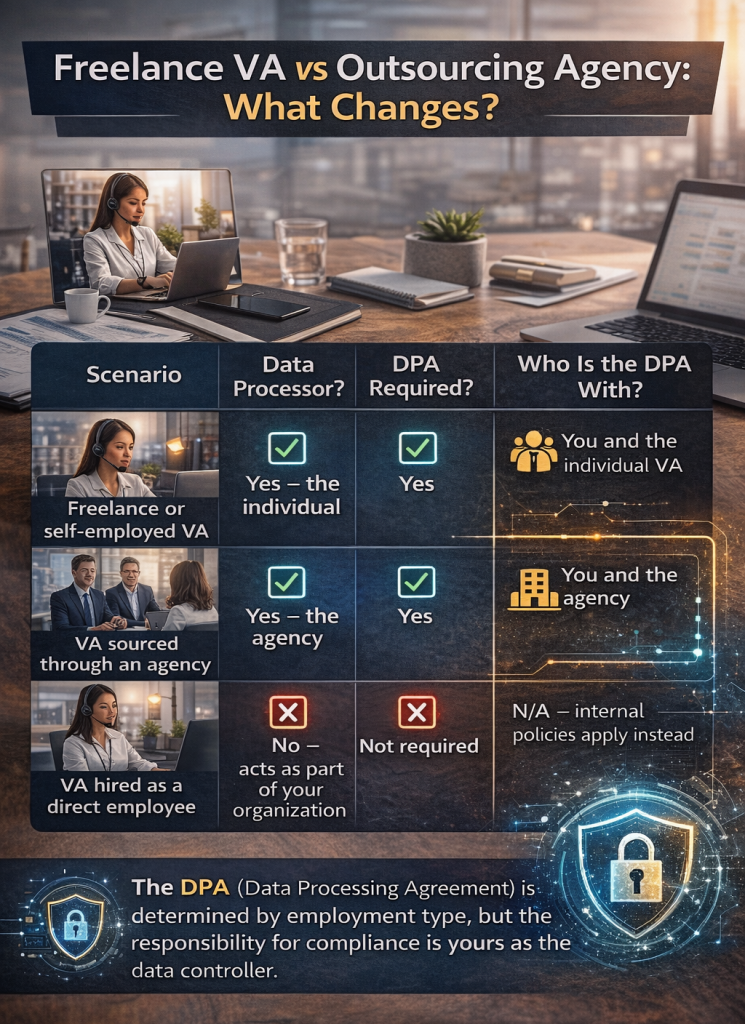
Yes. The legal requirement attaches to the processing activity, not the employment structure. A solo freelance VA accessing a CRM triggers the same Article 28 obligation as an assistant placed through a staffing agency. The difference shows up in practice, not in law: An independent freelancer typically signs the controller’s own DPA directly, while an agency placement usually runs through the agency’s processor agreement with the client, plus a separate sub-processor agreement between the agency and the assistant. Both structures satisfy the law if the paperwork is actually in place before access begins; neither does if it isn’t.
What happens if a regulator or a client audits my business and no DPA exists?
Under GDPR, UK GDPR, and POPIA alike, the missing agreement is itself the violation, independent of whether any data was ever misused. A regulator investigating an unrelated complaint who discovers an undocumented processing relationship can act on that discovery alone. Increasingly, the practical trigger isn’t a regulator at all: Enterprise clients now routinely ask vendors to produce their DPA and sub-processor list during procurement and security reviews, and a business that cannot produce one risks losing the contract before any regulator gets involved.
Do I need a separate DPA for every virtual assistant, or does one agreement cover all of them?
Most businesses use one master DPA with their staffing or placement partner, covering the processing activities, security measures, and sub-processor terms that apply across every assistant placed under that relationship, rather than negotiating a new contract per hire. What has to stay specific to each engagement is the access itself: Which systems a given assistant can reach, and the audit trail confirming that access maps to least-privilege principles for that individual’s actual role.
This article is for informational purposes only and does not constitute legal advice. For guidance specific to your business, consult a qualified data protection solicitor or visit ico.org.uk.
