

DIY travel planning doesn’t look dangerous until it starts hemorrhaging your executive productivity. Every minute spent hunting flight deals, tweaking itineraries, or fighting airline cancellations erodes your capacity to lead, think strategically, and generate value. Think travel planning services for executives done by a skilled virtual travel assistant.
This is not about convenience. It’s about opportunity cost.
It’s about trading $500/hour executive time for $30/hour tasks.
It’s about mental bandwidth, not just time management.
Let’s unpack what executives really lose when they plan their own travel and how delegation rewires the cost structure entirely.
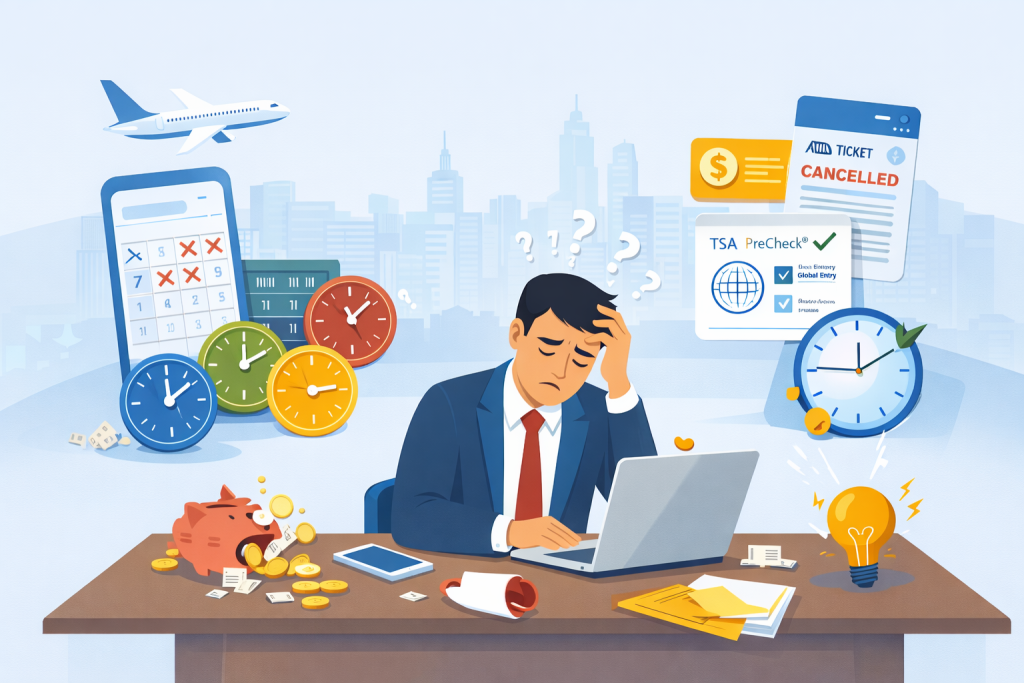
Loyalty Program Leakage: Where Real Money Disappears
Booking business travel independently often looks like savings on the surface. But behind every DIY booking is a graveyard of missed upgrades, split status points, and fragmented perks.
Common Loyalty Pitfalls Executives Face:
- Forgetting to input loyalty numbers at booking
- Using multiple booking platforms that break accrual chains
- Missing elite status tiers due to scattered vendor usage
- Losing upgrade priority from late or unqualified bookings
Example:
An executive who flies Delta, books on Expedia, and pays with a personal card forfeits:
- Complimentary upgrades
- Priority boarding
- Business lounge access
- Accelerated miles accumulation
That’s hundreds of dollars per trip in tangible value, plus status erosion that snowballs over time.
Delegating to a travel professional centralizes loyalty strategy. Every booking ladders up to elite status. Every point maximized.

Multi-City Travel: Where Chaos Becomes Inevitable
Modern business travel rarely means one destination. Executives often stack 3–5 meetings across multiple cities or even continents.
What Can Go Wrong When You DIY:
- Overlapping meetings across time zones
- Inadequate buffer between flights and presentations
- Hotel bookings in the wrong part of the city
- Missed connections triggering downstream cancellations
- No backup plan for IROP (Irregular Operations)
Flight time is not door-to-door time.
TSA PreCheck doesn’t cover passport control delays.
And airport lounges don’t help when you’re sprinting across terminals.
Delegating means these failure points disappear. A travel assistant doesn’t just book it orchestrates logistics to eliminate friction.
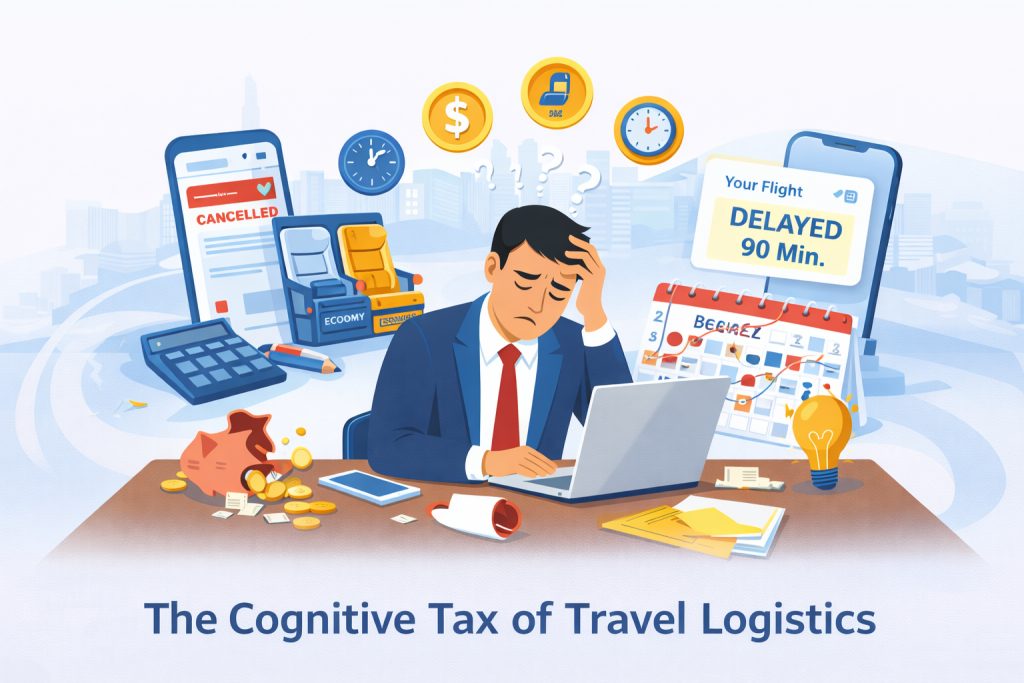
The Cognitive Tax of Travel Logistics
When executives manage their own travel, they pay in mental clarity. This is the silent cost most leaders ignore until performance drops.
What This Looks Like in Real Life:
Decision Fatigue
Flight times, hotels, seating charts, loyalty tradeoffs hundreds of micro-decisions drain judgment reserves needed for real business calls.
Context Switching
Jumping between budget forecasting and checking TSA line wait times breaks cognitive flow. It takes 23 minutes, on average, to refocus after a distraction.
Burnout Acceleration
DIY logistics stack stress atop already complex leadership responsibilities. This drives long-term exhaustion silently, invisibly, and with compounding impact.
This isn’t just annoying. It’s corrosive.
It chips away at executive performance and nobody sees it until it’s too late.
Executive Time Tradeoff Table: DIY vs Delegation
| Task | DIY Time (Exec) | Delegated Time (VA) | Hidden Cost |
|---|---|---|---|
| Flight research | 45 mins | 5 mins (approve options) | $375 (opportunity loss) |
| Hotel booking | 30 mins | Automated with loyalty sync | Missed upgrades, rewards |
| Travel profile updates | 15 mins | 0 | Frequent flyer erosion |
| Handling cancellations | 1+ hour | Done for you | Meeting loss, stress |
| Calendar syncs | 20 mins | Automated | Missed buffers, overlap |
Assumption: Executive time = $500/hr | Travel Assistant = $30/hr
That’s over $500 lost per trip, per executivewithout counting mental fatigue.
Why Tools Alone Don’t Solve the Problem
Apps like TripIt or Expensify organize chaos. But they don’t erase it. Tools require operators.
Notifications don’t delegate. Automation without judgment still creates work.
Tools:
- Can’t resolve airline IROPs
- Don’t optimize loyalty programs
- Don’t detect back-to-back meeting conflicts
- Can’t decide when to book or wait
A travel assistant uses tools as force multipliers not as replacements for strategy.
Cost Structure Visual: DIY vs Delegation
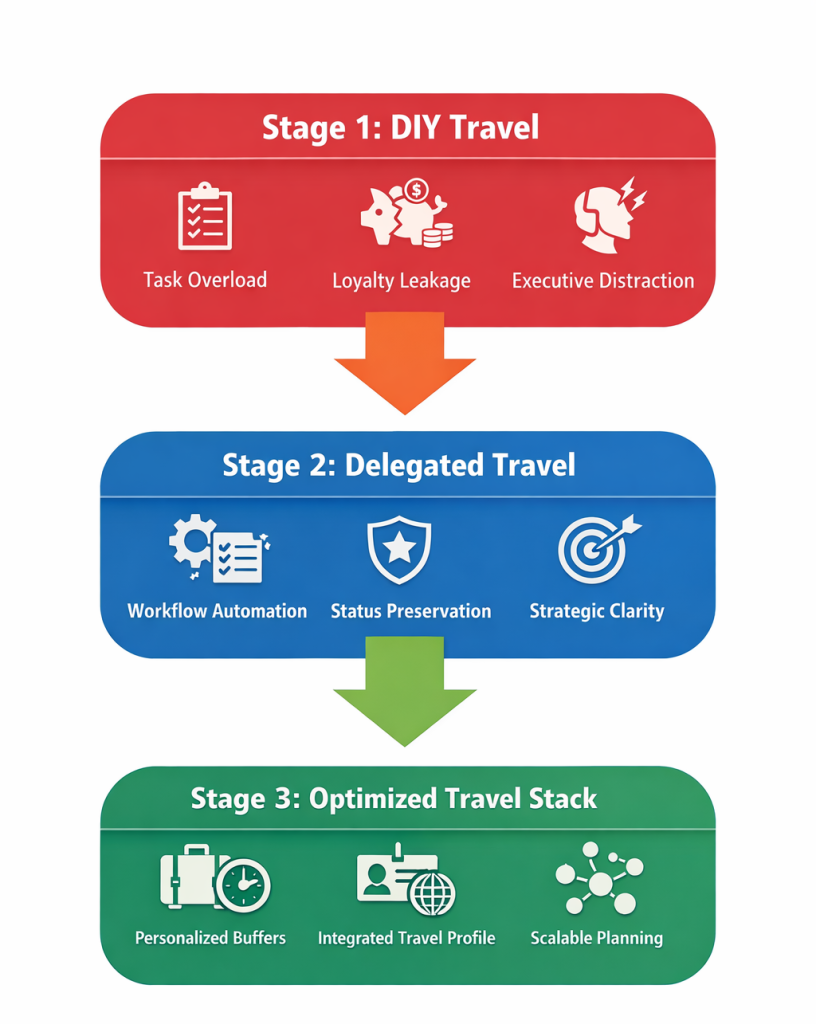
The 20-Minute Handover: How to Stop Planning Your Own Travel
You don’t need a six-week onboarding. You need 20 minutes and five steps.
Step 1: Forward Your Travel Profile
Share your frequent flyer numbers, seating preferences, passport scans (securely), and preferred vendors.
Step 2: Set Booking Triggers
Define what counts as “bookable” e.g., “Book under $1,000 direct, send for approval above.”
Step 3: Define Your Alert Thresholds
Do you want Slack alerts? Daily summaries? Emergency-only texts?
Step 4: Assign Emergency Protocols
Missed flights? Canceled conferences? Your assistant owns the IROP fix loop.
Step 5: Approve One Trip
Give feedback once. By trip #2, your time involvement drops to less than five minutes.
After that, travel becomes background noise not a recurring bottleneck.
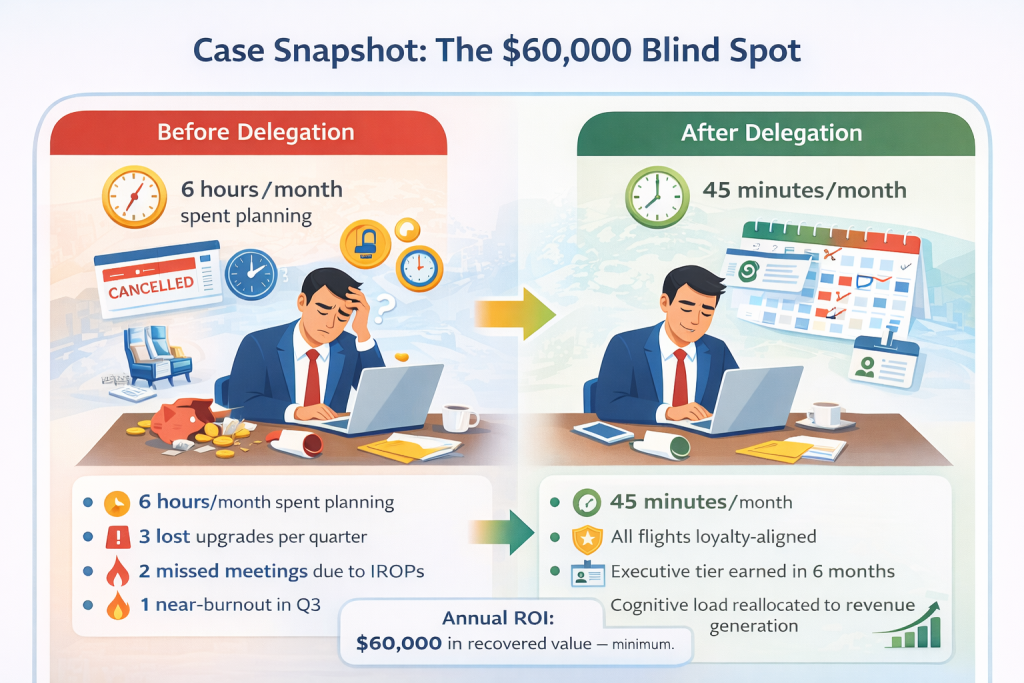
Case Snapshot: The $60,000 Blind Spot
Executive Profile:
Tech founder traveling monthly for investor meetings and conferences.
Before Delegation:
- 6 hours/month spent planning
- 3 lost upgrades per quarter
- 2 missed meetings due to IROPs
- 1 near-burnout in Q3
After Delegation:
- 45 minutes/month
- All flights loyalty-aligned
- Executive tier earned in 6 months
- Cognitive load reallocated to revenue generation
Annual ROI:
$60,000 in recovered value minimum.
Final Verdict: DIY Travel Planning Is a High-Cost Myth
What looks like control is actually overhead. What feels like saving money is bleeding leverage.
Every trip you plan yourself is a tradeoff:
- Between clarity and clutter
- Between strategic thinking and tactical trivia
- Between high-leverage impact and mental tax
Delegation isn’t a luxury. It’s an executive multiplier.
You don’t need more tools you need someone to operate the system.
Ready to Reclaim Your Time?
Delegate your travel planning in 20 minutes.
Avoid burnout, stop leaking loyalty, and reclaim strategic clarity.