

Appointment setters are no longer simply “calendar schedulers”; they are top-of-funnel performance drivers with measurable influence on lead quality, pipeline velocity, and revenue outcomes. In modern sales operations, appointment setters execute multi-channel outreach, apply structured qualification frameworks, and manage the handoff process that enables sales teams to focus on closing. This article defines the role in operational terms, explores responsibilities and outcomes, and examines how setters contribute across diverse sectors from SaaS to professional services.
Clarifying the Function: Beyond “Not a Closer”
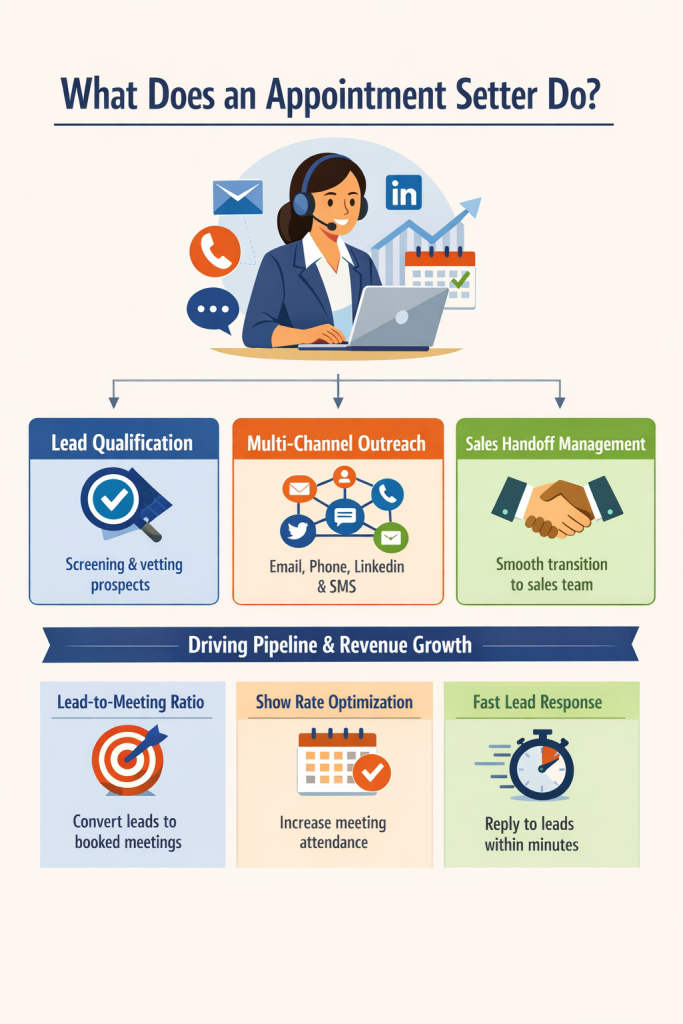
Appointment setters generate, qualify, and schedule sales opportunities. Their core value lies in lead qualification, outreach execution, and optimization of the sales handoff process, measured by metrics such as lead-to-meeting ratio, show rate optimization, and inbound lead response time (ILRT).
By focusing on early-stage pipeline activity, setters enable sales representatives to prioritize high-value conversations. This separation of responsibilities drives productivity and reduces acquisition costs.
With this role clarified, we can explore what appointment setters actually do within a daily workflow.
Core Responsibilities: The Tools and Tasks That Drive Results
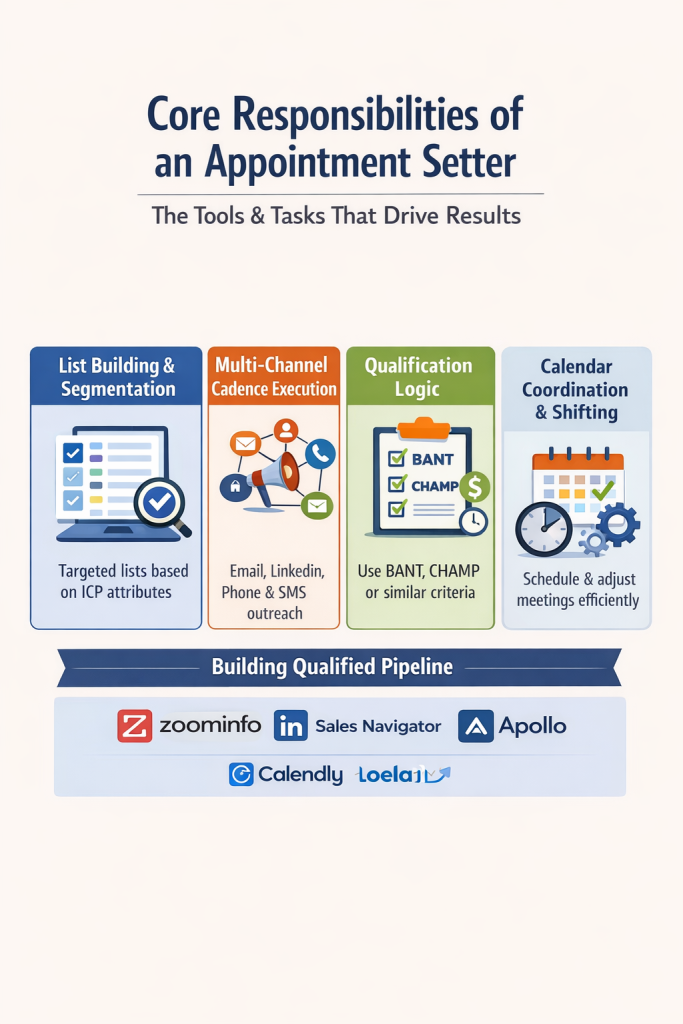
In high-performing sales functions, appointment setters execute structured, repeatable workflows that involve list building and segmentation, multi-channel cadence execution, qualification logic, and calendar coordination.
List Building and Segmentation
Setters begin by constructing segmented lists based on Ideal Customer Profile (ICP) attributes, industry, company size, persona, and intent data. They rely on tools like ZoomInfo, LinkedIn Sales Navigator, and Apollo to maintain clean data and precise targeting.
Proper segmentation ensures relevance and increases the likelihood of conversion, forming the foundation of effective outreach.
Multi-Channel Cadence Execution
Modern appointment setters operate across email, LinkedIn, phone, and SMS. Using platforms such as Salesloft or Lemlist, they manage multi-touch sequences that maximize engagement.
Cadences are structured over days or weeks, combining value-based messaging with personalized outreach to increase connect rates and nurture prospects.
Qualification Logic
Setters assess whether a lead meets specific criteria such as budget authority, decision-making role, timing, and stated pain points. They use qualification frameworks such as BANT or CHAMP to determine if a lead warrants escalation.
Only qualified leads progress to scheduled meetings, preserving the sales team’s time for high-probability deals.
Calendar Coordination and Shifting
Once a prospect is qualified, setters manage time zone coordination, meeting confirmations, and follow-up logistics using tools like Calendly and Chili Piper.
This ensures a seamless transition into the next sales stage and avoids friction in the buyer experience.
KPIs and Outcomes: What “Success” Looks Like
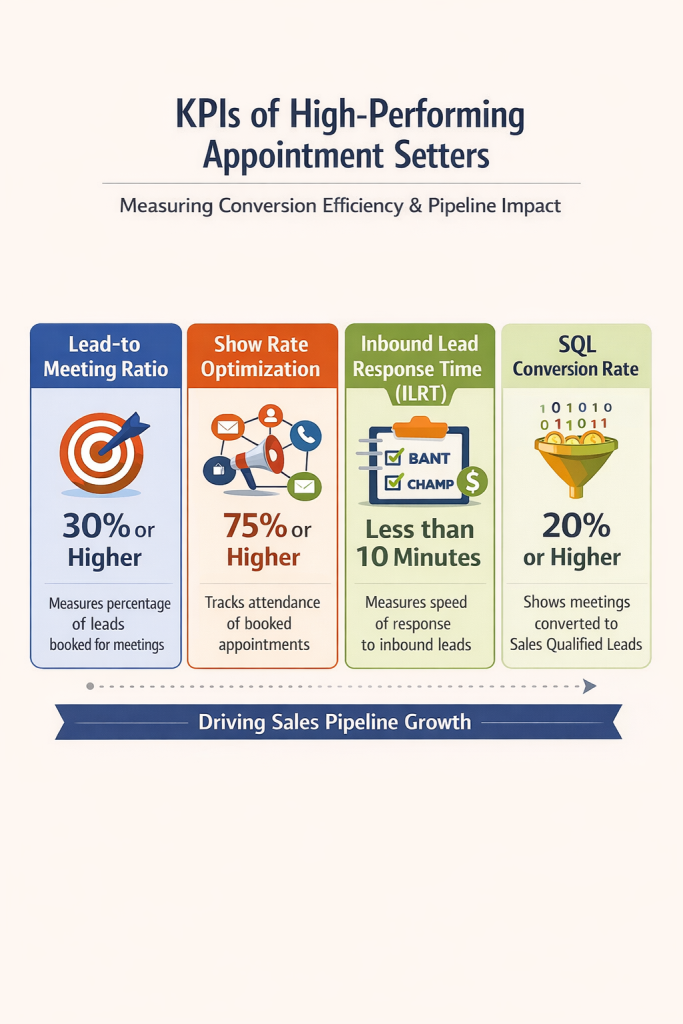
Appointment setters are evaluated based on metrics that reflect conversion efficiency, not just raw activity.
Lead-to-Meeting Ratio
Tracks the percentage of contacted leads that result in booked meetings. A high ratio indicates strong targeting and qualification alignment.
Show Rate Optimization
Measures how many scheduled meetings are attended. Setters improve this by using reminders, context-setting messages, and pre-meeting confirmations.
Inbound Lead Response Time (ILRT)
Rapid response to inbound leads significantly improves conversion odds. Top-performing setters initiate contact within 5–10 minutes of form submission, beating industry benchmarks.
SQL Conversion Rate
Determines the percentage of meetings that progress to Sales Qualified Leads. High SQL rates validate that setters are bringing in high-intent prospects.
These KPIs provide a clearer picture of performance and forecastable pipeline impact.
Sector Applications: How Different Industries Leverage Setters
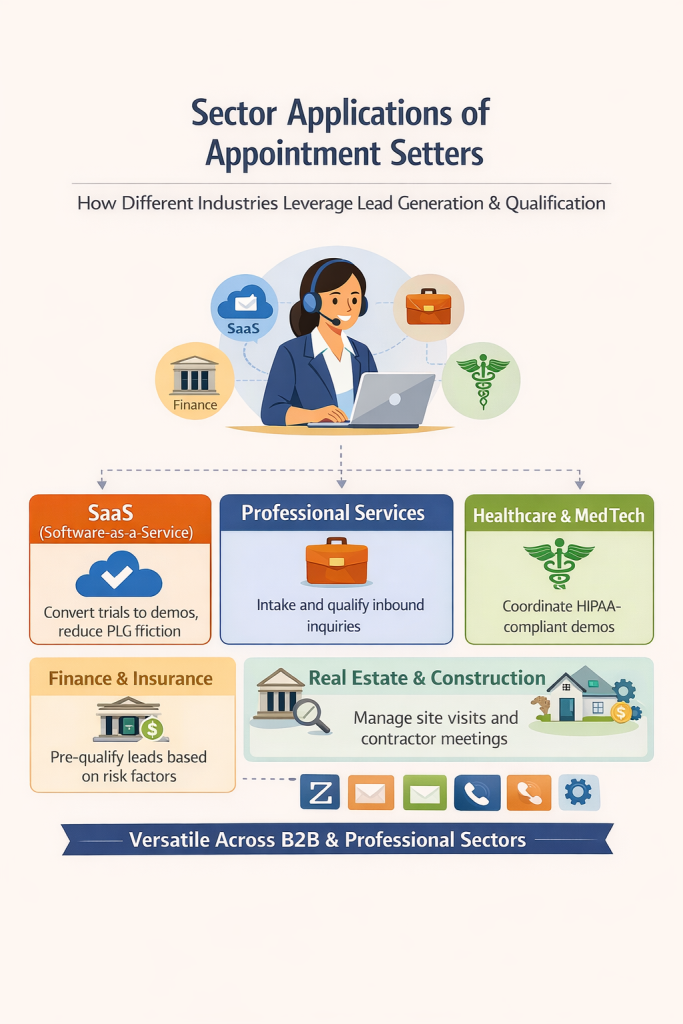
The role of an appointment setter adapts to the operational realities of each sector.
SaaS (Software-as-a-Service)
Setters convert trial signups into demos, qualifying product usage intent within Product-Led Growth (PLG) models. They reduce friction between marketing acquisition and sales activation.
Professional Services
In legal, consulting, and agency environments, setters manage the intake and qualification of inbound inquiries—ensuring that discovery calls align with firm capacity and expertise.
Healthcare and MedTech
Setters coordinate demo bookings, compliance-safe outreach, and partner onboarding sequences for clinical software, devices, and solutions, balancing HIPAA constraints with urgency.
Finance and Insurance
In regulated industries, setters pre-qualify leads based on financial thresholds, risk categories, or regional compliance factors, improving efficiency and reducing compliance risk.
Real Estate and Construction
Setters manage site visit scheduling, contractor meetings, and prospect walkthroughs, especially in multi-stakeholder deals involving developers, agents, and vendors.
This versatility confirms that setters are relevant across B2B, professional, and transactional sectors.
Skills and Technology: What Makes a Top Performer
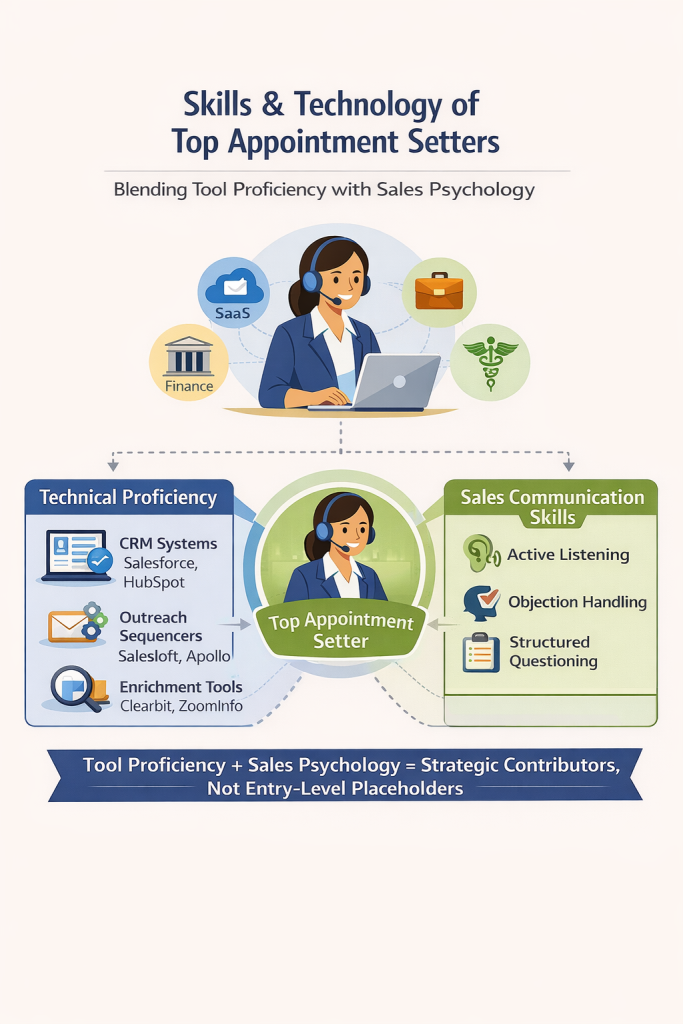
The most effective appointment setters combine tool proficiency with sales psychology.
Technical Proficiency
Setters use CRM systems (Salesforce, HubSpot), outreach sequencers (Salesloft, Apollo), and enrichment tools (Clearbit, ZoomInfo) to execute their workflows. They maintain CRM data integrity for accurate forecasting and lead scoring.
Sales Communication Skills
Setters apply active listening, objection handling, and structured questioning to uncover prospect pain points. This increases conversion and ensures the sales team receives context-rich opportunities.
This hybrid of soft and technical skills makes setters a strategic hire, not an entry-level placeholder.
Challenges and Misconceptions: A Balanced View
Appointment setters are not immune to failure points, especially when poorly integrated.
Messaging Misalignment
Setters must reflect accurate brand voice and segment-specific messaging. Poor alignment can result in disconnects between outreach and offer positioning.
Data and Process Gaps
Without clean data or a structured feedback loop from sales teams, setters lose efficiency. Outreach becomes scattershot and untrackable.
Metric Misfocus
Organizations that reward meeting volume over show rate or SQL conversion incentivize poor quality. Clear KPIs are essential to performance alignment.
These challenges are solvable through tighter integration and better training not through abandoning the setter function.
Setter-to-Closer Handoff Checklist
A clean handoff process defines whether meetings are high-value or wasteful. Setters should provide:
- Lead Source Tagging
- Qualification Notes
- Pain Points & Use Cases
- Objection History
- Meeting Type (Discovery vs. Demo)
- Next-Step Expectations
This structure ensures that closers enter calls with context, increasing conversion rates and improving pipeline forecast accuracy.
Conclusion: Strategic Leverage at the Top of the Funnel
By owning the top-of-funnel, setters provide the necessary leverage for revenue teams to scale. Their contributions to lead quality, meeting efficiency, and sales readiness have tangible effects across industries.
Companies that treat appointment setting as a strategic function supported by process, tooling, and KPI alignment stand to improve not just their meeting volume, but their entire revenue architecture.
Ready to Add Predictable Meetings to Your Pipeline?
If you want a reliable way to turn outreach into booked conversations without pulling your closers into early-stage follow-ups, Aristo Sourcing can help you build the right support function. Book a call and we will recommend the ideal setter profile for your market, define success targets for the first 30–60 days, and outline a simple handoff flow your sales team will actually use.
