

Outsourcing changed shape in the last five years, and most companies haven’t caught up to that change yet. In 2020, 70% of executives named cost reduction as their top reason for outsourcing. By 2024, that number had dropped to 34%, according to Deloitte’s Global Outsourcing Survey. Executives now chase specialized talent, AI-augmented delivery, and agility instead of the lowest hourly rate.
That shift creates an opening for small and mid-sized businesses, but it also creates confusion. Most outsourcing research still targets enterprise procurement teams negotiating multi-year BPO contracts worth millions of dollars. A 12-person SaaS company or a regional accounting firm reads that research and walks away with nothing it can use on Monday morning.
This article fixes that gap. It breaks down the real risks decision-makers face when they outsource work, backs each one with current data, and shows exactly how the virtual assistant model removes risks that traditional outsourcing contracts leave in place.
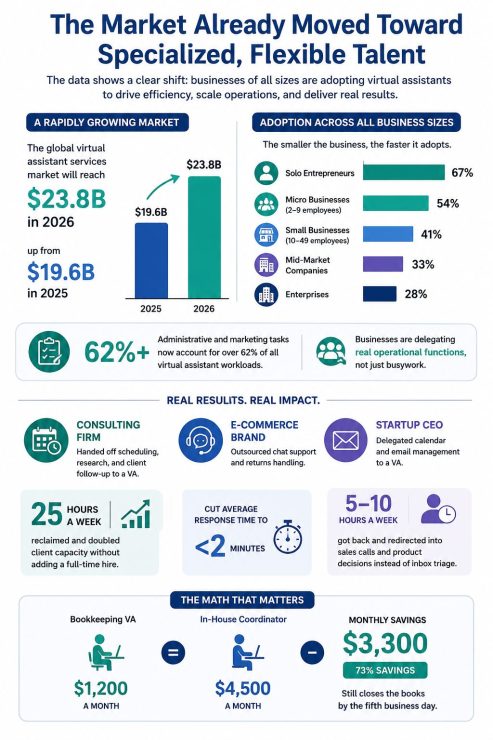
The Market Already Moved Toward Specialized, Flexible Talent
The numbers tell a clear story. Analysts project the global virtual assistant services market will reach $23.8 billion in 2026, up from $19.6 billion in 2025. Adoption now splits clearly by company size: 67% of solo entrepreneurs use a VA, alongside 54% of micro businesses with 2 to 9 employees, 41% of small businesses with 10 to 49 employees, 33% of mid-market companies, and 28% of enterprises. The smaller the business, the faster it adopts the model, because a smaller business feels the cost of a bad full-time hire much faster than a large one does.
Cost plays a role, but it isn’t the whole story. Companies that replace full-time in-house hires with virtual assistants report operational savings of up to 78%. That number gets attention, but the deeper trend matters more: administrative and marketing tasks now account for over 62% of all virtual assistant workloads, which means businesses delegate real operational functions, not just busywork.
The results show up in documented outcomes, not just survey responses. A consulting firm that handed off scheduling, research, and client follow-up to a VA reclaimed 25 hours a week and doubled its client capacity without adding a full-time hire. An e-commerce brand that outsourced chat support and returns handling cut its average response time to under two minutes. A startup CEO who delegated calendar and email management to a VA got back 5 to 10 hours a week, which that CEO redirected into sales calls and product decisions instead of inbox triage.
The math that matters: A bookkeeping VA who costs $1,200 a month replaces a $4,500-a-month in-house coordinator role and still closes the books by the fifth business day. The savings aren’t theoretical. They show up on the P&L every single month.
Fractional staffing backs this up at the executive level, too. A.Team and MassChallenge surveyed tech founders and found that 73% now run blended teams that combine full-time staff with freelance and fractional talent. Of those founders, 71% said fractional talent gave them more agility during economic uncertainty, and 67% said traditional hiring took too long and cost too much.
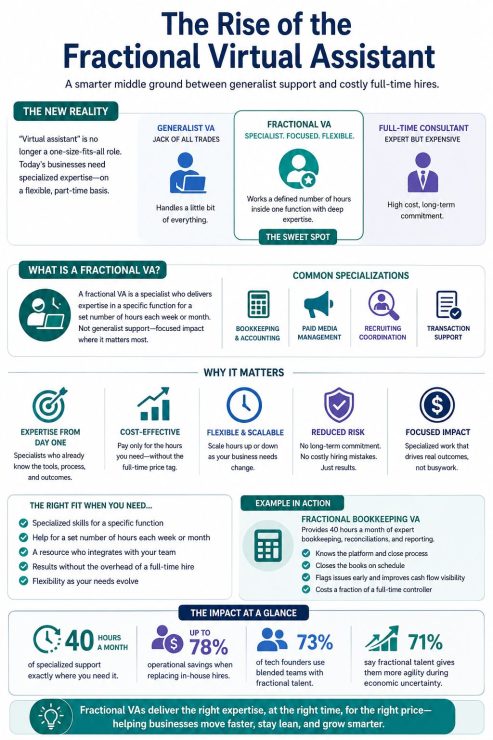
The Rise of the Fractional Virtual Assistant
This is where the terminology needs an update. “Virtual assistant” still carries a generic, low-skill connotation in a lot of executives’ minds, left over from a decade of associating the term with basic data entry and inbox forwarding. That perception no longer matches reality. The fractional virtual assistant model fills the gap between a generalist VA and an expensive full-time consultant: a specialist who works a defined number of hours a week inside one function, whether that’s bookkeeping, paid media, recruiting coordination, or transaction support, rather than a generalist who dabbles across everything.
The distinction matters for hiring decisions. A business that needs forty hours a month of specialized bookkeeping doesn’t need a full-time controller and shouldn’t settle for a generalist VA learning the role on the job. It needs a fractional bookkeeping VA who already knows the platform, the close process, and the reporting cadence on day one. At Aristo Sourcing, this is the default placement model: clients request a role with a defined scope and skill set, not a generic seat to fill.
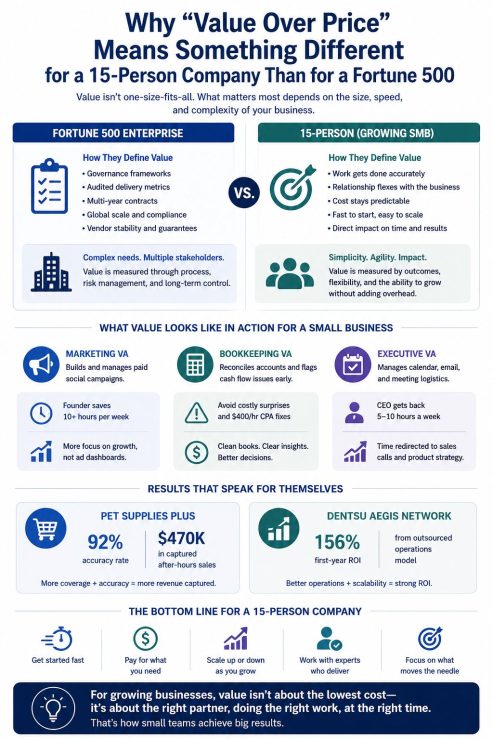
Why “Value Over Price” Means Something Different for a 15-Person Company Than for a Fortune 500
Large enterprises define value through governance frameworks, audited delivery metrics, and multi-year strategic partnerships with global BPO firms. A growing SMB doesn’t have a procurement department, and it doesn’t need one. For a smaller business, value means three concrete things: the work gets done correctly, the relationship flexes when the business changes, and the cost stays predictable.
A marketing VA who builds and manages a client’s paid social campaigns delivers value because the founder no longer spends ten hours a week inside an ad dashboard. A bookkeeping VA who reconciles accounts and flags cash flow problems before they become emergencies delivers value because the owner avoids a $400-an-hour CPA call to fix a mess that has compounded over three months. Neither example needs a steering committee or a quarterly business review with slide decks. It needs a competent person doing a defined job well, consistently, at a price that scales with the business instead of outpacing it.
The data backs this pattern at scale, too. Pet Supplies Plus documented a 92% accuracy rate and $470,000 in captured after-hours sales after deploying outsourced support coverage outside normal business hours. Dentsu Aegis Network reported a 156% first-year ROI from a similar outsourced operations model. Neither result came from cost-cutting. Both came from coverage and accuracy that the business didn’t have the in-house capacity to deliver itself.
Mapping the Real Risks Operational Managers Actually Worry About
Risk language gets thrown around loosely in outsourcing content. Most articles list “quality control” and “cultural differences” as risks and move on without explaining what those risks look like in practice or how a business actually manages them. Here’s the breakdown an operational manager needs before signing anything.
Data Security and Compliance Risk
This risk carries the highest financial stakes of anything on this list. Verizon’s 2025 Data Breach Investigations Report found that third-party involvement in breaches doubled year over year, and nearly one in three data breaches now traces back to a vendor, partner, or supplier. PwC’s 2025 Global Digital Trust Insights survey found that 35% of leaders rank third-party breaches among their top cyber threats.
The number that should change how you vet a provider: IBM’s 2025 Cost of a Data Breach Report put the average breach cost for US firms at $10.22 million, the highest figure on record. Noncompliance alone adds another $174,538 to that average, on top of fines and remediation costs.
European regulators aren’t slowing down either. They issued more than $1.4 billion in GDPR fines during 2025, and breach notifications to European data protection authorities hit an average of 443 per day, a 22% increase year over year, and the highest daily rate since GDPR took effect. Meanwhile, 54% of organizations admit they cannot confirm their GDPR risk position is current, and 31% of compliance professionals don’t even know when their organization last reviewed its risk assessment.
A business that hands sensitive customer data, financial records, or healthcare information to an outsourcing provider without verifying that provider’s security practices takes on liability it often doesn’t fully understand until something goes wrong.
The Security Baseline Checklist
Before signing any agreement, confirm the provider can verify each of these:
- Identity verification. Does the provider run background checks on every VA before placement, not just a resume review?
- Principle of least privilege. Are system credentials scoped to only the tools a specific role requires, rather than blanket access to every platform the client owns?
- Regulatory protocol alignment. Does the provider have a documented workflow for your specific environment, whether that’s HIPAA for healthcare data or GDPR for EU customer data?
- Access revocation. Does the provider have a same-day process for cutting off system access the moment a placement ends?
- Audit trail. Can the provider show you a log of who accessed what, and when?
Aristo Sourcing builds these controls into the placement process rather than treating them as an afterthought. Every VA goes through identity verification and background screening before placement, and access to client systems gets scoped to the specific tools a role requires. A bookkeeping VA gets access to the accounting platform. A bookkeeping VA does not get access to the CRM, the email server, or the HR system unless the role specifically calls for it. That scoping is a compliance control, not a convenience feature.
Communication Friction and Time Zone Overlap
Distributed teams run into a coordination problem that doesn’t show up in a sales pitch but shows up fast in daily operations. Cross-border hiring data shows the scale of the issue: in the UK, only 50% of cross-border hires land in the same time zone as the hiring company, and in Germany, only 41% of cross-border hires fall within one hour of the parent company’s working hours. That gap forces async communication by default, which works for some roles and breaks down completely for others.
A customer support VA who answers tickets eight hours after a customer submits them creates a worse experience than no outsourcing at all. A marketing VA who needs same-day approval on ad copy but only overlaps with the founder for ninety minutes a day will miss deadlines no matter how skilled they are. Time zone overlap isn’t a minor scheduling detail. It determines whether a role can function asynchronously or needs real-time collaboration to do the job.
Match the overlap to the role, not the other way around:
- Live, real-time roles (customer chat, phone support, sales development) need 5+ hours of business-hours overlap, minimum.
- Mixed roles (project coordination, social media management) function well with 2 to 4 hours of overlap plus solid async handoff documentation.
- Fully async roles (bookkeeping, data entry, research, content drafting) can run with little to no overlap, as long as deadlines and deliverables are explicit.
This is where geography becomes a sourcing decision, not an afterthought. Aristo Sourcing places VAs based in the Philippines and South Africa specifically because both regions offer substantial working hours overlap with US and UK business hours, unlike outsourcing hubs eleven or twelve time zones removed from North America. A client in Chicago working with a VA in Cape Town gets six to seven hours of live overlap during the VA’s normal shift. That overlap turns a support ticket queue or a live chat function into something that runs in real time instead of a 24-hour relay race.
Quality Control and Service Level Agreements
“Quality control” sounds vague until you turn it into something measurable: a Service Level Agreement that defines response time, error rate, and output volume in writing before work starts. Generic outsourcing contracts often skip this kind of specificity, and the data shows the consequence: in the 2026 CX Outsourcing Report, 83% of leaders said they were satisfied with their outsourcing partner’s SLA execution, yet 79% said they were still considering switching providers. Satisfaction and loyalty aren’t the same thing, and a vague SLA is usually the gap between them.
A defined SLA answers concrete questions:
- What response time does a support ticket require?
- What’s the acceptable error rate on a data entry or bookkeeping task?
- How many transaction files does a VA close per month, and what’s the escalation path if a deadline slips?
- What remedy applies if the VA misses the standard: a credit, a remediation plan, or a replacement?
Without those numbers in writing, quality control becomes a subjective argument after the fact instead of an objective standard everyone agreed to up front. Aristo Sourcing sets these benchmarks at the start of every placement and reviews performance against them on a recurring schedule, not just when a client raises a complaint. That structure gives a client an early warning system. A VA who starts missing a defined metric gets identified and addressed in week three, not month six, after the gap has already cost the business money or customer trust.
Rigid Contracts Versus Operational Flexibility
Traditional outsourcing contracts, especially the multi-year BPO agreements enterprises sign, lock a company into a staffing level and a fee structure long before anyone knows whether the business’s needs will change. A company that signs a three-year contract for a ten-person offshore team has no good options when a recession hits, and headcount needs to shrink by half, or when the business pivots and suddenly needs a completely different skill set.
SMBs face this risk acutely because their needs change faster than an enterprise’s. A seasonal business needs more customer support coverage in Q4 and almost none in February. A startup that just closed a funding round needs to scale a sales development function in sixty days, not eighteen months. Research backs the urgency: 37% of small businesses already outsource at least one task, and more than 52% plan to outsource additional work in 2026, which means the businesses locked into rigid terms today will be the ones least able to capture that next wave of flexibility.
The virtual assistant model breaks the rigid contract by design. Aristo Sourcing places VAs on a month-to-month basis rather than locking clients into multi-year terms, which means a client can scale a team up for a product launch and scale back down afterward without breach-of-contract penalties or stranded headcount. That flexibility is the direct answer to the “rigid contract trap” enterprise outsourcing has used for decades.
Talent Retention and Onboarding Friction
Retention risk gets less attention than data security, but it costs businesses real money through repeated onboarding cycles. Gallup and SHRM both put the cost of replacing an employee at 50% to 200% of that role’s annual salary, with specialist and technical roles running as high as 150%. Gallup estimates voluntary turnover costs US businesses roughly $1 trillion a year in total. SHRM’s 2026 workforce data adds a sharper point for smaller companies specifically: 17% of small businesses now flag retention as a top concern, and 51% of employees say they’re open to new opportunities at any given time.
Every time a business loses an outsourced worker and starts over, it pays that replacement cost again in a smaller, faster cycle: training time, knowledge transfer, and a productivity dip while the new hire ramps up. Onboarding friction compounds this. A VA who doesn’t receive clear documentation, defined workflows, and a real point of contact in the first two weeks takes far longer to reach full productivity, and businesses that treat onboarding as an afterthought see it in slower ramp times and higher early turnover.
Aristo Sourcing addresses retention on both ends. The vetting process screens for VAs who plan to build a long-term remote career rather than treat a placement as a stopgap, and the onboarding process gives each client a structured first-30-days plan instead of a “figure it out” handoff. That combination is why clients see VAs stay in a role for years rather than months, which removes the repeated onboarding tax that erodes the savings outsourcing is supposed to deliver in the first place.
Building Risk Mitigation Into the Outsourcing Strategy From Day One
Every risk above has a mitigation that works best when a business builds it into the hiring decision rather than bolting it on after a problem surfaces. Four practices make the biggest difference.
- Write the SLA before the VA starts, not after a missed deadline forces the conversation. Define response times, error tolerances, and reporting cadence in the same conversation where the role and compensation are defined.
- Treat time zone overlap as a hard requirement for any role involving live customer interaction, and as a soft preference for roles that run asynchronously, like bookkeeping or research.
- Choose month-to-month flexibility over long-term contracts unless a long-term contract earns a meaningfully lower rate. The administrative savings of a rigid multi-year deal rarely outweigh the cost of being stuck with the wrong staffing level when needs shift.
- Hire fractional and specialized, not generalist. A role with a defined scope, matched to a VA who already has the relevant skill set, ramps faster and produces measurably better output than a generalist VA learning the function from scratch. The 40-70% productivity gains companies report from AI-augmented VA support in 2026 mostly come from specialists who already know how to use the tools, not from generalists figuring it out on the client’s clock.
The Risk Was Never Outsourcing. The Risk Was Doing It Without a Framework.
Outsourcing trends didn’t get “too hot to handle.” They got more specific, more measurable, and more demanding of businesses that want to use them well. The Deloitte data shows executives have already moved past cost-driven outsourcing decisions. The VA adoption data shows SMBs have already moved past the pilot stage. The breach and compliance data show exactly where the real risk sits, and it sits in unverified vendors and unscoped data access, not in the concept of outsourcing itself.
A business that maps its risks explicitly, writes them into an SLA, matches roles to the right time zone overlap, and chooses fractional, month-to-month flexibility over rigid contracts removes nearly every variable that makes outsourcing dangerous. That’s the model Aristo Sourcing builds every placement around: vetted virtual assistants, scoped data access, defined performance benchmarks, and the flexibility to scale a team up or down as the business actually requires.
The question worth asking isn’t whether outsourcing trends are worth the risk. It’s whether a business has built the framework that turns outsourcing from a gamble into an operational advantage.
