

This is why hiring virtual assistants in South Africa works for UK and European teams. Let’s discuss.
Hiring a virtual assistant is easy. Building a remote team that runs smoothly every day is the real challenge.
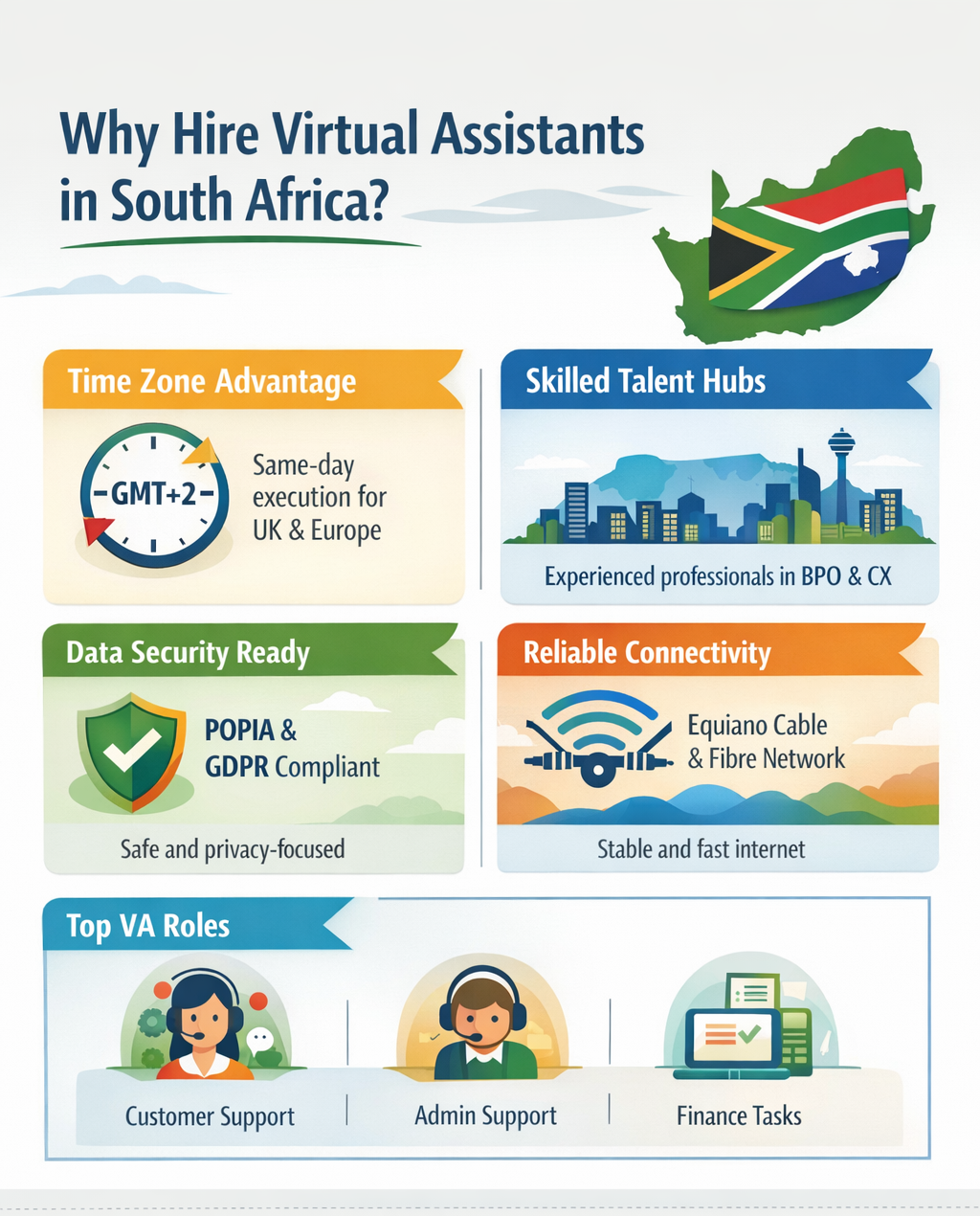
South Africa has become a strong option for businesses that want reliable remote delivery without the usual friction of offshore outsourcing. The advantage is not just cost. It is the combination of GMT+2 time alignment, English-first communication, and a mature BPO talent market that supports consistent execution.
If you want a remote team that feels integrated, not “external,” South Africa is one of the most practical places to build it.

South Africa is a proven BPO market, not an experiment
South Africa already supports global customer experience and back-office operations at scale. Hubs like Cape Town and Johannesburg have deep experience in structured service delivery, including customer support, admin, operations, and finance-adjacent roles.
That matters because you are not hiring into a market that is still learning how remote delivery works. You are hiring from an ecosystem where team leads, QA processes, escalation paths, and performance metrics are normal.
Common strengths you can expect:
- Process discipline (SOP-driven work, checklists, documentation habits)
- Customer-facing communication (clear written English, professional call handling)
- Operational consistency (structured shifts, coverage planning, coaching culture)
English proficiency with neutral-accent communication
If your team interacts with customers, language quality is not a “nice-to-have.” It is a conversion lever.
South African professionals typically operate in English in education and business environments. Many companies hire from talent pools explicitly trained for customer experience delivery. In practice, this often means high proficiency, neutral-accented English that works well for UK, European, US, and Australian markets.
This supports:
- Fewer misunderstandings in tickets, inbox management, and SOP execution
- Higher customer trust in calls
- Smoother collaboration with founders and managers
Time zone overlap (GMT+2) removes handover delays
For UK and European companies, the biggest productivity killer in offshore hiring is the delay loop. You ask a question, wait overnight, then wait again.
South Africa runs on South African Standard Time (UTC+2) with no daylight saving time, which creates a substantial overlap with European working hours and a practical overlap with UK workdays as well.
What this changes operationally:
- same-day approvals instead of next-day approvals
- live collaboration on complex tasks
- faster cycle time for delivery, revisions, and customer responses
- better “follow-the-sun” workflows when paired with other regions
This is one of the simplest ways to increase output without adding headcount.
Data protection readiness: POPIA alignment and GDPR awareness
If you outsource anything that touches customer records, employee data, invoices, or login-based systems, trust is not a statement. It is a system.
South Africa’s privacy law, POPIA, shares many core concepts with GDPR, including similar definitions and data subject expectations.
That does not remove your responsibility, but it helps because:
- Privacy language and controls are more familiar
- Secure handling expectations are easier to train and enforce
- Compliance conversations are less abstract for team members
A strong remote program still needs permissions, access controls, and audit logs. The difference is that the baseline awareness is often higher.
Connectivity and operational reliability
One of the biggest fears in remote hiring is simple: “Will my team be online consistently?”
South Africa’s connectivity has improved through fiber expansion and increased international capacity from subsea cable infrastructure. Google’s Equiano cable landed at Melkbosstrand near Cape Town, adding capacity and improving resilience for modern remote work, such as cloud tools, VoIP, and screen sharing.
This supports operational continuity, mainly when your workflows depend on:
- Google Workspace or Microsoft 365
- Slack, Teams, Zoom, Meet
- CRMs, ticketing tools, and shared dashboards
- Password managers and secure access systems
Where South African VAs tend to perform best
To improve outcomes, match roles to strengths and infrastructure.
South Africa is a strong fit for:
- Customer support and CX (tickets, chat, email, phone, escalation support)
- Executive assistant and admin ops (calendar, inbox, travel, document prep)
- Sales support (CRM hygiene, lead follow-up, scheduling, pipeline support)
- Finance admin support (invoicing, AR follow-up, reconciliation prep, reporting)
- Marketing operations (content upload, QA, reporting, coordination)
This is where the talent pipeline and process culture usually deliver the fastest ramp.


3 Key Takeaways
- Seamless overlap (GMT+2): Same-day execution for the UK and Europe reduces delays and increases output.
- Job-ready talent hubs: Cape Town and Johannesburg support mature BPO delivery, not just entry-level VA work.
- Lower operational risk: POPIA awareness plus improving connectivity strengthens remote delivery reliability.

Hire a South African Virtual Assistant With Confidence
Ready to hire a South African Virtual Assistant who fits your role, time zone, and standards? Book a call with Aristo Sourcing, and we’ll map your tasks, define the ideal profile, and show you what top talent from Cape Town and Johannesburg looks like in real terms (communication, tools, experience, and availability). You’ll leave the call with a clear hiring plan, realistic timelines, and a shortlist-ready role scope so you can start delegating with confidence.
How does South Africa’s time zone (GMT+2) specifically benefit US-based companies?
South Africa’s GMT+2 time zone benefits US-based companies by enabling a follow-the-sun workflow. For East Coast (EST) companies, South African VAs operate 6–7 hours ahead, allowing administrative tasks, email triaging, and data entry to be completed before 9:00 AM EST. This time zone advantage ensures productivity before the US workday begins.
What niche industries are South African VAs most qualified for?
South African VAs are most qualified for Finance, Law, and Engineering support roles. South Africa produces high volumes of graduates in these fields, enabling VAs to handle paralegal tasks, bookkeeping in Xero or Sage, and technical project coordination. These roles require higher cognitive skills than general administrative support.
Does South Africa have the infrastructure to support reliable remote work?
South Africa supports reliable remote work through fiber-optic networks, 5G coverage, and backup power systems. In cities like Cape Town and Johannesburg, professional VAs maintain 99.9% uptime using uninterruptible power supplies and solar systems, ensuring service continuity during scheduled power outages (load shedding).
How does the cultural “neutrality” of South African VAs impact customer-facing roles?
Cultural neutrality of South African VAs improves communication in customer-facing roles. South African English, often described as neutral or mid-Atlantic, aligns with UK, US, and Australian expectations. This linguistic clarity makes South African VAs ideal for Customer Success, Executive Assistance, and Appointment Setting roles.
Are there specific legal or compliance advantages to hiring from South Africa?
South Africa offers legal and compliance advantages through the Protection of Personal Information Act (POPIA), which aligns with the EU’s GDPR. Hiring South African VAs ensures familiarity with strict data privacy standards, simplifying compliance for UK and European businesses handling sensitive client data.
