

If you are asking, “Where should I advertise my properties?”, you are really asking a bigger question:
How do I generate more qualified enquiries, respond faster, and prove what is working, without spending my whole week uploading listings and chasing leads?
Property advertising is not a directory of portals. It is an operating system made up of four parts:
- Distribution: where your listing appears
- Conversion: how your listing turns views into enquiries
- Speed-to-lead: how quickly you reply and book viewings
- Attribution: which channels actually produce deals
This guide breaks down the modern channel stack, then shows how a Real Estate Virtual Assistant can run the workflow end-to-end so you scale output without sacrificing quality.
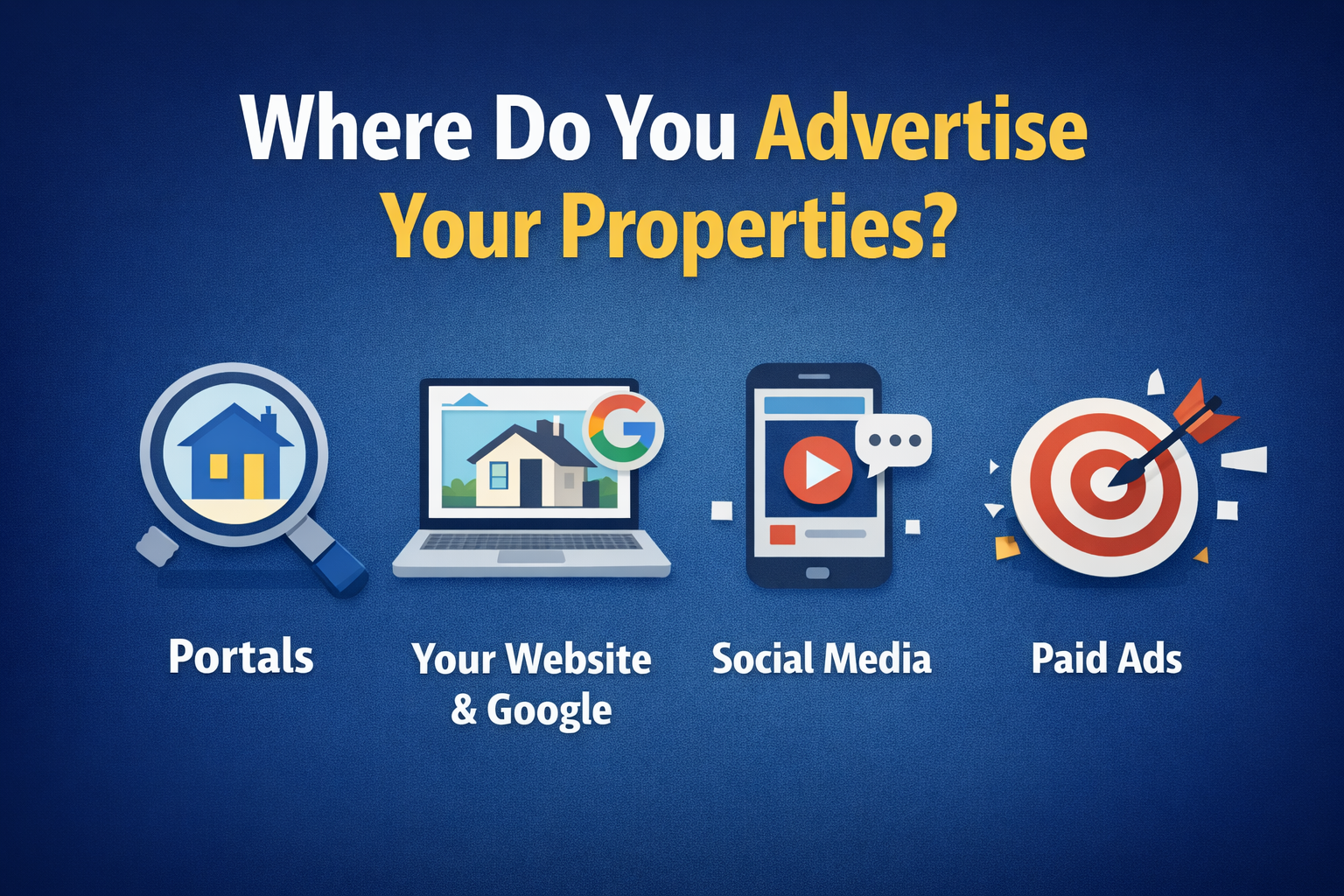
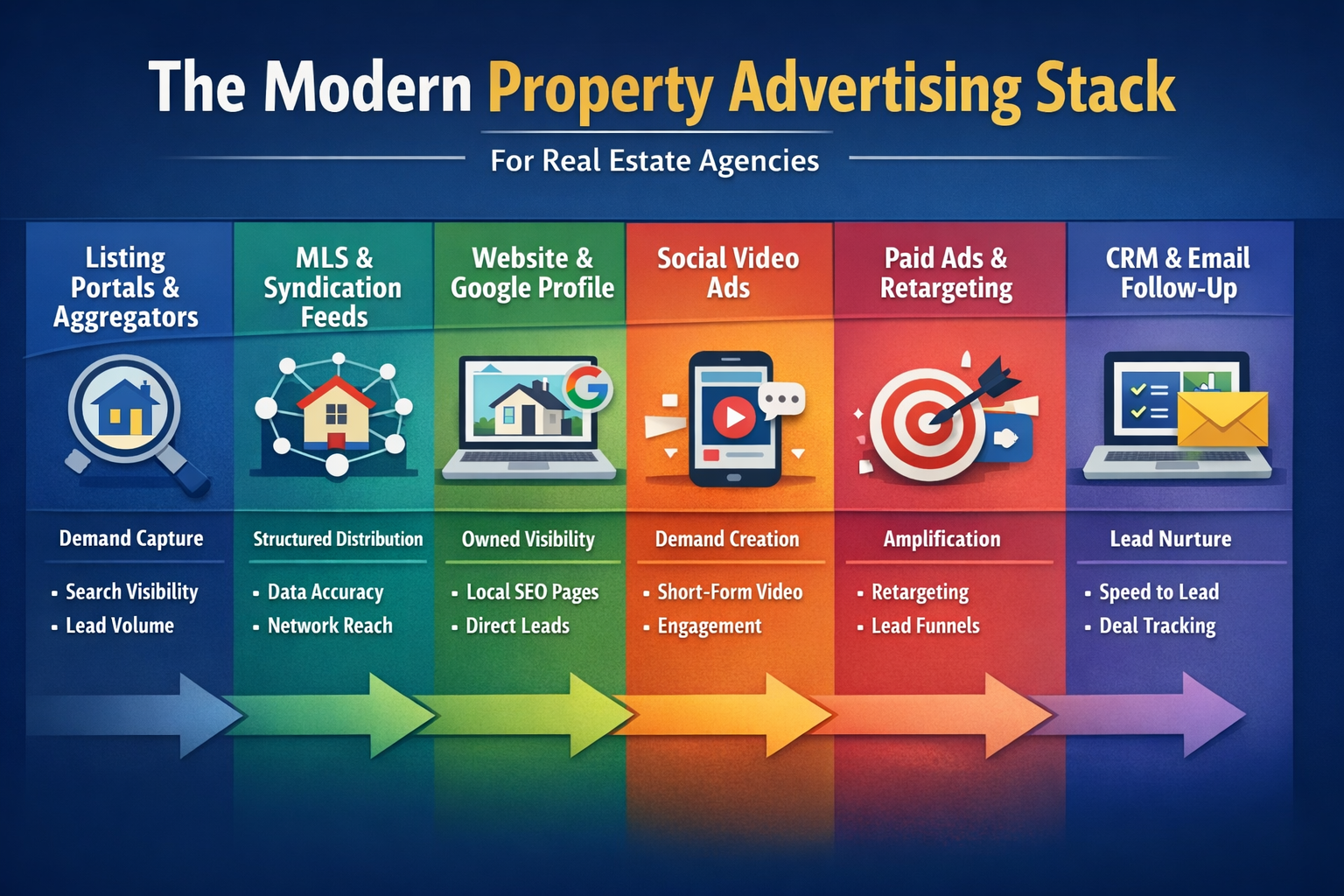
The modern property advertising stack (what actually works today)
High-performing agencies use multiple channels at once, but each channel has a job.
1) Listing portals and aggregators (demand capture)
These platforms convert existing intent. People arrive ready to buy or rent.
Use portals to win on:
- Search visibility for your area
- Lead volume
- “Save” and “share” behaviour that signals buyer intent
Best practice: portals reward complete listings, which means great photos, accurate features, strong descriptions, and consistent updates.
2) MLS and syndication feeds (structured distribution)
If your market uses an MLS or syndication network, it is the backbone of consistent distribution.
This is where operations matter:
- Correct fields
- Clean property data
- Photo order and captions
- Open home times
- Status changes, price reductions, and under offer updates
3) Your website and Google Business Profile (owned visibility)
Your website is where you control conversion and build long-term authority.
Minimum standards:
- Dedicated listing pages that load fast
- Local area pages (suburb, neighbourhood, school catchments)
- Embedded enquiry forms and viewing request CTAs
- Trackable phone numbers and click-to-call
4) Social video (demand creation)
This is how you reach buyers and sellers before they are actively searching.
Use short-form video for:
- Walkthrough highlights
- Neighbourhood lifestyle clips
- “Just listed / just sold” proof
- Behind-the-scenes credibility
5) Paid media plus retargeting (amplification)
Paid ads work best when they support a strong listing and a fast follow-up system.
High-leverage paid tactics include:
- Retargeting visitors who viewed listings
- Lead forms for buyer lists and seller appraisals
- Lookalike audiences based on past leads
6) Email and CRM follow-up (where deals are won)
A large share of “advertising ROI” is created after the initial enquiry.
Your CRM should:
- Assign leads instantly
- Trigger follow-ups automatically
- Track source, stage, and outcomes
-
Prevent leads from going cold
How to choose the proper channels (based on your goal)
Most agencies waste money because they pick channels first, then hope for outcomes. Flip it.
If your goal is seller leads
Prioritise:
- Google Business Profile
- Local SEO pages and market updates
- Meta lead ads for valuations
- Retargeting site visitors
- Review generation campaigns
If your goal is buyer leads
Prioritise:
- Portals plus selective premium placements
- Social video plus retargeting
- “New listings alert” buyer list signups
- Fast response time and viewing coordination
If your goal is rentals or tenant leads
Prioritise:
- Portal listing completeness
- Fast tenant enquiry handling
- Viewing scheduling systems
- Pre-qualification workflows
If your goal is short-term rentals
Prioritise:
- Airbnb and booking platforms (where relevant)
- Reputation management (reviews)
- Photo optimisation and listing refresh cycles
- Automated guest messaging and calendar control
The part most agencies miss: conversion is created in the listing
If two agencies advertise on the same portals, why does one win?
Because the winners operate like marketers, not uploaders.
A high-performing listing improves:
- CTR (click-through rate) with stronger thumbnails, photo order, and headlines
- Enquiry rate with tighter copy and clearer calls to action
- Time-to-response with lead routing and response templates
- Lead quality with better qualification questions
This is precisely where a Real Estate VA becomes an advantage, because optimisation and consistency get done every time.
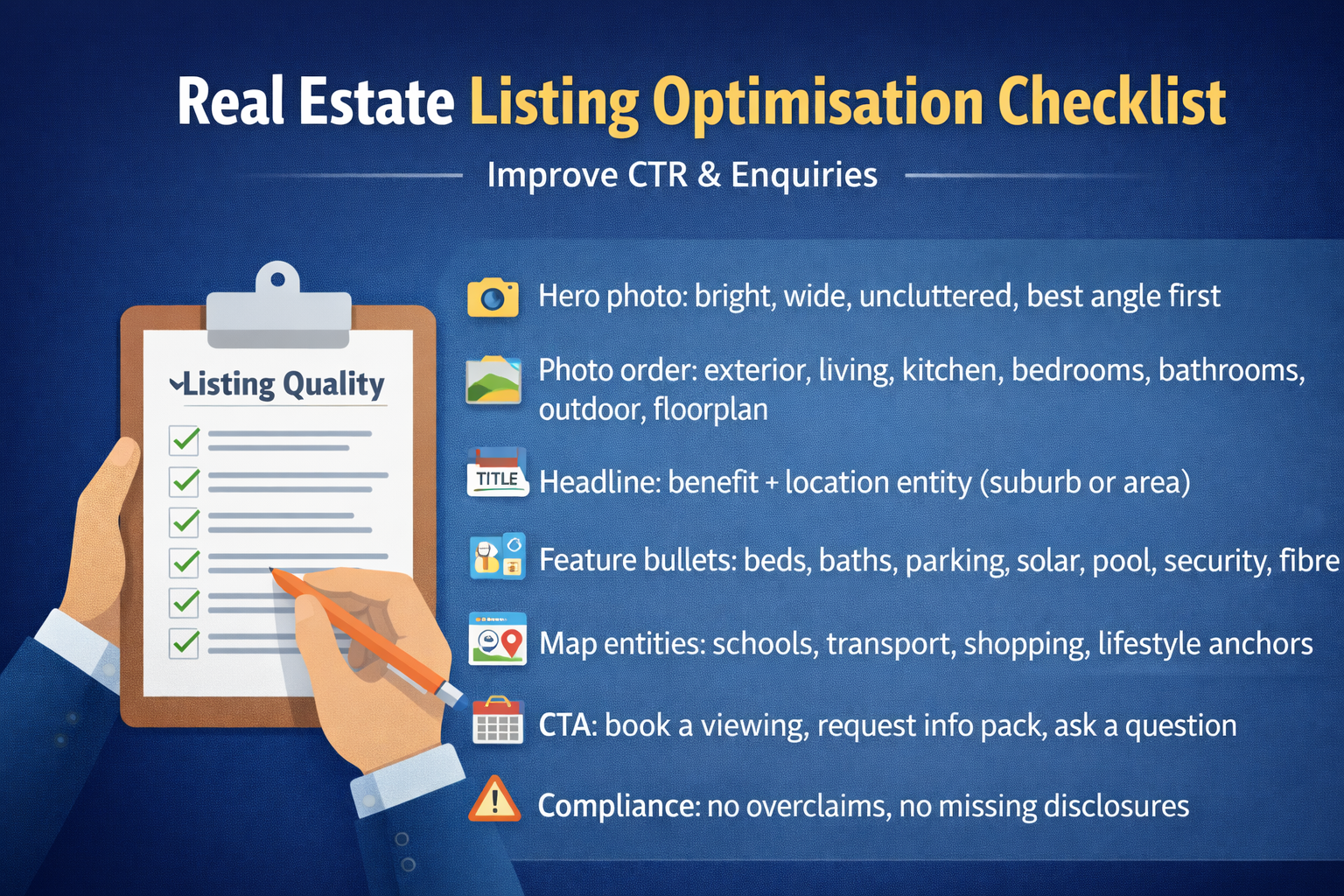
Listing quality checklist (portal, website, social)
Use this checklist before you publish anywhere:
- Hero photo: bright, wide, uncluttered, best angle first
- Photo order: exterior, living, kitchen, bedrooms, bathrooms, outdoor, floorplan
- Headline: benefit plus location entity (suburb or area)
- Feature bullets: beds, baths, parking, and high-intent features (solar, pool, security, fibre)
- Map entities: schools, transport, shopping, lifestyle anchors
- CTA: book a viewing, request an info pack, ask a question
- Compliance: no overclaims, no missing disclosures
- Tracking: UTMs on every link, CRM source field enforced
Tools we support (typical real estate stack)
Simple tools and clean data support a strong advertising operating system.
Common setups include:
- CRM: Follow Up Boss, HubSpot, Salesforce, Zoho, Pipedrive
- Lead routing and automations: Zapier, Make, n8n
- Tracking: GA4, UTM templates, call tracking (where used)
- Scheduling: Calendly and Google Calendar rules
- Asset management: Google Drive, Dropbox
- Listing and collateral: Canva, copy templates, basic photo preparation workflows
How a Real Estate Virtual Assistant scales your property advertising
A VA does not replace your expertise. They replace the repetitive operational workload that slows you down.
Here is what a good Real Estate VA can own end-to-end.
1) Listing intake and asset management
- Collect property details from agents and vendors
- Create a clean “listing pack” (photos, floorplan, copy, key features, disclosures)
- Organize assets in a folder system with consistent naming
- Tag and order photos so the best image leads every platform
2) Listing optimisation (copy plus structure)
- Write or rewrite descriptions using a consistent format:
- Hook
- Key features
- Lifestyle and location entities (schools, transport, amenities)
- Viewing instructions
- CTA
- Create platform-specific variants (short, medium, long)
- Maintain compliance and consistent brand tone
3) Multi-channel publishing
- Upload to portals and syndication feeds
- Publish to your site (or prep inside your CMS)
- Repurpose for social from the same listing pack:
- 1 short video caption
- 1 carousel caption
- 1 story script
- Schedule posts and track links with UTMs
4) Lead response operations (speed-to-lead)
- Monitor inboxes and lead sources
- Respond using approved templates within minutes
- Ask qualification questions
- Book viewings using your calendar rules
- Escalate hot leads to the agent immediately
5) Lead attribution and reporting
- Track where every lead came from
- Maintain clean CRM source fields
- Weekly reporting on:
- Views, saves, enquiries
- Cost per lead (if paid)
- Response time
- Viewing bookings
- Pipeline movement (where tracked)
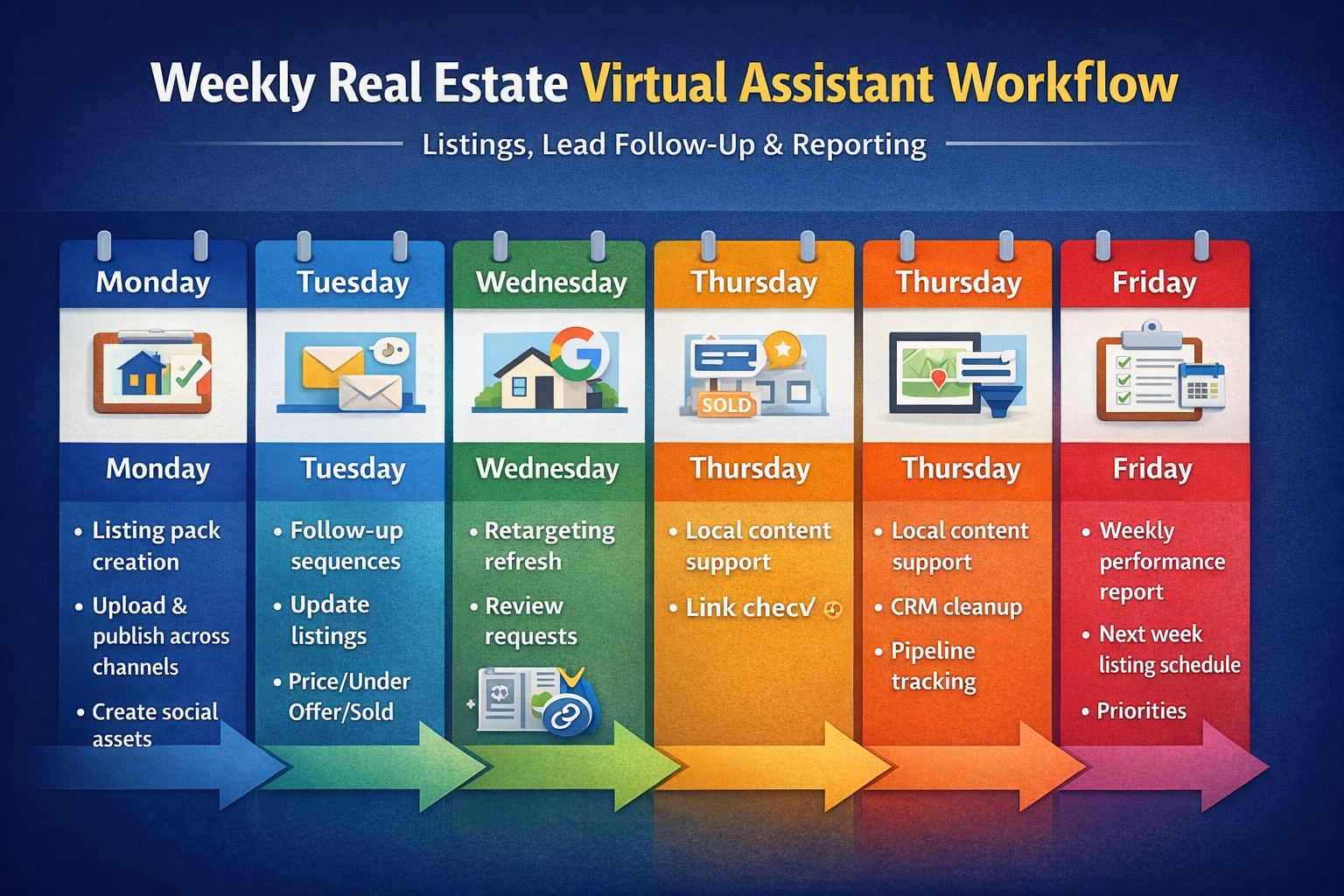
A simple VA-run weekly workflow for property advertising
Monday
- Listing pack creation for new instructions
- Upload and publish across channels
- Create social assets
Tuesday
- Follow-up sequences for last week’s enquiries
- Update listings (price changes, under offer, sold)
Wednesday
- Retargeting audience refresh and link checks
- Review requests from recent buyers and sellers
Thursday
- Local content support (market update, suburb highlight)
- CRM cleanup and pipeline tracking
Friday
- Weekly performance report
- Next week, listing schedule and priorities
Common mistakes that kill performance (even on the best portals)
- Publishing with weak photo order (best photo not first)
- Generic descriptions that could describe any house
- No lead routing, leads sit too long in inboxes
- No UTMs or tracking, you cannot prove ROI
- Treating social as branding only, instead of lead capture plus retargeting
- No listing refresh cycle, stale listings decay over time
Example: how this looks in practice
In a typical week, your VA coordinates listing packs, publishes across portals and your website, repurposes content for social, and manages enquiry triage so buyers get a fast, professional response. Agents stay focused on viewings, negotiations, and vendor updates while the advertising engine stays consistent.

FAQs
What is the best place to advertise property listings?
The best place to advertise property listings is on real estate portals and MLS platforms used by local buyers and tenants. Supplement listing visibility with a branded website, a Google Business Profile, and retargeting ads to maintain visibility after first contact.
Should I pay for premium listings?
Pay for premium listings only when the property has strong photos, effective descriptions, and a fast agent response time. Premium placement increases exposure but does not fix low-quality listings.
How do I know which channel brings the best leads?
The best way to identify high-performing lead channels is through lead attribution. Use UTM parameters for links, call tracking tools, and CRM source tagging. Compare lead quality based on sales pipeline progression, not lead count.
What tasks should I delegate to a Real Estate VA?
Delegate operational tasks to a Real Estate VA to save time and improve consistency. Key tasks include:
- Listing pack creation
- Property upload and photo organization
- Description formatting
- Social media repurposing
- Enquiry triage and viewing scheduling
- CRM updates and weekly reporting
Can a VA handle enquiries without hurting the client experience?
A trained Real Estate VA can improve the client experience by ensuring fast, consistent replies. Use scripts, escalation rules, and response time targets to maintain quality.
Book a call
If you want property advertising that generates more enquiries without adding admin chaos, we can help.
Our Real Estate Virtual Assistants support listing coordination, multi-channel publishing, lead response workflows, and reporting so you can scale volume while staying consistent.
Book a call, and we will map the exact tasks to delegate, the tools to use, and the weekly workflow to run.
What does the verb “advertise” mean in English grammar?
The word “advertise” is a transitive verb in English grammar. It means offering or making something known, generally for commercial purposes, using different media, such as newspapers, radio, TV, social media, or other online platforms.
Are there any differences in the usage of “advertise” between American English and British English?
Indeed, there are some differences in the usage of “advertise” between American and British English. For instance, in American English, it is more common to use the verb “advertize” instead of “advertise.” Moreover, some expressions or terms related to advertising may differ between the two variants of English.
Can you provide some English terms related to advertising?
Some English terms related to advertising include marketing, promotion, branding, copywriting, media planning, ad campaign, target audience, call-to-action, conversion rate, and ROI (return on investment).
What is the difference between the dual masculine and neuter dual in English grammar?
In English grammar, dual masculine refers to a form of grammatical gender that refers to two male objects or persons. In comparison, neuter dual is a grammatical category that refers to two objects or things with no gender or that are gender-neutral. For example, “these two pens” would be dual masculine, while “these two chairs” would be neuter dual.
Where can I find word lists, synonyms, and dictionaries to improve my English vocabulary for advertising purposes?
Many resources are available online to improve your English vocabulary for advertising purposes, including dictionaries, thesauri, word lists, vocabulary quizzes, and language learning platforms. Some popular options include Merriam-Webster, Oxford English Dictionary, Thesaurus.com, Quizlet, and Duolingo. You can also read books, articles, and online content related to advertising to expand your knowledge of the topic and improve your language skills.
