

Outsourcing fails less from talent and more from structure. Most leaders delegate unclear work, then expect a vendor to create the clarity. This checklist is an operational framework for delegation: workflow design, vendor lifecycle management, measurable outcomes, and credential governance.
Key takeaways
- Start with one workflow that repeats weekly and blocks revenue or time.
- Define outputs and “done” before you pick a vendor or role type.
- Treat SOPs as the asset. The worker runs the SOP, you own priorities.
- Use least privilege, approvals, and clean offboarding to reduce risk.
- Validate with a paid test task and a simple scorecard.
- Track two numbers: hours saved and one workflow KPI.
- Scale scope after consistency, not after optimism.

Why this matters now
Small teams do not run out of ambition. They run out of operational capacity. Outsourcing can improve speed and resource allocation, but it also magnifies weak process design. One sloppy handoff becomes rework. One bad permission choice becomes an incident.
Deloitte’s research on modern sourcing highlights the need to govern and manage an “extended workforce ecosystem.” You do not need enterprise bureaucracy. You need governance that stays lightweight and consistent.
The operating model that keeps control
Harvard Business Review captured the core warning in one sentence: “Think outsourcing eases leadership burdens? Think again.”
Use this model:
- You own the outcome and priorities.
- The outsourced worker runs a defined workflow.
- Edge cases route through escalation and approvals.
When you run this system, you build business continuity because the company stops relying on one person’s memory.
Choose the right engagement model first
Most teams document the work, then discover they chose the wrong model. Flip it.
Pick the engagement model based on repeatability and risk:
- Project outsourcing: one deliverable with a deadline (migration, website, one-off build).
- Staff augmentation: a dedicated person inside your tools, managed by you.
- Business Process Outsourcing (BPO): a repeatable process handed off end-to-end with defined inputs and outputs.
- Managed services: you buy service levels, cadence, reporting, and coverage.
Rule of thumb:
- Choose project when work ends.
- Choose dedicated when work repeats and needs context.
- Choose BPO/managed when you want service levels and coverage.
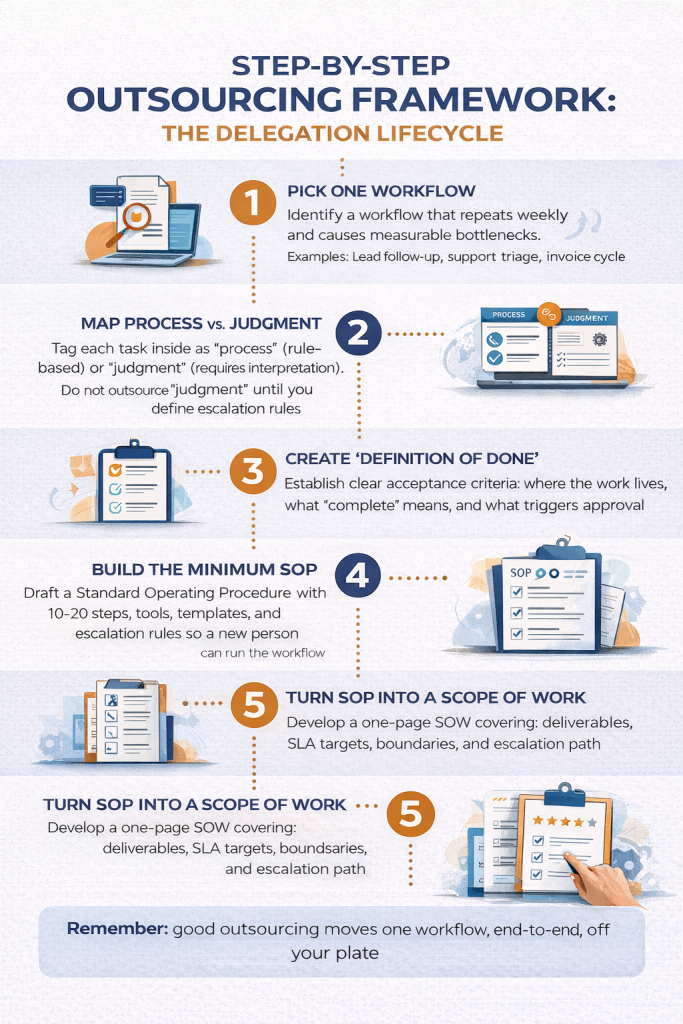
Step-by-step outsourcing framework (the delegation lifecycle)
Step 1: Pick one workflow with a measurable bottleneck
Choose a workflow that repeats weekly and creates friction.
Examples:
- Lead follow-up from inquiry to booked call
- Customer support triage to resolution
- Invoice cycle from issuance to payment
- Content publishing from draft to live
Write the bottleneck as one sentence:
“Growth stalls because ______.”
Step 2: Separate process from judgment from leadership
Tag each task inside the workflow:
- Process: rule-based, repeatable, easy to QA
- Judgment: requires interpretation, but can follow escalation rules
- Leadership: strategic direction, final approvals, accountability
Do not outsource leadership early. Outsource process first. Add judgment later with guardrails.
Step 3: Create a “definition of done” before you write anything else
A good definition of done includes:
- where the work lives (tool, folder, ticket)
- what “complete” means (fields filled, status updated, proof attached)
- what triggers approval (refunds, pricing, bank changes, contract edits)
- what gets logged (notes, timestamps, tags)
This reduces rework more than any other step.
Step 4: Build the minimum SOP that someone else can run
Aim for:
- 10–20 steps
- exact tools
- templates
- 3 examples of finished work
- edge cases and escalation rules
If a new person cannot run it without extra explanation, the SOP is not done.
Step 5: Turn the SOP into a one-page scope of work
A scope of work prevents drift and reduces back-and-forth.
Include:
- deliverables and format
- SLA targets (response times, turnaround times)
- acceptance criteria (what “done” means)
- boundaries (what is excluded)
- escalation path and approval rules
- reporting cadence (weekly scorecard)
Step 6: Validate with a paid test task and scorecard
Use a real task with a rubric:
- Accuracy (0–5)
- Completeness (0–5)
- Communication (0–5)
- Edge-case handling (0–5)
This gives you signal fast and sets expectations.
Step 7: Install credential governance (least privilege architecture)
Most outsourcing disasters start with access, not intent.
NIST defines least privilege as restricting access privileges “to the minimum necessary to accomplish assigned tasks.”
Minimum security baseline:
- MFA on email, CRM, support, finance tools
- password manager for credential sharing
- separate user accounts, no shared admin logins
- approval gates for money movement and sensitive changes
- offboarding checklist: revoke access, rotate credentials, archive work
Cyber risk is not theoretical. IBM’s Cost of a Data Breach Report shows the global average breach cost was USD 4.4M in 2025.
Step 8: Run one operating cadence and keep it boring
Pick one stack and enforce it:
- Communication: Slack or Teams
- Task tracking: Asana, ClickUp, or Trello
- SOP home: Notion or Google Drive
Daily update format:
- Done
- In progress
- Blockers
- Decisions needed
- Next actions
Weekly review:
- KPI snapshot
- wins
- issues
- SOP fixes
- next priorities
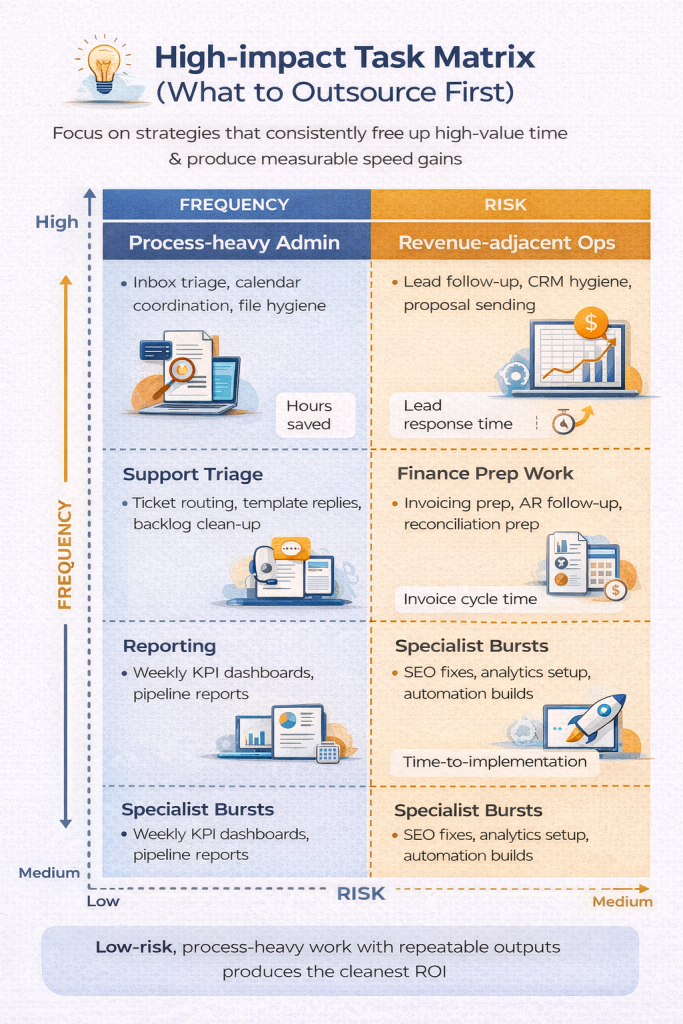
High-impact task matrix (what to outsource first)
Use this to avoid scattering random tasks.
| Task type | Frequency | Risk | Best first outsourced examples | KPI to track |
|---|---|---|---|---|
| Process-heavy admin | High | Low | inbox triage, calendar coordination, file hygiene | hours saved |
| Revenue-adjacent ops | High | Medium | lead follow-up, CRM hygiene, proposal sending | lead response time |
| Support triage | High | Medium | ticket routing, template replies, backlog clean-up | ticket backlog / first response time |
| Finance prep work | Medium | Medium | invoicing prep, AR follow-up, reconciliation prep | invoice cycle time |
| Reporting | Medium | Low | weekly KPI dashboards, pipeline reports | reporting timeliness |
| Specialist bursts | Low | Medium | SEO fixes, analytics setup, automation builds | time-to-implementation |
Avoid outsourcing first:
- pricing and positioning decisions
- vendor selection for critical systems
- cash movement approvals
- legal commitments and contract edits
- strategy ownership
Measurement framework (keep it simple)
Track only two numbers for the first 30 days:
- Hours saved (weekly)
- One workflow KPI (pick one): lead response time, ticket backlog, invoice cycle time, content publish cadence
If both improve, you scale scope. If one improves and the other declines, you fix the workflow before adding more work.
Common failure points and fixes (no repeats, only new signal)
Failure point: You outsource tasks, not handoffs
Fix: Define the handoff package (where it lives, what proof is attached, what status changes).
Failure point: You create “chat-based training”
Fix: Move answers into SOPs weekly. Reduce repeated questions by design.
Failure point: You add judgment work without escalation lanes
Fix: Create a decision tree and escalation rule before expanding scope.
Failure point: You lack change control
Fix: One owner per SOP. Add a change log. Review monthly.
Mini case snapshots
E-commerce follow-up system
Outsourced: inbox triage + order status templates + CRM updates
System: SOP + refund approvals + daily update
Outcome: faster responses and fewer founder interruptions
Agency delivery ops
Outsourced: project admin + asset hygiene + weekly report drafts
System: one task board + report templates + weekly review
Outcome: fewer late deliveries and cleaner client comms
Professional services governance
Outsourced: low-risk reporting + support triage
System: access matrix + least privilege + escalation rules
Outcome: better responsiveness with tighter risk control.

How long until outsourcing creates real ROI?
Outsourcing creates real ROI within 2 weeks when the workflow is defined, examples are provided, and a consistent cadence is enforced. Stable ROI occurs when the SOP no longer changes daily and the KPI improves weekly.
What is the fastest way to reduce outsourcing risk?
The fastest way to reduce outsourcing risk is by using a paid test task, limiting access with least-privilege permissions, and requiring approval for actions involving money, contracts, or user administration.
What should I ask an outsourcing partner to prove competence?
Ask an outsourcing partner to describe their process for scope definition, test tasks, reporting cadence, access control, and offboarding to prove competence. Vendor management maturity is as critical as labor delivery.
Next step
Start with one workflow, one SOP, one KPI. Install governance on day one. Expand only after the workflow runs clean for 30 days.
If you want, I can convert this into a clean “pillar page” layout with:
- and a downloadable one-page checklist version for lead capture.
- a stronger AEO definition block (under 60 words),
- a tighter internal linking map,
