

Ecommerce founders scaling past $200,000 USD in annual revenue run into a specific wall: order volume outgrows what one person can process by hand, well before marketing becomes the limiting factor. A founder who can review, tag, and route 15 orders a day manually cannot do the same for 150. This guide covers how to hire, structure, and manage an ecommerce virtual assistant team so the business stops depending on the founder’s personal hours, using Aristo Sourcing’s placement data, named third-party research, and four management frameworks applied directly to store operations.

Why Ecommerce Founders Hit an Operational Ceiling Between $200K and $2M
Marketing rarely breaks a store at this stage. Operations usually do, since no amount of extra ad spend fixes a fulfillment queue that is already at capacity. Three specific constraints cap revenue in this band.
- Order management complexity. Manual order processing has a hard ceiling, and once daily volume exceeds what one person can review by hand, errors compound: wrong addresses, missed customizations, duplicate shipments.
- Inventory synchronization failures. A store selling on Shopify, Amazon, and a marketplace like Walmart needs real-time stock counts across all three. Without a synced system, oversells happen, and oversells on Amazon damage seller metrics directly.
- Slower customer service response times. Response time carries real financial weight. According to LeadResponse’s 2026 customer response time research, moving first response time from four hours to under one hour raised email-attributed conversion by 18%, and customers contacted within five minutes convert 21 times more often than those contacted later. Other research on support response benchmarks puts the industry average first response time at four to six hours, against a customer expectation, per the same research, of under one hour 89% of the time. That gap between expectation and delivery is where churn starts.
A better marketing plan will not close that gap. Executing the plan the store already has, with more people on the operational side, will.

What Does an Ecommerce Virtual Assistant Actually Do? The Modern VA Tech Stack
“Hire a VA for customer service” was reasonable advice in 2012. It is incomplete now, because a competent ecommerce VA rarely handles one task in isolation. They run a connected stack of platforms and AI-assisted tools across the day.
| Role | Core platforms and tools | Primary responsibility |
|---|---|---|
| Customer Experience Specialist | Gorgias, Zendesk | Sorts and routes support tickets, compiles chargeback and A-to-Z evidence packages |
| Catalog and Inventory Specialist | Amazon Seller Central, Shopify, Helium 10, Inventory Planner, ShipStation, ShipBob, Ordoro | Manages listings, safety stock, SKU rationalization, supplier POs, 3PL coordination |
| Marketing and Admin Support | Klaviyo, Zapier, Make.com | Builds email campaigns, coordinates UGC and influencer outreach, connects platform handoffs |
Customer Experience Specialist: Chargeback Defense and Ticket Routing
Gorgias and Zendesk both offer AI-assisted routing that pre-sorts tickets by urgency and topic, which frees the human VA to handle disputes and edge cases that need judgment. This role also compiles evidence packages for chargeback disputes and A-to-Z Guarantee claims within Amazon’s required windows, a task that rewards someone who understands the platform’s dispute process, not just customer tone.
Catalog and Inventory Specialist: Amazon FBA and Multi-Channel Stock
This role owns product listings across Shopify, Amazon Seller Central, eBay, and WooCommerce. Day to day work includes safety stock calculations, SKU rationalization, supplier purchase order initiation, and 3PL coordination. Anyone searching for how to hire an Amazon FBA virtual assistant is describing this role specifically: someone who tracks FBA inventory health and catches ASIN suppression risk before it happens.
Marketing and Admin Support: Campaign Assembly
A marketing VA builds Klaviyo email campaigns and coordinates content and outreach, while Zapier or Make.com connects the handoff so a new order or review triggers the next step automatically rather than sitting in someone’s inbox.

The Eisenhower Matrix: Deciding What to Delegate
Dwight Eisenhower is credited with the line, “What is important is seldom urgent, and what is urgent is seldom important.” Stephen Covey later built this into a matrix with four quadrants, and it works as a direct filter for what goes to a VA.
| Quadrant | Example ecommerce task | Who owns it |
|---|---|---|
| Urgent, not important | Routine shipping question, tracking update, standard return | Virtual assistant |
| Not urgent, not important | Spreadsheet formatting, ticket archiving | Virtual assistant |
| Important, not urgent | Supplier negotiation, product development, brand positioning | Founder, once time is freed up |
| Urgent and important | Strategic or financial decisions with real risk | Founder only |
Most founders never make this split explicit. They delegate reactively, based on whatever feels most irritating that week, which is why delegation often fails to reduce their hours. Running the actual task list through this matrix before hiring shows exactly which role to hire for first.

Work ON Your Business, Not IN It: The E-Myth Applied to Ecommerce
Michael Gerber’s The E-Myth Revisited names a specific failure pattern:
“The fatal assumption is: if you understand the technical work of a business, you understand a business that does that technical work.”
A founder who is excellent at sourcing products or designing a storefront is not automatically equipped to run the operational machine underneath the business. Gerber splits every owner into three roles: the Technician, who does the work, the Manager, who plans and measures it, and the Entrepreneur, who sets direction. Most ecommerce founders start as Technicians out of necessity. The problem is staying there. A founder still personally answering every support ticket at $800,000 USD in revenue is not running a business; they are running a demanding job with employees. Hiring a VA only fixes this if the founder actually moves into the Manager and Entrepreneur roles once the Technician work is handed off, since moving tasks without changing your own role just relocates the bottleneck.

Finding the Real Bottleneck: The Theory of Constraints
Eliyahu Goldratt introduced the Theory of Constraints in his 1984 book The Goal, arguing that a system has exactly one constraint limiting its output at any given time, and improving anything other than that constraint does not increase throughput.
Apply this before hiring. If the real constraint is manual order processing, hiring a marketing VA does nothing for revenue, because fulfillment speed still caps how many orders the store can deliver. If the constraint is Amazon account health, hiring for email campaigns does not touch it either. Amazon’s Account Health policy calculates Order Defect Rate over a trailing 60 day window, combining negative feedback, A-to-Z Guarantee claims, and chargebacks, and sellers who cross the 1% threshold get 17 days to submit a corrective Plan of Action before facing suspension. Amazon’s own guidance notes the median seller operates between 0.3% and 0.8%, with experienced sellers setting internal alerts at 0.5% to stay ahead of it. Identify the actual constraint first, then hire the role that relieves it.

Who Owns What: A RACI Matrix for Founder, Operations, and VA
A RACI matrix assigns four roles to every task: who is Responsible for doing it, who is Accountable for the outcome, who needs to be Consulted, and who needs to be Informed. It exists to remove the ambiguity that causes dropped tasks and duplicated work.
| Task | Founder | Operations Manager | Specialist VA |
|---|---|---|---|
| Supplier price negotiation | Accountable | Consulted | Informed |
| Inventory reorder points | Consulted | Accountable | Responsible |
| Customer refund under $50 | Informed | Consulted | Responsible, Accountable |
| Brand positioning decisions | Responsible, Accountable | Consulted | Informed |
| Sorting and routing tickets daily | Informed | Accountable | Responsible |
Founders who skip this exercise tend to default to being Accountable for everything by habit, which recreates the bottleneck they hired a VA to solve in the first place. A five-row table built before onboarding prevents most of the confusion that shows up in the first month.

How to Document a Process So a Virtual Assistant Can Run It: The SOP Framework
A founder cannot hand off a task that exists only in their head. Building a usable SOP takes three steps:
- Record it. Use Loom to capture the screen while narrating what you’re doing and why, not just the clicks.
- Write it up. Convert the recording into a step-by-step document in Notion, or use Scribe, which auto-generates a screenshot-based SOP directly from screen activity.
- Add the exception path. Every SOP needs a clear answer for what to do when a case doesn’t match the standard pattern, and when to escalate to the founder instead of guessing.
Without a written SOP, onboarding a new VA takes weeks of live correction. With one, a new hire can run the process correctly from day one.

The Real Cost of Scaling: In-House Hire vs a Managed Virtual Assistant
Glassdoor’s 2026 salary data puts a US-based ecommerce operations manager at roughly $124,600 USD a year in base salary; Salary.com’s 2026 figures run closer to $139,700 USD. Either way, that’s before payroll tax, benefits, or the cost of a bad hire.
| In-house US ops hire | Managed VA (Philippines or South Africa) | |
|---|---|---|
| Base annual cost | Roughly $125,000 to $140,000 (Glassdoor, Salary.com, 2026) | Aristo Sourcing states pricing runs up to 70% less than a local hire |
| Vetting | Founder’s own process, time cost included | Skills test, platform knowledge assessment, live interview |
| Time to hire | Weeks to months, plus a prior employer’s notice period | 5 to 10 business days from engagement to placement |
| Risk if it doesn’t work out | Severance, rehiring cost, lost time | Replacement guarantee: account manager sources a new candidate |
| Ongoing task direction | Founder or internal manager, directly | Founder or internal manager still directs daily work; Aristo Sourcing handles recruitment and placement, not day-to-day task management |
That last row is the reason the SOP and RACI sections above aren’t optional extras. They’re the mechanism that makes a staffing partnership function at all.
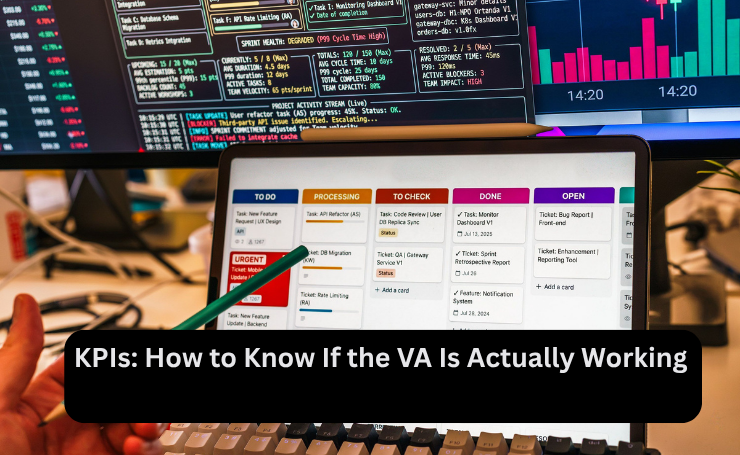
KPIs: How to Know If the VA Is Actually Working
| KPI | What it measures | Why it matters |
|---|---|---|
| First Contact Resolution (FCR) | Percentage of tickets closed without a follow-up message | A rising FCR means the VA and the SOPs are resolving issues correctly the first time |
| Order Processing Error Rate | Wrong items, addresses, or customizations per 100 orders | Earliest warning sign of a training or SOP gap, before it hits account health |
| Listing Health Score | Missing attributes, suppressed listings, incomplete variants on Amazon and Shopify | Catches problems before they suppress sales |
| Order Defect Rate | Combined negative feedback, A-to-Z claims, and chargebacks over 60 days | Keeping this near 0.3% to 0.8% protects Buy Box eligibility, which can be lost for up to 60 days once ODR crosses 1% |
| Chargeback win rate and cost per dispute | Dollar cost per chargeback, and how many are successfully disputed | LexisNexis’s 2026 True Cost of Fraud study found merchants absorb roughly $5 in total related costs for every $1 lost directly to a chargeback |
A VA compiling a strong evidence package before a dispute deadline isn’t doing paperwork. The LexisNexis figure above is what that paperwork is actually worth.

Data Security and Access Control
- Use a password manager. 1Password or LastPass share credentials without typing them into chat or email.
- Grant role-based access, not master logins. Shopify’s staff permission system scopes a VA to specific sections (orders, products, discounts). Amazon Seller Central’s user permissions work the same way.
- Sign an NDA before day one. Not after onboarding starts.
- Put a written data handling agreement in place. Covers what the VA can access, export, and store, and for how long.
None of this is optional once real inventory and customer data move through a third party. It’s the baseline, not the upgrade.
Managed VA Team vs Freelance Marketplaces
Upwork, Fiverr, and OnlineJobs.ph give direct access to individual freelancers, which works fine for a single, well-defined task. The failure mode shows up when a founder needs a reliable, ongoing operational hire and treats it like a one-off freelance job instead.
Aristo Sourcing runs candidates through a multi-stage screening process, a skills test, a platform knowledge assessment across Amazon Seller Central, Shopify, eBay, Walmart Marketplace, WooCommerce, and Magento, and a live interview, before a client sees a shortlist. The company reports a 93% staff retention rate, places most candidates within 5 to 10 business days, and assigns a dedicated account manager after placement to handle scaling and, per its stated policy, source a replacement if a placement isn’t working out. Staff are recruited specifically from the Philippines and South Africa, which matters for time zone alignment with US and UK founders and for consistent vetting standards. A freelance marketplace gives a resume. A managed model gives a vetted hire, a backup plan, and a point of contact.
What This Looks Like in Practice
Lesley Koekenbier, co-founder of Aiver Sport, brought on support specifically to get a new online store live faster than her team could manage alone:
“We needed help getting our website up and running and adding a huge amount of products in our new online store.”
That’s the catalog and inventory role, applied at launch rather than at the scaling stage.
Richard Hill, founder of UK-based Ecom1, has expanded gradually rather than hiring once and stopping:
“We just confirmed our fourth hire with them.”
Four hires over 18 months, added as different operational bottlenecks surfaced, which is the RACI and Eisenhower filters working as intended: hire for the clearest constraint first, prove it, then add the next role.
Kasra Dash, of BrightonSEO, put it directly:
“Aristo Sourcing has been instrumental in helping scale my business with their cost-effective and high-quality outsourcing solutions.”
Getting Started
- Run the task list through the Eisenhower Matrix.
- Identify the real constraint using the Theory of Constraints.
- Write a one-page RACI for that specific process.
- Record a Loom walkthrough and turn it into a written SOP.
- Book a discovery call to define the role.
- Review a shortlist from Aristo Sourcing’s screening pipeline, typically within days.
- Interview top candidates and confirm placement, usually within 5 to 10 business days.
A free pricing calculator is available on the site for a cost estimate before that first call. Identify the constraint, document the process, hire against it, then measure the result with the KPIs above. That sequence determines whether this works for a given store, not how many people get hired.
Ready to build your operational layer? Schedule an exploratory sourcing call.
