

Sunday night arrives. You open your laptop to “just check a few things.” Within minutes, you fix a design draft, reply to emails, chase a deadline, and rewrite a caption that should already be done. You move between Slack messages, Asana boards, and Google Docs, trying to connect instructions with output. You do not review work. You rebuild it.
This is not a time problem. This is an operations problem.
Most creative agencies start by outsourcing to freelancers or independent contractors. That feels fast and flexible. But as the workload grows, outsourcing without structure increases management overhead. You spend more time coordinating work than producing results. Harvard Business Review reports that managers spend more than half their time on communication and coordination.
This is the Freelancer Trap.
Freelancers handle tasks, but they do not manage systems. As your agency grows, you take on:
- Project management across tools like Asana or Monday.com
- Quality control on design files in Canva or Adobe Creative Cloud
- Communication across Slack or email
- Onboarding and training
- Replacements when freelancers leave
You become the system that keeps everything running.
As one agency owner said, “I thought I was hiring help. I actually hired more work for myself.”
Here is the key shift:
When comparing BPO providers vs. freelancers, the decision is not about hourly cost. It is about operational ownership.
- Freelancers provide execution
- BPOs provide systems that manage execution
If you own the process, you carry the pressure. If your partner owns the process, you gain control.
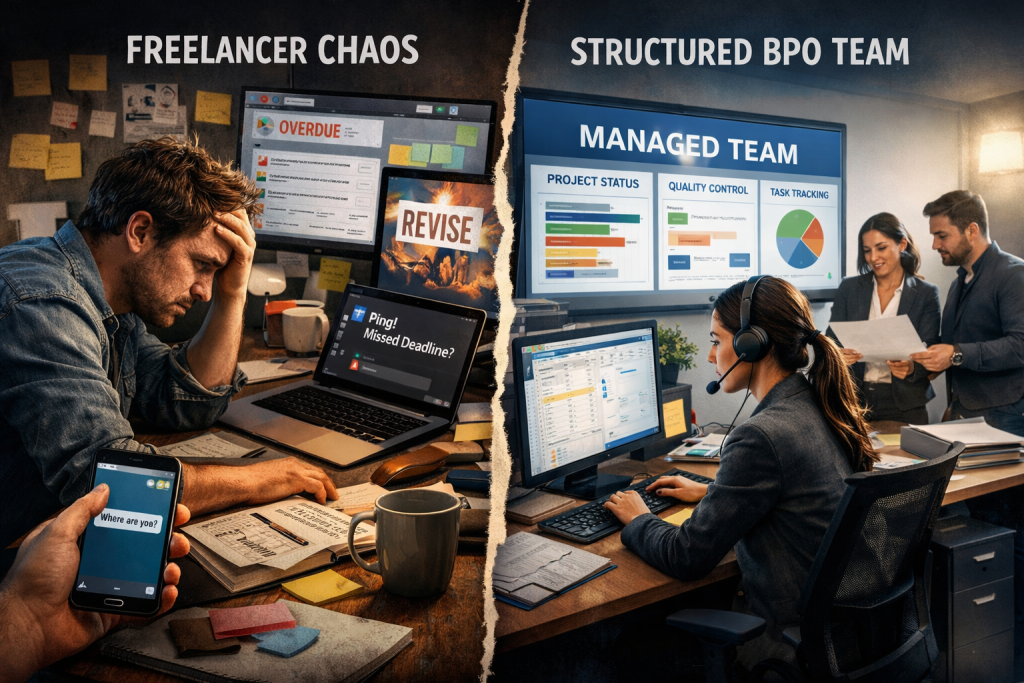
Defining the Players: Freelancer vs BPO vs Creative Partner
Freelancer (Independent Contractor)
A freelancer is an independent contractor who completes specific tasks. Most agencies hire freelancers for design, video editing, paid ads, or content writing. They work across multiple clients and manage their own schedules.
They provide flexibility, but they also create dependency.
A freelancer:
- Works independently
- Uses their own tools
- Handles multiple clients at once
- Does not provide backup
If they stop, your workflow stops. If they misunderstand your brand, you correct them. If they leave, you restart the process.
They deliver output. You manage everything around it.
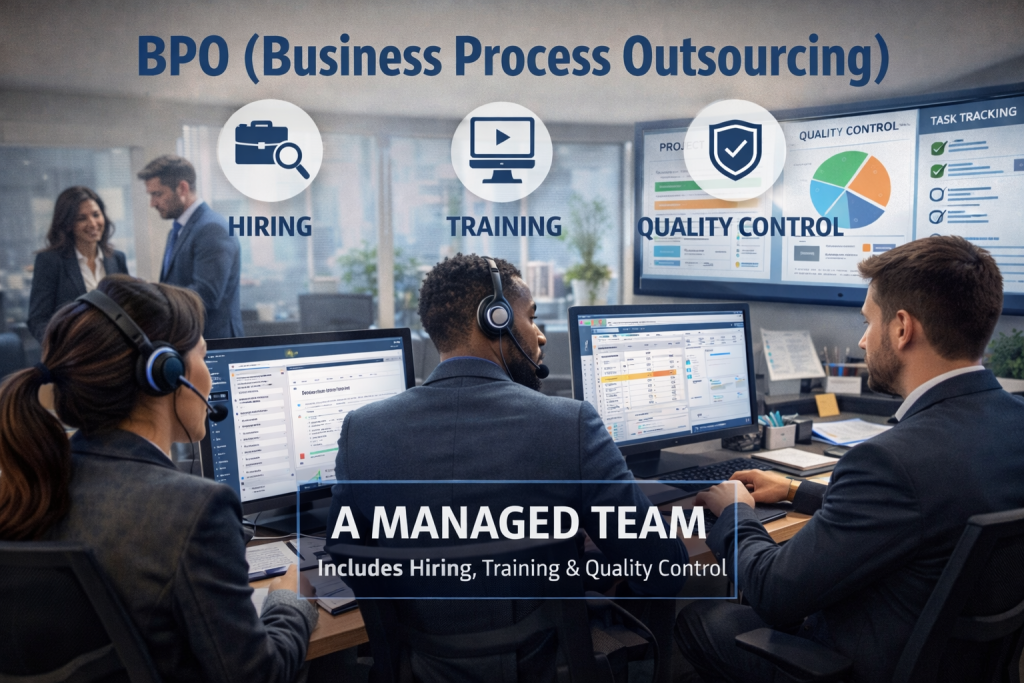
BPO (Business Process Outsourcing)
A BPO provides a managed outsourcing system.
You do not hire a person. You outsource a function.
That includes:
- Recruitment
- Training
- Performance management
- Quality control
- Replacement staff
You define what needs to happen. The BPO ensures that it happens.
McKinsey research shows that companies with structured processes reduce errors and rework by up to 30%. That happens because systems retain knowledge, not individuals.
A BPO manages the work. You manage the outcome.
The Specialized Creative BPO: Aristo Sourcing
Creative work requires context. Brand tone, visual consistency, and client expectations matter. Generic outsourcing providers often miss this.
Aristo Sourcing bridges that gap.
You get:
- Creative virtual assistants
- Design and content support
- Structured workflows and SOPs
- Managed teams with accountability
You do not manage freelancers. You operate with a system.
Creative output backed by operational control.
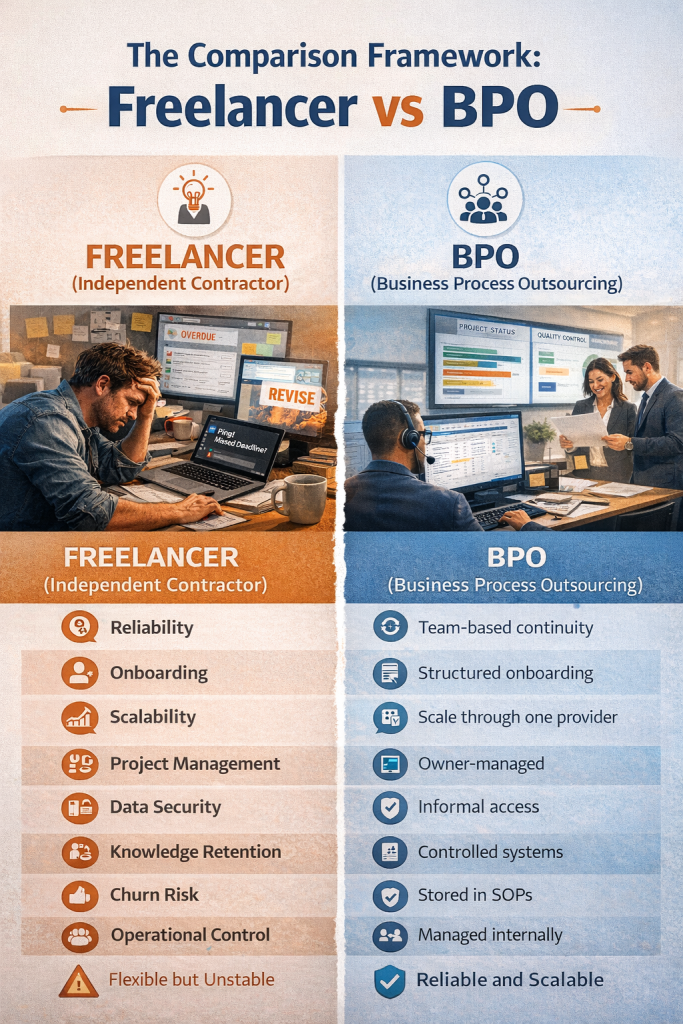
The Comparison Framework: Freelancer vs BPO
| Factor | Freelancer (Independent Contractor) | BPO / ArtistSourcing |
|---|---|---|
| Reliability | Single point of failure | Team-based continuity |
| Onboarding | You train each person | Structured onboarding system |
| Scalability | Hire one by one | Scale through one provider |
| Project Management | Owner-managed | Managed internally |
| Data Security | Informal access | Controlled systems |
| Knowledge Retention | Leaves with person | Stored in SOPs |
| Churn Risk | High | Managed internally |
| Operational Control | You own it | Shared or outsourced |
| Risk | Business continuity risk | Operational stability |
Key takeaway:
Freelancers give you flexibility.
BPOs give you reliability and scalability.
Where the Real Difference Shows
Reliability & “Ghosting” Risk
Freelancers control their schedules. That flexibility benefits them, but it introduces risk for you. If they take on more work, miss deadlines, or disappear, your projects slow down.
Your business depends on one person.
A BPO spreads responsibility across a system. Teams document work, share access, and follow processes. If one person becomes unavailable, another steps in.
As one operations manager said, “We don’t depend on people. We depend on process.”
Freelancer = interruption risk
BPO = continuity
Onboarding and Training: The Context Debt Problem
Every new freelancer needs context. You explain your brand, your clients, your tools, and your standards. That process takes time and rarely stays documented.
This creates context debt.
You repeat instructions. You fix the same mistakes. You rebuild knowledge that should already exist. Over time, this slows your agency.
A BPO removes this repetition.
They build SOPs, document workflows, and retain knowledge inside the system. New team members follow structured onboarding instead of starting from zero.
Freelancer = repeated training
BPO = compounding knowledge
Scalability Without Chaos
Scaling with freelancers means hiring more people. Each hire requires sourcing, interviewing, testing, and onboarding. That process adds friction.
Growth increases complexity.
A BPO simplifies scaling. You request more capacity, and the system expands. The provider handles hiring, onboarding, and management.
As one agency owner explained, “Scaling freelancers multiplied my problems. Scaling a system reduced them.”
Freelancer = more management
BPO = controlled growth
Data Security and Client Risk
Agencies manage sensitive data:
- Client logins
- Ad accounts
- Financial data
- Brand assets
Freelancers often access this data through shared passwords or informal systems. That creates risk.
Deloitte reports that more than 60% of small businesses face data exposure due to poor access controls.
A BPO uses structured systems:
- Permission-based access
- Internal policies
- Secure workflows
Freelancer = informal access
BPO = managed security
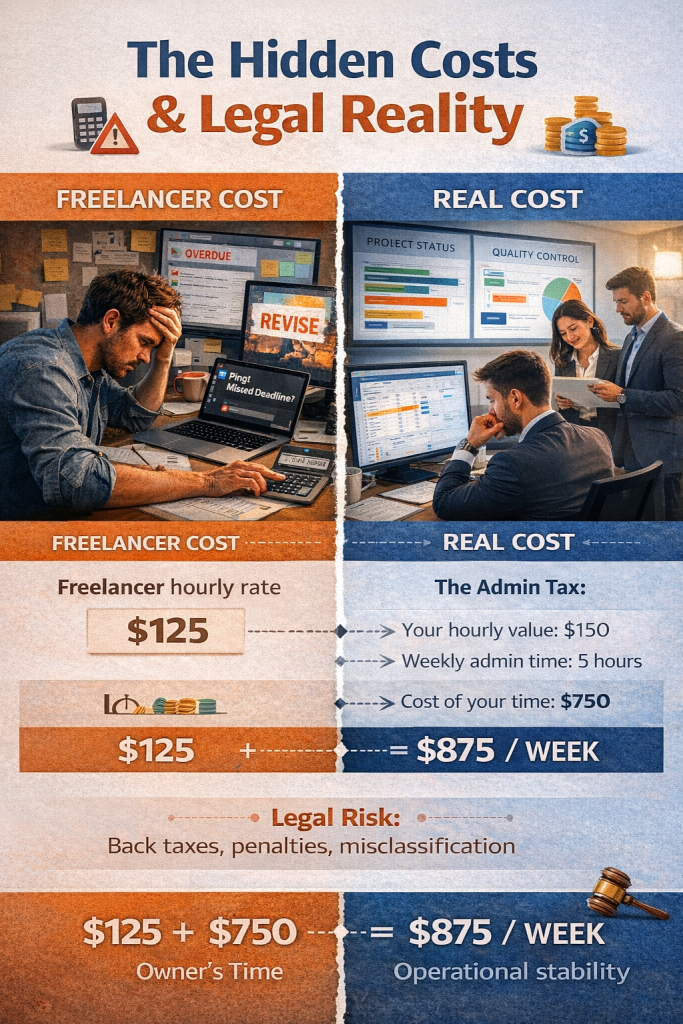
The Hidden Costs & Legal Reality
Freelancers often look cheaper. But you must calculate total cost, not hourly rate.
The Admin Tax (Real Cost of Freelancers)
| Item | Value |
|---|---|
| Your hourly rate | $150 |
| Weekly management time | 5 hours |
| Cost of your time | $750 |
| Freelancer cost | $125 |
| Total real cost | $875/week |
You pay for output. You also pay for:
- Project management
- Follow-ups
- Corrections
- Rework
Your time becomes the most expensive part of the system.
The Churn Penalty
Freelancers change. Every few months, you may need to replace them. That requires sourcing, vetting, testing, and onboarding.
Each cycle costs time and breaks momentum.
As one founder said, “I didn’t scale. I kept rebuilding the same role.”
A BPO absorbs churn. The system stays stable even when people change.
Misclassification: The “Right to Control” Test
Regulators such as the IRS and Department of Labor use a simple principle:
Who controls how the work gets done?
If you:
- Set hours
- Direct daily work
- Depend on one contractor long-term
You may classify a freelancer as an employee.
That can lead to:
- Back taxes
- Penalties
- Legal exposure
Rule of thumb:
If you tell them what to do, they are a contractor.
If you tell them how, when, and where to do it, they are likely an employee.
A BPO reduces this risk because they manage the worker.
Service Level Agreements (SLAs)
An SLA defines expectations in writing.
It sets:
- Turnaround times
- Quality standards
- Accountability
Freelancers rarely formalise this. BPOs rely on it.
An SLA creates measurable performance.
Intellectual Property (IP) Protection
Your creative work must stay protected.
Freelancers often work across borders with limited legal structure. That can create uncertainty around ownership.
A BPO uses contracts, policies, and access control to protect your assets.
Your work remains yours.
Real-World Scenarios
Scenario A: Project-Based Work (Freelancer)
You need a website redesign. The scope is clear and the timeline is fixed. You hire a freelancer to deliver a specific outcome.
This works well.
Scenario B: Ongoing Creative Operations (Aristo Sourcing)
You need consistent output:
- Social media management
- Video editing
- Design updates
- Inbox support
This requires structure.
Aristo Sourcing provides creative virtual assistants and design support within a managed system. The work continues without daily oversight.
Consistency requires systems, not individuals.
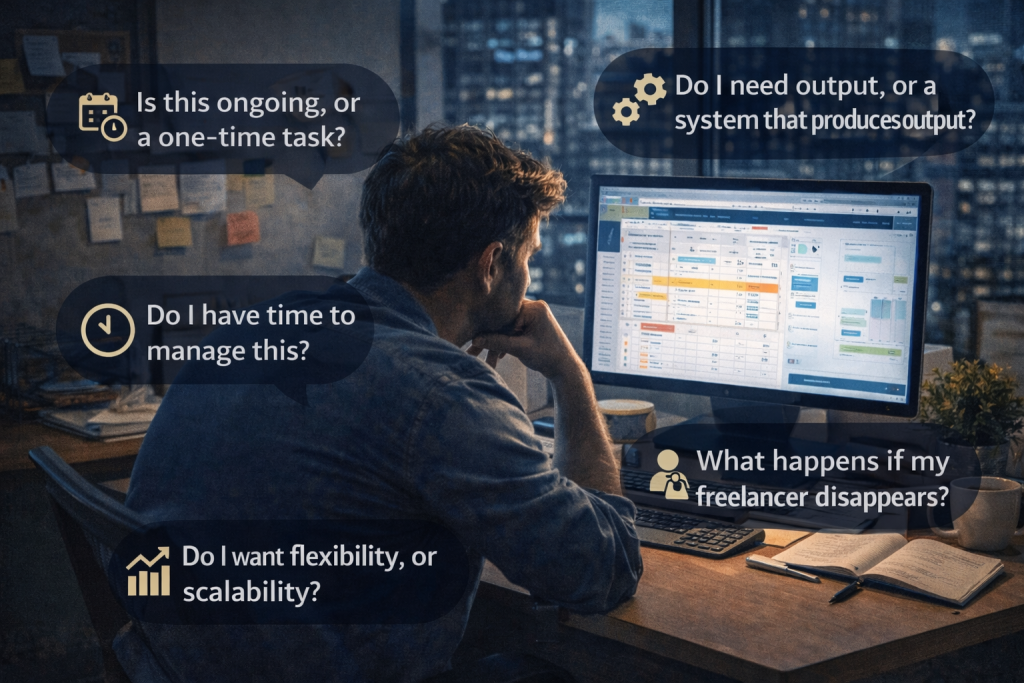
Decision Framework: What Do You Actually Need?
Ask these questions:
- Do you need this done once, or every day?
- Do you want output, or a system that produces output?
- Can you spend 10+ hours each month managing people?
- What happens if your freelancer disappears tomorrow?
- Do you want flexibility, or scalability?
If your work is ongoing, you need structure.
Growth depends on systems, not individuals.
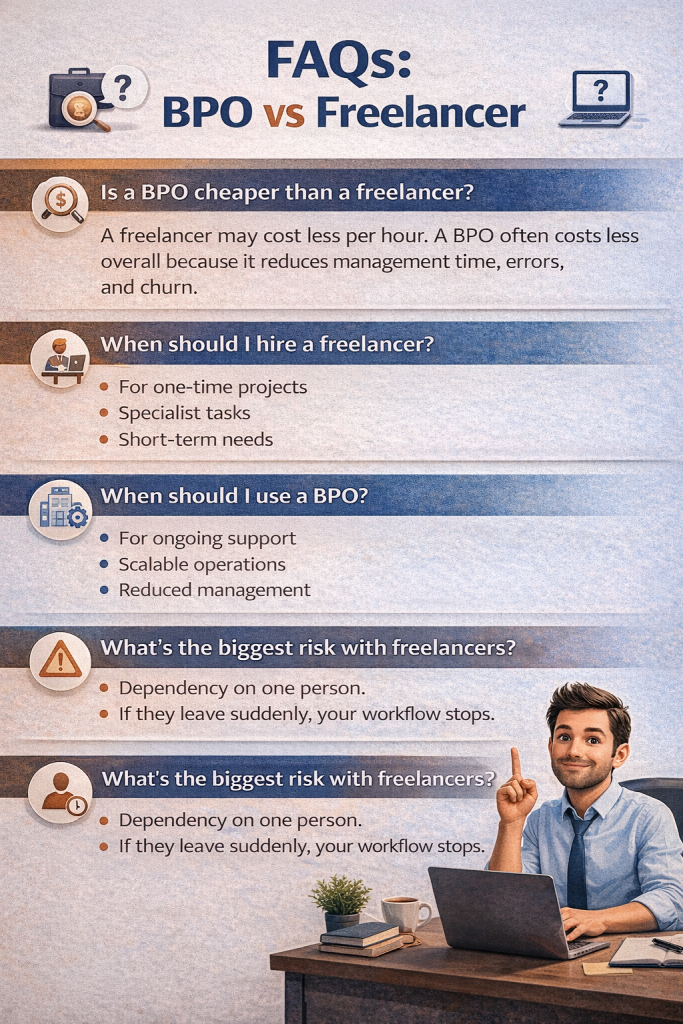
FAQs: BPO vs Freelancer
Is a BPO cheaper than a freelancer?
A freelancer may cost less per hour. A BPO often costs less overall because it reduces management time, errors, and churn.
When should I hire a freelancer?
Use freelancers for:
- One-time projects
- Specialist tasks
- Short-term needs
When should I use a BPO?
Use a BPO when you need:
- Ongoing support
- Scalable operations
- Reduced management overhead
- Reliable output
What is the biggest risk with freelancers?
The biggest risk is dependency on one person. If they leave, your workflow stops.
What does Aristo Sourcing provide?
Aristo Sourcing provides:
- Creative virtual assistants
- Design and content teams
- Managed workflows
- Operational systems
You get output without constant oversight.
Conclusion: Move From Output to Ownership
Freelancers help you start. Systems help you scale.
Outgrowing freelancers means your business is working. It means demand has increased and your operations need structure. You do not need more people. You need a system that runs without you.
Aristo Sourcing gives you that system.
If you want to see where your current setup slows you down, book a free consultation today.
You will identify gaps, reduce risk, and build a structure that supports growth without increasing your workload.
