
E-commerce outsourcing is hiring a third-party agency, freelancer, or dedicated team to manage specific parts of an online store’s operations instead of building that function in-house. According to Capital One Shopping’s 2025 market data, 60% of online retailers outsource at least part of their fulfillment process. That same approach extends well beyond fulfillment into customer support, marketing, and day-to-day business operations.
Store owners typically start by handing off one function, customer support or catalog entry, then expand from there as volume grows. Below: which functions you can delegate, what the benefits and trade-offs look like, when it’s actually worth doing, what it costs, and how to pick a provider.
What Is E-Commerce Outsourcing?
E-commerce outsourcing means delegating specific online-store functions, like support, fulfillment, or marketing, to an external provider instead of building that capability in-house. Providers range from full-service agencies and specialized 3PLs to individual freelancers and offshore teams, each suited to different scopes of work.
It’s a specific application of the broader business process outsourcing model, adapted to the tools and workflows an online store actually runs on. Understanding what gets outsourced is only half the picture, though; the mechanics of how that handoff actually happens matter just as much.
How Does E-Commerce Outsourcing Work?
E-commerce outsourcing works by first identifying which tasks are repetitive or non-core, the ones pulling time away from strategy rather than requiring a founder’s direct judgment. From there, a business picks both a provider and a model, project-based, dedicated team, or per-task, depending on how much ongoing support the work actually needs.
Onboarding follows next, connecting the provider to existing tools like a CRM, helpdesk, or inventory system, and setting clear SLAs so expectations are defined upfront rather than assumed. Once live, the relationship is managed through regular check-ins and performance reviews, scaling the engagement up or down as order volume and business needs shift over time.
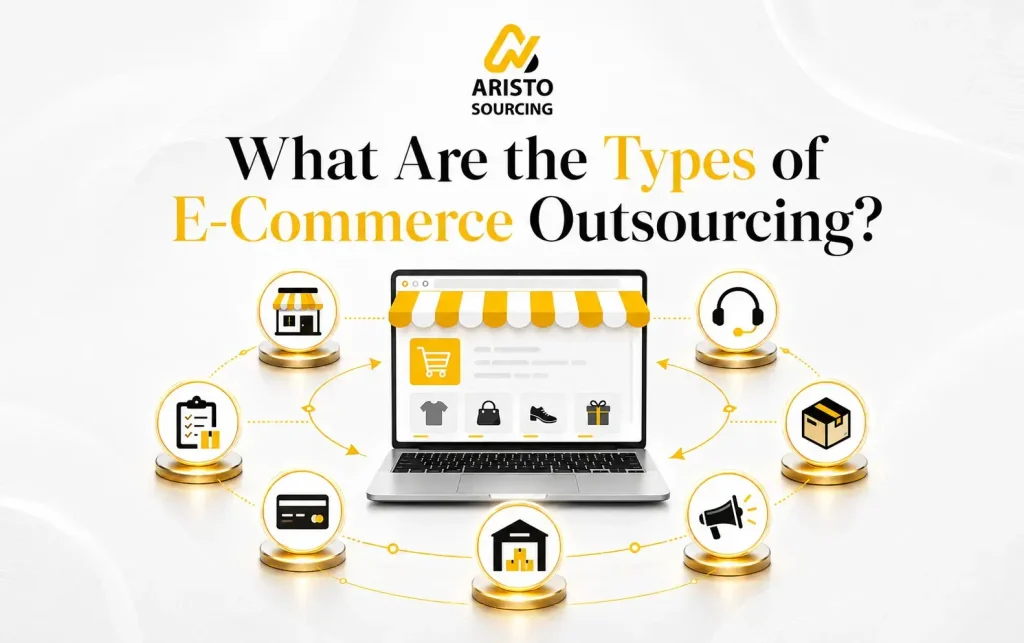
What Are the Types of E-Commerce Outsourcing?
E-commerce outsourcing splits across seven functions: support, logistics, marketing, web development, data entry, order management, and back-office finance. Each routes to its own dedicated breakdown below.
1. Customer Support
Customer support outsourcing covers phone, chat, email, and social responses to buyer questions, complaints, and order issues. It solves the problem of founders getting buried in tickets instead of running the business.
E-commerce sellers outsource customer support to protect response times during growth or seasonal spikes without hiring a full internal team. None of that support matters, though, if the orders behind those tickets aren’t handled well through order fulfillment and 3PL logistics.
2. Order Fulfillment and 3PL Logistics
Order fulfillment and 3PL logistics covers warehousing, picking, packing, and shipping, handled through a third-party logistics provider instead of an internal warehouse. It solves the capital and space problem of storing inventory in-house.
E-commerce sellers outsource fulfillment to avoid the fixed cost of warehouse space and staff, paying instead for space and labor as volume actually requires it. Fast shipping alone won’t bring in new orders, though, without digital marketing driving traffic to the store.
3. Digital Marketing (SEO, PPC, Social)
Digital marketing outsourcing covers SEO, paid ads, and social media management, run by an external specialist rather than an internal marketer juggling every channel. It solves the expertise gap most small teams face across three very different disciplines at once.
E-commerce sellers outsource marketing to access specialists in each channel instead of one generalist stretched too thin. All that traffic still lands on a storefront that depends on solid website development and maintenance to hold up.
4. Website Development and Maintenance
Website development and maintenance covers building, updating, and troubleshooting the storefront itself, from theme customization to app integrations. It solves the risk of a non-technical founder breaking something critical mid-launch.
E-commerce sellers outsource this to developers who already know platforms like Shopify or WooCommerce inside out, cutting both build time and error rate. A fast, working site still depends on accurate data entry and product listings behind every page.
5. Data Entry and Product Listings
Data entry and product listings covers uploading, formatting, and updating product titles, descriptions, images, and pricing across a catalog. It solves the sheer time drain of listing hundreds or thousands of SKUs manually.
E-commerce sellers outsource this to keep catalogs accurate and consistent without pulling founders or marketers into repetitive manual work. Accurate listings still can’t prevent the volume of work that shows up under order, returns, and refund management.
6. Order, Returns, and Refund Management
Order, returns, and refund management covers processing cancellations, exchanges, and refund requests according to store policy. It solves the operational drag of returns eating into time that should go toward growth.
E-commerce sellers outsource this to keep return turnaround fast and consistent, since slow refunds are a leading driver of bad reviews. Every refund processed here still has to reconcile cleanly through accounting and back-office work.
7. Accounting and Back-Office
Accounting and back-office outsourcing covers bookkeeping, reconciliation, tax prep, and financial reporting behind the scenes of the storefront. It solves the compliance risk of financial records falling behind as transaction volume grows.
E-commerce sellers outsource this to keep books accurate without hiring a full internal finance team too early, closing out the full range of functions a store can hand off to outside help.
What Are the Benefits of E-Commerce Outsourcing?
E-commerce outsourcing delivers six measurable advantages, starting with the one every founder asks about first: cost. From there, the gains extend into expertise, scalability, focus, efficiency, and the customer experience itself.
1. Lower Overhead Costs
Lower overhead costs mean spending less on a function than an equivalent in-house hire or department would require. E-commerce outsourcing achieves this by replacing salaries, benefits, and infrastructure with a single contract sized to actual need.
Deloitte’s Global Business Services Survey found that 55% of organizations with a dedicated global business services leader achieved savings exceeding 20% annually. Lean and bootstrapped stores gain the most here, since every dollar saved on overhead is a dollar available for growth, and that same lean structure only works if the provider brings real specialized expertise to the table.
2. Access to Specialized Expertise
Access to specialized expertise means tapping trained professionals in a specific function, like fulfillment or paid ads, without building that skill set internally from scratch. Outsourcing providers develop this depth by concentrating hiring in established talent hubs built specifically for these functions.
The Philippines’ IT-BPM sector alone closed 2025 with over $40 billion in export revenue and roughly 1.9 million workers, according to IBPAP, a depth of specialized talent few individual stores could recruit on their own. Stores lacking in-house specialists gain the most, and that same expertise only pays off if it can scale fast enough for peak-season demand.
3. Scalability for Peak Seasons
Scalability for peak seasons means absorbing sudden demand spikes, like Black Friday or Cyber Monday, without permanently overstaffing the rest of the year. Outsourcing providers deliver this by reallocating shared teams across clients whose peak periods don’t all land at once.
Adobe Analytics reported that US consumers spent a record $257.8 billion online during the 2025 holiday season, up 6.8% year over year, with 25 separate days crossing $4 billion in spend. Retailers with sharp seasonal curves gain the most, and handling that surge well is exactly what frees a team to focus on the core business instead of firefighting.
4. Focus on Core Business
Focus on core business means redirecting internal time toward product, brand, and growth instead of operational tasks. Outsourcing creates this by shifting repetitive functions entirely onto an external team.
McKinsey’s research on business process outsourcing found that shifting a function externally frees internal teams to concentrate on the capabilities that actually differentiate the business, with documented case studies showing operational cost reductions of up to 60% alongside that shift in focus. Growth-stage founders gain the most here, and that freed-up focus tends to show up next in overall operational efficiency.
5. Improved Efficiency
Improved efficiency means getting more output, faster, from the same or a smaller budget, often through automation the provider already has in place. Outsourcing partners deliver this by layering AI-assisted tools into routine tasks rather than building that infrastructure per client.
Salesforce’s State of Service research found that AI resolved 30% of service cases in 2025, a figure projected to reach 50% by 2027. Stores without dedicated engineering resources gain the most, and all of that efficiency ultimately serves one purpose: a better experience for the customer on the other end.
6. Better Customer Experience
Better customer experience means consistent, high-quality interactions across every touchpoint a customer has with the brand. Outsourcing supports this by maintaining service levels during busy periods that an internal team would otherwise struggle to sustain.
PwC’s 2025 Customer Experience Survey, based on 5,511 U.S. consumers, found that 52% of consumers stopped using or buying from a brand because of a bad experience with its products or service. Brands competing on service rather than price gain the most from getting this right consistently.
When Should You Outsource E-Commerce Tasks?
A store should consider outsourcing when staff are overwhelmed, operating costs keep climbing, in-house expertise is missing, or peak-season demand consistently outpaces what the current team can handle. It’s also a signal worth acting on when scaling further, or simply staying competitive, feels harder every quarter rather than easier.
- Overwhelmed staff – Tasks pile up faster than the team can clear them.
- Rising operating costs – Internal hiring and overhead grow faster than revenue.
- Lack of in-house expertise – No one on the team specializes in the function that needs attention.
- Peak-season strain – Demand spikes overwhelm a team sized for normal volume.
- Struggling to scale or compete – Growth stalls because operations can’t keep pace with ambition.
Once one or more of these signals shows up consistently, the next question is what to actually hand off first.
What Should You Outsource First?
E-commerce businesses should outsource customer support, data entry, or order processing first because these are non-core, repetitive, high-volume tasks that eat time without requiring a founder’s direct judgment.
These three functions are the most common starting point precisely because they’re easy to scope narrowly and measure quickly. Testing with a small piece of the workload, a single channel of support tickets, or one category of listings lets a business validate a provider’s quality before expanding into more sensitive or strategic functions.
How Much Does E-Commerce Outsourcing Cost?
E-commerce outsourcing costs depend on the pricing model, the delivery location, and the specific function being outsourced. Providers typically bill per task, per hour, per order, or through a dedicated monthly retainer, with per-task and per-order suiting low-volume needs and dedicated retainers suiting sustained, high-volume operations.
Location drives the widest swing in price. The U.S. Bureau of Labor Statistics puts the median hourly wage for a domestic customer service representative at $20.59, while offshore providers in regions like the Philippines and India typically charge $8-16/hr for comparable work, according to industry vendor benchmarks rather than one single audited source. CS Outsourcing Cost breaks this rate structure down in more depth for support specifically.
Beyond location, price ultimately comes down to three factors: which function is being outsourced, since technical work costs more than routine data entry, how much volume it involves, and how specialized the required skill set is.
Onshore vs Offshore E-Commerce Outsourcing
The difference between onshore and offshore e-commerce outsourcing is cost, proximity, and cultural fit, a split covered in more depth under types of bpo by location.
Onshore providers operate in the seller’s own country, offering the fastest time-zone alignment and cultural fit, though at the highest cost of any option. Offshore providers, concentrated in regions like the Philippines and India, cut costs significantly and open access to a much wider talent pool, at the expense of a larger time-zone gap and, in some cases, cultural distance.
Sellers prioritizing tight, real-time oversight or serving a domestic-only customer base tend to fit onshore best. Sellers focused on margin, especially those with high-volume, repetitive tasks like data entry or order processing, tend to fit offshore best.
What Are the Risks of E-Commerce Outsourcing?
The main risks of e-commerce outsourcing are quality control gaps, communication breakdowns, data security exposure, and inconsistent brand voice, the same BPO disadvantages that surface whenever a provider isn’t vetted properly. Losing direct, day-to-day oversight is the risk underlying most of these, since problems get caught later than they would with an in-house team sitting a few desks away.
Quality can slip when a provider isn’t closely managed, and communication gaps widen when teams work across time zones or don’t share full context upfront. Sharing customer or business data with a third party also raises security exposure, and brand voice can feel inconsistent when new agents haven’t fully absorbed a company’s tone yet.
Most of these risks shrink considerably with the right structure in place: clear scope defined before work begins, enforceable SLAs, ongoing QA checks, and a provider chosen for fit rather than price alone.
How Do You Choose an E-Commerce Outsourcing Partner?
Choosing a partner starts with defining exactly what needs to be outsourced, then evaluating a provider’s expertise and track record against that specific scope. From there, check their data security practices, communication style, and how well their tools integrate with the store’s existing systems. Finally, decide on onshore versus offshore and the staffing model that fits, dedicated, shared, or project-based, before signing anything. Aristo Sourcing’s e-commerce support services are built around exactly this kind of fit-first vetting, if you’d rather start with a pre-vetted option.
What Are Common E-Commerce Outsourcing Mistakes?
The most common e-commerce outsourcing mistakes are handing off core or strategic work too early, starting without clear objectives or SLAs, and choosing a provider on price alone.
Outsourcing something too central to the brand, like product strategy, before mastering the basics leaves little room to catch quality issues early. The fix is starting with non-core, repetitive tasks and expanding only once trust is established.
Vague expectations cause the same kind of damage. Defining clear objectives and measurable SLAs before work begins prevents disputes later over what “good” actually looks like.
Picking the cheapest quote, paired with weak communication habits, is the final trap. Avoiding it means weighing track record and responsiveness as heavily as rate, and setting a regular check-in cadence from day one.