
BPO outsources routine business processes, KPO outsources knowledge-based work, and LPO outsources legal work to external providers. The main differences between BPO vs KPO vs LPO are the skills each model needs, the cost of each model, and the sensitivity of the data each model handles. This guide covers the definitions of BPO, KPO, and LPO, how the 3 models are related, the key differences, the costs, and how to choose between them.
The KPO, BPO, and LPO difference starts with task complexity. BPO suits rule-based, high-volume work, KPO suits work that needs expert judgment, and LPO suits legal tasks that need legal training and strict confidentiality.
All 3 models are large and growing markets. Fortune Business Insights valued the global business process outsourcing market at $327.01 billion in 2025. Market Glass, formerly Global Industry Analysts, estimated the knowledge process outsourcing market at $141.0 billion in 2024 and projects $374.3 billion by 2030. IMARC Group valued the legal process outsourcing market at $31.0 billion in 2025 and expects $168.3 billion by 2034.
What Are BPO, KPO, and LPO?
BPO, KPO, and LPO are outsourcing models in which a company contracts routine processes, knowledge-based work, or legal work to an external provider. The 3 outsourcing models are defined below.
What Is BPO?
BPO (business process outsourcing) is the practice of contracting routine, rule-based, and high-volume business processes to an external provider. BPO covers tasks such as customer support, data entry, and payroll processing, where clear procedures matter more than specialist judgment. A full explanation of business process outsourcing covers its types and models.
What Is KPO?
KPO (knowledge process outsourcing) is the practice of contracting analytical, judgment-based work that needs domain expertise to an external provider. KPO covers tasks such as market research, financial analysis, and data analytics, which are handled by professionals with advanced degrees or certifications. A full explanation of knowledge process outsourcing covers its services and use cases.
What Is LPO?
LPO (legal process outsourcing) is the practice of contracting legal work, performed by lawyers and paralegals, to an external provider. LPO covers tasks such as contract review, legal research, and document review for law firms and corporate legal departments. A full explanation of legal process outsourcing <!– planned –> covers its services and providers.
How Are BPO, KPO, and LPO Related?
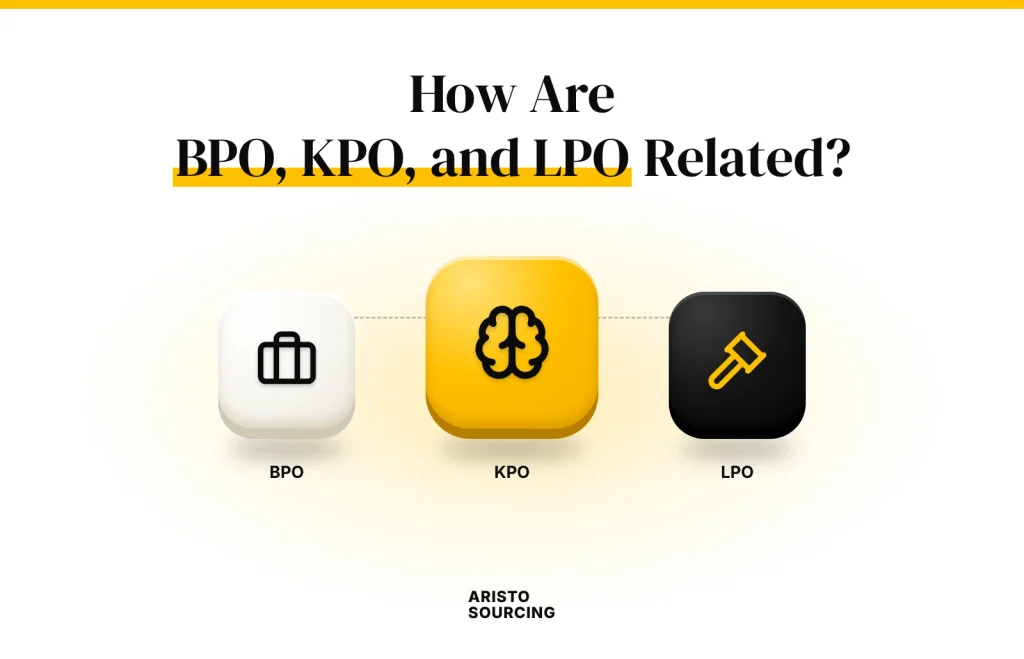
BPO is the broad category, KPO is a specialized subset of BPO, and LPO is a subset of KPO focused on legal work. The 3 models form a hierarchy in which skill level, cost, and data sensitivity rise from BPO to KPO to LPO.
LPO tasks can also sit under BPO when the work is administrative. Legal intake and legal billing are BPO-level LPO tasks, while legal research and contract analysis are KPO-level LPO tasks, which is why many frameworks treat LPO as a subset of KPO.
What Are the Differences Between BPO, KPO, and LPO?
The differences between BPO, KPO, and LPO are focus, skills and qualifications, examples, relative cost, and data sensitivity. BPO handles standard processes, KPO handles expert analysis, and LPO handles legal work under strict confidentiality.
The differences between BPO, KPO, and LPO are presented in the table below.
| Factor | BPO | KPO | LPO |
| Focus | Routine, rule-based processes | Analytical, judgment-based work | Legal research, review, and compliance |
| Skills and Qualifications | Basic computer and communication skills | Advanced degrees and domain expertise | Law degrees and paralegal training |
| Examples | Customer support, data entry, payroll | Market research, financial analysis, data analytics | Contract review, legal research, document review |
| Relative Cost | Lowest | Higher | Usually highest |
| Data Sensitivity and Compliance | Moderate, depends on the process | High, includes business and financial data | Very high, includes privileged and confidential client data |
How Much Do BPO, KPO, and LPO Cost?
BPO costs the least, KPO costs more, and LPO usually costs the most, because each model needs higher skills and stricter data controls. Crescendo, an AI customer service company, estimates 2026 BPO contact center rates at $29.40 to $42 per agent hour in the United States and $7 to $16 per agent hour in India, the Philippines, and Pakistan.
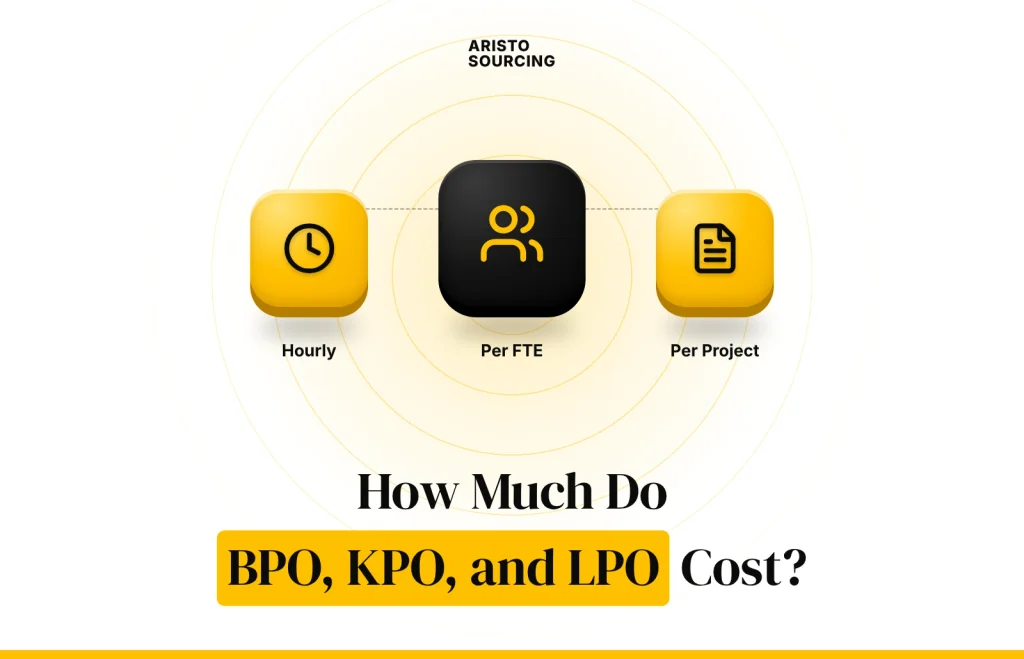
KPO and LPO rates depend on the expertise, qualifications, and jurisdiction of the professionals involved, so providers usually quote them by role or project. The 4 common pricing models for BPO, KPO, and LPO are listed below.
- Per Hour: The provider bills for each hour a professional works on the account.
- Per FTE: The provider bills a fixed monthly fee for each full-time equivalent employee.
- Per Transaction: The provider bills a set fee for each processed item, such as a claim, invoice, or document.
- Per Project: The provider bills a fixed price for a defined scope, such as a research report or a contract review batch.
How to Choose Between BPO, KPO, and LPO
To choose between BPO, KPO, and LPO, match the outsourcing model to the complexity of the task, then check data security, compliance, and qualifications. The steps to choose between BPO, KPO, and LPO are listed below.
- Choose BPO for routine, high-volume work such as customer support, data entry, and payroll.
- Choose KPO for research, analysis, and work that needs expert judgment.
- Choose LPO for legal tasks that need legal training and confidentiality.
- Check the provider’s data security certifications and access controls.
- Confirm the provider’s compliance with the laws of every jurisdiction served.
- Verify the qualifications and experience of the assigned team.
Law firms with smaller volumes of legal support work often hire a legal virtual assistant instead of a full LPO provider. Matching task complexity to the right model is how a business applies the key differences, examples, and costs of BPO vs KPO vs LPO to a real outsourcing decision.

What Are the Other Types of Outsourcing?
The other types of outsourcing are information technology outsourcing (ITO), recruitment process outsourcing (RPO), human resources outsourcing (HRO), and finance and accounting outsourcing (FAO). The 4 other types of outsourcing are listed below.
- ITO: Information technology outsourcing covers software development, IT support, and infrastructure management.
- RPO: Recruitment process outsourcing covers all or part of the hiring process, from sourcing to onboarding.
- HRO: Human resources outsourcing covers payroll, benefits administration, and HR compliance.
- FAO: Finance and accounting outsourcing covers bookkeeping, accounts payable and receivable, and financial reporting.
A complete list of the types of outsourcing shows how these models fit beside BPO, KPO, and LPO. The questions below cover BPO vs KPO, KPO vs LPO, and the procurement meaning of LPO.
Which One Is Better, BPO or KPO?
Neither BPO nor KPO is better, because the right model depends on task complexity. BPO is better for routine work at a lower cost, while KPO is better for expert work that adds higher value. A detailed look at how BPO and KPO compare covers both models side by side.
What Is the Difference Between KPO and LPO?
The difference between KPO and LPO is that LPO is KPO applied only to legal work. KPO covers any knowledge field, such as finance, research, or analytics, while LPO covers legal tasks only and operates under stricter confidentiality rules.
What Does LPO Mean in Procurement?
In procurement, LPO means Local Purchase Order. A Local Purchase Order is a buyer’s official order to a supplier for goods or services, and the term is not related to legal process outsourcing.