
The ROI of outsourcing accounting processes is the net return a business gains when the cost it removes exceeds the fee it pays a provider. The common formula subtracts the outsourcing cost from the total in-house cost, adds the value of soft benefits, and divides the result by the outsourcing cost. The main ROI sources are labor savings, bundled software, lower turnover, a faster month-end close, fewer errors, and reclaimed leadership time.
What Is the ROI of Outsourcing Accounting Processes?
The ROI of outsourcing accounting processes is the percentage return a business earns by moving accounting work, such as bookkeeping, payables, payroll, and reporting, to an external provider instead of an internal team. Accounting process outsourcing produces two kinds of return. Hard ROI is the direct cost saving from replacing salaries, benefits, software, and overhead with a provider fee. Soft ROI is the value of time saved, higher accuracy, and lower compliance risk, which improves results without appearing as a single line on the income statement.
How to Calculate the ROI of Outsourced Accounting
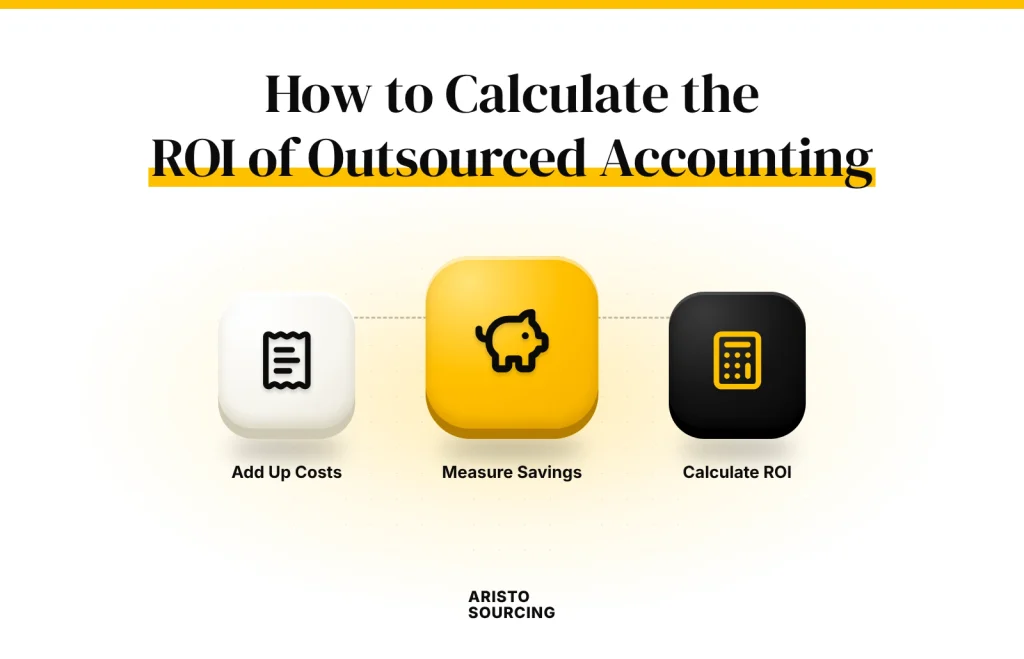
To calculate the ROI of outsourced accounting, compare the total cost of an in-house accounting function with the cost of the outsourcing contract, then add the value of soft benefits. The calculation uses 3 inputs: total in-house cost, outsourcing cost, and soft benefits.
ROI Formula for Accounting Outsourcing
The ROI formula for accounting outsourcing is ROI % = (Total In-House Cost − Outsourcing Cost + Soft Benefits) ÷ Outsourcing Cost × 100. Wiss, a US accounting and advisory firm, uses this formula and also gives a basic version that leaves out soft benefits.
The 3 inputs of the ROI formula are listed below.
- Total In-House Cost: Total in-house cost is the full annual cost of the internal accounting function, including salaries, benefits, employer payroll taxes, software, training, and turnover.
- Outsourcing Cost: Outsourcing cost is the annual fee paid to the accounting provider, plus any onboarding or setup fees.
- Soft Benefits: Soft benefits are the estimated dollar value of faster reporting, avoided penalties, and leadership time returned to the business.
Worked Example: In-House vs Outsourced Accounting
A worked example shows how the ROI formula applies to one full-time accountant replaced by an outsourced service. The figures below are illustrative and use public salary data.
The worked ROI example for in-house vs outsourced accounting is presented in the table below.
| Cost Item | In-House Accountant | Outsourced Accounting | Explanation |
| Base salary | $83,680 | – | BLS median annual pay for accountants and auditors, May 2025 |
| Benefits and payroll taxes | $35,863 | – | BLS reports benefits at 30.0% of private industry compensation costs, June 2026 |
| Annual cost | $119,543 | $42,000 | Outsourced fee assumed at $3,500 per month |
| Annual saving | – | $77,543 | In-house cost minus outsourcing cost |
| ROI before soft benefits | – | About 185% | ($119,543 − $42,000) ÷ $42,000 × 100 |
The example excludes software, training, and turnover costs, so the real in-house cost is usually higher. The $3,500 monthly fee sits inside the $500 to $5,000+ monthly range that SDO CPA, a US accounting firm, reports for outsourced accounting. Actual ROI depends on transaction volume, the scope of services, and the provider’s rates.
Where Does the ROI of Outsourced Accounting Come From?
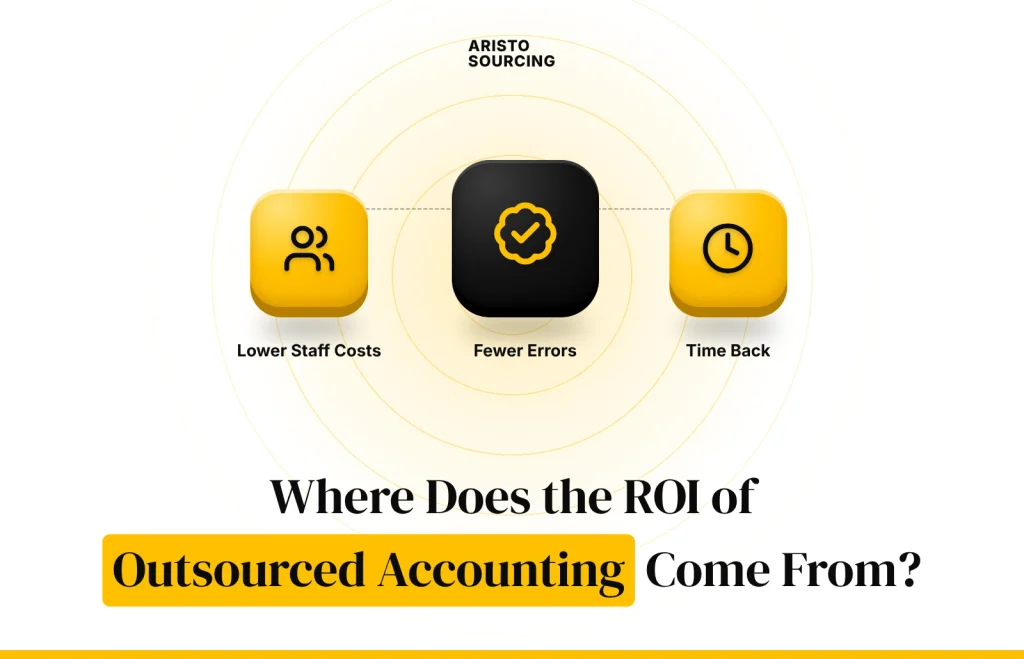
The ROI of outsourced accounting comes from 7 sources: lower labor and overhead costs, bundled software, lower recruitment and turnover costs, a faster month-end close, fewer errors, reclaimed leadership time, and scalability. The first 3 sources produce hard ROI, while the last 4 produce mostly soft ROI.
The 7 sources of ROI from outsourced accounting are listed below.
- Labor and Overhead Savings: Outsourced accounting replaces fixed salaries, benefits, and office costs with a variable monthly fee.
- Bundled Accounting Software: Outsourced accounting providers often include accounting and reporting software in their fees.
- Lower Recruitment and Turnover Costs: Outsourced accounting removes the cost of hiring, training, and replacing internal accountants.
- Faster Month-End Close: Outsourced accounting teams follow standard close checklists that shorten the time to final financial statements.
- Fewer Errors and Penalties: Outsourced accounting adds review layers that reduce reporting errors and late-filing penalties.
- Reclaimed Leadership Time: Outsourced accounting frees owners and managers from bookkeeping so they can focus on revenue work.
- Scalability: Outsourced accounting scales service levels up or down with transaction volume without new hires.
Which Accounting Processes Deliver the Highest ROI?
The accounting processes that deliver the highest ROI are bookkeeping, accounts payable and receivable, payroll, and month-end close and reporting. These processes are repetitive, rule-based, and easy to measure, so external teams can run them at a lower cost per transaction. Small businesses often start with bookkeeping, either through a provider or a virtual bookkeeping assistant who handles daily transaction entry and reconciliations.
The 4 accounting processes that deliver the highest ROI are listed below.
- Bookkeeping: Bookkeeping delivers high ROI because transaction entry and reconciliation are high-volume, repetitive tasks.
- Accounts Payable and Receivable: Accounts payable and receivable deliver high ROI because faster invoice processing and collections improve cash flow.
- Payroll: Payroll delivers high ROI because a fixed schedule and strict tax rules make errors costly for an internal team.
- Month-End Close and Reporting: Month-end close and reporting deliver high ROI because faster, accurate statements support earlier decisions.
Which KPIs Measure Accounting Outsourcing ROI?
The KPIs that measure accounting outsourcing ROI are days to close, error rate, cost per transaction, days sales outstanding (DSO), hours reclaimed, and on-time filing rate. Each KPI should be measured before outsourcing to set a baseline, then tracked every month after onboarding.
The 6 KPIs that measure accounting outsourcing ROI are listed below.
- Days to Close: Days to close measures how many days the team needs to finalize monthly financial statements.
- Error Rate: Error rate measures the share of entries or reports that need correction.
- Cost per Transaction: Cost per transaction measures the total accounting cost divided by the number of transactions processed.
- Days Sales Outstanding (DSO): DSO measures the average number of days the business takes to collect payment after a sale.
- Hours Reclaimed: Hours reclaimed measures the internal staff and leadership hours freed from accounting work.
- On-Time Filing Rate: On-time filing rate measures the share of tax and regulatory filings submitted by the deadline.
Tracking these KPIs against the baseline is how a business calculates the ROI of outsourcing accounting processes over time, rather than relying on the first-month fee comparison alone.

Is Outsourced Accounting Worth It?
Yes, outsourced accounting is worth it when the total in-house cost of the accounting function exceeds the outsourcing fee plus the internal time needed to manage the provider. The questions below cover the payback period, the factors that reduce ROI, and the role of AI.
How Long Does It Take to See a Return?
Outsourced accounting usually starts showing a measurable return within 3 to 6 months after onboarding, according to Datamatics CPA, an accounting outsourcing provider. The onboarding period covers process handover, system access, and cleanup of existing records. Clean books and clear process documentation speed up payback, while messy records and frequent scope changes delay it.
What Can Reduce the ROI of Outsourcing Accounting?
The ROI of outsourcing accounting falls when hidden fees, poor provider fit, data security gaps, or high internal management time raise the real cost. Hidden fees and scope creep add charges beyond the agreed monthly rate. A provider without experience in the business’s industry produces rework, and weak access controls create data risk, which is why bookkeeping data security must be agreed before handover.
Is AI Replacing Bookkeepers?
No, AI is not replacing bookkeepers, because AI automates data entry and transaction categorization while review, judgment, and client communication still need people. AI tools now handle bank feed matching, receipt capture, and invoice coding. Bookkeepers still resolve exceptions, check accuracy, and explain the numbers, which is part of the wider finance and accounting outsourcing trend toward review-focused roles.