
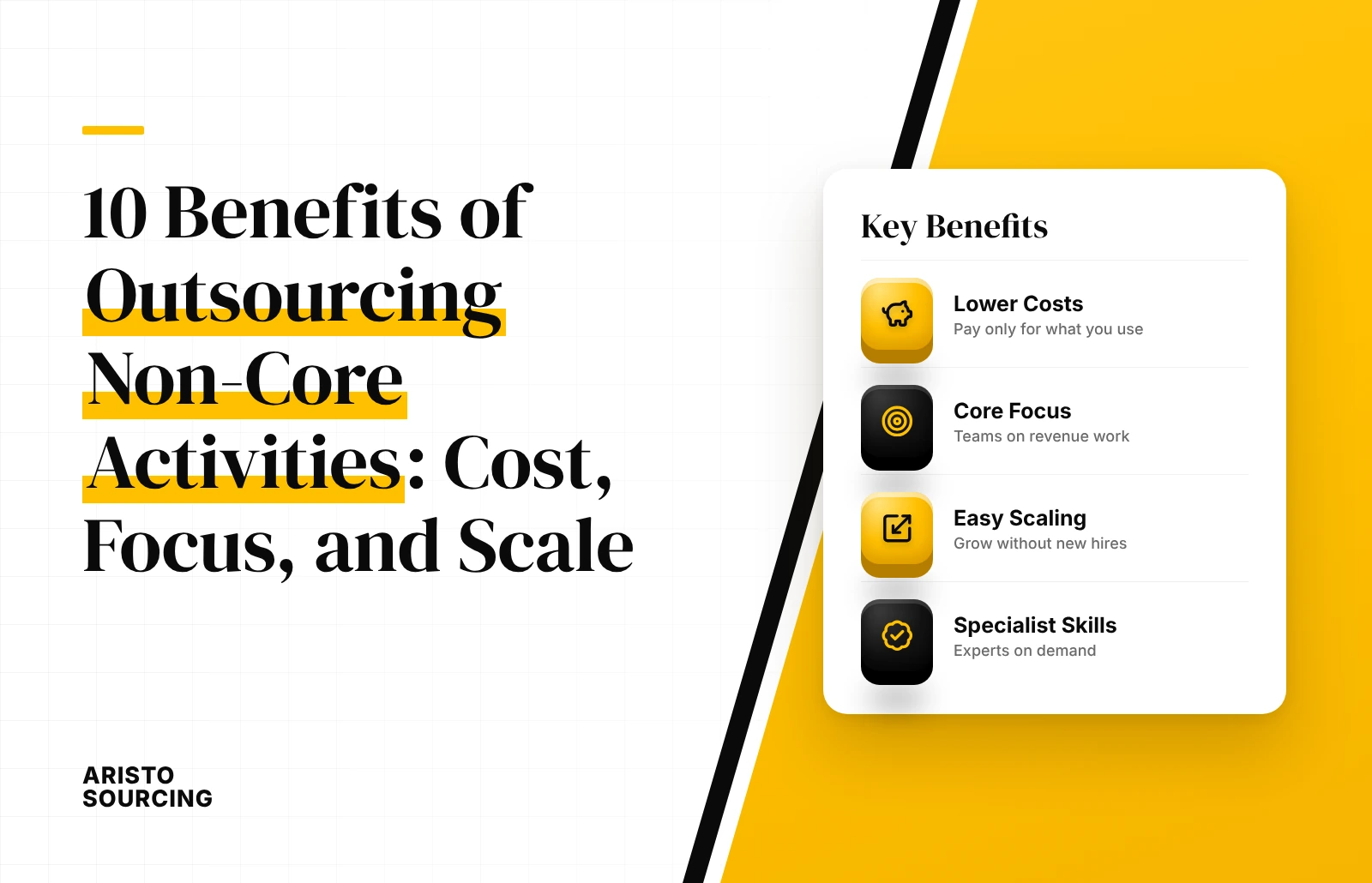
Outsourcing non-core activities is the practice of handing supporting work, such as administration, bookkeeping, and customer support, to outside providers so internal teams can focus on the core work that creates competitive advantage. The 10 benefits of outsourcing non-core activities are lower operating costs, more focus on core competencies, scalability, access to specialized skills and technology, higher efficiency, lower operational risk, 24/7 coverage, better customer experience, faster project starts, and stronger growth. Cost, focus, and scale lead the list because they produce the largest and most immediate gains.
This page explains what non-core activities are, the benefits of outsourcing non-core functions, the risks of outsourcing non-core activities, how to decide which non-core business processes to outsource, and how AI is changing non-core outsourcing. Each section treats outsourcing non-core activities as one part of a wider business outsourcing strategy.
The reasons companies outsource have shifted in recent years. Deloitte’s 2024 Global Outsourcing Survey of more than 500 business and technology leaders reports that improved access to talent (42%) is now the most cited reason for outsourcing. The same survey shows that the share of executives naming cost reduction as a primary objective fell from 70% in 2020 to 34% in 2024.
What Are Non-Core Activities?
Non-core activities are the supporting tasks a business needs to run that do not create its competitive advantage. Non-core activities keep operations working, such as paying staff, answering routine emails, and recording transactions, but customers do not choose the business because of them. Across this article, non-core activities are also called non-core processes, non-core functions, and non-core business functions.
The difference between core and non-core activities and the most common types of non-core activities are covered in the two sections below.
What Is the Difference Between Core and Non-Core Activities?
The difference between core and non-core activities involves value creation, competitive advantage, and profit contribution. Core activities are the tasks that create customer value and competitive advantage, built on the core competence concept that C.K. Prahalad and Gary Hamel introduced in The Core Competence of the Corporation (Harvard Business Review, 1990). Non-core activities are necessary, repetitive, and rule-based, and they do not act as profit centers. The same task can be core for one company and non-core for another: customer support is core for a call center operator, while customer support is non-core for a law firm.
The differences between core and non-core activities are presented in the table below.
| Factor | Core Activities | Non-Core Activities | Explanation |
| Value creation | Create direct customer value | Support operations | Customers buy because of core activities |
| Competitive advantage | Differentiate the business | Rarely differentiate the business | Competitors can copy non-core processes easily |
| Profit role | Profit centers | Cost centers | Non-core work consumes budget without generating revenue |
| Task nature | Strategic, judgment-based | Repetitive, rule-based | Rule-based work is easier to document and outsource |
| Example | Product design at a software company | Payroll processing at a software company | The same task changes category by business model |
What Are Types of Non-Core Activities?
The types of non-core activities are administrative tasks, data entry and data management, customer support, bookkeeping and accounting, payroll processing, HR administration and recruiting coordination, IT support, social media and digital marketing, logistics and warehousing, invoicing and collections, and market research. Most non-core activities share three traits: they repeat on a schedule, they follow defined rules, and their output can be measured.
The 11 most common types of non-core activities are listed below.
- Administrative Tasks: Scheduling, email management, and document management.
- Data Entry and Data Management: Updating databases, CRM records, and spreadsheets.
- Customer Support and Live Chat: Answering customer emails, calls, and chat messages.
- Bookkeeping and Accounting: Recording transactions and reconciling accounts.
- Payroll Processing: Calculating wages, deductions, and payroll tax filings.
- HR Administration and Recruiting Coordination: Managing employee records and scheduling interviews.
- IT Support and Help Desk: Resolving user tickets and maintaining devices and accounts.
- Social Media and Digital Marketing: Scheduling posts, managing ads, and reporting on campaigns.
- Logistics and Warehousing: Storing inventory, fulfilling orders, and arranging shipping.
- Invoicing and Collections: Sending invoices and following up on overdue payments.
- Market Research: Gathering competitor, customer, and pricing data.
What Are the Benefits of Outsourcing Non-Core Activities?
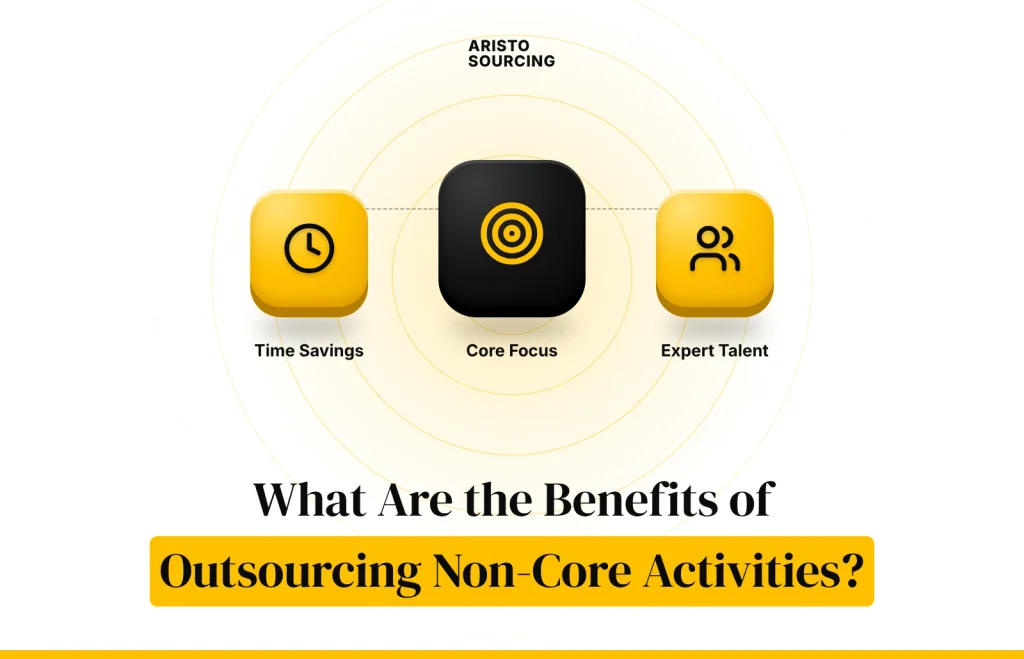
The benefits of outsourcing non-core activities are lower operating costs, more focus on core competencies, scalability and flexible staffing, access to specialized skills and technology, higher efficiency and productivity, lower operational risk, 24/7 coverage across time zones, better customer experience, faster project starts, and stronger growth and competitiveness. Outsourcing non-core activities lowers cost, frees management focus, and adds the capacity to scale without new hires.
The 10 benefits of outsourcing non-core activities are listed below.
- Lower Operating Costs
- More Focus on Core Competencies
- Scalability and Flexible Staffing
- Access to Specialized Skills and Technology
- Higher Efficiency and Productivity
- Lower Operational Risk
- 24/7 Coverage Across Time Zones
- Better Customer Experience
- Faster Project Starts
- Stronger Growth and Competitiveness
1. Lower Operating Costs
Lower operating costs are the reduction in fixed and variable spending a business achieves by moving non-core work to an outside provider. Outsourcing non-core activities turns fixed costs into variable costs and removes salaries, benefits, payroll taxes, office space, equipment, software licenses, recruiting, and training costs from the internal budget. A US accounting practice that moves bookkeeping data entry to an offshore team pays one monthly service fee instead of a full-time salary plus benefits and desk space. Deloitte’s 2020 Global Outsourcing Survey found that 70% of respondents named cost reduction as a primary objective of outsourcing.
2. More Focus on Core Competencies
More focus on core competencies is the shift of leadership and team time from supporting tasks to the work that creates competitive advantage. Outsourcing non-core activities removes routine administration, reporting, and support work from managers and specialists, so their time moves to product development, sales, and strategy. A software founder who outsources inbox management, invoicing, and scheduling regains hours each week for product and customer conversations. Deloitte reports that half of organizations now use outsourced services for sales, marketing, and R&D, which shows how freed capacity is being redirected.
3. Scalability and Flexible Staffing
Scalability and flexible staffing are the ability to increase or reduce non-core capacity quickly without hiring or layoffs. Outsourcing non-core activities lets a business add support staff for seasonal peaks and project spikes, then reduce capacity when demand drops. An e-commerce brand that triples its customer support team for the holiday season through an outsourcing provider avoids recruiting, training, and releasing temporary employees. Scalability also protects the business from overstaffing during slow periods.
4. Access to Specialized Skills and Technology
Access to specialized skills and technology is the use of trained specialists and professional tools without hiring them full time. Outsourcing non-core activities gives a business trained bookkeepers, support agents, and IT technicians who already use accounting software, help desk platforms, and CRM systems. A small marketing agency that outsources bookkeeping gains a trained bookkeeper using QuickBooks or Xero without buying training or software expertise in-house. Outsourcing also widens the talent pool across countries, and Deloitte reports that improved access to talent (42%) is now the leading reason organizations outsource.
5. Higher Efficiency and Productivity
Higher efficiency and productivity are the faster turnaround and higher output that result from documented processes and dedicated staff. Outsourcing non-core activities places the work with staff who perform the same process every day under service level agreements, standard operating procedures, and measured turnaround times. A property management company that outsources tenant inquiry handling to a dedicated team gets consistent response times instead of replies that depend on which manager has free time. Efficiency gains grow as the provider refines the documented process over time.
6. Lower Operational Risk
Lower operational risk is the reduction in disruption a business faces when non-core work depends on a few internal staff. Outsourcing non-core activities shares operational risk with the provider through KPIs, SLAs, and contract terms, and the provider covers absences, turnover, and regulatory changes in its specialty. A small business that outsources payroll processing keeps paying staff on time when its office manager resigns, because the provider holds the process and backup staff. Providers that specialize in a function also track rule changes, such as payroll tax updates, as part of their service.
7. 24/7 Coverage Across Time Zones
24/7 coverage across time zones is the ability to keep non-core work running around the clock by using providers in different time zones. Outsourcing non-core activities to offshore locations such as the Philippines and South Africa enables follow-the-sun workflows, in which work moves to teams whose working day starts as the home team’s day ends. A US software company with support staff in the Philippines answers overnight customer tickets before the US team logs in. Round-the-clock coverage also shortens turnaround on tasks such as data processing and report preparation.
8. Better Customer Experience
Better customer experience is the improvement in speed, availability, and consistency that customers notice when support work is outsourced to trained teams. Outsourcing non-core activities such as customer support gives a business faster response times, multichannel coverage across email, chat, phone, and social media, and consistent service quality guided by scripts and quality checks. An online retailer that outsources live chat answers customer questions within minutes instead of hours. Consistent service also reduces complaints that stem from slow or uneven responses.
9. Faster Project Starts
Faster project starts are the shorter time between deciding to staff a function and having trained people doing the work. Outsourcing non-core activities moves recruiting, onboarding, and training to the provider, so work starts faster than an internal hiring cycle allows. A company launching a new product line can have an outsourced order processing team working within weeks instead of waiting through job postings, interviews, and notice periods. Faster starts also let a business test a new function before committing to permanent headcount.
10. Stronger Growth and Competitiveness
Stronger growth and competitiveness is the ability to reinvest savings and freed time into revenue work and to compete with larger companies. Outsourcing non-core activities releases budget and leadership attention that a business can spend on sales, marketing, and product development, while outsourced teams give a small business the support capacity of a larger competitor. A 10-person agency with outsourced bookkeeping, scheduling, and support can serve clients with the responsiveness of a much larger firm. Taken together, the 10 benefits of outsourcing non-core activities come down to cost, focus, and scale: lower operating costs, more focus on core work, and the capacity to grow without matching growth in fixed headcount.
What Are the Risks of Outsourcing Non-Core Activities?
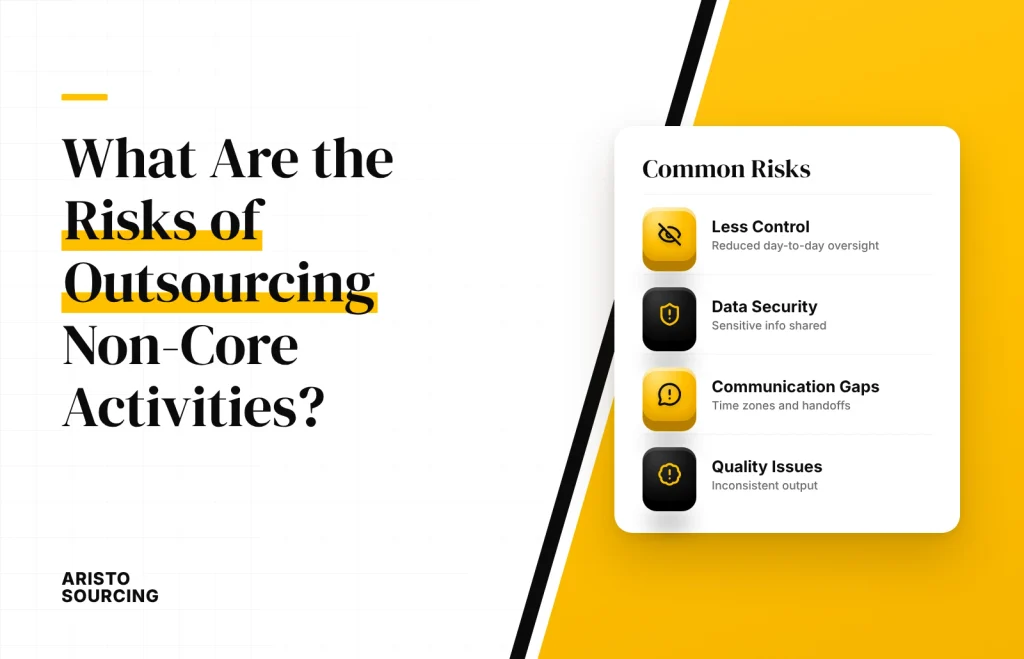
The main risks of outsourcing non-core activities are hidden and transition costs, less direct quality control, data security and compliance exposure, communication and time zone gaps, and dependence on one provider. Each risk is manageable when the business plans for it before signing an outsourcing contract.
The five risks of outsourcing non-core activities are listed below.
- Hidden and Transition Costs
- Less Direct Quality Control
- Data Security and Compliance Exposure
- Communication and Time Zone Gaps
- Dependence on One Provider
1. Hidden and Transition Costs
Hidden and transition costs are the expenses of outsourcing that do not appear in the provider’s headline rate. Hidden and transition costs arise from knowledge transfer, process documentation, management oversight time, and provider fees or markups added after the contract starts. To reduce hidden and transition costs, the business should request an all-in pricing breakdown and budget for a transition period before comparing providers.
2. Less Direct Quality Control
Less direct quality control is the reduced visibility a business has over work performed outside its office. Less direct quality control arises because managers no longer supervise the work in person and depend on reports and samples. To reduce the quality risk, the business should define quality standards in writing and review output against agreed KPIs every week during the first months.
3. Data Security and Compliance Exposure
Data security and compliance exposure is the risk that customer, employee, or financial data is mishandled by an outside provider. Data security and compliance exposure arises because outsourcing extends system access to people and networks outside the company’s direct control. To reduce data security and compliance exposure, the business should grant role-based access only, require password managers and confidentiality agreements, and choose providers with recognized security practices.
4. Communication and Time Zone Gaps
Communication and time zone gaps are the delays and misunderstandings that occur when outsourced teams work in different locations and hours. Communication and time zone gaps arise from limited working-hour overlap, language differences, and missing context about the business. To reduce communication and time zone gaps, the business should set fixed overlap hours, use shared communication tools, and document every recurring process.
5. Dependence on One Provider
Dependence on one provider is the risk that a business cannot easily switch or recover a function if the provider underperforms or exits. Dependence on one provider arises when process knowledge, data, and tools sit only with the provider. To reduce dependence on one provider, the business should keep process documentation in-house, retain data ownership in the contract, and agree exit and transition terms upfront.
How Do You Decide Which Non-Core Activities to Outsource?
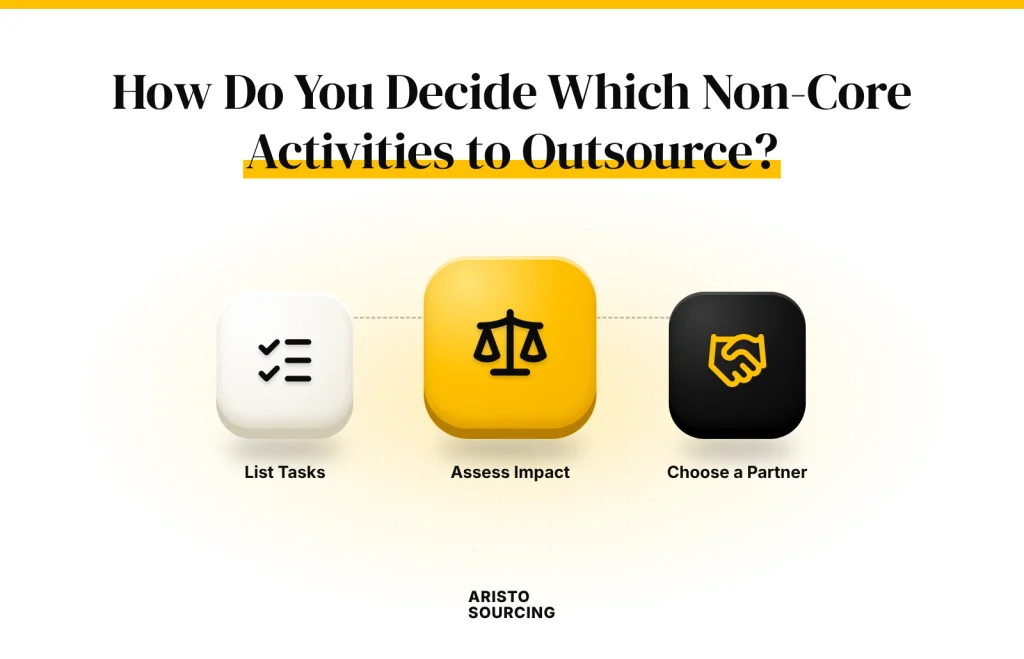
To decide which non-core activities to outsource, list and classify every activity, decide what stays in-house, choose the right outsourcing model, vet the provider, set KPIs and SLAs, and monitor performance. The six steps move from identifying candidate tasks to managing the outsourced function over time.
The six steps to decide which non-core activities to outsource are listed below.
- List and Classify Every Business Activity
- Decide What Stays In-House
- Choose Between BPO, Virtual Assistants, and Staff Augmentation
- Vet and Select the Outsourcing Partner
- Set KPIs, SLAs, and Communication Rules
- Monitor Performance and Adjust
Step 1: List and Classify Every Business Activity
The first step is to list every recurring task in the business and classify each task as core or non-core. Each team should record its recurring tasks with the time each task takes per week. Every task is then tagged core or non-core based on whether it creates competitive advantage. Tasks that are repetitive, rule-based, and measurable are flagged as the strongest outsourcing candidates.
Step 2: Decide What Stays In-House
The second step is to decide which activities stay in-house by comparing each activity’s strategic value with the company’s internal capability. Richard Insinga and Malcolm Werle set out this approach in Linking Outsourcing to Business Strategy (Academy of Management Executive, 2000). Activities with high strategic value and strong internal capability stay in-house. Activities with high strategic value but weak internal capability may benefit from outsourcing or partnership, while activities with low strategic value and weak internal capability should be outsourced or bought as a ready-made solution.
Step 3: Choose Between BPO, Virtual Assistants, and Staff Augmentation
The third step is to choose the outsourcing model that fits each non-core activity: BPO, virtual assistants, or staff augmentation. BPO suits whole processes, such as payroll or high-volume customer support, where the provider runs the process against service level agreements. Virtual assistants suit administrative and support tasks, such as inbox management, scheduling, and data entry, handled by remote staff. Staff augmentation suits ongoing functions where dedicated full-time staff work under the company’s own direction. Businesses that want direct control over daily tasks can hire a dedicated virtual assistant through providers such as Aristo Sourcing, which places full-time remote staff from the Philippines and South Africa.
Step 4: Vet and Select the Outsourcing Partner
The fourth step is to vet and select the outsourcing partner by checking track record, security standards, communication, references, and replacement terms. The provider’s industry track record should include clients with similar tasks and volume. The provider’s data security standards should match the sensitivity of the data the outsourced team will handle. The provider’s communication process, client references, and staff replacement terms complete the selection criteria.
Step 5: Set KPIs, SLAs, and Communication Rules
The fifth step is to set KPIs, SLAs, and communication rules before the outsourced work begins. Each outsourced task needs at least one KPI, such as response time, accuracy rate, or volume completed. SLA targets, reporting cadence, and the escalation path for problems should be written into the outsourcing agreement terms. Contract terms should also define notice periods, data ownership, and how scope changes are priced.
Step 6: Monitor Performance and Adjust
The sixth step is to monitor outsourced performance on a fixed schedule and adjust scope when results change. KPIs should be reviewed weekly during the first months and monthly once the process is stable. Scope can expand when the provider meets targets consistently. Work should return in-house, or move to another provider, if quality drops and does not recover after corrective action.

How Is AI Changing the Outsourcing of Non-Core Activities?
AI is changing non-core outsourcing by automating routine non-core tasks, such as data entry and ticket triage, while outsourced staff handle exceptions, judgment calls, and customer conversations. Deloitte’s 2024 Global Outsourcing Survey reports that 83% of executives already use AI as part of their outsourced services, and 20% are developing strategies to manage digital workers. AI is turning non-core outsourcing into a blended service in which software processes the volume and people handle the cases that need context.
Are Companies Now Outsourcing Core Functions Too?
Yes, companies now outsource core functions too, because outsourcing has moved from cost-cutting support work into front-office and capability-building work. Deloitte’s 2024 Global Outsourcing Survey reports that 56% of organizations outsource front-office functions and 46% outsource research and development. Core work is outsourced for capability rather than cost, since providers bring specialist skills, AI tools, and scale that internal teams lack, and this shift is one of the main outsourcing trends reshaping provider relationships.